The Quiet Premium: Why Podcast Advertising Earns More Per Hour Than Any Other Audio Format
There is a particular kind of quiet that surrounds a channel that works. Not the quiet of failure — failure is loud, it announces itself in quarterly earnings calls and hastily rewritten strategy decks. This is the other kind: the quiet of something steadily compounding while nobody bothers to argue about it.
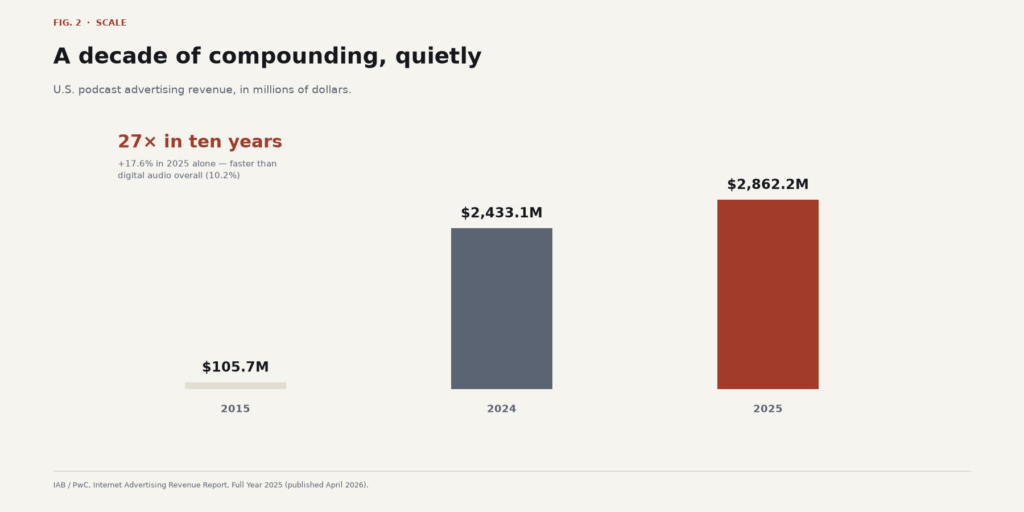
Podcast advertising has been in that quiet for roughly a decade. In 2025, U.S. podcast advertising brought in $2.86 billion, up 17.6% year over year — a growth rate that beat digital audio as a whole, and beat digital advertising overall. Nothing about that number is spectacular. And that, strangely, is the most interesting thing about it.
The number that should be bigger
Here is the arithmetic that ought to make a media planner pause for a second.
Podcasts now account for about 21% of all ad-supported audio listening time in the United States. They account for about 34% of digital audio advertising revenue. Divide one by the other and you get something that doesn’t happen often in advertising: a format that monetizes each hour of attention at roughly 1.6 times the rate of its category average.
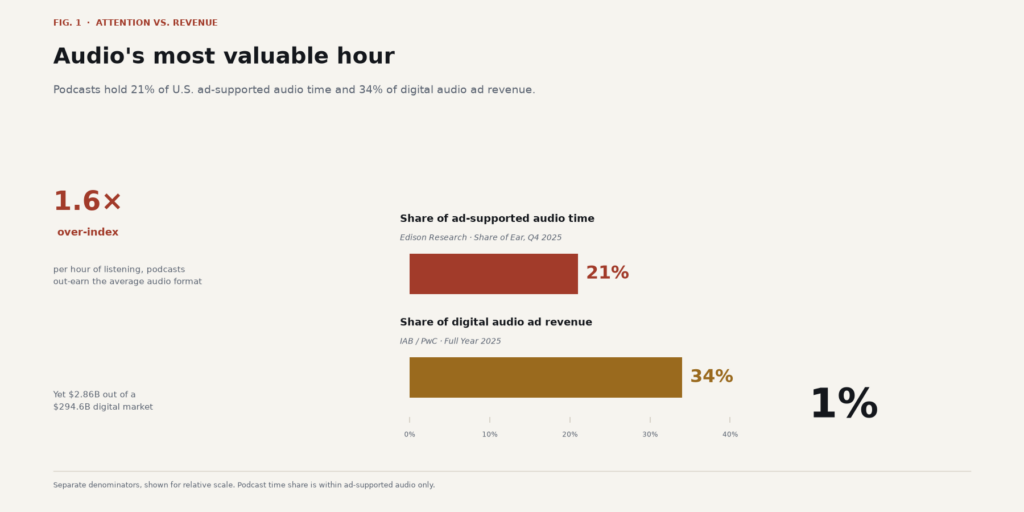
And then zoom out, and the picture flips completely. That $2.86 billion sits inside a U.S. digital advertising market worth $294.6 billion. Podcast advertising is, in other words, approximately one percent of the digital pie.
Both facts are true at once, and the tension between them is the entire story. Podcasting is the most efficiently monetized audio format in existence, and it is still an asterisk in the media plan. The industry has spent years describing this as a measurement problem, or a scale problem, or a perception problem. It is now, increasingly, none of those things. It is something subtler, and more permanent.
How a channel grows without a narrative
The growth itself is not a fluke, and it isn’t recent. In the ten years to 2025, U.S. podcast ad revenue went from about $106 million to $2.86 billion — a 27-fold expansion. Very few media categories have done that without a corresponding hype cycle.
Part of the explanation is that podcasting never had a boom to correct from. There was no 2015 podcast bubble, no gold rush, no wave of me-too networks that collapsed. Growth arrived in single digits and low double digits, year after year, mostly from the same mechanism: a listener finds a show, likes the host, and comes back next week. That is an unusually durable acquisition engine. It is not viral, but it does not decay either.
The audience composition explains the rest.
Edison Research’s Infinite Dial puts monthly podcast consumption in the United States at 58% of the population aged 12 and up — 167 million people — with 45%, or 130 million, listening in any given week. Nearly half the country has a weekly habit. That is not a niche. What’s more interesting is where the growth is coming from. The 35-to-54 cohort, the demographic advertisers fight over, is at 68% monthly consumption. And among Americans over 55, monthly online audio listening climbed from 52% in 2024 to 70% in 2026 — a 20-point jump in two years, driven by an age group that advertising has largely written off.
The habit, in other words, is not just deep. It is getting wider at the edges, where attention is usually hardest to find.
The mechanic nobody wants to name
Ask a podcast advertiser why the channel works and you will get a vague answer about “engagement.” That word is doing a lot of hiding. The actual mechanism is more specific, and slightly awkward to say out loud in a performance marketing meeting.
It is trust transfer. A listener has spent, say, forty hours with a host over a year. They know the host’s verbal tics, their politics, the way they sigh when they’re bored. This is a one-sided relationship — a parasocial one, in the literature — but its effects are not imaginary. When that host says a product is good, the listener’s brain does not file it under “advertisement.” It files it under “person I listen to said a thing.”
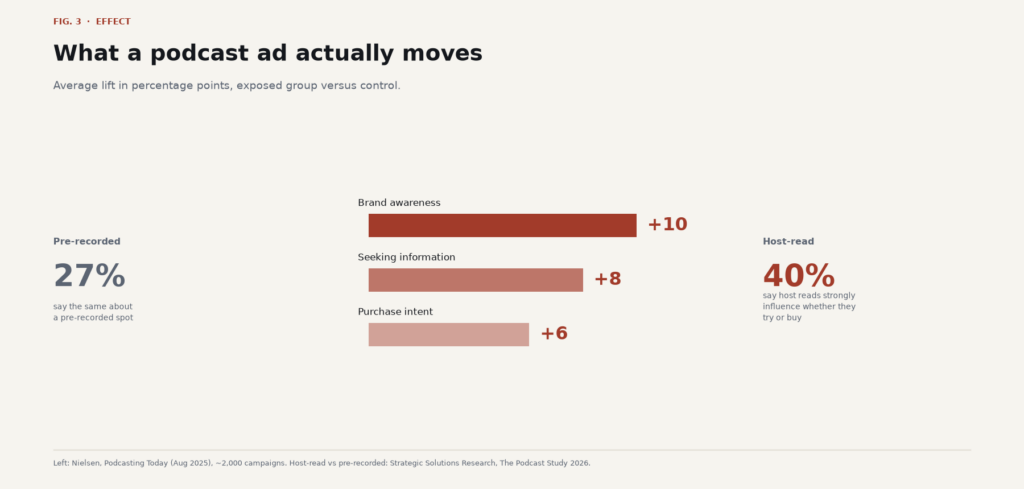
Nielsen’s meta-analysis of nearly 2,000 podcast campaigns quantifies what that does to brand metrics. Podcast ads produce an average 10-percentage-point lift in brand awareness, an 8-point lift in intent to seek more information, and a 6-point lift in purchase intent. Roughly seven in ten listeners recall the brand they heard.
The comparison that matters isn’t podcast versus display, though. It’s host-read versus everything else — including, awkwardly, other podcast ads.
When Strategic Solutions Research asked listeners directly, 40% said host-read ads have a strong influence on whether they try or buy a product. For pre-recorded spots, the figure was 27%. Same medium, same audience, same thirty seconds of audio. The only variable is whose voice is doing the reading.
That gap is not a creative preference. It is a pricing signal, and the market has already priced it.
What the market pays for a human voice
Published 2026 rate cards make the trust premium unusually legible. A baked-in host read clears around $24 to $26 per thousand downloads. Dynamically inserted spots in new episodes run $18 to $22. Back-catalogue insertion sits at $14 to $16. Programmatic network inventory trades at $12 to $15.
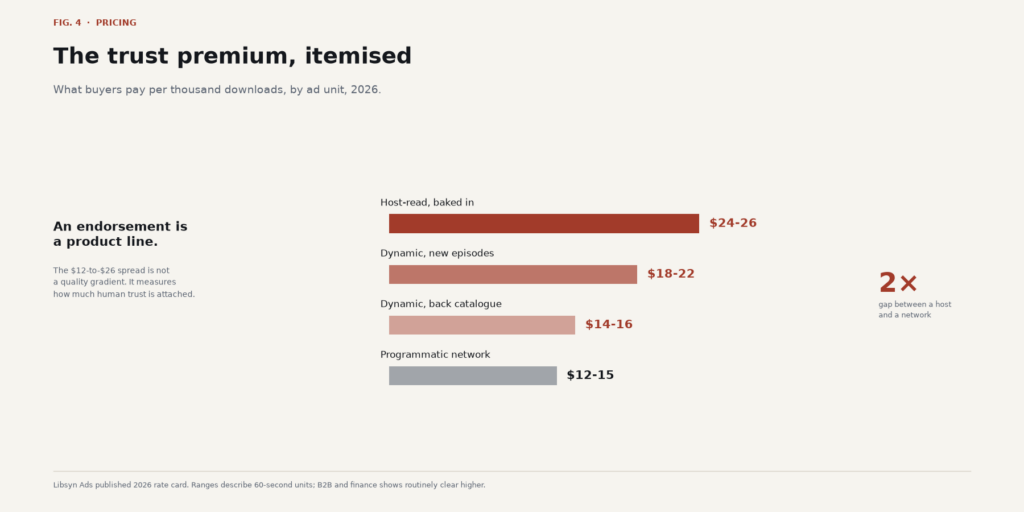
Read that ladder again and notice what it is actually describing. It is not a quality gradient, where better ads cost more. It is a measurement of how much human endorsement is attached to the impression. The top rung is a person. The bottom rung is a file.
This is also why niche B2B and finance shows routinely clear $35 and above, and why top-tier titles can command multiples of the marketplace average. A show with three thousand senior decision-makers who trust their host is worth more, per ear, than a general-interest show with thirty thousand casual listeners. Podcast buying rewards precision in a way that most programmatic channels only pretend to.
And it is why the channel’s economics are structurally different from what a CPM-obsessed buyer expects. You are not buying reach. You are renting credibility, at a rate set by how much of it the host has.
The measurement problem is mostly solved, which is inconvenient
For most of its life, podcast advertising carried a single, convenient objection: you can’t measure it. That objection is now mostly dead, and its death has been awkward for everyone who relied on it.
Three things changed. Promo codes and vanity URLs turned host reads into trackable direct response, which is why the channel became a DTC staple long before brand advertisers showed up. Brand-lift studies gave upper-funnel spending a defensible number. And dynamic ad insertion — which now accounts for the overwhelming majority of delivery — turned entire back catalogues into monetizable, targetable, refreshable inventory.
The attribution technology matured too. Pixel-based measurement now captures dramatically more conversions than the old proxies: roughly 4.6 times what promo codes alone capture. That is not a marginal improvement. It means the campaigns that looked mediocre under promo-code attribution were frequently just undercounted.
This cuts both ways, and it is worth sitting with. If promo codes were systematically undercounting podcast performance, then a decade of “podcast doesn’t perform for us” conclusions were partly artifacts of bad measurement. But it also means the channel’s best results were invisible to the people funding it — which is a strange and specifically modern kind of failure.
Where the channel actually wins
Strip away the category marketing and the use cases sort themselves by one question: does the purchase require trust, or does it require volume?
Podcast advertising wins where trust is the bottleneck. Direct-to-consumer brands built entire playbooks on promo-code host reads, because the read converts at rates display never approached. High-consideration purchases — financial products, B2B software, healthcare, anything with a long sales cycle — benefit disproportionately from a trusted voice doing the recommending. Niche and enthusiast audiences, where a show’s listeners are unusually homogeneous and unusually engaged, let you buy precision that social platforms can only approximate. And brand-building works better here than the channel’s small size suggests, because a sixty-second host read is one of the few ad formats that a listener will actually sit through.
It loses where the purchase requires volume. Podcasting is depth, not breadth. It will not deliver a mass-market launch, and its reach accumulates over quarters rather than weeks. If your plan needs ten million people to see something on Tuesday, this is the wrong channel, and no amount of clever buying will change that.
There’s a second limit that gets discussed far less often, and it’s the more important one.
The ceiling is supply-side, not demand-side
For years the assumption was that podcast advertising was constrained by measurement and by scale. Both were plausible. Both are now largely solved. What remains is a constraint nobody in the industry particularly wants to advertise: the audience’s patience has a hard floor, and we are close to it.
In 2026, 54.8% of U.S. podcast listeners said podcasts already carry too many ads. Only 8.6% said they would tolerate a few more to keep shows free. Roughly one in five said advertising had caused them to listen to fewer podcasts — not skip the ads, listen to fewer shows.
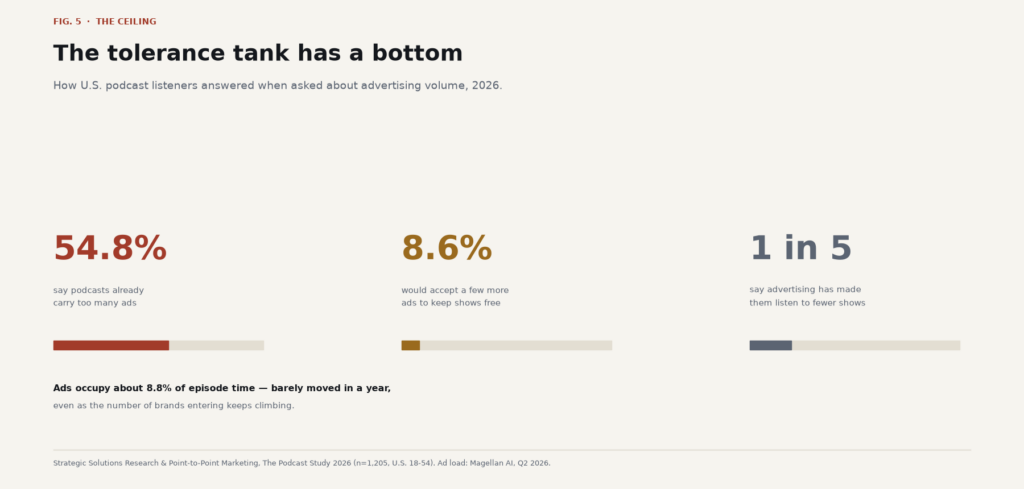
Meanwhile ad load has held at roughly 8.8% of episode time — essentially flat year over year — even as the number of brands entering the channel keeps climbing. In the second quarter of 2026 alone, 1,297 brands ran podcast ads for the first time, at an average spend of about $31,400. Spend rose 23%. Inventory demand is rising. Load is not. Something has to give, and it will not be listener tolerance.
This is where programmatic becomes a genuinely risky proposition rather than a convenient scaling tool. Impression-based buying can expose a single listener to fifteen or more ads across a campaign, against roughly one per episode in a direct-sold deal. Fifteen ads is not a media buy. It is an endurance test. And podcasting’s entire commercial advantage rests on ads not feeling like interruptions — 25% of U.S. media consumers call podcast ads annoying, against 50% for online display. That gap is the business. Spend it and there is no second advantage underneath.
The video detour
The other thing happening in 2026 is the migration to video, and it deserves a colder look than it has been getting.
The audience data is real. Roughly 71% of U.S. podcast creators now produce video versions. YouTube has become the platform weekly listeners use most, at 37%, overtaking Spotify. Video consumption and audio consumption are now roughly level, and most people do both. This is a genuine expansion of the medium, not a fad.
But expansion of reach and improvement in advertising performance are two different claims, and the evidence for the second is much weaker than the enthusiasm suggests.
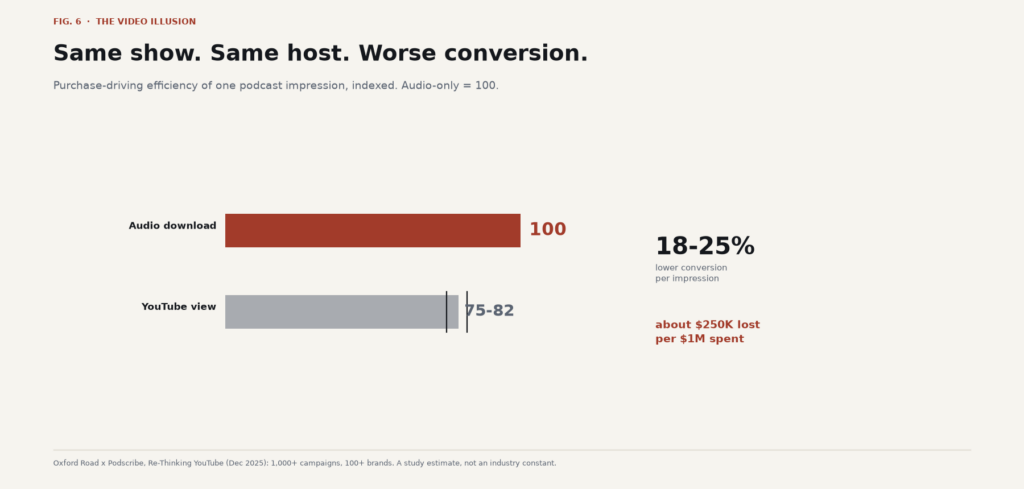
Oxford Road and Podscribe analysed more than a thousand campaigns across a hundred-plus brands and found that YouTube podcast views convert to purchase 18% to 25% less efficiently than audio downloads. On a million dollars of YouTube impressions, the estimated conversion value forgone approaches a quarter of a million.
The reasons are not mysterious. Audio listening is a lean-in, intentional act; YouTube viewing is frequently algorithmic and incidental. Podcast audiences have been trained for fifteen years to respond with promo codes, a habit that doesn’t travel to a video player. YouTube’s audience is more international and therefore more likely to be mistargeted. And a “view” is a much looser unit than a download.
None of this means video is bad. It means the two formats are not interchangeable, and the industry’s habit of treating a YouTube view and an RSS download as equivalent units of attention is doing quiet damage to the numbers advertisers use to justify spend. If you are buying podcasts for performance, the audio feed is still where the performance lives.
The honest caveats
Any channel with a real advantage has real limits, and podcasting’s are specific.
Measurement is better, not solved. Attribution still relies on a degree of modelled inference, and the gap between what tracking shows and what surveys reveal can be large. One integration test found pixel data reporting a 2.3x ROAS while survey responses surfaced an additional 31% of conversions that tracking missed entirely. If you only measure one way, you will be wrong in a predictable direction.
Scale remains modest, and structurally so. This is a $2.86 billion channel inside a $294.6 billion market. It will not become a mass-reach engine, because the format’s value depends on intimacy, and intimacy does not scale to everyone.
The trust dependency is the sharpest risk. Every dollar of that premium CPM ladder rests on the host’s credibility. A mismatched brand-host pairing wastes the spend. A host scandal doesn’t just damage the ad; it retroactively contaminates every read they ever did. You are, in a real sense, underwriting a person.
And the ad-load ceiling is not a hypothetical. It is a number: 8.6% of listeners willing to accept more. The channel’s growth from here has to come from better ads, not more of them — which is a harder business than the last decade was.
What to actually do
If you are going to spend in this channel, the strategy writes itself from the mechanics.
Lead with host reads, and treat programmatic as a supplement rather than a substitute. Buy fewer, better-integrated placements on shows whose audience genuinely matches your buyer, and accept the higher CPM as the price of the endorsement rather than a cost to be negotiated down. Use programmatic to extend reach into mid- and long-tail inventory and to refresh back catalogues — with firm frequency caps, because the tolerance tank is not refilled by a different show.
Measure two ways, always. Promo codes and vanity URLs for direct response, brand-lift studies for the upper funnel, and ideally an incrementality test before you scale. The channel is systematically undercounted by last-click models, and over-credited by anyone who only reads their pixel dashboard.
And keep the audio feed at the centre of the buy. Video is a discovery and reach expansion. Audio is where the conversion economics still work.
The unglamorous conclusion is that podcast advertising is worth roughly what it costs, which is a strange thing to have to say about a channel that most media plans still treat as an afterthought. It grows because it works. It stays quiet because it works slowly, and because the mechanism — a person you trust saying a thing — doesn’t lend itself to a keynote slide. That is not a weakness. It is the whole point.