Why Gmail’s inbox got smaller just as senders got cleaner
The most misleading sentence in email marketing right now is a true one: inbox placement improved in 2025.
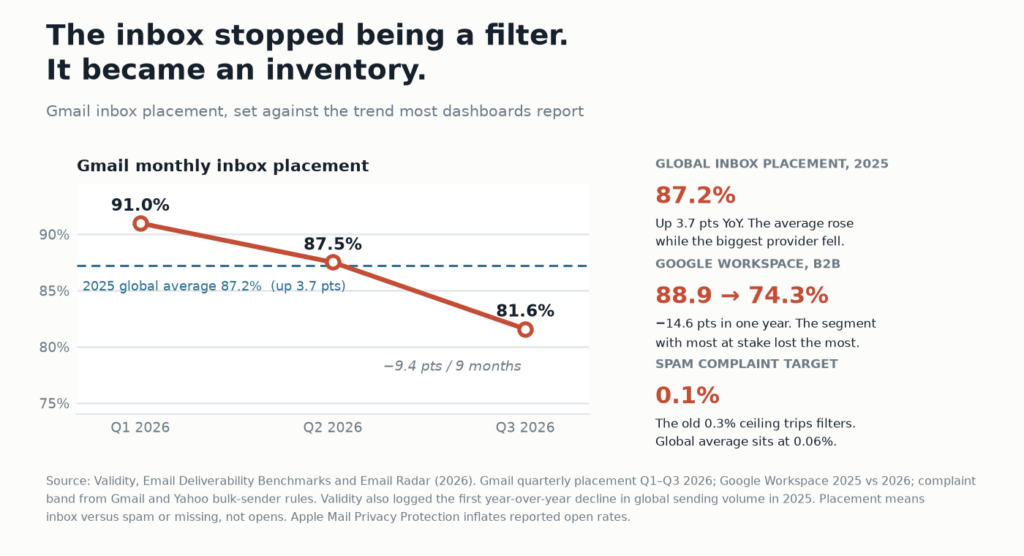
Validity’s 2026 benchmark puts the global average at 87.2%, up 3.7 points year over year. Read that alone and you’d conclude the channel is getting healthier. Then read the rest of the same report and the shape reverses. Gmail — which holds roughly 40% of global inbox share and 54% in the US — moved from 90.97% placement in Q1 2026 to 87.50% in Q2 to 81.57% in Q3. Nine points, nine months. Spam placement nearly doubled, from 5.4% to 9.5%. Blocked and rejected mail more than doubled, from 3.6% to 8.9%.
For B2B senders on Google Workspace the year-over-year drop was 88.9% to 74.3%. Fourteen and a half points.
So the average went up while the biggest door got narrower. That isn’t a contradiction. It’s a redistribution, and understanding it explains most of what’s happening to email right now.
The mechanics: filters stopped filtering and started rationing
For most of email’s history, the spam filter was a classifier. It asked a question about your message — is this wanted? — and returned a verdict. Good senders passed. Bad senders didn’t. The whole discipline of deliverability was built around being classified correctly: authenticate your domain, keep complaints low, don’t look like a botnet.
That model is gone, and the reason is arithmetic rather than policy.
Gmail’s inbox is a finite surface. The number of messages that can sit above the fold on a phone screen has not changed in fifteen years. What changed is supply. When total global sending volume falls for the first time in the history of a benchmark report — which is exactly what Validity recorded in 2025 — you’d expect pressure to ease. It didn’t, because the decline wasn’t distributed evenly. AI-assisted segmentation let sophisticated senders cut volume while keeping reach, and the volume they cut was the marginal, low-intent mail. Meanwhile the senders who hadn’t cleaned up kept pushing the same tonnage into a funnel that now has a hard cap.
A classifier can say yes to everyone who deserves a yes. An allocation system cannot. Once the inbox is treated as inventory, “qualified” stops meaning “allowed in” and starts meaning “ranked high enough to displace someone else.”
That’s the shift. The Gmail requirement that bulk senders keep spam complaints under 0.1% — down from the long-standing 0.3% guidance — is not a stricter version of the old rule. It’s the price of a slot. You are no longer being judged against a standard. You are being ranked against every other sender competing for the same twenty centimeters of screen at 7:40 on a Tuesday morning.
Why the clean-up didn’t buy the lift everyone expected
Here’s the part that stings. The industry did the work. SPF, DKIM, DMARC aligned, one-click unsubscribe in the header, list hygiene programs, sunset flows for non-openers. Compliance rates went up across the board.
And placement at Gmail went down anyway.
The explanation is that authentication was never the thing being rewarded. It was the thing that stopped you being disqualified. Think about the difference between a bouncer checking IDs and a bouncer working a door with a capacity limit. Passing the ID check gets you into the queue. It does not get you inside.
This is the same pattern that ran through paid search a decade ago. When everyone learned quality score, quality score stopped being an edge and became table stakes, and the cost of the same position rose for all of them. Email is running the identical play, except the currency isn’t bid — it’s engagement, and the auction clears continuously.
Which produces the outcome that confuses dashboard-driven teams most: their authentication is perfect, their complaint rate is 0.04%, their list is opt-in, and their reach still dropped four points. Nothing is broken. They’re just no longer the only ones doing it right.
The part that is actually actionable
If placement is a ranking rather than a verdict, then the variable that moves it is not technical hygiene. It’s whether opening your message was worth the space it took.
Read the Gmail numbers again with that lens and they make sense. Spam placement rose faster than blocking, which means more mail was delivered and then judged unwanted by recipients — a relevance failure, not a reputation failure. The senders who lost the most were those sending more, not those sending badly.
That reframes the decision most teams are facing this quarter. The instinct when reach falls is to send more, to make up in volume what was lost in placement. Under an allocation model that is precisely inverted. Volume is now the tax. Every additional message that underperforms spends reputation your best messages need.
The brands holding placement at Gmail this year are, almost without exception, sending less than they did two years ago and getting more from it. Not because they found a trick. Because they stopped competing on quantity in a market that had started pricing it.
What this means for the comeback story
None of this contradicts the case for owned channels. It sharpens it. Email is still the only channel where you own the list, the relationship, and the measurement, and where a large majority of your audience can be reached without an auction. But the era of treating the inbox as a free distribution pipe is over, and it ended for the same reason paid media got expensive: too many people wanted the same slot.
The channel didn’t get worse. It got priced. And a priced channel rewards exactly the discipline that a free one never did.