Why a $3,000 AI Short Drama Out-Earns a $1.5 Million AI Movie
AI Micro-Dramas Earn Billions Overseas. AI Cinema Earned $180,000. Same Technology, Different Business.
One format was born inside the feed. The other was born inside a theatre. Generative video only pays where the format already fits the channel.
Two numbers from the same month
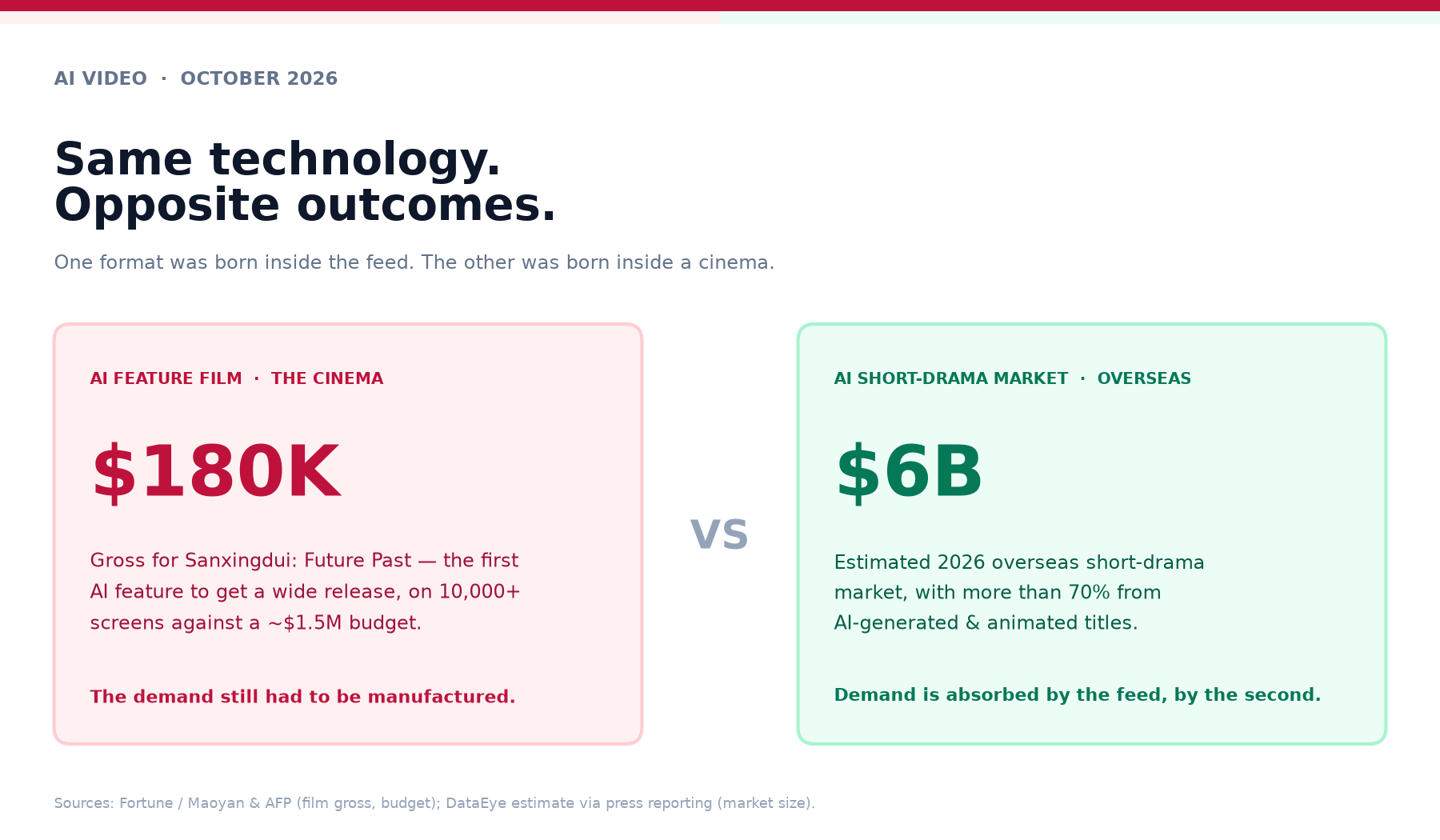
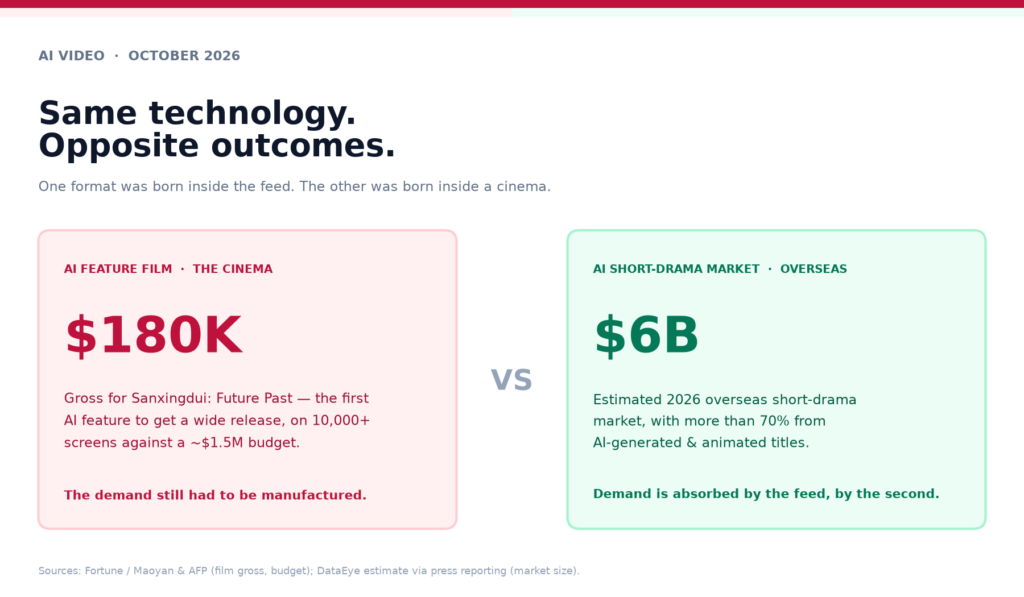
In late October 2026, China’s first fully AI-generated feature film reached cinemas. Sanxingdui: Future Past, produced by Bona Film Group, opened on more than 10,000 screens and took in roughly $180,000 over its opening stretch — a small fraction of a reported budget near $1.5 million.
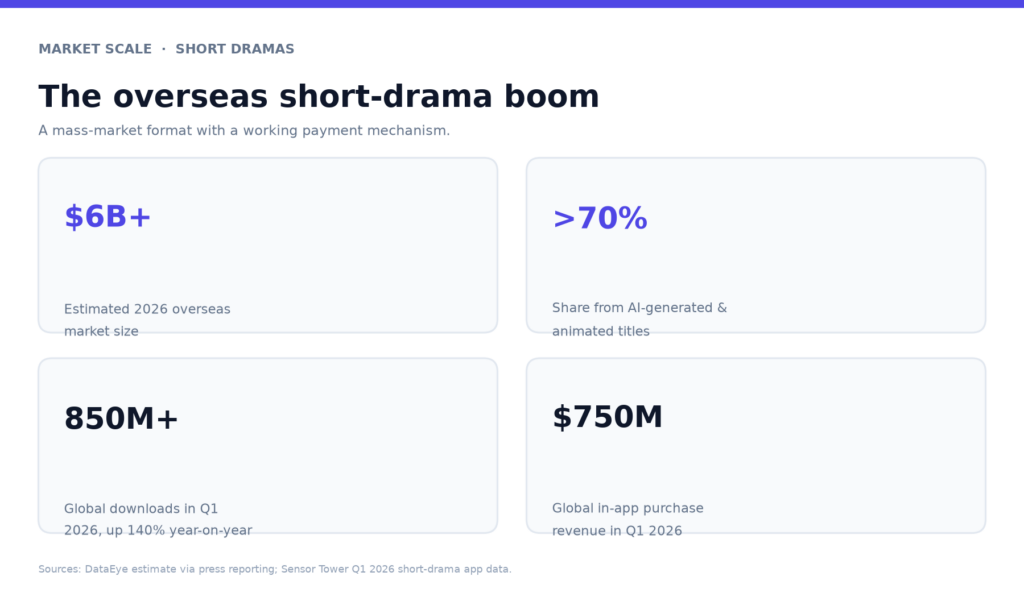
In the same period, industry estimates put the overseas market for micro-dramas — the vertical, serialised short shows built for social feeds — at more than $6 billion for the year, with AI-generated and animated titles accounting for more than 70% of it.
Same underlying technology. Opposite outcomes. The difference is not talent, and it is not the model.
The overseas market in more detail
The boom outside China is no longer a niche export. Sensor Tower data show global short-drama apps passed 850 million downloads in the first quarter of 2026 alone — up 140% year on year — with in-app purchase revenue around $750 million over the same period.
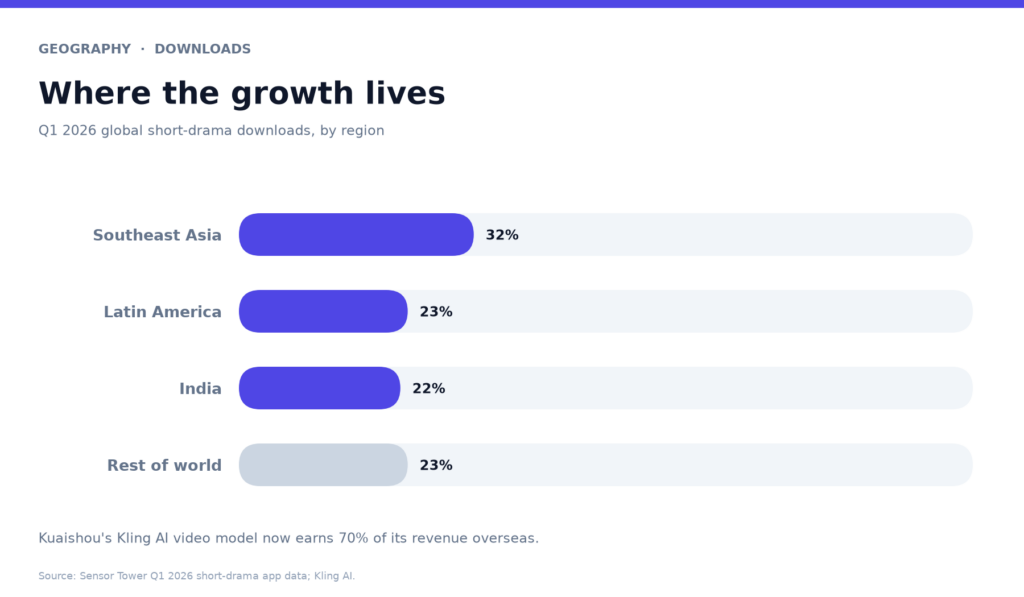
The format’s gravity has shifted decisively toward the Global South: Southeast Asia accounted for about 32% of downloads, Latin America 23%, and India 22%.
Chinese video models are riding the same wave. Kling AI, Kuaishou’s generative-video platform, reports 100 million users and says roughly 70% of its revenue now comes from overseas. In other words, this is not a niche export. It is a mass-market format with a working payment mechanism.
Why the format decides, not the model
A micro-drama asks for two minutes and gives back a cliffhanger. It is vertical, serialised, free at the point of entry, and distributed by an algorithm that can test a thousand variations a week. If episode three loses viewers, episode four can be reshot for the price of a laptop rental.
A feature film asks for two hours, a babysitter and a trip into town. It is distributed through screens that must be booked months ahead, promoted with marketing budgets that often exceed production budgets, and judged by critics before audiences arrive. If the first weekend fails, there is no episode four.
AI reduces the cost of making things in both categories. It does nothing about the second category’s actual constraint, which is giving people a reason to leave the house.
The cost curve was never the binding constraint
This is where most AI-in-media commentary goes wrong. The assumption is that cheaper production unlocks value. In practice, cheaper production unlocks supply — and supply is only valuable if demand can absorb it cheaply.
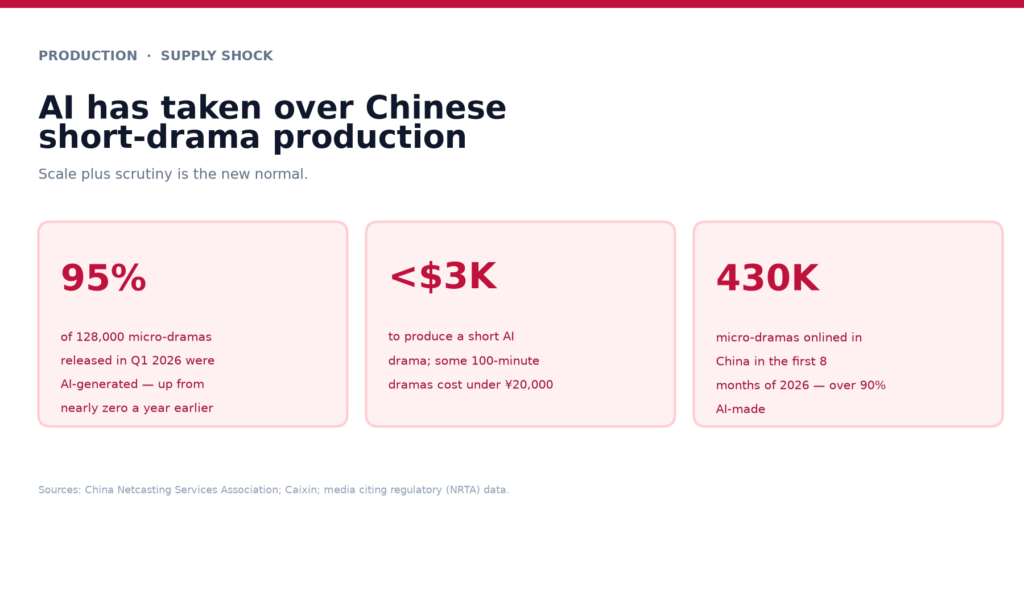
The cost collapse is real and dramatic. Chinese state media and Caixin report that more than 95% of the 128,000 micro-dramas released in the first quarter of 2026 were AI-generated, up from nearly zero a year earlier. A short AI drama can now be produced for under $3,000, and some 100-minute dramas cost under ¥20,000.
In micro-drama, that landmine of cheap supply lands in a feed that costs nothing to serve and monetises by the second. In cinema, demand still has to be manufactured with advertising, stars, reviews and a release date. AI can fund the first. It cannot fund the second.
Why animated and AI-native series are the sweet spot
Animated micro-dramas, often adapted from comics and web novels, sit exactly where generative video is strongest and weakest in the right proportions.
They have no actor likeness to license, no location to book, no weather to work around. Their visual style is already stylised, which means the consistency problems that plague photoreal AI video matter far less. Characters, sets and props can be reused across dozens of episodes, so cost per minute falls with volume rather than rising with ambition. And the source material usually arrives with an existing audience, which lowers customer-acquisition cost before a single frame is generated.
Photoreal AI cinema has none of those advantages. It has to look flawless at 4K for two hours — the hardest possible test for the technology, in the channel with the highest cost of failure.
The audience keeps reminding us what it wants
The contrast is not purely about AI. Months before Sanxingdui flopped, a crudely animated, entirely human-made film about a cow — Niu Lai, made by an amateur mother-and-son duo with no filmmaking experience — grossed roughly 60 million yuan (about $9.1 million), beating Spider-Man: Brand New Day at the Chinese box office.
Audiences did not reject novelty. They rejected a product that asked for two hours of their time and gave back too little reason to care. Craft was never the binding constraint on either side — attention was.
The domestic picture looks like a supply shock
Inside China, the numbers are staggering and slightly alarming. Roughly 430,000 micro-dramas went online in the first eight months of 2026, more than 90% of them AI-generated. AI-generated shows must now be labelled, and platforms must document consent for likeness and voice.
Scale plus scrutiny is the new normal. It rewards operators who can produce at volume and absorb compliance costs, and it punishes anyone treating AI video as a shortcut to a hit.
What this means for marketers outside China
Sell volume, not craft. AI-native content competes on cost per impression and speed of iteration. Positioning it as premium work invites a comparison it will lose.
Localise formats, not scripts. In Southeast Asia and Latin America, subtitled Chinese productions travel well. In the United States and Europe, the scripts are typically remade with local talent while the format and pacing stay Chinese. The exportable asset is the structure, not the dialogue.
Build reusable character assets. The economics of this business are driven by how many episodes one character design can carry.
Budget for compliance from day one. Labelling, consent and content review are not optional in the largest market for this format.
The lesson in one sentence
AI video is a supply-side technology, and revenue is still a demand-side outcome.