AI Marketing Won’t Save You: What the Data Actually Shows
AI Marketing Is Not a Magic Button: Separating Signal From Noise
The phrase stopped carrying information
Ask ten vendors what AI marketing means and you will get ten different answers, most of them describing whatever they happen to sell. At the cheap end it means a chatbot bubble on a landing page. At the serious end it means agents that plan media, draft variants, buy inventory and report back. Both get filed under the same four words. When one label covers every level of sophistication, buyers lose the ability to tell competence from theater. That is the actual problem, and it is not a technology problem.
Two hard numbers show why the noise has survived so long.
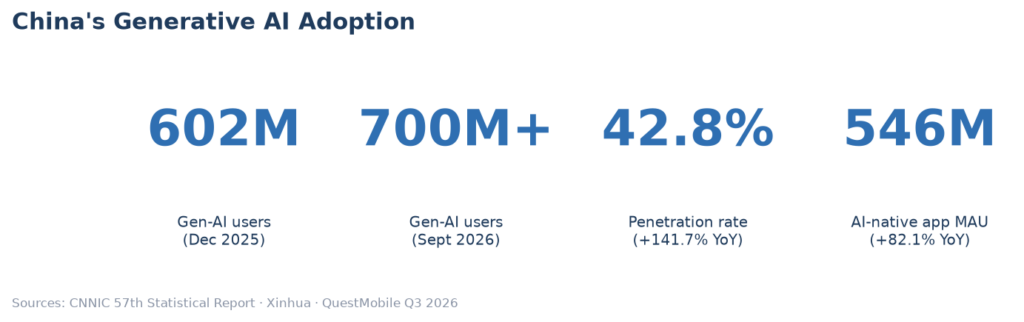
The first is adoption. China’s generative AI user base reached 602 million by December 2025, a penetration rate of 42.8 percent and year-on-year growth of 141.7 percent, according to the China Internet Network Information Center’s 57th statistical report. By September 2026, Xinhua reported that the figure had passed 700 million. QuestMobile measured 546 million monthly active users on AI-native apps in September 2026, up 82.1 percent year on year.
The second is money. OpenAI’s advertising business crossed a 1 billion dollar annualized revenue run rate roughly 200 days after launch, with ads live in more than 40 markets. Adobe data cited in Semrush’s 2026 AI Visibility Index found that visitors referred by AI systems convert 60 percent better than other traffic and generate 53 percent more revenue per visit.
So the market is not built on nothing. It is built on a real shift, wrapped in inflated claims. That combination is harder to argue with than pure nonsense, which is why so many teams sign contracts they cannot later justify.
The market has started charging for hype
Here is what changed in the last eighteen months, and why it matters more than any new model release.
The United States Federal Trade Commission ran an enforcement sweep specifically targeting companies that used AI as a marketing hook. The actions covered a service built to mass-produce fake consumer reviews, a product marketed as a substitute for a licensed lawyer, and several business-opportunity schemes promising AI-powered storefronts that would deliver five-figure monthly income, with consumer losses running into tens of millions of dollars. The commission’s position was blunt: existing consumer protection law applies, and there is no AI exemption.
The Securities and Exchange Commission settled charges against two investment advisers for what it called AI washing, with 400,000 dollars in combined penalties. Both firms had claimed AI capabilities in marketing that they did not actually possess.
Then the disclosure side arrived. The IAB’s Transparency and Disclosure Framework put ultimate responsibility for AI disclosure on the advertiser, not the agency and not the platform, and warned about label fatigue, the point at which audiences stop reading disclosures at all.
Read those three developments together and a new verification standard appears. The question is no longer only whether a claim is technically true. It is whether the person making the claim can survive being asked to prove it in writing.
Pseudo-claim one: fully automated, no humans needed
This is the oldest pitch and the easiest to dismantle.
The claim sounds efficient because the visible work does disappear. Briefs get drafted, variants get generated, reports get assembled. What does not disappear is accountability. The IAB framework states plainly that advertiser accountability cannot be delegated, even when a platform applies the label on your behalf. Someone still has to decide whether an AI-generated image crosses the disclosure threshold, and that someone has a legal name.
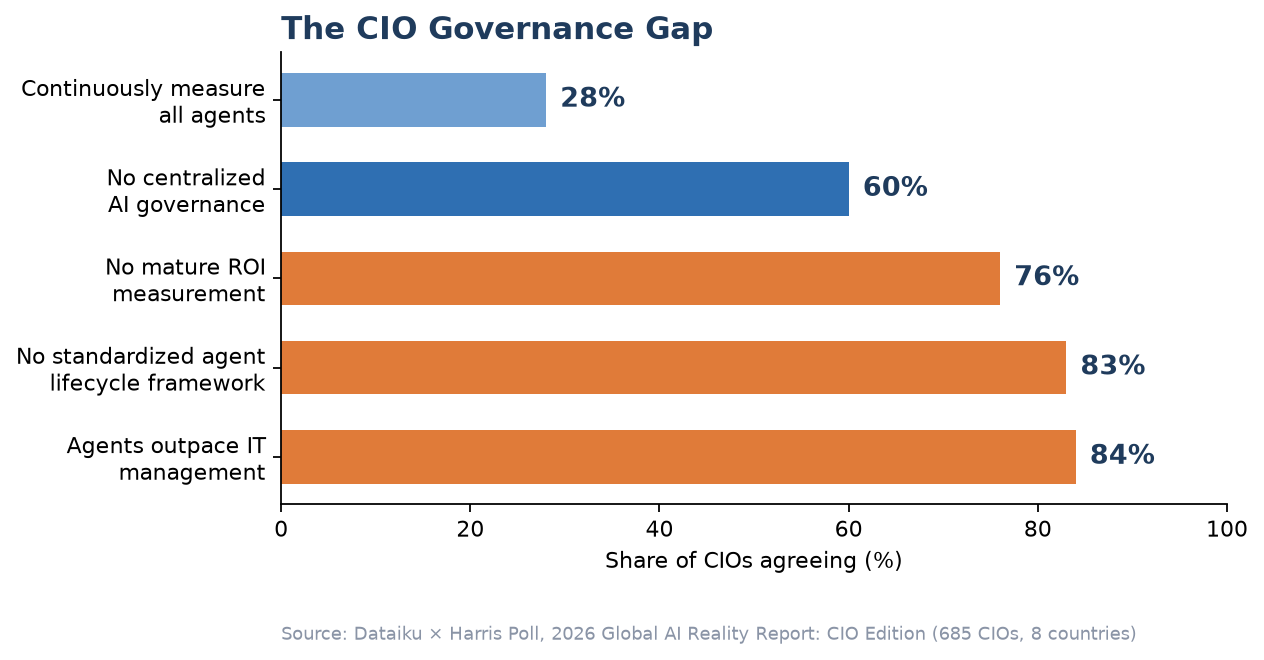
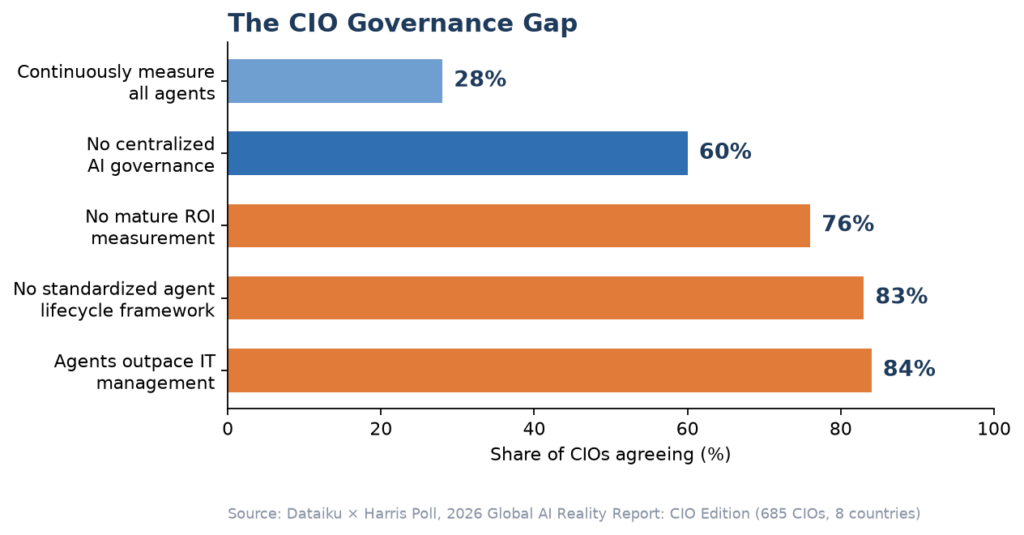
The operational picture is worse than the marketing picture. Dataiku and Harris Poll surveyed 685 chief information officers across eight countries in July 2026 for the Global AI Reality Report. Eighty-four percent said employees are building AI agents and applications faster than the IT department can manage. Eighty-three percent have no standardized lifecycle management for those agents. Sixty percent lack any centralized governance system.
Automation does not remove the human seat. It moves the seat somewhere less visible, usually to governance, review and exception handling, which is precisely where under-resourced teams have no capacity. Vendors rarely price that work in.
Pseudo-claim two: we guarantee AI will recommend you
No one can guarantee this, and the reason is measurable rather than philosophical.
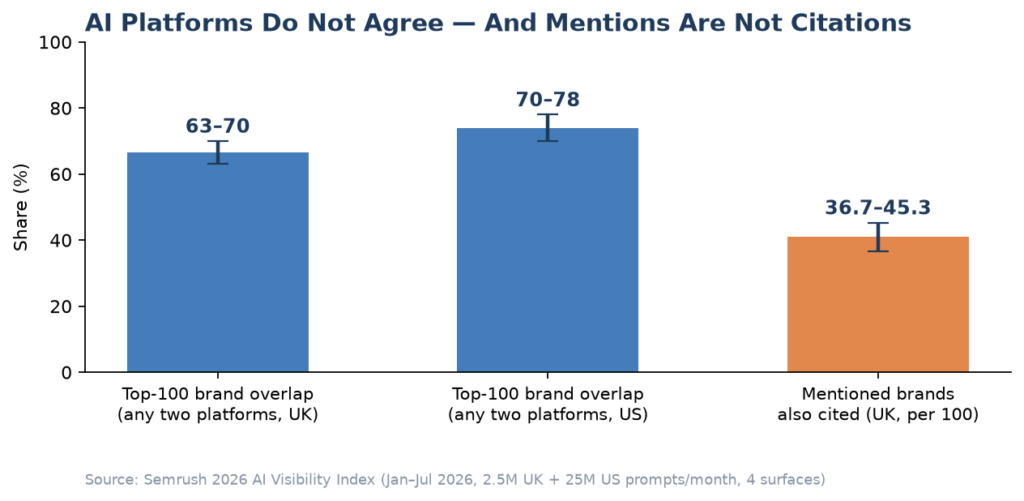
Semrush tracked seven consecutive months of AI visibility data from January to July 2026, using fixed monthly prompt sets of 2.5 million in the United Kingdom and 25 million in the United States across four answer surfaces. Any two platforms shared only 63 to 70 of their top 100 mentioned brands in the UK, and 70 to 78 in the US. Of the small group of brands visible on every platform every month, 24 qualified in the UK and 36 in the US, with just 15 domains appearing in both markets.
The more damaging finding is that being mentioned and being cited are different achievements. Across 22 categories and four platforms, fewer than half of the top 100 mentioned brands also appeared among the top 100 cited domains. In the UK the overlap ranged from 36.7 to 45.3 out of 100 depending on the month.
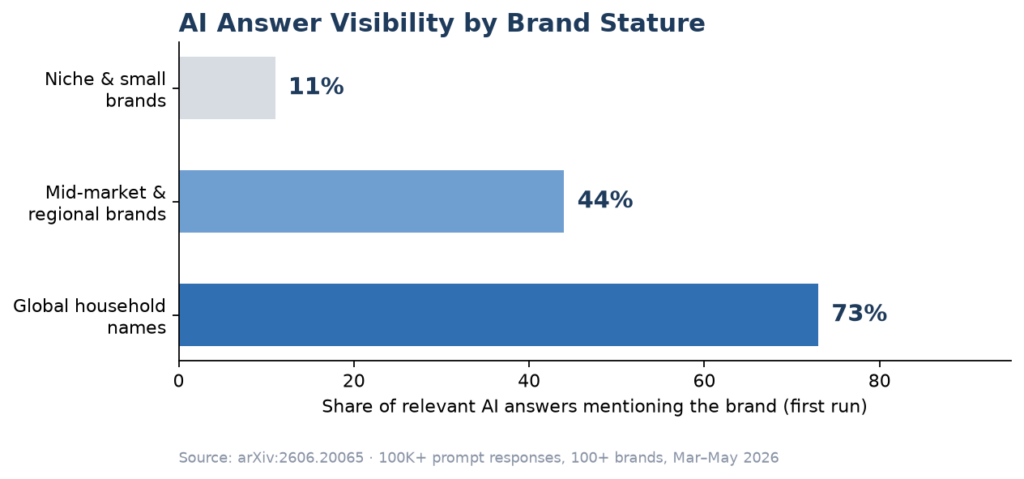
Independent academic work points the same direction. A preprint analyzing more than 100,000 prompt responses across 100-plus brands between March and May 2026 found a three-tier visibility ladder: global household names appeared in 73 percent of relevant AI answers on a first run, established mid-market brands in 44 percent, and niche or small brands in just 11 percent, roughly 30 percentage points per step.
And if someone offers to buy the recommendation, check the platform’s own terms. OpenAI states that its ChatGPT ads are labeled and do not influence answers, and that advertisers have no access to private conversations. Paid placement buys attention next to the answer. It does not buy the answer.
Pseudo-claim three: zero-cost customer acquisition
AI-referred traffic is genuinely valuable. That is exactly why it will not stay free.
The 60 percent conversion lift and 53 percent revenue-per-visit advantage cited in Semrush’s index are the kind of numbers that get priced into an auction within a couple of quarters. The auction already exists. OpenAI went from testing ads to a billion-dollar annualized run rate in about 200 days, and its ad formats now reach the free and low-cost tiers that make up the majority of its weekly users.
What marketers are actually experiencing is arbitrage, not structural advantage. Organic visibility in AI answers is cheap today because the measurement is immature and the inventory is underpriced. Dataiku’s CIO survey suggests how quickly that window closes: 76 percent of CIOs have no mature return-on-investment measurement for all or most AI projects, and only 28 percent continuously measure the operational and business performance of every agent they run.
Unmeasured channels are cheap until someone builds the dashboard. Then the price adjusts.
Pseudo-claim four: one-click content for every platform
Distribution is not the hard part. Translation into each engine’s preference structure is.
Semrush found that Gemini mentions more distinct brands per answer than ChatGPT, while ChatGPT cites more sources per answer than any of the other three surfaces and Gemini the fewest. Source concentration differs sharply too: in the UK, the ten leading source domains accounted for 23.2 to 35.8 percent of citations on Google AI Mode, against only 12.8 to 15.4 percent on ChatGPT. A strategy tuned for one surface does not transfer, and the study found that even between the UK and the US, news publishers carried 29.5 percent of ChatGPT citations in the UK against 19.6 percent in the US.
China shows the same pattern from a different angle. QuestMobile’s third-quarter 2026 analysis describes citation policy divergence across domestic assistants, with some engines cutting citation volume to reduce noise, others deepening coverage, and others widening source breadth. One upload, one format, one template cannot satisfy four different citation philosophies.
Pseudo-claim five: permanent indexing, never drops
Nothing in this category is permanent, and the volatility is documented monthly.
Semrush’s seven-month series shows the overlap between mentioned and cited domains moving within a 36.7 to 45.3 band rather than holding steady. The preprint on brand visibility found that whether a brand is framed positively or negatively flips about 6.7 times more often than whether it is mentioned at all. Your presence can persist while your framing quietly deteriorates, which is the worst combination because it looks like stability on a dashboard.
Forecasting has a poor record here too. Gartner predicted in February 2024 that traditional search engine volume would drop 25 percent by 2026 as chatbots absorbed queries. What actually happened is migration rather than collapse, and the clearest evidence comes from China: QuestMobile recorded per-user sessions on search apps falling 21.7 percent and time spent falling 17.2 percent year on year as of August 2026, while AI-native apps added 82.1 percent in monthly active users. Search did not vanish. It changed address, format and owner.
If credentialed analysts get the mechanism wrong, treat any vendor claiming a permanent position as a warning sign rather than a reassurance.
A four-question test you can run in ten minutes
Before you sign anything, ask these four questions in this order.
One. How absolute is the promise? Forever, guaranteed, never drops, zero cost, every platform. Absolute language is a substitute for evidence. Real operators describe ranges, conditions and failure modes.
Two. How specific is the method? Ask what exactly gets changed in your content, your data or your workflow. If the answer describes outcomes instead of inputs, there is no method, only a forecast.
Three. Can you verify it without their help? Independent measurement matters more than vendor reporting. Semrush, for example, publishes methodology and prompt volumes, which is why its platform disagreement figures are usable in a budget meeting. A slide with no methodology is a mood, not a metric.
Four. Who carries the liability? After the FTC sweep and the SEC settlements, this question has teeth. If a claim fails, the advertiser is the party holding the disclosure obligation. Ask who signs.
The five claims and their counter-evidence
| Pseudo-claim | What it promises | What the evidence shows |
|---|---|---|
| Fully automated | No humans required | 84% of CIOs say agents outpace IT management; advertiser accountability cannot be delegated |
| Guaranteed recommendation | AI will name your brand | Any two platforms share only 63–70 of the top 100 brands in the UK; small brands appear in 11% of relevant answers |
| Zero-cost acquisition | Free customers forever | AI referral traffic converts 60% better, which is exactly why it gets auctioned |
| One-click everywhere | One asset, all surfaces | Citation volume and source concentration differ by platform and by market |
| Permanent indexing | Position never drops | Mention–citation overlap moves month to month; framing instability outpaces presence instability |
What actually holds up: the data foundation
Start with the least glamorous layer, because it is the most cited.
The preprint measuring brand visibility across AI engines found that roughly 78 percent of citations point to corporate websites. Among non-corporate sources, YouTube leads, ahead of Reddit, editorial media and Wikipedia. That means your own domain is still the primary evidence base, but only if the information on it is unambiguous, current and machine-readable.
The IAB framework adds the operational requirement: provenance metadata and disclosure thresholds handled by the advertiser. Dataiku’s survey supplies the warning: 60 percent of CIOs lack centralized governance. If your product data, pricing, claims and legal statements live in four unconnected systems, no optimization layer will reconcile them for you.
What actually holds up: content structure
Structure is now measurable, which makes it the most defensible place to invest.
A peer preprint on structural feature engineering for generative engine optimization decomposed content into macro document architecture, meso information chunking and micro visual emphasis, then tested it across six mainstream engines. The result was a 17.3 percent improvement in citation rate and 18.5 percent in subjective quality, without altering the underlying argument.
The visibility study adds a practical detail: the ranked best-of listicle was the most cited content format, at roughly 21 percent of all citations. That is a structural signal, not a keyword trick. Comparison pages, specifications and explicit criteria earn citations because engines can extract a decision from them.
What actually holds up: team AI literacy
Every governance gap in the CIO survey resolves into a skills gap.
Eighty-four percent of CIOs said agents are being built faster than IT can oversee. Eighty-three percent have no lifecycle framework. Sixty percent have no central governance. Meanwhile 88 percent said AI performance affects their professional reputation, and 76 percent said their role could be at risk if they fail to produce measurable results by the end of 2027.
That is not a tooling problem. It is a training, review and ownership problem, and it is the reason two companies with identical software stacks get opposite results.
What actually holds up: measurable outcomes
Define the test before the campaign, not after.
Only 28 percent of CIOs continuously measure the operational and business performance of every AI agent in production, and 76 percent have no mature return-on-investment system for all or most AI projects. Those numbers describe an industry that bought first and planned to measure later.
A claim worth funding survives three tests: it names the metric, it names the baseline, and it names the point at which you would call it a failure. Vendor dashboards rarely include the third.
What China’s numbers mean for marketers outside China
China is not a curiosity here. It is the pressure test, running about two years ahead on adoption and roughly one regulatory cycle ahead on enforcement.
Three numbers frame it. Generative AI reached 42.8 percent penetration and 602 million users by December 2025, then passed 700 million by September 2026. AI-native apps held 546 million monthly active users, with general assistants across form factors at 1.157 billion and AI office tools at 142 million. And the State Administration for Market Regulation, together with six other authorities, issued a 2026 to 2030 advertising plan targeting around 10 percent average annual growth, against a 14th Five-Year-Plan base of more than 2 trillion yuan in advertising revenue, of which internet advertising already accounted for 89.1 percent of all-media revenue.
Three lessons follow, and none of them are about copying tactics.
First, migration is faster than most Western planning cycles assume. A 21.7 percent drop in search app sessions per user happened within a year, not a decade.
Second, delivery beats attention. QuestMobile’s framing is explicit: the winning position is the shortest path to a completed task, not the busiest entry point. Marketing content that only generates interest is now competing against interfaces that close transactions.
Third, regulation arrives with scale. The Chinese advertising plan pairs growth targets with tighter rules on content quality and advertising law, while the US applies consumer protection and securities law to AI claims without creating new exemptions. Scale attracts scrutiny. Budget for it.
A 90-day sequence that beats a pitch deck
If you want to move from noise to signal without waiting for a perfect strategy, run this order.
Days 1 to 15. Audit what AI systems currently say about you. Pick four surfaces relevant to your market, run the same 30 questions monthly, and record mentions separately from citations. You will discover that your mention rate and your citation rate are different numbers.
Days 16 to 45. Fix the evidence layer. Consolidate product facts, pricing, claims and credentials into one governed source. Add provenance metadata where creative is AI-assisted. This is unglamorous and it is the layer most competitors skip.
Days 46 to 75. Restructure the top twenty pages for extraction: direct answer in the first paragraph, explicit comparison tables, named criteria, dated figures. Then measure citation rate again. Structural changes of this kind have produced double-digit improvements in controlled tests.
Days 76 to 90. Write the failure condition into the contract. Any vendor claim gets a baseline, a metric, a review date and a stop rule. If a partner cannot accept a stop rule, that tells you what the claim was worth.
The honest conclusion
AI marketing works when it amplifies fundamentals that already exist: clean data, structured content, trained people, measurable goals. It fails when it is asked to substitute for them, which is precisely what the loudest pitches promise.
The uncomfortable part is that this conclusion costs you money in the short term. Governance, provenance, documentation and measurement are all overhead until something goes wrong, and then they are the only thing that saves you. The FTC sweep, the SEC settlements and the IAB framework are not abstract policy. They are the invoice for the last three years of unverified claims, arriving now.
Summary
- Adoption and spend are real; the inflated claims riding on them are not.
- Enforcement has turned claim verification into a legal issue, not a marketing preference.
- Guaranteed AI recommendation is unsupportable: platform agreement is partial, and mention is not citation.
- Zero-cost acquisition is arbitrage with a short half-life, already being priced by ad auctions.
- Structure, data quality, team literacy and measurement are the four assets that compound; everything else depreciates.