One Default, Two Answers: The Cost Nobody Instruments
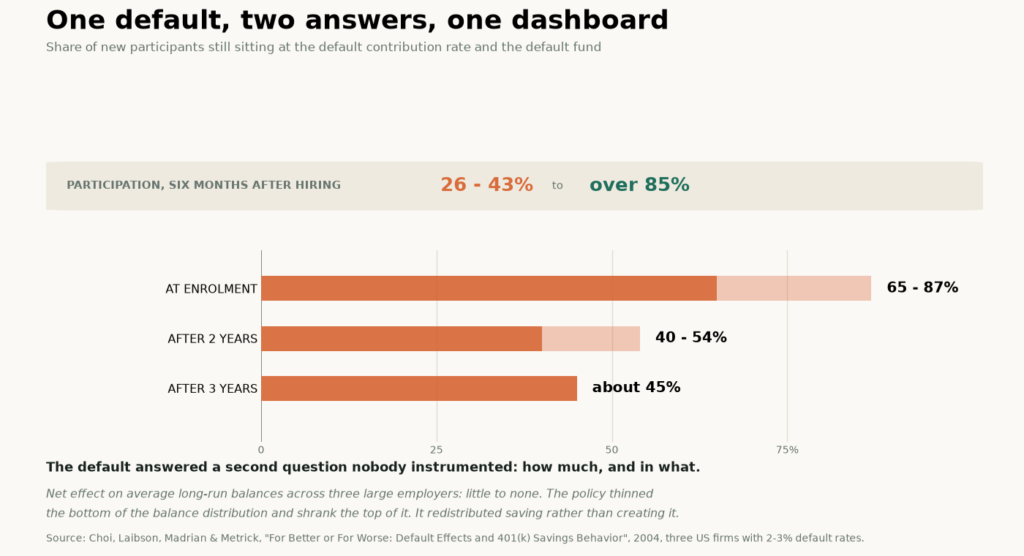
The most quoted statistic in choice architecture is a participation rate. Three large US employers switched a 401(k) from opt-in to automatic enrolment and watched participation climb from 26–43% at six months of tenure to more than 85% — in every firm, in every tenure band. Nothing else about the plan changed. No new match, no new fund menu, no new education campaign. A box that used to arrive empty arrived ticked instead, and the outcome moved by more than 40 percentage points.
Then the same research team asked the question almost nobody quotes. What happened to the rate?
Under automatic enrolment, 65–87% of new participants saved at the default contribution rate and held every dollar in the default fund. The defaults were 2% and 3%, and the funds were stable value or money market. The default did not merely decide whether someone joined. It decided how much they gave, and where it went.
That is the structural point, and it has very little to do with retirement plans. A default answers two questions at once. It answers the question you asked, which was “will you join?” It also pre-answers the question you did not ask, which was “how much, and in what form?” The first answer appears on a dashboard, because somebody instrumented it. The second answer appears nowhere, because nobody thought to put a number on it.
The stickiness has a half-life. The share of participants parked at the default decayed from 65–87% at enrolment to 40–54% after two years, and to roughly 45% after three. That is not a switch people flip. It is a groove they slowly climb out of, if they climb out at all.
And the net effect on average long-run balances across the three firms was close to nothing. Higher participation and a lower rate per participant roughly cancelled out. What the policy actually did was redistribute: it thinned the bottom of the balance distribution, where people had saved nothing, and shrank the top, where people had saved properly. It moved saving around rather than creating it.
Every marketer runs a version of this experiment and rarely reads the second answer. The default term length on a subscription. The pre-selected seat count. The auto-renewal. The pre-checked data-sharing scope. The add-on that arrives already in the basket. Each one answers a question the customer was never asked, and each one is measured by nobody, which is exactly why it drifts toward what suits the seller.
The test needs one question. If three quarters of your customers never touch this setting, is the state they end up in one you would defend to them, out loud, with the number attached? If yes, you have a default. If no, you have a decision you were unwilling to make in the open, shipped at scale, with the deliberation removed.