The Maintenance Behind Freshness: Why AI Search Rewards Old Pages That Have Been Rewritten
When studies started showing that AI assistants prefer recent content, the industry did what it always does with a comfortable finding: it turned the finding into a publishing schedule. Post more often. Keep the feed warm. Timestamps matter now.
Then Seer Interactive did something more interesting than publishing another cadence recommendation. It dated the pages. Not by when they were written, but by when they were last touched. The sample covered 7,683 pages cited across 47,097 citations in ChatGPT, Gemini and Perplexity between March and June 2026, drawn from four brands in four verticals: pet supplies, vacation rentals, retail energy and commercial banking.
By last-modified date, 72% of those cited pages looked fresh, falling inside the past year. By original publication date, only 42% did. Same pages. Two different dates. Thirty points of daylight between them.
Thirty points is not a rounding error. It is an entire population of content that the models treat as current and that was, in the ordinary sense of the word, old.
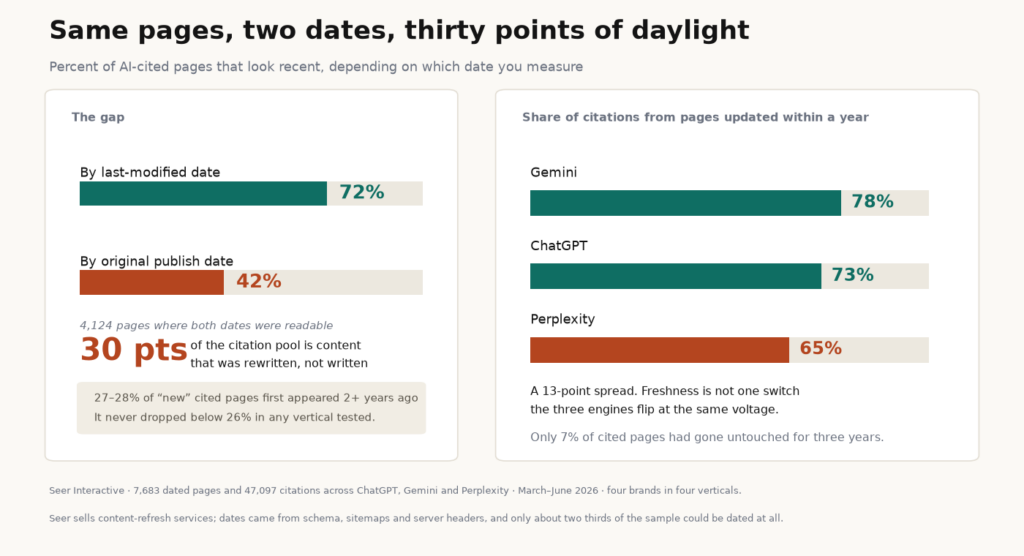
That gap is the refreshed material sitting on the new side of the line because somebody went back and rebuilt it. More than a quarter of the pages that looked new, 27% to 28% depending on the engine and never below 26% in any vertical, had first appeared more than two years earlier. They were not new articles. They were old ones, kept alive.
Why the mechanism works this way
The reason is structural, and it follows from what a language model actually reads.
An assistant does not consult a publication history. It retrieves the current version of a document, whatever date that version carries. Its only signal for whether a claim is still true is whatever freshness evidence the page and its headers provide. A last-modified date is the machine-readable version of “someone checked this recently.”
That produces a selection pressure most content strategies have not noticed they are under.
A brand-new post and a rewritten post occupy the same pool. Both look current. The rewritten one arrives with something the new one does not: prior accumulation. It has history in the index, possibly inbound links, possibly a position it has held for years. The new post has a launch date and an author who is tired.
Which is why the maintenance path is not a compromise. It is often the higher-yield door, for anyone whose production capacity is capped.
The engine spread matters more than the headline
Gemini cited pages updated within a year 78% of the time. ChatGPT: 73%. Perplexity: 65%.
Thirteen points of spread is a real planning variable. If Perplexity carries your buyer intent, an eighteen-month-old page has a longer runway than it would on Gemini. If Gemini does, a stale page is competing against a field in which three in four citations already look maintained.
The tail is steeper than the median
Share of cited pages by age of last modification: 75% within a year, 88% within two, 93% within three.
Read the tail, not the average. Past three years, a page has essentially left the distribution the citations come from. That gives you a shortlist for free: export your sitemap, sort ascending by last-modified date, and start at the top.
The part that undercuts the advice
Seer sells content-refresh services. A firm that bills for refreshes reporting that refreshes work deserves the same polite skepticism you would give a bakery recommending bread. The counts are first-party and the methodology is disclosed, but the direction of the conclusion is not neutral.
There are harder limits. Nobody randomised pages, updated half, and compared outcomes, so the effect size of a refresh is not measurable here. Only about two thirds of the sample could be dated at all. Four brands, four verticals, one of them heavily weighted toward retail energy. Seer published no limitations section, which is itself a limitation.
Then there is the sharper point. “Updated” is not a synonym for “improved.” A page can carry a fresh timestamp and the same wrong number. The mechanism rewards the appearance of maintenance, which means every incentive in this system points toward touching pages rather than fixing them. That is a drift risk, not a strategy.
So the honest reading is narrower than the headline. What the data supports is this: recency is a proxy for accuracy in a retrieval system that cannot audit claims, and it is the one proxy you can move by hand. What it does not support is that moving the date is the work.
What the mechanism implies
If freshness is manufactured rather than published, then the cadence question was always the wrong question. The right one is which pages are load-bearing and how recently anyone checked them.
Which reframes the job. The calendar’s output competes for attention against 74.2% of new pages carrying machine-written text. The maintenance queue competes for citation against a pool in which three in four entries already look current. One of those fights is winnable with a laptop and a Friday afternoon.
The uncomfortable corollary: a page nobody touches is not idling. It is decaying at about 1.21% a week on the one blog where that has been measured publicly, and it will hold its position in the index long enough that nobody notices the leak.
Freshness, in the end, is not what you publish. It is what you refuse to leave alone.