Two Tracks, One Profession: Why AI Is Splitting Marketing Careers in Half
You have heard the version where AI eats marketing jobs. It is a clean story, easy to share, and almost entirely wrong in the way it is usually told.
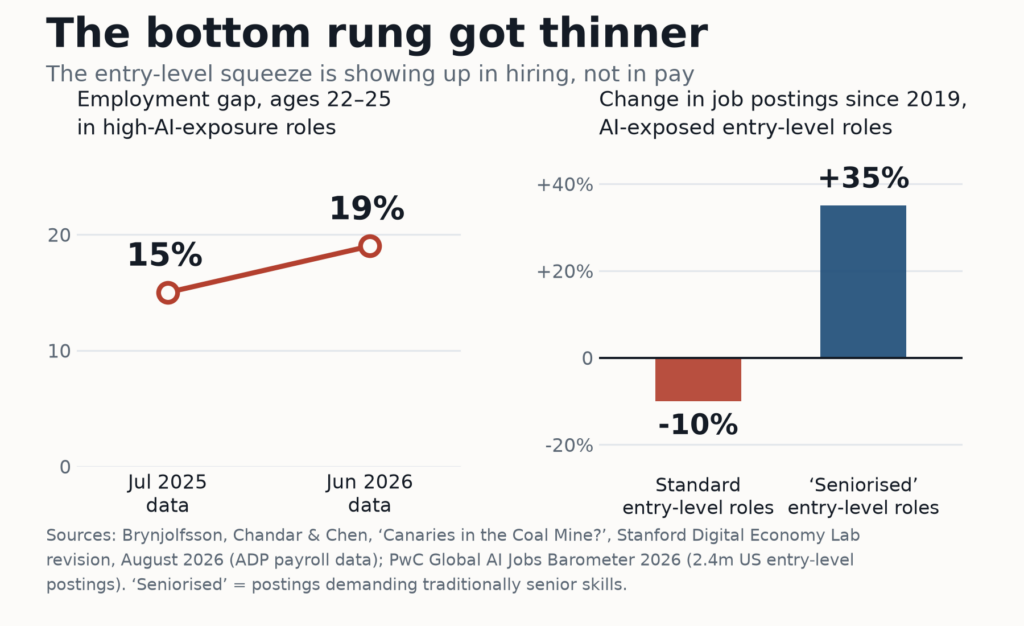
Here is what the actual payroll records show. In August 2026, three Stanford economists published a revision to their working paper on AI and employment, built on ADP payroll data covering millions of US workers. Their finding was not mass displacement. It was something narrower and stranger: employment for workers aged 22 to 25 in the most AI-exposed occupations now sits about 19% below where it would be if it had tracked their less-exposed peers. A year earlier that gap was 15%. Experienced workers show no comparable gap at all.
Read that carefully. The damage is concentrated at the bottom of the ladder, in a specific age band, and it is growing. That is not a story about marketing being eliminated. It is a story about the entry price of a marketing career going up.
The better frame is simpler. AI is not deleting marketing jobs. It is repricing them, and the repricing runs in two directions at once.
Two tracks, not one cliff
The strongest evidence for the two-direction claim comes from PwC’s 2026 Global AI Jobs Barometer, which analysed more than a billion job advertisements across 27 countries and territories. Its central finding is that AI is splitting the labour market into two tracks that behave nothing alike.
On one track sit what PwC calls professionalised roles, where AI absorbs the routine work and the remaining job demands more expertise, more judgment, more accountability. On the other track sit democratised roles, where AI makes the work simple enough that a non-expert can do it. Professionalised roles are growing twice as fast as democratised ones, and their wages are growing 42% faster since 2021.
That single sentence is the most useful thing you can carry into a career conversation this year. It says nothing about whether marketing survives. It says everything about which version of marketing you should be building toward.
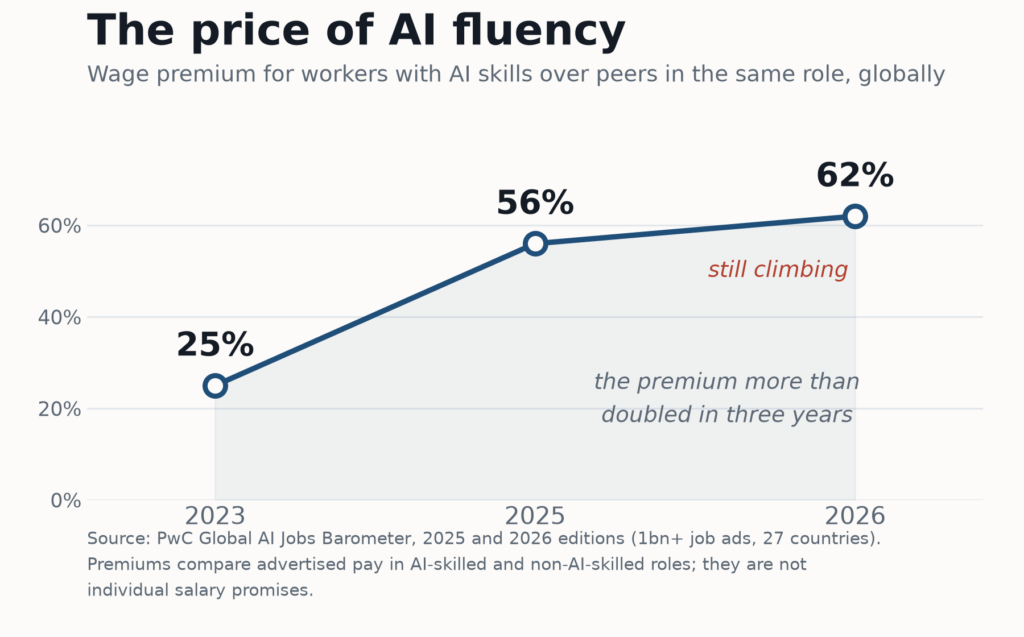
The wage data points the same way. PwC puts the premium for AI skills at 62% in 2026, up from 56% the year before and 25% in 2023. The premium more than doubled in three years. It varies wildly by sector, reaching 118% in consumer markets and about 16% in the public sector, but the direction is consistent everywhere they looked.
The bottom rung got thinner
If you are early in your career, the Stanford finding deserves a second look, because the mechanism matters more than the number.
The adjustment did not happen through firing. It happened through hiring. Employers simply stopped bringing juniors in, and the authors are careful to say the data cannot prove AI caused all of it. They tested the obvious alternatives. The divergence persists when you exclude tech firms, control for interest-rate exposure and remote work, and use different measures of AI exposure. They also flag real cautions: the gap shrinks when you account for education, and it looks larger in the ADP sample than in national survey benchmarks.
The pattern they describe is the one worth internalising. Employment fell among young workers in occupations built on codified knowledge, the kind you can write down in a textbook or a procedure. Employment rose among experienced workers in occupations built on tacit knowledge, the kind you only get from repetition, mentorship and being in the room when something goes wrong.
AI is very good at the codified half. It is poor at the tacit half. So the apprenticeship that used to be the on-ramp, the two years of doing the routine work badly until you developed judgment, is exactly the part being automated away.
Why it shows up in hiring, not in pay
The Stanford authors are explicit that so far the adjustment shows up primarily in employment rather than base pay. That is a strange and important detail. If AI were simply replacing marketers, you would expect wages to fall too. Instead the pipeline narrowed while the price of the people already inside it held.
PwC found the same shape from a different angle. Among AI-exposed entry-level roles, job postings have grown 35% since 2019 if they demand traditionally senior skills such as judgment, leadership and stakeholder management. Entry-level roles that did not get seniorised declined 10% over the same period. The junior job did not vanish. It was rewritten to ask for capabilities that used to take a decade to earn.
What the marketing numbers say
Now pull the lens in from the labour market to marketing specifically, because the aggregate numbers hide a sharp divergence.
Indeed’s chief marketing officer published the platform’s own hiring data in September 2026, and the headline is uncomfortable: marketing job postings remain roughly 25% below pre-pandemic levels, and marketing opportunities have fallen faster than almost any other white-collar function over the past five years. That is a real contraction, not a rounding error, and it comes from a platform whose core business is observing exactly this.
But the same data contains the counter-signal. Postings that mention AI are increasing. The volume of marketing jobs shrank while the specification of those jobs changed.
The job description moved first
If you want to know what employers actually want, read what they write down. CXL analysed about 1,750 marketing job descriptions across two snapshots in 2026, January and May. Mentions of AI in marketing ads rose from 30% to 37%. Mentions of specific AI tooling tripled, from 5% to 15%. Mentions of automation rose from 13% to 21%.
The phrase-level shift is the telling part. Language like “use AI to” and “AI in your workflow” more than doubled. That is not the vocabulary of experimentation. That is the vocabulary of infrastructure.
One result genuinely surprised me. You would expect content roles to be the first to demand AI fluency. They were not. AI mentions in performance and growth marketing roles nearly doubled in a single quarter, from 32% to 63%. The discipline that already runs on testing, measurement and iteration absorbed AI fastest, because AI slots directly into a loop that was already quantitative.
CXL’s later quarterly cut, on 878 US marketing ads, shows the trend steepening: explicit AI skill requirements went from 15% in the first quarter to 40% in the third. Note the source’s own interest here. CXL sells AI marketing training, so treat the direction as reliable and the exact multiples as indicative.
Same profession, opposite directions
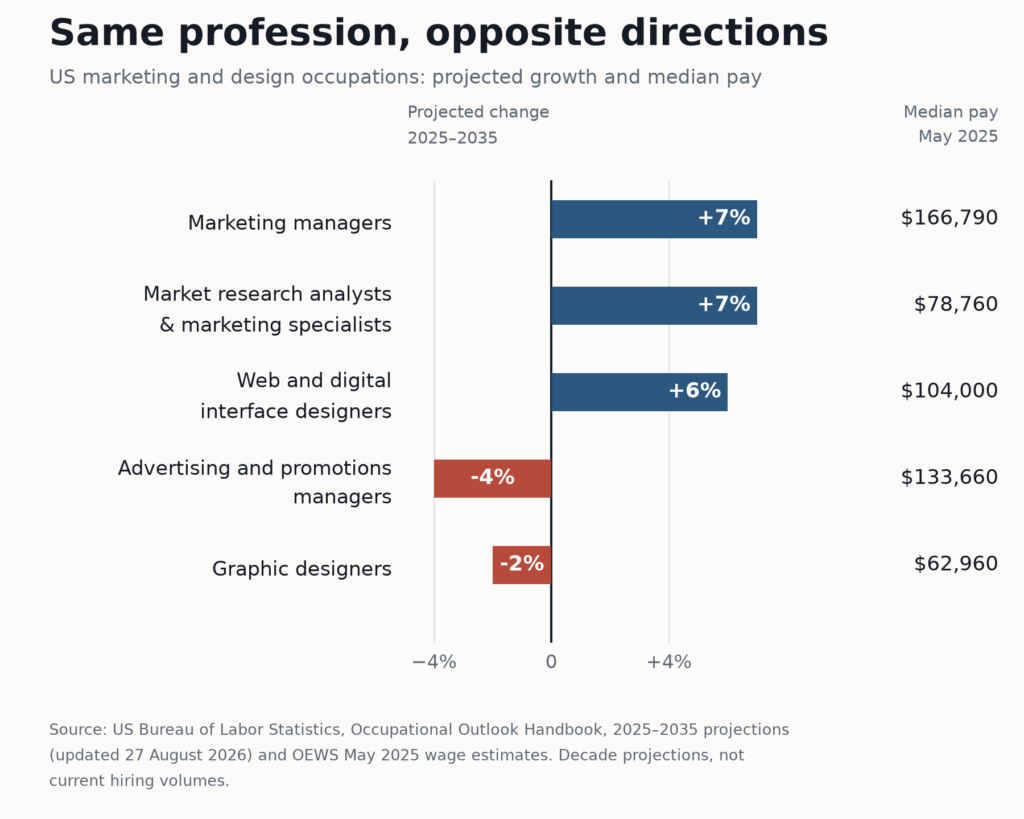
The cleanest evidence that this is a repricing rather than a collapse sits in the US Bureau of Labor Statistics projections, updated in August 2026 for the 2025 to 2035 horizon. Look at what happens to five occupations that a layperson would file under the same heading.
Marketing managers are projected to grow 7%, with a median wage of $166,790. Market research analysts and marketing specialists grow 7%, median $78,760, with roughly 82,000 openings a year. Web and digital interface designers grow 6% at a median of $104,000. Against an all-occupations average of roughly 3%, those are healthy numbers.
Then the same table shows graphic designers declining 2% at a median of $62,960, and advertising and promotions managers declining 4% at $133,660. The Bureau explicitly attributes the graphic design decline to automated design tools.
Two design jobs, one shrinking and one growing, in the same release, from the same agency, using the same method. The difference is not creativity. It is whether the job produces a discrete artefact or owns a system that has to be maintained, tested and defended.
The five skills that are inflating
So what actually pays? Not a list of tools. Five capabilities, each of which is expensive precisely because AI cannot finish the job alone.
Judgment under ambiguity
The thing AI does not do is decide. It generates options, ranks them by surface plausibility, and hands the problem back. PwC found that the new tasks being added to AI-exposed roles are 2.5 times more likely to depend on empathy, judgment and creativity than the tasks being removed. Judgment is not a soft skill in this framing. It is the residual, and the residual is where the margin sits.
Orchestration
Every marketer now has access to roughly the same models. That means the tool is no longer the differentiator, and the configuration is. The people who compound are the ones who build repeatable workflows, know which step to automate and which to keep manual, and can explain why. In CXL’s maturity benchmark, only about 9% of assessed marketers operate at what it calls AI-native, where workflows run whole jobs with a human reviewing the output. Most sit at the level of prompting a chatbot task by task, which produces speed without producing leverage.
Taste
HubSpot surveyed 1,505 marketers for its 2026 State of Marketing report and found that 80% already use AI for content creation and 75% for media production. When everyone can produce volume, volume stops being a signal. Sixty-three percent of those marketers said they need more unique, human-centred content to stand out. HubSpot sells software that benefits from that conclusion, so weigh it accordingly, but the underlying mechanism is not controversial: abundance at the bottom raises the price of discrimination at the top.
Data sense
Indeed’s CMO names this first among the three capabilities his team hires for, and his phrasing is worth borrowing: access to data is not the advantage, separating signal from surface noise is. The scarce skill is not building the dashboard. It is looking at a report that flatters you and knowing it is lying.
Trust
Relationships compound in a way campaigns do not. The parts of marketing that involve being a known person to a known audience, community, advocacy, founder voice, customer intimacy, are the parts with the longest useful life, because they are built out of accumulated human contact rather than output.
The skills that are compressing
Be equally clear about the other side, because pretending everything is fine is not a career strategy.
Volume copywriting compresses. Not writing, not voice, but the production of adequate text at scale, which is now close to free. Template design compresses, which is exactly what the Bureau’s graphic design number is measuring. Routine media buying and ad operations compress, because optimisation is a computational task and the platforms have already automated most of it.
The honest nuance is that these skills do not disappear. They re-base. The copywriter who directs a model toward a specific voice is doing a different job than the one who wrote sixteen variations of a product description, and the first job is still paid. What vanished is the version of the work whose entire value was throughput.
Four caveats worth taking seriously
I would distrust anyone who presented this cleanly, so here is where the argument is soft.
The Stanford result is descriptive, not causal. The authors say so plainly, more than once. The timing and structure are suggestive, but payroll data cannot isolate AI from everything else moving at the same time.
Salary data is noisy. The 62% premium compares advertised pay across roles, not what happens to one person who learns a tool. PwC’s own sector spread, from 16% to 118%, tells you the number is a distribution pretending to be a statistic.
The occupational projections are models. The Bureau itself notes that AI may soften growth in web and interface design by making designers more productive and letting non-designers handle basic tasks. A 6% projection is a forecast, not a vacancy count.
And the marketing contraction is real. A 25% shortfall in postings is not a narrative device. Some of the people reading this will find the market genuinely harder this year than last, and no amount of reframing changes that.
The playbook, if you want one
Move up the ladder rather than sideways along it. The single highest-return career move is shifting from producing the artefact to owning the decision about the artefact. That is the line between the two tracks.
Build a workflow, not a prompt library. Anyone can prompt. Very few can describe, precisely, what their process does, where a human checks it, and what changed as a result. That description is what gets asked about in interviews now.
Stack rare intersections. Platform fluency plus data literacy plus taste is a scarcer combination than any one of them at world-class level, and scarcity is what the compensation data is actually rewarding.
Build proof, not tenure. If entry-level roles now demand senior capabilities, then the portfolio of decisions you can defend matters more than the years you accumulated. Show a call you made, the reasoning, and the outcome, including the ones that went badly.
Assume you will re-enter the learning curve repeatedly. The World Economic Forum’s Future of Jobs 2025 survey, covering over 1,000 employers across 55 economies, found that 39% of existing skills are expected to change or become obsolete by 2030, and that 77% of employers plan to reskill their workforce. Continuous re-skilling is not a personality trait. It is the baseline assumption the market is now built on.
Where this goes next
Three things to watch over the next year, each of which would confirm or complicate the picture above.
Watch whether the entry-level gap keeps widening. Stanford’s 15% became 19% in twelve months. If it keeps moving, the apprenticeship problem becomes structural rather than cyclical, and the industry will have to rebuild the on-ramp deliberately.
Watch whether the seniorised entry job becomes a real title. A junior role that demands stakeholder management and strategic judgment is either a genuine new rung on the ladder or a way of getting senior work at junior pay. The difference will show up in retention.
Watch the freelance side. MBO Partners counted 72.9 million independent workers in the US in 2025, with 5.6 million earning over $100,000, up 19% year over year and nearly double the 2020 figure. Seventy-four percent of independents reported using generative AI, ahead of the 69% among traditionally employed workers. If judgment increasingly gets sold by the day rather than the year, the career stops being a ladder and starts being a practice.
The only question that matters
Strip away the forecasts and the surveys and you are left with one question, and it is not whether AI will take marketing jobs.
It is this: is your skill on the side of the market that AI makes more valuable, or the side it makes cheaper?
The evidence says the answer is not fixed and not random. It is decided by whether you spend your days producing output or deciding what output is worth producing. The marketers who move toward the decision, the taste and the trust will find their price rising with the tide. The ones who stay in the routine will find the routine priced accordingly.
That is not a comforting conclusion, and it is not meant to be. It is, at least, an actionable one.