The Last Surface: Why Positioning Is the Only Moat Left When Products, Prices and Copies Converge
Two serums sit on the same shelf. Same amber glass, same dropper, same promise about niacinamide and barrier repair. One costs 780 yuan. The other costs 89.
The woman holding both is not confused. She has read the ingredient list, watched three comparison videos, and done the arithmetic. She has decided the gap between the two bottles is not worth 691 yuan to her.
That decision, repeated a few hundred million times a year, is what commoditization looks like from the inside. And it is not really a pricing story. It is a story about what a brand is still allowed to claim.
The Gap Closed While Nobody Was Looking
For most of the past decade, brand teams told themselves a comfortable story: shoppers would trade down under pressure, then trade back up when pressure eased. Loyalty was a rubber band.
The rubber band has lost its snap.
Three numbers that ended the argument
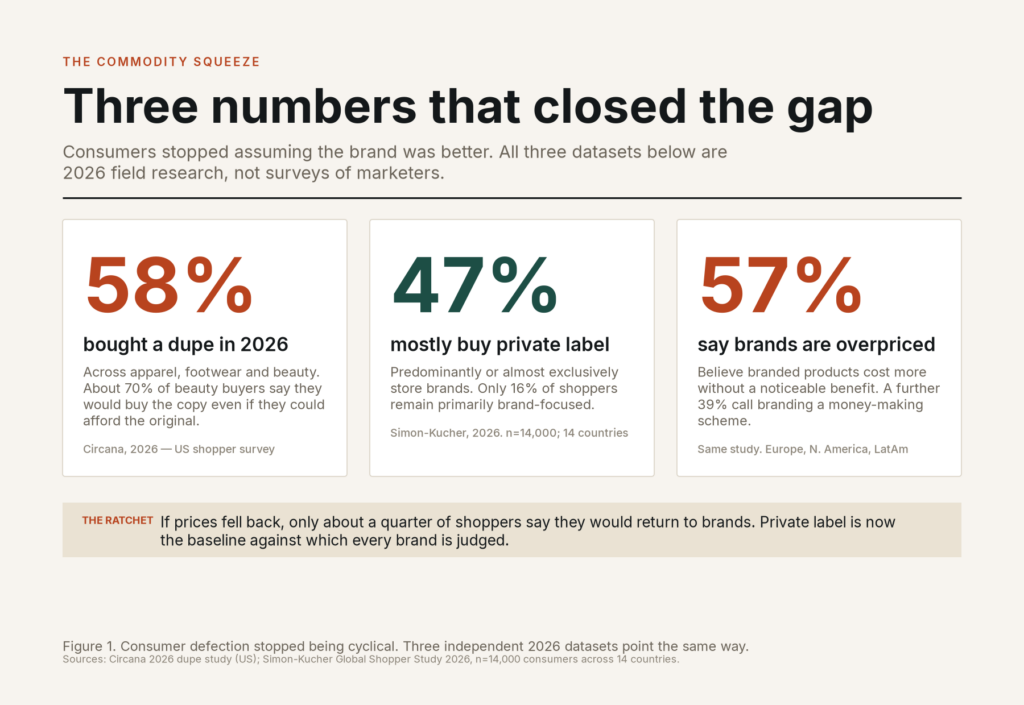
Start with Circana, which tracked dupe purchasing across apparel, footwear and beauty in the United States. Fifty-eight percent of shoppers bought a dupe in 2026. In beauty specifically, fifty-one percent had bought a dupe, and roughly seven in ten said they would buy the copy even if they could comfortably afford the original. Only fourteen percent believed a higher price reliably signals better quality.
Then take Simon-Kucher’s Global Shopper Study, which surveyed 14,000 consumers across 14 countries in Europe, North America and Latin America. Forty-seven percent now buy private label predominantly or almost exclusively. Only sixteen percent remain primarily brand-focused. Fifty-seven percent say branded products are overpriced without offering a noticeable benefit, and thirty-nine percent describe branding itself as a money-making scheme.
Sit with that last number. It is not that consumers think your brand is expensive. It is that a meaningful slice of them think the entire practice of branding is a markup with a story attached.
The part that does not bounce back
The detail that should keep you up at night is buried in the same study. If prices fell back to parity, only about a quarter of shoppers said they would return to brands.
That is the difference between a cycle and a ratchet. A cycle reverses. A ratchet does not.
Simon-Kucher’s own framing is blunter than most agencies would dare put in a deck: private label is no longer the cheap alternative, it is the benchmark against which every branded product is now judged. The burden of proof flipped. You no longer get credit for being a brand. You have to earn it back, purchase by purchase — and you have to earn it before the shopper stops putting you in the basket at all.
The Counter-Evidence You Have to Sit With
Here is where a lazy version of this argument would go wrong, and where most brand-bashing think-pieces quietly cheat.
If dupes were simply replacing brands, premium beauty should be shrinking. It is not. Circana’s first-half 2026 data shows US prestige beauty sales up 7 percent to 17.1 billion dollars, and mass beauty up 7 percent to 39.2 billion. Both channels grew at the same rate. Unit demand was positive on both sides.
What selective splurging actually means
Circana’s Larissa Jensen describes the behaviour precisely: consumers are willing to shop across price tiers, selectively investing in products that deliver the strongest emotional and functional value.
That is not a market abandoning brands. It is a market auditing them — bottle by bottle, category by category, deciding where the premium is earned and where it is a tax. The shopper who buys an 89 yuan dupe of a serum will still pay full price for a fragrance, because the fragrance is doing something the dupe cannot. Same person. Different verdict.
So the premium did not die. The blanket licence to charge it did. That distinction is the whole game, and it is the one most positioning advice gets wrong.
Different without meaningful stalls too
Kantar’s 2026 luxury data adds the second half of the warning. The global top ten luxury brands were worth 321.2 billion dollars, down 8 percent year on year, though still up 88 percent since 2019. Kantar’s diagnosis is pointed: luxury brands are generally perceived as Different, but frequently fail to be Meaningful — and that gap is what caps their growth.
Read that alongside the dupe data and a pattern appears. Difference without meaning is a curiosity. Meaning without difference is a commodity. You need both, and only one of them is easy to fake.
What Commoditization Actually Removed
Most positioning advice treats commoditization as a communications problem — as though the answer is better advertising for the same product.
It is not. Commoditization removed two specific things, and only two. Knowing which two tells you exactly what is left.
The product moat had a delivery date
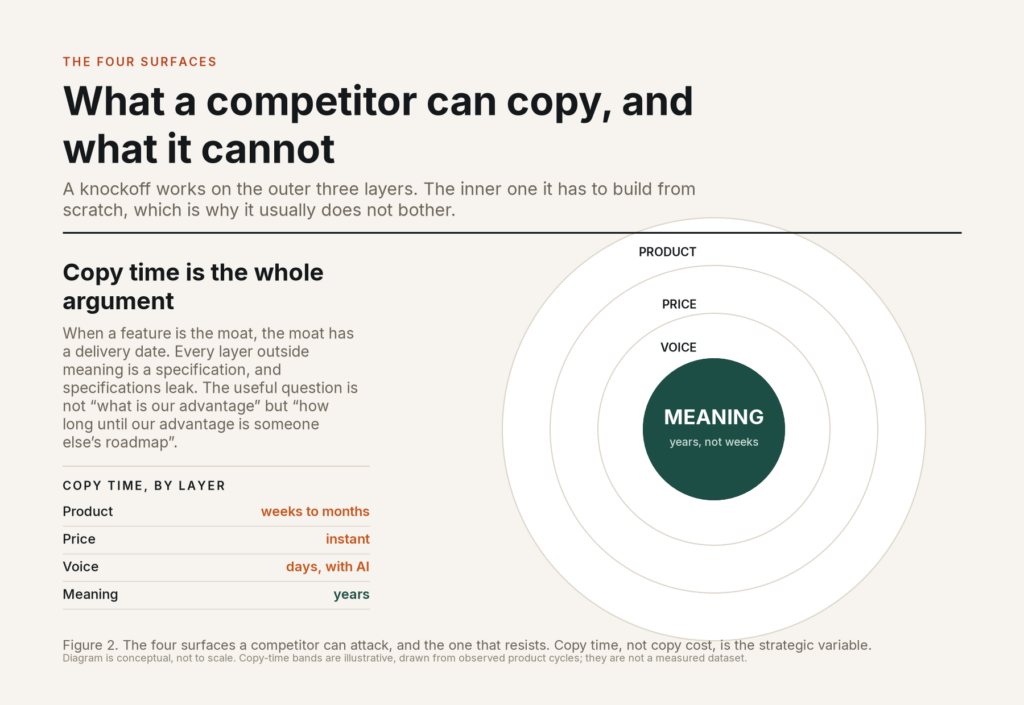
When your advantage is a feature, your advantage has a schedule. A formulation gets reverse-engineered. A design gets duplicated. A spec sheet leaks. In consumer categories the copy window is now measured in weeks to months.
The retail data shows how fast the copying machinery scales. Across five Western European markets — France, Germany, Italy, Spain and the UK — nearly one in two new products now carries a retailer’s own name, up from 42 percent a year earlier, with more than 83,000 new private-label items reaching shelves.
Bain’s August 2026 study reads the same shift as structural rather than cyclical: private label now exceeds 35 percent share in several European markets, while in the United States emerging brands hold under 2 percent of share but capture close to 40 percent of category growth. In Asia-Pacific, local brands account for nearly 80 percent of growth.
Bain also puts numbers on the graveyard. Up to 20 percent of large consumer companies’ revenue comes from brands with no realistic recovery path — their term is zombie brands — and up to another 30 percent from brands that have lost relevance but could still be revived.
The copying is not a threat on the horizon. It is the operating environment.
The price moat was never a moat
Competing on price fails in two ways, one honest and one not.
The honest failure is arithmetic. If your only defensible claim is a lower number, someone with a worse cost base, a thinner margin requirement, or a retailer’s distribution advantage will eventually beat that number. You are not building a position. You are renting one.
The dishonest failure is behavioural, and the IPA Databank contains the canonical case. Britain’s AA cut brand investment close to zero in favour of hard-working activation, used discounts to recruit members, and raised renewal prices to recover margin. Short-term profit looked excellent. Then brand metrics fell into free fall, the whole category began to commoditize, churn climbed, the discounts required to hold members grew every year, and the internal projection was that the business would be gone in five years.
Binet and Field’s analysis of the IPA data puts the trade-off in stark terms: shifting all spend to sales activation costs you more than 50 percent of your campaign effectiveness, and it is much harder to reverse than the equivalent shift toward brand.
Discounting is not a cheaper alternative to brand building. It is a way of consuming it.
Why “Just Differentiate” Is the Worst Advice You Can Give
So the answer is differentiation. Except that word has been flattened into a slogan, and the slogan is actively misleading.
The feature treadmill
If differentiation means a better feature, you have signed up for a race with no finish line. Every improvement gets copied. Every copy forces another improvement. Marketing becomes a treadmill where you run faster to stay in the same place, and the only winner is whoever sells the treadmill.
Feature parity is not a failure of ambition. It is the natural end state of any competitive market. The mistake is treating parity as a temporary condition to escape rather than the floor you now build on.
The uncomfortable finding: most buyers do not think you are different
Here is the part the differentiation gospel skips. In a widely cited Ehrenberg-Bass study — Romaniuk, Sharp and Ehrenberg, 2007, covering the UK and Japan across more than a dozen categories — only about 11 percent of a brand’s own users described it as different, and only about 10 percent called it unique.
Read that carefully. Not 11 percent of the market. Eleven percent of the people who already chose you.
This is why the differentiation debate in marketing is so bad-tempered. One camp points at that number and concludes difference barely exists, so stop chasing it. The other points at brand valuations and concludes it is the whole game.
Both are working from real evidence. Both are wrong to stop there.
The Two Camps Disagree, and Both Are Half Right
What the availability school gets right
Byron Sharp and the Ehrenberg-Bass Institute made the most useful correction in modern marketing: brands grow through mental and physical availability, not through converting a loyal base. Buyers are light, promiscuous and forgetful. Most people are not thinking about you most of the time, and no amount of meaning fixes that. You have to be recallable in the buying situation.
That finding is real, and ignoring it produces beautiful positioning decks for brands nobody remembers.
What the difference school gets right
Kantar’s evidence points somewhere else. Working with Oxford’s Saïd Business School, they analysed financial results from 872 brands between 2006 and 2022 using BrandZ data. Difference emerged as the number one factor in share-price outperformance — accounting for roughly 35 percent of share growth, against about 0.6 percent for salience. Kantar also reports the trend is strengthening: difference is becoming more predictive, salience less.
Kantar’s definition is precise, and it is not visual distinctiveness. Difference is the extent to which a brand is seen to offer something others do not, and to lead its category. Distinctive assets — colours, logos, pack shapes — are the trigger that reminds people of that difference. They are not the difference itself. A bank can own a distinctive blue booth and still be entirely substitutable, which is exactly the cautionary example Kantar’s own strategists use.
The reconciliation: two budgets, two jobs
Put the two findings side by side and the argument dissolves.
Availability decides whether you enter the consideration set. Difference decides what you can charge once you are in it.
They are not rival theories. They are consecutive stages of the same purchase, funded by different budgets. Salience is a media-and-distribution problem. Difference is a product-and-experience problem. A brand that buys only salience ends up famous and interchangeable — the worst possible combination in a market where the shopper has a cheaper substitute in her other hand.
Why Meaning Pays: The Arithmetic
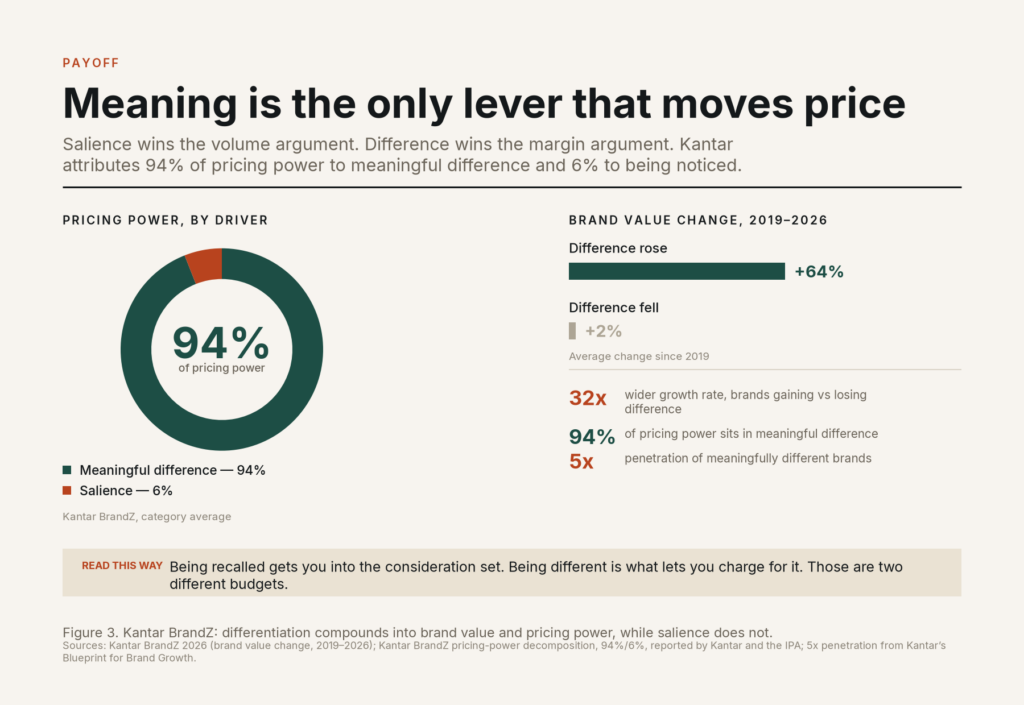
Pricing power: 94 and 6
Kantar’s decomposition of pricing power attributes about 94 percent to meaningful difference — being seen as both relevant and distinct — and about 6 percent to salience alone. Their data also shows brands perceived as meaningful and different commanding around five times the penetration of brands that are neither.
Note the asymmetry. Salience is the bigger driver of volume. Difference is the bigger driver of margin. If you are running a business rather than a reach contest, you need to know which of those your board is actually asking about.
The compounding gap
The clearest evidence is longitudinal. Since 2019, brands whose perceived difference rose have grown brand value by an average of 64 percent. Brands whose perceived difference fell grew 2 percent. That is a 32-fold gap in growth rate — a fair description, provided you say rate and not absolute value.
The commodity bin has an address
In Kantar’s 2026 China Top 100 analysis, more than three-quarters of the country’s most valuable brands sit in the low or middle price tier: 15 percent low, 70 percent middle, 15 percent premium. Among the global Top 100 the split is 6 / 47 / 47.
That middle column is the commodity bin. It is where brands land when they have real product quality, real innovation, and no defensible reason to be paid more for it. The brands are not bad. The positioning is missing.
A Moat Is a Trade-Off, Not a Tagline
If meaning is the last defensible surface, the work is building meaning that survives contact with a cheaper copy. Four rules, in order of difficulty.
Rule one: exclude someone
A meaning that includes everyone is a description, not a position. Quality you can trust is a claim any competitor can make by Friday. For people who fix their own bikes and do not want to be talked down to is a position, because it deliberately excludes the other 95 percent of the market.
The exclusion is not a flourish. It is the mechanism. A commodity is, by definition, for everyone. Anything genuinely for everyone is therefore a commodity. The narrowness is the protection.
Rule two: anchor in something true
You cannot declare your way into meaning. A meaning not rooted in how the product is actually made, how the service actually behaves, or what the company actually refuses to do will collapse the first time a customer checks.
The AA case is instructive in reverse. It did not fail because its advertising was weak. It failed because the experience — discounts to recruits, price hikes at renewal — contradicted any meaning it might have claimed. The experience overwrote the message, and the customer believed the experience.
Rule three: prove it in the experience
Kantar’s own measurement work is an argument against advertising-led positioning. Paid media, they estimate, delivers only about 25 percent of all touchpoint impact on brand building. The other 75 percent comes from product and service experience and word of mouth — roughly half the total from direct experience and word of mouth alone.
This is the practical consequence of everything above. You cannot design your way to a moat. You have to operate one. And Kantar’s framework for what makes an experience meaningfully different is more demanding than most brand guidelines: effectiveness, ease and affinity on the meaningful side; authenticity, uniqueness and inspiration on the difference side. Six elements, and only one of them is a communications task.
Rule four: hold it long enough to compound
Binet and Field’s classic benchmark remains roughly 60 percent of budget to brand building, 40 percent to activation — worth flagging that this is the pre-digital-era optimum, and in more digitized contexts the recommended split shifts closer to parity. The direction has aged better than the ratio.
The mechanism is simple. Meaning is a memory structure, and memory structures are built by repetition. A brand that reinvents its meaning every eighteen months is not repositioning. It is resetting, paying the full cost of building recognition and never collecting the compounding.
The AI Twist: Sameness Now Ships at Zero Marginal Cost
There is a second commoditization happening on top of the first, and it is faster.
Three studies, one direction
A 2024 study by Doshi and Hauser in Science Advances found that writers given generative AI story ideas produced work rated more creative, better written and more enjoyable — but the AI-assisted stories were measurably more similar to each other than stories written unaided. Individual creativity rose; collective novelty narrowed.
A 2025 study by Moon, Green and Kushlev in Computers in Human Behavior: Artificial Humans analysed 2,200 college admissions essays and introduced a diversity growth rate metric. Each additional human-written essay contributed more new ideas than each additional GPT-4 essay, and the gap widened as more essays entered the pool. It persisted even after they tuned prompts and parameters to force variety.
Then the widest evidence. The NeurIPS 2025 best paper in its track, Artificial Hivemind, tested 26,000 real open-ended queries against more than 70 models and found two things at once: intra-model repetition, where one model keeps producing variants of the same answer, and inter-model homogeneity, where different models converge on strikingly similar output. Ask twenty-five models for a metaphor about time and you get roughly two metaphors.
The marketing translation is blunt. Ten years ago, sameness was expensive — it took real effort for every brand in a category to sound identical. Now sameness is the default output of a tool everyone has. The marginal cost of generic has gone to zero.
Which cuts both ways, and this is the part most brands miss. If your content, tone and category language are all AI-reachable, you have not gained efficiency. You have joined the commodity bin at speed.
The discovery layer moved too
The other half of the shift is distributional. More purchase journeys now begin with a model being asked which brand to consider, and a model can only recommend what it can describe: what you do, who it is for, and why it differs. Vague positioning is not just weak in the market now. It is unretrievable.
The AI wave does not repeal the positioning argument. It raises the price of being vague and lowers the price of being copied.
Four Honest Risks
The slogan trap
Most positioning work produces a tagline and a values wheel. Neither is a position. A tagline without behavioural consistency behind it is noise with better typography. If your internal documents and your customer experience disagree, the experience wins.
The meaning-over-substance overcorrection
A compelling meaning laid over a mediocre product is a lie on a timer. Positioning elevates genuine value; it does not substitute for it. The brands in that 70 percent middle tier are usually not there because they forgot to write a manifesto. They are there because the product is genuinely comparable and nobody gave the buyer a reason to pay more.
The commoditization of meaning itself
As every brand pivots to purpose, purpose language commoditizes. We believe in your potential is now available in bulk. Distinctive meaning has to be specific enough that a competitor would have to change their business, not their copy, to claim it.
The patience problem
The meaning moat compounds slowly, and quarterly targets are not slow. Any brand that needs a number this month will drift back to discounts and features — the same race it was trying to leave.
What to Do on Monday
Forget the workshop. Answer five questions with your team in ninety minutes.
One. Name the buyer you are deliberately excluding. If you cannot, you have a description, not a position.
Two. Write the sentence a competitor would have to change their business model to say. If they could say it by Friday with a new deck, it is not a moat.
Three. Find the proof. Which specific thing in your product, service or operating behaviour makes that sentence true? If the answer is a claim rather than a mechanism, you have a problem, not a position.
Four. Audit your last twelve months of output for evidence of that meaning. Not stated, not claimed — evidenced. Most brands discover their communication is about a different brand than the one they think they are.
Five. Check your price architecture against your meaning. If most of your portfolio sits in the middle tier with no justification story, the market has already priced you as a commodity and simply has not finished telling you.
The Short Version
Commoditization did not delete the need for positioning. It deleted every version of positioning that leaned on the product or the price, and left one surface standing: the meaning a brand owns in the customer’s mind, proven in the experience, narrow enough to exclude, and held long enough to compound.
The arithmetic is no longer arguable. Difference moves price; salience moves volume. Brands whose differentiation grew compounded 64 percent in value since 2019; brands whose differentiation decayed grew 2 percent. Fifty-eight percent of shoppers bought a dupe in 2026, and only about a quarter of defectors say they would return if prices levelled.
And the counter-evidence is the most useful part. Prestige beauty still grew 7 percent in the same period, because consumers are not rejecting brands — they are auditing them. The brands that pass the audit charge what they like. The ones that fail get compared, bottle by bottle, to something that costs 89.
You cannot out-feature a copy that arrives in six weeks. You can build something a copy cannot arrive at, because it was never on the spec sheet.