Topic Clusters Were Built for Google. Here’s the AI-Search Version.
Topic clusters were built for Google. The pillar-and-cluster model — one comprehensive page with a ring of sub-topics linking up to it — was a machine for winning a ranked list. Google ranked pages in a list, so you optimized the page. That era is quietly over. AI search does not rank pages; it synthesizes an answer from extracted, quotable content. Topic clusters 2.0 is the upgrade: instead of pillar pages plus supporting links, you build answer graphs — dense networks of self-contained, quotable answer nodes the AI can lift out and stitch into a coherent answer. The goal shifts from “rank the pillar” to “be the extractable source the AI quotes.” Same domain expertise, different architecture.
Section 1 — Topic Clusters 1.0: What It Was (And Its Google-Era Logic)
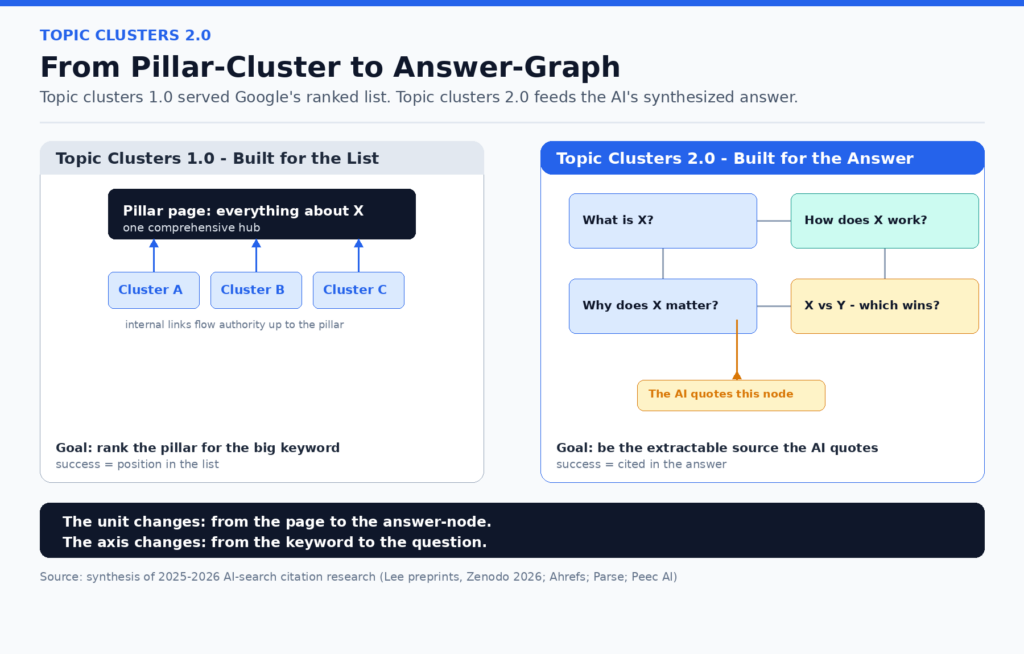
The classic topic cluster was simple: a pillar page (“everything about X”), cluster pages on the sub-topics, and internal links flowing authority up from the clusters to the pillar. The architecture existed to serve one mechanism — Google ranked pages in a list, and internal links shaped page-level authority. The cluster fed the pillar; the pillar captured the big keyword. It worked, and for a decade it was the smartest content move a brand could make.
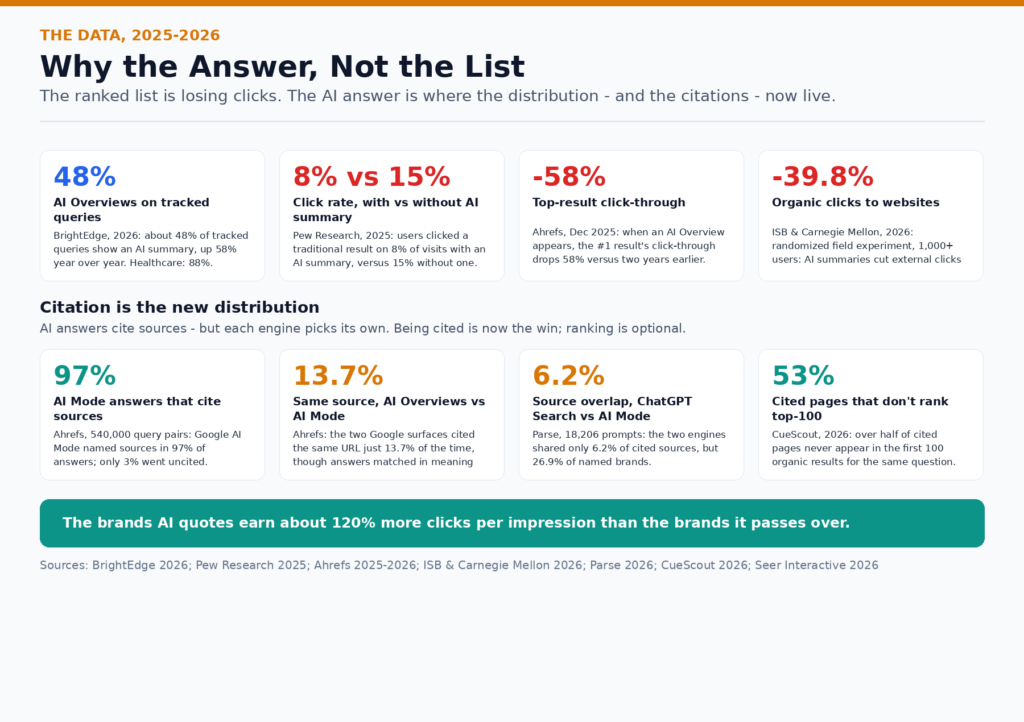
The numbers that made it work are now inverting. Pew Research found that when an AI summary appears, users click a traditional search result on 8% of visits, versus 15% without one — and only about 1% of visits end in a click on a link inside the summary itself. Ahrefs measured the top-ranked result losing 58% of its click-through when an AI Overview appears above it. A randomized field experiment from the Indian School of Business and Carnegie Mellon, covering more than 1,000 users, found AI summaries cut organic clicks to external websites by roughly 40% — with no measurable drop in user satisfaction when the summaries were removed.
The scale keeps growing. BrightEdge found AI Overviews now appear on about 48% of the commercial queries it tracks, up 58% year over year, with healthcare queries at 88%. None of this means search traffic is dead — it means the mechanism changed. Fewer and fewer users consume a ranked list. The list is still there; it is just no longer where the decision happens. An architecture built to win a list is now an architecture for the wrong game.
Section 2 — Topic Clusters 2.0: The Answer-Graph Upgrade
Here is the honest framing: the AI does not rank pages, it extracts from them. When you ask a model a question, it pulls candidate passages from a pool of sources, then stitches them into one synthesized answer with citations. That changes the fundamental unit of content architecture — from the page to the node.
Four principles define the 2.0 architecture.
Answer nodes, not pillar pages. Instead of one comprehensive hub, build a dense network of self-contained, quotable nodes — each one a complete, extractable answer to a specific question. The AI can lift any single node into its answer without needing the rest of the site.
Every node is self-sufficient. In 1.0, clusters depended on the pillar for context and authority. In 2.0, each node must stand alone as a complete answer, because the AI cites a node, not a hierarchy. The graph is what the model traverses; the ladder is not.
Interconnection by semantics, not just links. Nodes are linked by topic, intent, and question-relationship, so the model can find and stitch related answers together. Coherence across the graph is what makes a good answer possible in the first place.
Answer-everywhere coverage. The 2.0 architecture covers the full question space of a topic — every what, how, why, and compare. Whatever the AI asks, your node is the quotable source. Comprehensive coverage replaces pillar concentration.
The data backs the node logic. In a 2026 study of more than 100,000 AI citation events across ChatGPT, Perplexity, Claude, and Google AI Mode, pages ranked in Google’s top three were about 7.8 times more likely to be cited than pages ranked 11–30, while pages ranked 31–100 were about four times less likely. Yet here is the twist: most cited pages, in aggregate, sit outside the top 30, because the internet beyond rank 30 simply has vastly more pages. The same research shows AI visibility is winner-take-most — a tiny fraction of pages earns the bulk of citations. Peec AI found that on Perplexity, 64% of URLs never got cited at all, and the top 6% captured nearly half of all citations. That is exactly why being a clean, extractable answer node matters more than being a broad pillar.
Section 3 — The Goal Shift: From “Rank” to “Be the Extracted Source”
The success metric changes with the architecture. Topic clusters 1.0 measured pillar rank; 2.0 measures citation-and-inclusion — whether your content is actually quoted in the answer.
Three things make this more than a semantic shift.
First, citations are the new distribution. Google AI Mode cites sources in 97% of its answers, and ChatGPT Search averages roughly four sources per answer. Being cited pays: Seer Interactive’s analysis of 5.47 million queries found cited brands earn about 120% more clicks per impression than uncited brands, and Semrush finds AI referral traffic converts at roughly three times the rate of other channels. A smaller audience — but a far better one.
Second, ranking is optional, but not useless. CueScout found that 53% of pages cited by AI for a buying question do not appear in the first 100 organic results for that same question (measured against Brave’s index). At the same time, the Lee preprints (Zenodo/SSRN, 2026) show Google rank still dominates citation odds — position one gets cited about 54% of the time, position 100 about 2%. The picture is layered: rank is a strong predictor but not a gate. Content can get cited without ranking; and rank without extractable, quotable content earns nothing.
Third, engines disagree, so coverage is the strategy. Ahrefs compared 540,000 query pairs and found AI Overviews and AI Mode cited the same URL just 13.7% of the time, even though their answers matched in meaning 86% of the time. Parse found ChatGPT Search and Google AI Mode shared only 6.2% of cited sources across 18,206 identical prompts. One answer node per question will not cover the map — you need a graph, because each engine builds its answer from a different neighborhood of the web.
One honest caveat: citation is not the same as recommendation. Leoprd’s 2026 analysis of 31,200 AI answers found brands chosen as the AI’s first pick were selected only 29% of the time — and brands passed over actually averaged slightly more citations (9.2 vs 8.4) than the winners. The extractable answer gets you into the response; the substance of what you say decides whether the AI recommends you. Architecture earns the citation; substance earns the sale.
Section 4 — The Content-Architecture Playbook (2.0)
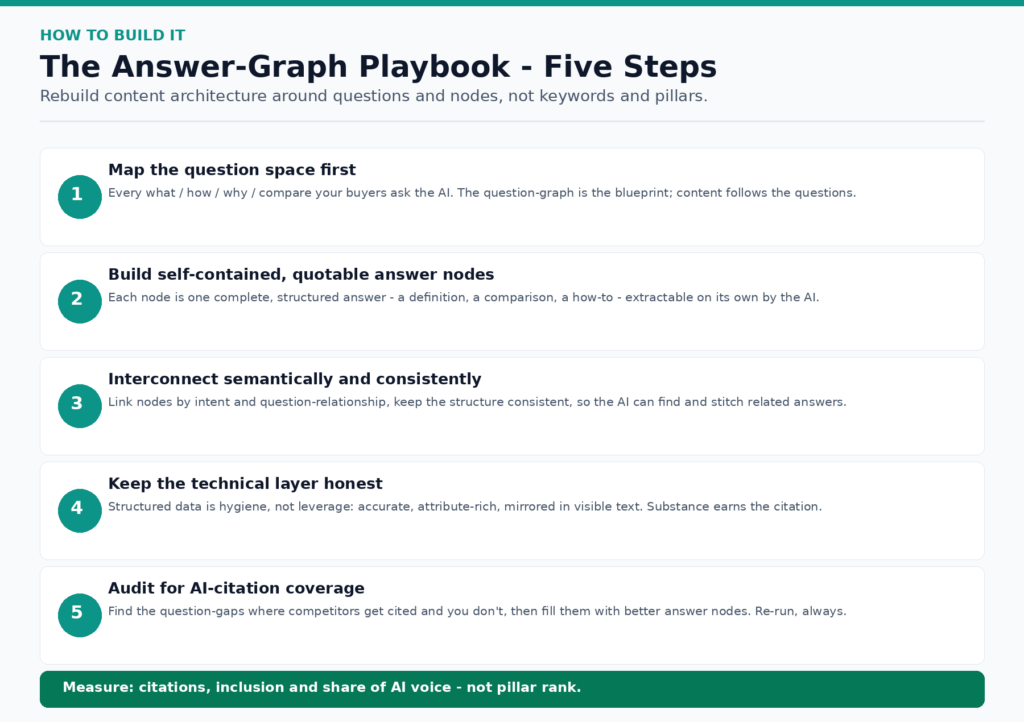
Step 1 — Map the question space first. Before writing anything, map every question the AI will get asked in your topic: informational, comparison, transactional. In Leoprd’s analysis of more than 420,000 real prompts, 44% asked for research or advice and 23% asked for direct comparisons or recommendations. Your question-graph is the blueprint; content follows the questions, not the other way around.
Step 2 — Build self-contained, quotable answer nodes. Each node is one complete, structured answer: a definition, a comparison, a how-to. It must be extractable on its own. Agents do targeted reads — in Peec AI’s Deep Research sessions, a successful in-page find triggered a targeted re-read of the page 95% of the time, and pages with heavy navigation (60+ links) delivered only about a third of their content in an agent’s first read, versus 78% for light-navigation pages. Clean structure is the interface the AI actually uses.
Step 3 — Interconnect semantically and consistently. Cross-reference nodes by relationship — “this connects to the comparison node,” “see the pricing node” — and keep the internal structure consistent across the graph. Consistency is what lets a model recognize your pages as one coherent source set rather than scattered fragments.
Step 4 — Keep the technical layer honest. This is where 2.0 departs from most GEO advice. The controlled evidence says structured data does not move citations. Ahrefs tracked 1,885 pages that added JSON-LD and found no meaningful citation lift (AI Mode +2.4%, ChatGPT +2.2%, AI Overviews −4.6%). An independent 2026 study found the same null result, with one exception: pages carrying attribute-rich Product and Review markup — real prices, ratings, and specifications — were cited more often, especially on lower-authority domains. Live-fetch tests show the engines read visible HTML, not JSON-LD, when they pull a page. Google deprecated FAQ rich results in May 2026, and its own guide says structured data is not required for generative AI search. So keep schema accurate and attribute-rich, mirror every fact in visible text, and do not treat markup as a citation lever. It is hygiene, not leverage.
Step 5 — Audit for AI-citation coverage. Run the footprint audit: for the questions in your map, who gets cited and who does not? Where competitors are cited and you are absent, that is a gap — fill it with a better answer node, then re-run. The audit is the maintenance loop of the whole architecture.
Section 5 — Risks & Honest Caveats
The over-fragmentation risk. The fastest way to build an answer graph badly is to build thin nodes — each one too narrow to be useful. That reproduces the content-shock problem with a new name. A node must be complete enough to be the answer, not just a fragment of one. Depth per node still matters.
The “architecture replaces substance” fallacy. The graph structures content; it does not make it true. Trakkr Research traced 1,285 AI citation trails and found only 40% of AI-cited statistics actually trace back to a study supporting the claim — more than half of first-citation pages were company blogs repeating numbers secondhand. A well-architected lie is still a lie, and the AI will cite it, then get exposed. Architecture enables citation; substance earns trust.
The keyword-to-intent carryover trap. Teams carry over the 1.0 mindset and build nodes around keywords instead of questions. That is the old architecture with a new label. The shift to intent is the real upgrade — not the vocabulary.
The maintenance burden. An answer graph is more nodes, more interconnections, more upkeep. A stale graph is a stale answer source. If you cannot maintain the graph, you are better off with fewer, deeper nodes than many shallow ones.
Section 6 — Trends & Forward Look
The AI-native content graph. The answer graph is increasingly generated and maintained by AI itself — filling gaps, updating nodes, re-linking as the question space shifts. Content architecture becomes a living system instead of a static sitemap.
The answer-graph-to-agent convergence. The graph increasingly feeds AI agents and assistants directly — it becomes the knowledge base an agent draws from. Content architecture and agent orchestration are becoming the same discipline, and they are merging fast.
Citation-as-the-new-ranking matures. As citation metrics mature, the value of a well-built answer graph compounds: every new platform, every new agent surface, re-reads the same nodes. That compounding is the moat the keyword-era pillar never fully built. The brands that re-architect their content as quotable answer graphs will be the extracted source the AI quotes; the brands that keep the pillar-cluster will keep ranking in a list that fewer and fewer users ever look at.
Conclusion
Topic clusters 1.0 served Google’s list; topic clusters 2.0 serves the AI’s answer. The upgrade replaces the pillar-page hierarchy with an answer graph of self-contained, quotable, semantically interconnected nodes — each one extractable into the AI’s synthesis. The measure shifts from “rank the pillar” to “be the extracted source the AI quotes.” Brands that re-architect content around questions, not keywords, and nodes, not pillars, become the citation the AI stitches into its answer. Brands that cling to the pillar-cluster keep optimizing for a ranked list the AI era is quietly retiring.