The Store That Isn’t a Store: How WeChat Mini Programs Replaced the App
Picture a noodle shop in Chengdu. There is no menu on the wall worth reading, no queue at a register, and no app to install. There is a square of black-and-white pixels taped to the table. You scan it, a menu opens inside the chat app you already had open, you pay with the wallet that is already linked to your bank card, and a receipt lands in your message list. Total elapsed time: about forty seconds. Nothing was downloaded. Nothing will need an update next Tuesday.
Now picture the Western version of the same moment. A QR code on a poster sends you to a landing page, which pitches you an app, which asks for an account, a password, an email verification, and permission to send notifications. Somewhere between the poster and the first purchase, most of the audience disappears.
That gap is not a UX preference. It is the whole argument. In China, the default digital storefront is not an app at all. It is a Mini Program — a small application that lives inside WeChat, opens instantly, and inherits the payment, identity, and social plumbing that a standalone app has to build from scratch. Marketers who treat it as “a smaller app” miss the point. It is a different architecture, with a different funnel, a different cost structure, and a different set of risks.
What a Mini Program actually is
A Mini Program ( literally “small program”) is a lightweight application built with web technologies that runs inside Weixin, Tencent’s messaging platform. It has no home-screen icon, no app-store listing, and no installation step. Users arrive by scanning a QR code, tapping a shared card in a chat, searching inside WeChat, or opening it from an Official Account menu. It launches in about a second.
Tencent introduced the format in January 2017 with a principle that still shapes everything built on top of it: use it and leave. Mini Programs were designed to solve a task and get out of the way — not to hoard attention. That design choice explains both their reach and their limits, which we will get to.
Why “app-less app store” is the right frame
Because the ecosystem behaves like a store without a storefront. There is discovery (search, categories, nearby listings, recommendations), distribution (shares, QR codes, ads), transactions (Weixin Pay), and inventory (millions of programs across retail, food, travel, government services, healthcare, and games). What is missing is the part Western marketers instinctively budget for: the download.
No install ad. No app-store optimization campaign. No 30-day retention curve to defend in a board deck. The store exists inside a chat window, and the customer is already there.
The scale nobody outside China quotes
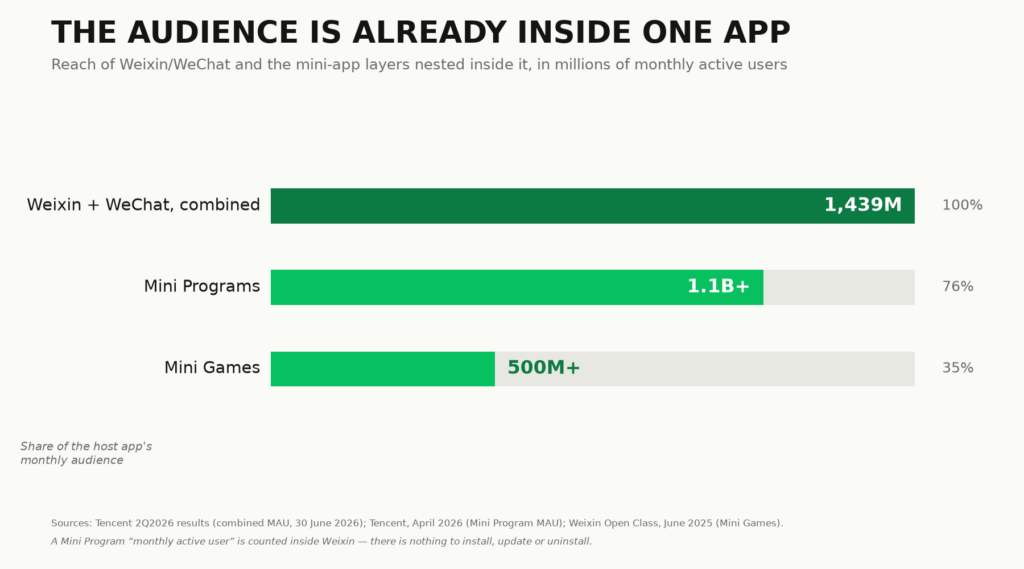
Tencent’s second-quarter 2026 filing puts combined monthly active users of Weixin and WeChat at 1.439 billion, up 2 percent year on year. That is the host app. Inside it, Tencent reported in April 2026 that Mini Programs serve over 1.1 billion monthly active users. Third-party measurement firm QuestMobile counted 946 million monthly Mini Program users in May 2025 — a lower number, partly because of methodology, but the direction is unambiguous.
Then there is the layer most people forget: Mini Games. More than 500 million monthly users, 70 titles above one million daily actives, and 300 titles each generating over RMB 10 million in a single quarter. Four hundred thousand developers, most of them teams of fewer than 30 people.
Depth matters more than the headline. In December 2025, QuestMobile identified 68 lifestyle-services Mini Programs with more than 10 million monthly users each — 14 more than the year before. Read that again: dozens of individual mini-apps inside one chat app, each with an audience the size of a mid-sized country’s app market.
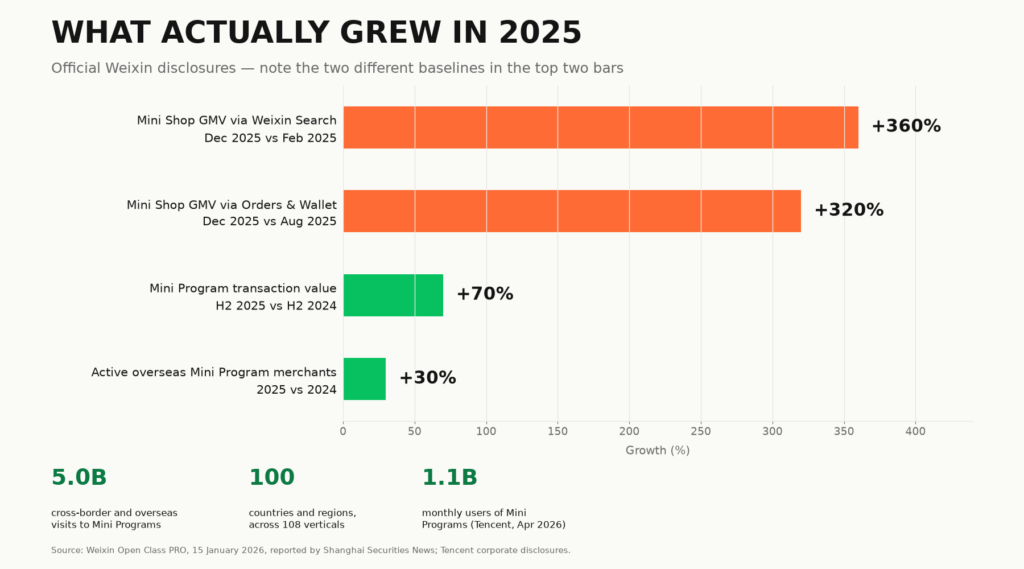
And it is no longer a China-only story. In 2025, cross-border and overseas users opened Mini Programs more than 5 billion times, across 100 countries and regions and 108 industry verticals. Halfway through the year, transaction value completed through Mini Programs was growing more than 70 percent year on year. Active overseas Mini Program merchants rose over 30 percent.
Why the download died: the friction math
Western app marketing has spent a decade optimizing a funnel that leaks at the front door. AppsFlyer’s 2025 benchmarks tell the story plainly: average Day 1 retention is 23.9 percent on iOS and 20.3 percent on Android. By Day 7 it is 8.3 and 5.6 percent. By Day 30, 3.7 and 2.1 percent. Cross-industry averages from OneSignal are kinder but still bleak: roughly 28 percent return the next day, and under 8 percent are left at Day 30. On Android, 46.1 percent of installed apps are deleted within 30 days.
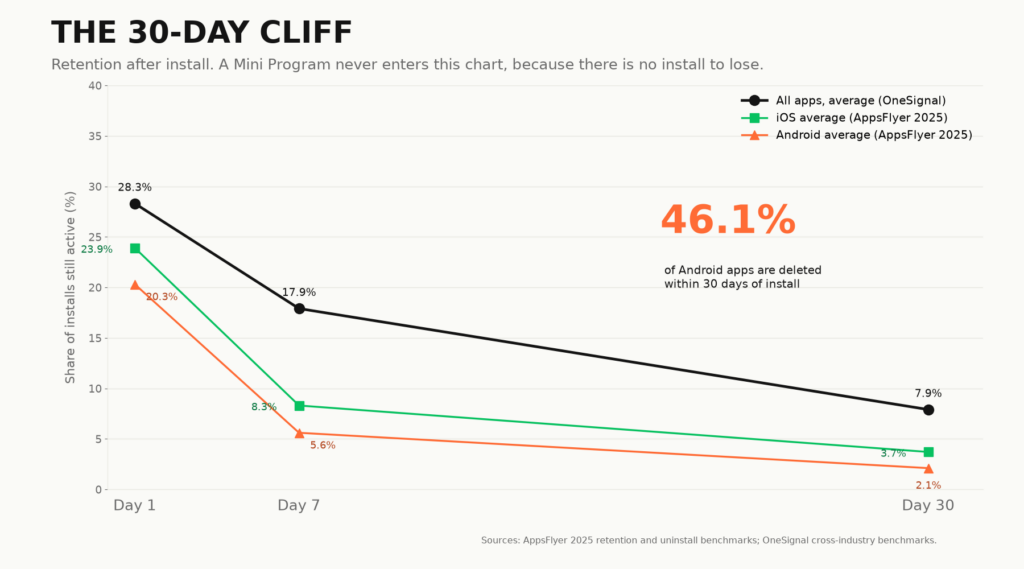
Those numbers are not a product failure. They are the cost of asking for permission. A download is a commitment requested before any value has been delivered, and modern audiences have become extremely good at declining.
A Mini Program inverts the sequence. Value arrives first; commitment, if it ever comes, arrives later — as a membership registration, a saved address, a followed Official Account, a service notification the user opted into. The first transaction can happen before the second thought.
Here is the honest counterpoint, though: zero install also means zero home-screen presence. Nothing reminds the user to come back. Mini Programs are structurally weak at retention unless you build return paths deliberately — subscription messages, membership tiers, coupon wallets, WeCom follow-ups. Frictionless entry is not a retention strategy. It is a starting line.
The four rails a standalone app has to build
Strip away the branding and every commerce app needs four pieces of infrastructure. In the West, each one is a project.
Identity. Account creation, password resets, verification, privacy consent. In a Mini Program, WeChat login is one tap, and the platform already knows the user is a real, phone-verified person.
Payment. Card tokenization, fraud checks, chargebacks, wallet integrations. In a Mini Program, Weixin Pay is the default, and it is already bound to a bank card the user has used a hundred times.
Social distribution. Referral mechanics, share cards, group invites — usually bolted on afterwards. Inside WeChat, sharing is not a feature; it is the substrate. A Mini Program card can be forwarded into a group chat as easily as a photo.
Discovery. Paid installs, app-store optimization, search ads. Inside WeChat, discovery comes from search, QR codes, nearby listings, Official Account menus, Channels content, and shares.
A standalone app builds all four and pays for each. A Mini Program inherits them. That is the structural advantage, and no amount of creative testing closes it.
The private-domain bridge
There is a Chinese marketing concept that has no clean English equivalent:“private domain” — an audience you can reach repeatedly without paying a platform each time. Most Western brands approximate it with email lists and loyalty programs. In China, it is a physical-ish place: group chats, WeCom contacts, Official Account followers, membership records.
Mini Programs sit at the hinge of that system. Public traffic — a Channels video, a Moments ad, a shared article — flows into the Mini Program, where the transaction happens. The transaction creates a relationship, which moves into WeCom or a membership tier, which produces the next visit. Public attention in; owned relationship out.
That is the strategically interesting part. The Mini Program is an owned surface inside a rented ecosystem. You control the catalog, the pricing, the service flow, and the customer record. You do not control the landlord’s rules.
The playbook, part one: the storefront that lives in the chat
There are two ways to sell inside WeChat, and they are not interchangeable.
A Mini Shop is Tencent’s native storefront: listings, checkout, order management, and increasingly social mechanics like gifting and group buying, with near-zero setup for qualifying merchants. A custom Mini Program is your own build: bespoke catalog logic, booking flows, loyalty engines, content, tools, and integrations with your own systems.
Most serious brands run both, plus an Official Account for content and WeCom for one-to-one follow-up. The combination is the actual “digital flagship.”
The commerce data coming out of Weixin’s January 2026 Open Class shows how fast the native layer is compounding. Between August and December 2025, visits to the “Orders and Wallet” surface that hosts Mini Shops rose 132 percent, and transaction value rose 320 percent. In the search scenario alone, transaction value in December 2025 was 360 percent higher than in February 2025.
The three-tap rule
Inside a chat app, attention is borrowed, not owned. Every extra step is a chance to lose the session to a message from a friend. The practical rule Chinese teams follow: browse, pay, done — three taps, no external redirects, no account forms, no “check your email to continue.” Address books, coupons, invoices, and order tracking all live inside the same container. If a step can be removed, it is removed.
The playbook, part two: the QR is the ad
Western marketers treat the QR code as a bridge between offline media and a web page. Chinese marketers treat it as the store itself.
A QR code on a table, a receipt, a package, a taxi headrest, or an event badge opens a Mini Program in one second, with the payment method already attached. Foot traffic becomes an in-WeChat relationship rather than an anonymous visit. This is why the physical world in China is wired for scanning: the code is not a link to a website; it is a door into a transaction.
Cross-border is where this gets interesting for global brands. Malaysia’s national payments network integrated DuitNow QR with Weixin Pay, putting more than three million QR touchpoints within reach of Chinese visitors. Around Chinese New Year 2026, Mini Program transaction value in Malaysia grew over 140 percent year on year. AirAsia sells flights inside WeChat; the airport express train sells tickets there; hotels take commission-free direct bookings through their own Mini Programs.
The playbook, part three: membership, not downloads
If you cannot rely on a home-screen icon, you have to manufacture reasons to return. The Chinese answer is membership, and it is unusually concrete: tiers, points, stored-value cards, subscription passes, birthday coupons, and — critically — service notifications that arrive inside the chat thread rather than in a notification tray the user has muted.
Nike’s All-Star Weekend activation is the classic illustration. Instead of buying media to push product, Nike built the viewing experience inside its Mini Program: live stream, chat rooms, limited-edition drops, purchase without leaving the session. Traffic to the Mini Program rose 206 percent, revenue rose 165 percent, and membership rose 240 percent during the campaign window.
More recent signals come from QuestMobile’s December 2025 data. Xtep’s Mini Program matrix reached 2.17 million monthly users, up 134.8 percent year on year; Li Ning’s reached 1.81 million, up 190.3 percent. These are not apps competing with apps. They are brand-owned surfaces growing inside a chat app, against categories where standalone app downloads have been flat for years.
The playbook, part four: the sharing loop
The most under-priced channel in the ecosystem is the group chat. A Mini Program card forwarded into a family group or a hobby group carries social proof that no ad unit can buy. Add gifting mechanics — send a friend a coffee, a coupon, a course — and the transaction becomes a social act rather than a marketing ask.
WeChat has spent the last two years industrializing this. Video Accounts’ total time spent grew more than 20 percent year on year in the second quarter of 2026. Tencent’s marketing services revenue rose 22 percent, helped by “closed-loop” capabilities that let Mini Games and Mini Shops advertise on Tencent properties and complete the purchase inside WeChat. The ad and the checkout are no longer separate systems.
Case evidence: what actually moved
The cleanest global example is Uber. Its Mini Program launched in July 2025 in Hong Kong and Japan, and by January 2026 it operated in 20 countries and more than 1,000 cities. Riders hail a car in Chinese, message the driver with in-app translation, and pay through Weixin Pay without binding a foreign card. Roughly 90 percent of Uber’s Mini Program users were entirely new to Uber — a distribution channel disguised as a convenience feature.
That is the pattern worth stealing: the Mini Program is not a loyalty app for people who already love you. It is an acquisition surface for people who already live inside WeChat and have never had a reason to try you.
The re-map for global brands
The mistake global brands make is replication. They take a Western stack — brand.com, iOS app, email CRM, Meta ads — and rebuild each piece in China, one product team at a time. The result is expensive and structurally wrong.
The better move is a re-map: keep the function, swap the form.
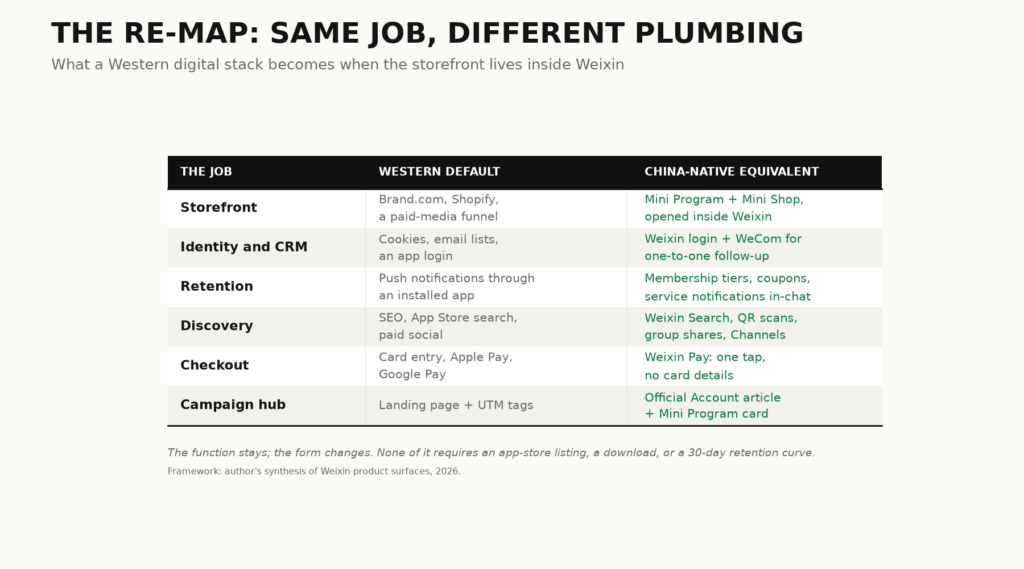
Your website does not disappear. It still serves global markets, search engines, and AI answer engines. But in China, the storefront is a Mini Program, the content hub is an Official Account, the CRM is WeCom, the discovery engine is WeChat Search plus QR plus shares, and the wallet is Weixin Pay.
What to stop doing
Stop budgeting for install campaigns in a market where the install is optional. Stop measuring success by app-store rankings. Stop treating “download our app” as the call to action on a Chinese landing page — it reads like a request to leave the place where the purchase could have already happened.
The honest risks
You are renting the rails
A Mini Program is owned space inside someone else’s building. WeChat sets the review rules, the category restrictions, the API surface, the ad formats, and the data boundaries. It can change them. Programs get rejected, features get deprecated, and external links are tightly controlled. Build for portability: keep your catalog, customer records, and content in systems you control, and treat WeChat as a distribution layer rather than a database.
The 15 percent toll
For years, Mini Programs sat in a regulatory gray zone on iOS: digital goods sold inside a mini-app could bypass Apple’s commission. That ended in November 2025, when Apple launched its Mini Apps Partner Program, cutting the commission on qualifying mini-app in-app purchases to 15 percent from the standard 30 percent, with WeChat moving to support virtual payments on iOS.
Read that carefully. It is a discount, not an exemption. The app-less store still pays the app-store owner — just less. Any unit economics model that assumed zero platform tax on iOS needs to be rebuilt.
Discoverability outside WeChat
Mini Programs are not indexed like websites, and they do not benefit from app-store browsing. Discovery happens inside WeChat — search, QR, shares, menus, ads. If nobody scans, searches, or shares, the storefront is a beautifully built room with the lights off. Traffic generation is a marketing budget line, not a platform guarantee.
Compliance is a build step, not paperwork
Selling inside WeChat means mainland filing requirements, ICP registration for the domains you call, mini-program filing with the telecom authority, personal-information rules under PIPL, and category licenses for verticals such as games, healthcare, and finance. Foreign brands typically need a mainland entity or a vetted local partner. Teams that treat this as an afterthought ship late.
It is not universal
Mini Programs are excellent for commerce, booking, membership, content, service, and casual games. They are a poor fit for heavy computation, offline-first tools, privacy-sensitive products, and audiences that live entirely outside China. The format is a default, not a universal.
Where this goes next: the agent in the chat
In its second-quarter 2026 results, Tencent confirmed a small-scale prototype of Xiaowei, an agentic AI inside Weixin, powered by a custom model built for privacy and Weixin-specific use cases. Earlier, Tencent had already deployed AI-driven recommendation across Video Accounts and Mini Programs, and AI-powered campaign automation for advertisers.
Put those two facts together and the next chapter writes itself. If an assistant can understand intent, hold a conversation, and execute a task inside WeChat, then a Mini Program becomes a tool the agent calls. “Book a table for four at 7pm near Jing’an” stops being a search query and becomes a transaction the agent completes.
That changes what “marketing-ready” means. Your product feed, price logic, inventory accuracy, service policies, and booking rules have to be machine-readable, not just human-readable. The structured catalog becomes the new landing page. The merchant who answers the agent clearly wins the booking; the one whose opening hours live in a JPEG does not.
Cross-border is the second vector. Tencent has been lowering entry barriers for overseas merchants — multilingual support, simplified qualification, compliance guidance — and the Uber case shows the playbook: one Mini Program, many countries, one payment method the traveler already trusts.
Conclusion: build where the user already is
The app was never the point. It was a habit formed in a specific decade, on specific devices, under specific network constraints. China skipped ahead and built the storefront inside the place where people already spend their attention — and then wired the physical world to it with QR codes.
Mini Programs won because they removed the one step Western marketing never questioned: the download. They inherited identity, payment, social distribution, and discovery from the host app. They became the hinge between public attention and owned relationship. And they now carry a billion monthly users, a hundred countries of cross-border traffic, and an AI agent being trained to use them.
The lesson for global brands is not “copy the format.” It is “re-map the stack.” Keep your website for the world that still searches. Build the storefront where the transaction can actually happen. And stop asking for a download from people who never needed one.