The Voucher Was the Door: How China Merged the Store and the Feed
The bill lands at 8:40 on a Saturday night and nobody at the table looks at it. Someone lifts a phone, scans the QR code taped to the napkin holder, and a voucher bought at midnight three days ago gets eaten by the same little screen. The server nods. The kitchen never sees the coupon. The system sees a redemption.
That gesture is the whole story. Everything below is a consequence of it.
For roughly a decade, local-life marketing in China lived inside a split. On one side sat the feed: the short video, the note, the deal of the day, the discounted package. On the other side sat the store: the smell of the fryer, the queue at seven, the manager who knows which table always orders the second bottle. Two worlds, two teams, two budgets, and two sets of numbers that never introduced themselves to each other.
The decade we spent measuring half a business
Two teams, two budgets, one customer
If you ran a restaurant in 2019, your plan had an “online marketing” line and a “store operations” line. The first bought exposure: a listing, a banner, a discount package. The second bought rent, wages, and gas. Different people managed them, they rarely shared a spreadsheet, and if you asked either one what the marketing spend returned, the honest answer was a shrug with a foot-traffic estimate stapled to it.
That wasn’t stupidity. It was architecture. The available tools measured everything that happened before the door: impressions, clicks, coupon downloads. Past the door, the lights went out. Did the coupon customer order the set menu or the à la carte? Did they come back in six weeks? Did they bring three friends? Nobody knew, so nobody counted.
The black box at the door
The industry had a phrase for it: the offline conversion gap. In practice it meant the single most valuable moment in the whole funnel, a person physically inside your business with a wallet open, generated no data whatsoever. You could buy a customer and never learn whether you had actually bought one.
Scale that across a market and you get the shape the numbers describe. iResearch puts China’s local-life services market at roughly RMB 35.3 trillion for 2025, with online penetration climbing from 12.7% in 2021 to 30.8%. The striking part isn’t the penetration rate. It’s that penetration stopped being a story about advertising and became a story about settlement.
What the merge actually looks like
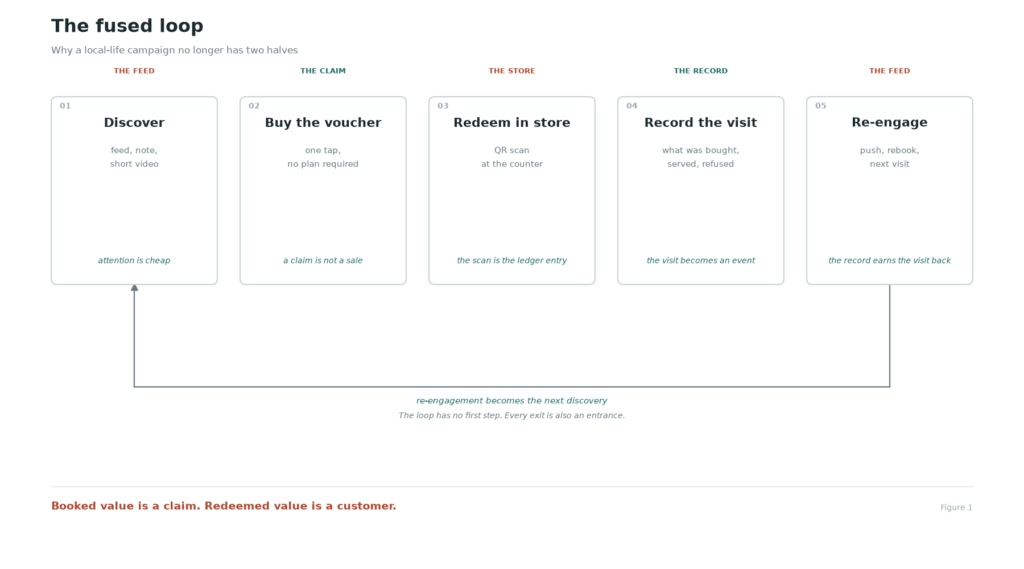
Strip out the platform rivalries and the merge is a five-step loop. Every step was technically possible before 2023. What changed is that they now run inside one continuous system with one identity attached.
Step one: discovery becomes a transaction
A video, a note, a ranked list. You don’t bookmark it, you buy it. This is the part everyone already understands, and it’s the part that flatters content platforms, because the distance between “that looks good” and “I own a claim on it” collapsed into one thumb.
Step two: the voucher has to survive the walk
Here is where the merge lives or dies. A voucher isn’t a sale. It’s a promise with an expiry date, and the walk from the sofa to the store is where most promises quietly die. That is why the redemption rate is simultaneously the most important number in this category and the number least quoted in marketing decks.
Step three: the visit writes itself down
The scan at the counter does two jobs at once. It settles the bill, and it files a record: who came, when, what was redeemed, what got added at the table, what got refused. The offline visit becomes an event in a database instead of a memory in a manager’s head.
Step four: the record earns the next visit
Now the loop has something to work with. The same system can push a membership tier, a rebooking nudge, a quiet weekday offer, or a review request timed to the taxi ride home. The person who walked in is no longer a stranger holding a receipt.
Step five: a loop, not a funnel
Notice what’s missing: a beginning. The re-engagement message is itself a discovery surface. The review the customer leaves becomes discovery for the next customer. Funnels end. Loops compound. That difference is the entire strategic argument, and it took one accounting change to unlock.
The redemption rate is the whole story
Two demand modes, two conversion curves
In June 2026, Nomura’s China internet team ran an expert call on Douyin’s local-services business, and the numbers that came out of it explained this industry better than most strategy writing published that year. Douyin booked about RMB 551 billion of pre-refund transaction value in the first half of 2026, up 44% year on year. Meituan’s in-store business did roughly RMB 629 billion over the same period, up 11%. On paper, the challenger had caught up.
Then came the qualifier. Douyin’s redemption rate sat at 57–58%. Meituan’s was above 80%.
Run the arithmetic and the two businesses stop looking alike.
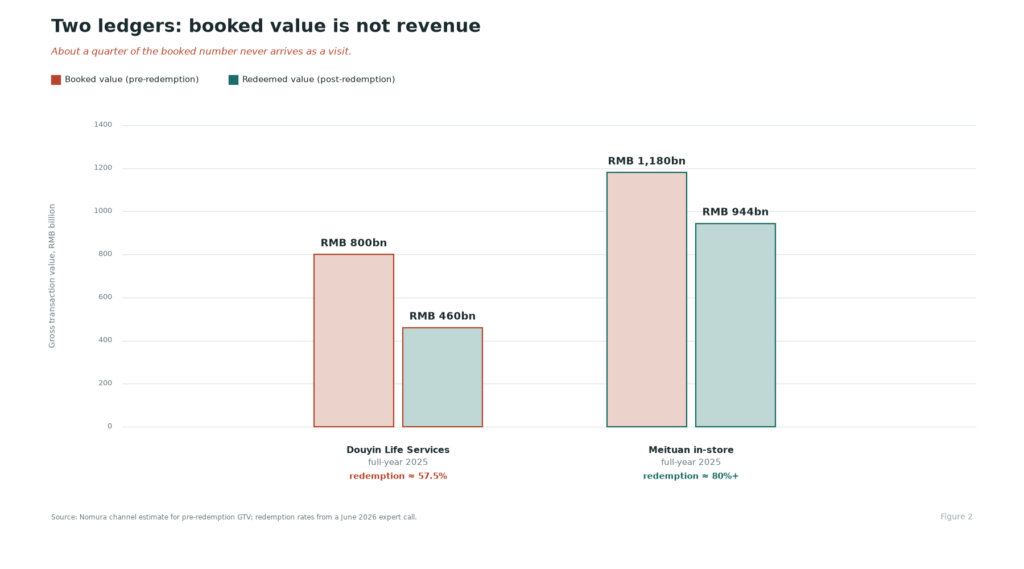
Of Douyin’s projected RMB 1.2 trillion for the full year, roughly RMB 600 billion becomes a real visit. Meituan’s RMB 1.3 trillion at 80% becomes more than RMB 900 billion. The booked gap looked closed. The redeemed gap was still around 30%.
None of this is a slur on Douyin. It’s a description of two demand modes. Meituan’s traffic is intent-first: you open the app because you already want dinner within two kilometres. Douyin’s is content-first: a video makes you want dinner, and you buy the claim before you’ve picked a day. Intent converts. Content inspires. Both are real, and they only get measured with the same yardstick if you believe a claim and a visit are the same thing.
The eighteen-point experiment
Meituan’s own answer to this problem hides inside an ordinary product feature. When the company rolled out 秒提 in 2024, settle the voucher, order, get a pickup code before you leave the house, group-buying redemption rose from 60% to 78%. Participating brands saw order growth in the 20% to 40% range. The feature covered more than 80,000 stores across 360-plus cities and counties and passed 20 million users.
Read that again. No new traffic. No deeper discount. No new creative. Same demand, redeployed. All they did was move the redemption moment closer to the visit, which is this entire article compressed into a pickup code.
Why the shelf app redeemed better than the feed
The second experiment belongs to Douyin. In February 2026 it launched Doushengsheng, a stripped-down shelf app with little more than search, coupons, and orders. By mid-year it was carrying around 10% of Douyin’s local-services daily transaction value, with peak daily actives past 10 million.
Independent researchers tracking the category put its redemption rate near 70%, against 50–60% on the main app. Same company, same supply, same discounts. The only variable was the demand mode. A boring list you open on purpose beats an exciting feed you fall into, if what you’re counting is visits.
That is the finding worth taping to your monitor: content wins the impression, shelf wins the redemption, and the merge is what lets one pay for the other.
The other half of the ledger
Channel research circulating among analysts puts the merchant’s all-in cost at roughly 11–12% of transaction value on Meituan against 15–17% on Douyin, with returns near 2.8–2.9x and 2.5–2.6x respectively. Treat those figures as directional rather than gospel; they come from interviews, not audited filings.
But direction has a message. Buying reach on a content platform costs more per visit and delivers a colder visitor. Buying intent on a shelf costs less and delivers someone already standing in your postcode. Neither is a bargain or a rip-off in the abstract. The mistake is choosing one and calling it strategy.
Why this could only happen here
The super-app held both ends of the trip
Chinese consumers never had to be taught to buy a physical experience inside a digital feed, because the architecture had already collapsed the steps. One app held the content, the listing, the payment, the map, the review and the receipt. When the rails are laid end to end, closing the loop is an engineering task, not a cultural one. That is also why the same playbook stumbles when exported to markets where discovery, transaction, and fulfilment still live inside three separate companies.
The profit pool got repriced
The bill shows up in one number. Before 2024, Meituan’s in-store, hotel and travel segment ran at operating margins above 40%, and held near 35% through most of the fight. By the second quarter of 2026, Nomura estimated roughly 25%.
That compression is the merge’s price tag, and the incumbent paid it. Douyin’s scale ended a decade of excess margin that existed precisely because the offline world was opaque. When the door became countable, the toll booth lost its pricing power. Meituan’s 2025 results tell the same story from the other direction: revenue up 8.1% to RMB 364.9 billion, core local commerce up 4.2% to RMB 260.8 billion, and a segment operating loss of RMB 6.9 billion against a profit of RMB 52.4 billion the year before, though most of that swing came from the delivery subsidy war rather than from the merge.
What the holidays proved
The demand is real; it just arrives differently. Douyin’s own consumption report for the 2026 Mid-Autumn and National Day window recorded group-buying orders up 53%, dining orders up 61%, travel orders up 42% and hotel orders up 79%. Meanwhile, 2-to-4-person meals now account for 43.8% of the platform’s dining transaction value, and weekday order volume rose 847% year on year, evidence that the content mode is creating occasions that didn’t exist rather than merely intercepting ones that did.
The merchant-side proof is more interesting. Ziyan Chicken roughly doubled both payment and redeemed value on Douyin in the first half of 2026, and Yuanji Dumpling reported that 80% of its group-buying customers were net-new. That is what a discovery engine is for. If your business is already full and your problem is margin, buy intent. If your business is empty at 3pm and your problem is awareness, buy reach.
What a local brand should actually do
Kill the second budget
One funnel, one number. If your plan still has an “online” line and an “in-store” line, you are running a model your customer abandoned years ago. Budget against redeemed visits and repeat visits, not impressions and foot-traffic guesses. And if your agency can’t report in those units, they’re selling you the pre-2023 version of the job.
Own the profile, rent the reach
Reach is a rental. The profile is an asset. Every loop passes through a moment where an anonymous visitor can become a known one: the scan, the membership, the booking, the review. That moment is the only place where you build something the platform can’t reclaim, and it usually lasts about ninety seconds at the counter. Design the store around it, not around the poster.
Worth noting what the platforms themselves are doing here. Meituan’s tiered membership now spans delivery, dining, hotels, travel and health, and third-party tracking has put top-tier members at roughly three times the cross-category purchase frequency of ordinary users, with repurchase rates about 58% higher. Membership is the loop’s memory. If you don’t have one, you’re borrowing theirs.
Instrument the visit, not just the sale
The visit is the richest event you own and the least instrumented. What was ordered. What was declined. What time people actually arrive versus what time they booked. Which table turns fastest. Who came back without a coupon. None of that needs a data team. It needs someone to decide the QR scan is not merely a payment tool.
Feed the feed
The loop runs both ways. The feed pulls the visit; the visit supplies the feed. Reviews, user posts, before-and-after photos, the queue at peak hour, all of it is raw material for the next round of discovery, and all of it is generated for free by customers you already served. Most merchants treat this as a review-management chore. It is inventory.
Let the AI take the boring half
By July 2026, Meituan’s assistant Xiaotuan had moved from answering questions to completing tasks: checking live availability, confirming whether a shop is actually open, booking a table, hailing the ride, after a single confirmation. It covers more than 2,800 cities, has run over 700 million merchant-information verifications, and sits on top of 1.3 billion reviews.
Follow the direction of travel. The planning layer of local marketing, translating a vague human desire into a real, bookable, currently-open business, will be done by models holding live data. Your job becomes narrower and more brutal: be the correct answer in that system. Accurate hours. Accurate availability. Honest photos. Review volume that survives scrutiny. Every merchant that fudges its listings is teaching the model to skip it.
The parts that don’t work
You are renting the loop
The loop runs on someone else’s rails: their voucher, their payment, their identity graph, their ranking. That’s fine until it isn’t. A merchant whose entire repeat relationship lives inside one platform’s membership tier owns nothing, and will discover this the week the commission changes. The defensive move is unglamorous: capture a contact point you control, and make the in-store experience good enough that people return without a coupon.
Compliance just got easier for small merchants
This one is genuinely new, and it invalidates a common excuse. On 1 September 2026, China’s rules for small personal-information handlers took effect. Businesses processing data on fewer than 100,000 individuals can now publish a short notice on the premises instead of building a full privacy apparatus, rely on a simplified notice-and-consent path for information that’s necessary to deliver the service, and stretch compliance audits to once every five years.
Read it carefully, because it cuts both ways. It removes the barrier. A noodle shop keeping phone numbers for a membership list can now do that legally with a sheet of paper by the till, which means “we’re too small to do this properly” is no longer a defence, it’s an admission. And the hard lines haven’t moved: sensitive data still needs separate consent, and anything involving children under 14 still needs its own written rulebook.
A merged funnel can’t rescue a bad product
Fusion removes friction. It does not create desire. If the food is mediocre, the loop will efficiently deliver the same mediocre experience to the same person, twice as often, with better attribution. The merge makes good businesses compound faster and bad businesses fail more visibly. That is not a bug in the model.
Where this goes next
The fifteen-minute version of the same loop
The next frontier is measured in minutes, not steps. The Ministry of Commerce Research Institute’s 2025 instant retail report put the category at RMB 781 billion in 2024, up 20.15%; estimated RMB 971 billion for 2025; forecast a crossing of RMB 1 trillion in 2026 and RMB 2 trillion by 2030.
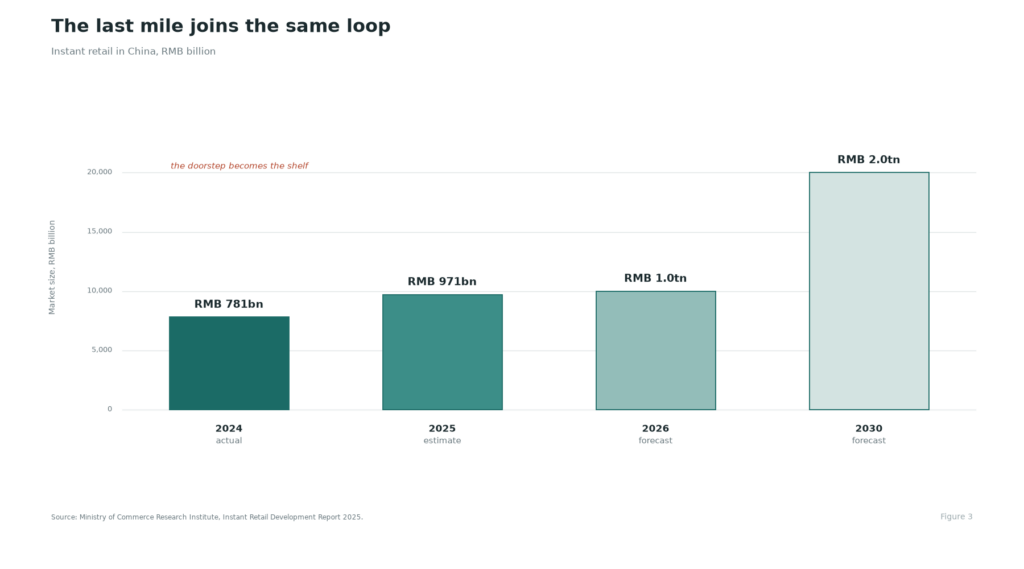
Follow the logic and the destination is obvious. If the feed can make you want something and the store can serve it, the only remaining friction is distance. Remove distance and discovery, transaction, fulfilment and re-engagement collapse into a single machine that ends at your door.
The corner store becomes a data company
The romantic version of this story says small merchants get crushed. The likelier version is subtler: the small merchant who runs the loop out-competes the chain that runs the split. A thirty-seat noodle shop with accurate hours, a live queue, four hundred honest reviews, a membership list and a well-timed rebooking message holds more usable signal than a regional chain with a billboard budget and a spreadsheet of footfall estimates.
The two questions that decide who compounds
Park the platform war for a minute. Two questions decide your outcome.
- Can you tell the difference between a booked claim and a redeemed visit?
- When a stranger walks in, do they leave as a record you can act on?
Answer both and you’re running the merge. Answer neither and you’re still buying half a business.
Conclusion
The offline-online merge didn’t arrive as a strategy. It arrived as a QR code on a napkin holder. Everything downstream, the trillion-yuan transaction volumes, the margin compression, the shelf apps, the AI concierge, the 15-minute doorstep, flows from that one change in bookkeeping.
What it means for you is narrower and less comfortable than the trend pieces suggest. Your customer was never choosing between online and offline. They were choosing between a business that continues after they leave and one that resets every time they walk out. That gap used to be invisible. Now it’s a column in a dashboard, and it’s the only column that matters.
A note on the numbers
Market size and penetration: iResearch, via Chinese business press, 2025. Macroeconomics: National Bureau of Statistics, full-year 2025 release. Platform financials: Meituan’s audited FY2025 results. Douyin’s paid GMV of RMB 850 billion-plus for 2025 and its 15.2 million transacting stores come from Chinese tech media reporting, not a public filing, so treat them as reported rather than confirmed. GTV, redemption rates and margin estimates are Nomura channel and expert-call work from mid-2026; the 57–58% figure for Douyin has been quoted elsewhere in a 50–60% range by other brokers, and category-level rates diverge far more widely, so read the aggregate numbers and not the sub-category ones. The roughly 70% redemption figure for Doushengsheng comes from an independent researcher, not the platform. Merchant cost and ROI percentages are interview-based and directional. Instant retail figures are the Ministry of Commerce Research Institute’s. Small-handler compliance terms follow the regulation published by the Cyberspace Administration of China and the Ministry of Public Security, effective 1 September 2026.