CDP vs SCRM in China: The Messy Data-Platform Landscape
Ask a Western martech team to explain their customer data stack and you get a tidy answer. The CDP unifies the data. The CRM acts on it. The boundaries are documented, the contracts are separate, and the integration project has a name. Ask the same question in Shanghai and the answer arrives with a shrug. Which one — the CDP or the SCRM? Depends who you ask, and the two vendors quoting you will disagree.
That confusion is not a failure of the Chinese market. It is a rational response to a structural difference most Western analysis misses. In China, the platform that holds the customer relationship and the platform that holds the customer record are the same platform. Once you accept that, the overlap stops looking like vendor sloppiness and starts looking like an inevitability.
The clean Western division, briefly
Before we can discuss why China broke the model, it is worth being precise about the model being broken.
The CDP Institute defines a customer data platform as software that “creates and maintains a persistent, unified customer record that is accessible to other systems.” The original 2013 definition was more pointed: packaged software creating a persistent, unified customer database accessible to other systems. Three elements do the work — packaged, persistent-unified, accessible. A CDP ingests from every source, keeps the full detail, resolves identities across them, and publishes a durable profile outward.
Gartner’s framing is compatible: software that supports marketing and customer experience use cases by unifying a company’s customer data from marketing and other channels, optimising the timing and targeting of messages and offers, and enabling analysis of individual-level customer behaviour over time.
Notice what is absent from both definitions. Neither says the CDP sends the message. Neither says it owns the conversation. The CDP is explicitly a record, built to be read by other systems — CRM, ad platforms, service desks, warehouses.
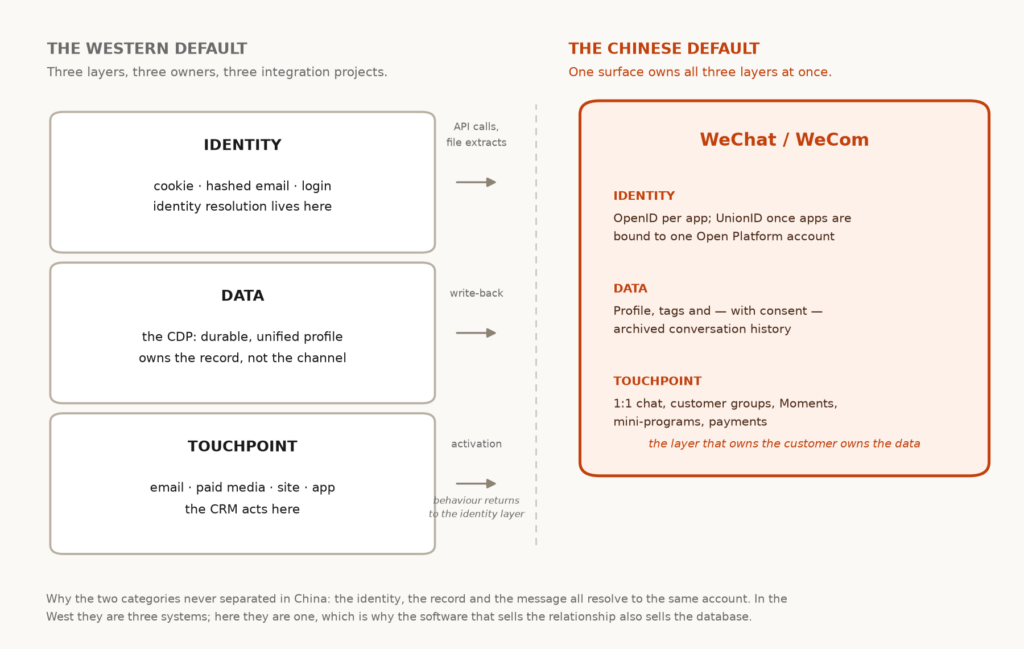
A CRM, by contrast, is where a human works. It stores the relationship as your staff experience it: pipeline, tickets, calls, notes. In the Western default these are two products from two vendors with an API between them. The CDP knows; the CRM touches. That separation is not an accident of history — it is an artefact of where identity lives.
Why identity is the whole argument
Here is the hinge on which everything turns, and it is worth slowing down for.
In the West, a customer’s identity is fragmented across systems you own: a login on your site, a hashed email in your ad platform, a cookie on your storefront, a phone number in your point-of-sale. Identity resolution — stitching those fragments into one person — is difficult, valuable, and someone’s job. That job is the CDP’s reason to exist. The CDP is the place where fragments become a person.
In China, that job is largely done by the platform before your software arrives. WeChat’s documented mechanism is precise about this. Every WeChat user carries a different OpenID for each app: your mini-program, your official account, and your mobile app all see different OpenIDs for the same human. But bind those apps to a single WeChat Open Platform account, and each user resolves to one UnionID that is identical across all of them. The platform’s own shorthand is the clearest explanation available: WeChat user + AppID = OpenID; WeChat user + Open Platform account = UnionID.
Read that again, because it explains an entire industry. Identity resolution in China is not a data-science problem you solve with probabilistic matching. It is a configuration step you complete by binding your apps to an Open Platform account. The hardest and most defensible function of a Western CDP — the identity graph — is, in China, a feature of the platform.
This is why the two categories never separated. When identity, the record, and the message all resolve to the same account, the software that sells you the relationship also sells you the database, and the software that sells you the database has every incentive to sell you the conversation.
What WeCom actually is: a substrate, not a product
Western readers often hear “WeChat CRM” and picture a messaging add-on. That undersells it by an order of magnitude.
At its August 2025 product launch, WeCom — Tencent’s enterprise communication product — disclosed that more than 14 million enterprises and organisations had registered on the platform, and that businesses were serving more than 750 million WeChat users through it every single day. WeChat itself reported 1.418 billion combined monthly active accounts at the end of December 2025, up 2% year on year. Put those two facts side by side and the strategic picture appears: a company-run channel reaches roughly half of the world’s largest consumer graph daily, and no consumer had to install a second app to be reachable.
The architectural details matter more than the headline scale, and three of them explain the SCRM industry.
The contact layer is open. WeCom exposes external contacts, customer groups, and Moments through documented APIs. Because the platform shipped primitives rather than finished products, an entire third-party software industry became possible — and that industry is what everyone calls SCRM.
The archive layer exists and is governed. Conversation archiving is not surveillance bolted on afterwards; it is a documented, disclosed, contractually framed record-keeping capability. Tencent’s own help documentation spells out the mechanics: an administrator sets the archive scope, the trusted IP addresses, and the message encryption public key; employees in scope see a disclosure page when they log in; and when an employee talks to an external contact, that contact is shown a service notice stating the conversation may be archived, and may decline. If the contact declines, the employee cannot receive their messages.
The identity is inherited, not issued. A WeCom external contact is a WeChat account, not a registration. There is no sign-up funnel to lose people in, and no new credential to manage.
Once chat history becomes a system of record, chat stops being a channel. It becomes part of the customer database. That is the definition of a substrate, and it is why a CDP built for Western identity fragmentation has so little to do here.
Then why do Chinese buyers still ask for a CDP?
This is the question that makes the category genuinely confusing rather than merely different, and it deserves an honest answer rather than a dismissal.
China does have a CDP market. It is real, it is measured, and it is growing. IDC’s China customer data platform tracker for the second half of 2025 put the domestic market at roughly USD 134 million, up 18.5% year on year, with Tencent’s QiDian marketing cloud CDP holding a 21.5% share and growing 36.7%. A separate research estimate projects a five-year compound growth rate near 18.7%. Those are respectable numbers for a software category anywhere.
But look at what the leader sells. Tencent’s win is attributed to the WeChat ecosystem, its AI agent layer, and its ability to run an end-to-end loop from acquisition through repurchase. The winning CDP in China wins because it sits inside the same ecosystem as the relationship. That is not a CDP displacing an SCRM. That is the platform extending downward into the record layer.
So the honest structural read is this: in China, the CDP survives as a feature and a purchase line item of the ecosystem-owning platform, not as an independent category with its own gravity. It is bought to make the relationship layer smarter — better segmentation, better scoring, better next-best-action — not to be the place where identity is invented.
Which is precisely why the labels stopped meaning what Western buyers expect. When one vendor sells “CDP + SCRM in one,” the CDP badge on the invoice describes a module, not a category.
The numbers that should make you suspicious
If you want to evaluate a China data-platform vendor, you need to know which numbers in the market are load-bearing and which are folklore. This is where most procurement decks fail, and it is worth being blunt, because the difference between the two is often the difference between a defensible business case and an expensive lesson.
Start with the growth story, which is genuinely favourable. China’s private-domain commerce — transactions completed through owned, re-engageable channels rather than paid marketplace traffic — reached RMB 6.4 trillion in 2025, up 28% year on year, per the 100EC e-commerce research centre’s third annual dataset. Users reached 680 million, up 30.76%. That is a large, maturing channel, and it is the market SCRM was built to operate.
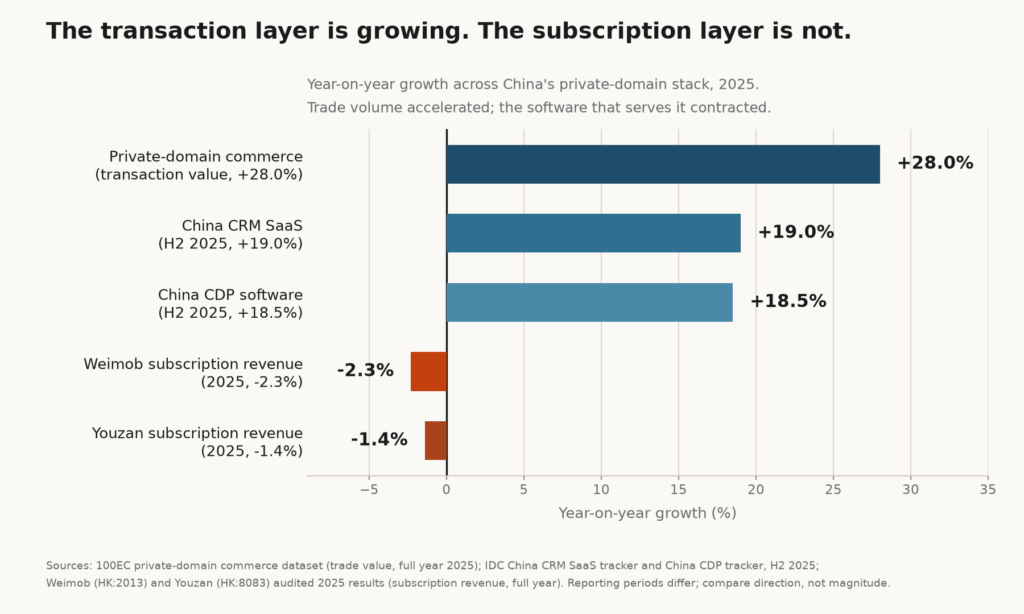
Now the part nobody puts in the deck. The software layer is not growing with the transaction layer. Weimob’s 2025 subscription solutions revenue fell 2.3% to RMB 897 million, and paying merchants dropped 7.2% to 58,396. Youzan’s subscription revenue fell 1.4% to RMB 770 million, and its paying merchants fell from a peak above 100,000 to 52,809. Both companies reached adjusted profitability in 2025 largely by cutting cost, not by growing the core SaaS base. Weimob’s sales and distribution expenses fell 23.3%; its employee costs dropped by RMB 138 million.
Set that against the transaction line. Private-domain trade grew 28% while the two largest listed SaaS vendors serving it shrank. Something is being captured, but it is not being captured by seat licences.
Two further numbers circulate widely and should be retired. The first claims Chinese SCRM vendors command 75% of the market in aggregate. It traces to SEO listicles with no methodology and no denominator; a separate resale document puts the top five near 40% — two claims thirty-five points apart, neither auditable. The second is the 60–70% private-domain repurchase rate against 15–25% for platform retargeting. That comparison is not so much false as unfalsifiable: the denominator excludes non-buyers, the measurement window is chosen after the results are known, channel attribution credits the sales rep for orders the platform actually sourced, and churned contacts are dropped from the panel. A number that survives none of those questions does not belong in a budget meeting.
What you can defend instead: cohort repeat rates at 90 and 180 days measured from first order with non-buyers in the denominator; contribution margin per cohort after discount, returns, and service cost; incremental conversion against a holdout group; and monthly contact decay — how many external contacts delete you. That last one is the most honest satisfaction metric a chat-native stack produces, and almost nobody reports it.
The practical difference that does survive
Despite the label chaos, the functional distinction is real, and it is the only reliable basis for procurement.
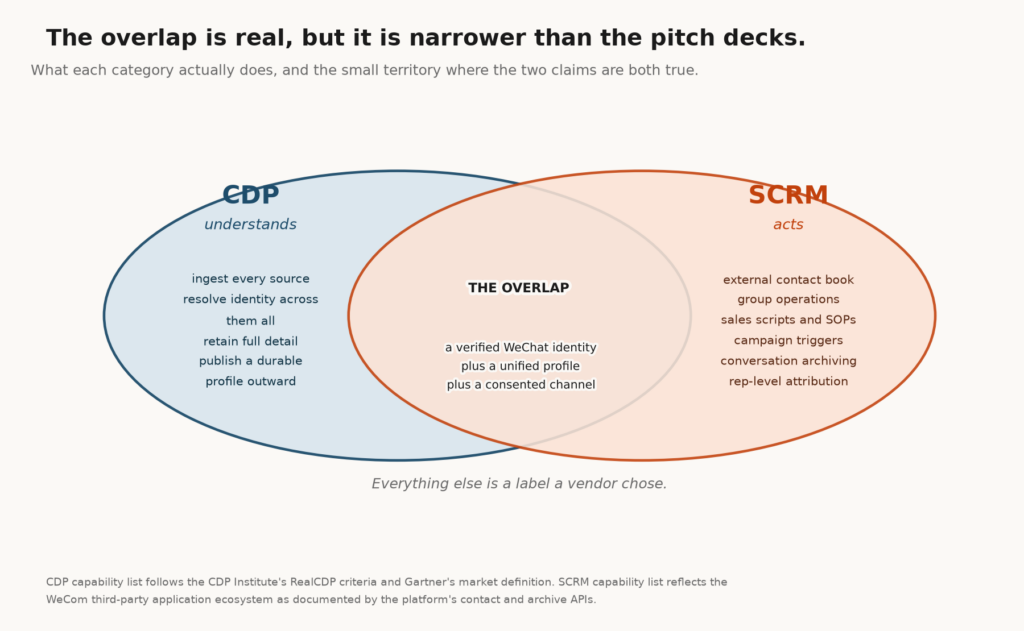
A CDP understands. Ask it who this person is across every channel, what they did, what they are worth, and what they are likely to do next. Its output is a profile and a score, published outward through APIs, queries, or file extracts. It is the brain, and its failure mode is a beautiful dashboard nobody acts on.
An SCRM acts. Ask it how to reach this person through the channel they actually use, what to say, when to stop, and who on your staff owns the relationship. Its output is a conversation, a group, a campaign trigger, a retention play. It is the hands, and its failure mode is a contact list that grows while revenue does not.
The overlap is real but narrower than the pitch decks suggest. It consists of exactly three things: a verified WeChat identity, a unified profile attached to it, and a consented channel to act through. A genuine CDP in China must handle the first two. A genuine SCRM must handle all three. Vendors on both sides claim all three and deliver two.
The test that cuts through it is not a feature list. It is a question about evidence: ask the vendor to produce a cohort repeat-purchase curve, net of discount and returns, joined to acquisition channel and campaign. If the answer contains the words “modelled,” “estimated,” or “assisted,” you are looking at a messaging tool. That is fine. Price it as one.
Compliance: the constraint that reshapes the architecture
There is a second reason the Western CDP template does not transfer, and it is harder to argue with than market structure.
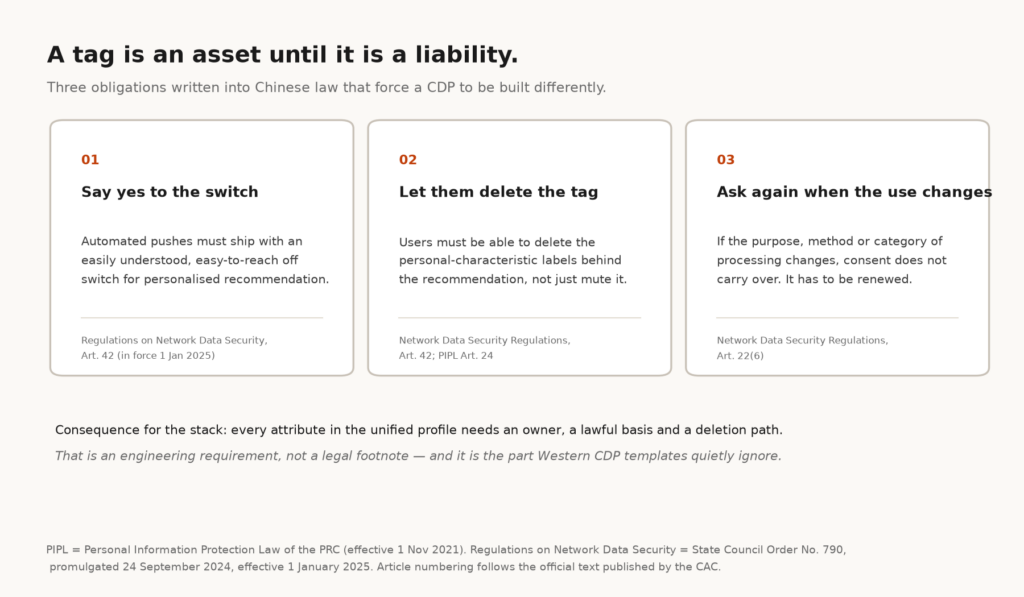
Chinese retention software operates inside one of the world’s more specific data regimes, and the regime became considerably more concrete in the last two years. The Regulations on Network Data Security Management, State Council Order No. 790, took effect on 1 January 2025. Read alongside the Personal Information Protection Law, three provisions restructure what a unified profile may contain.
Article 42 requires that any network platform service provider pushing information to individuals through automated decision-making must offer an easily understood, easily accessible, and easily operable switch to turn off personalised recommendation — and must let users delete the personal-characteristic labels behind it. Not mute the feed. Delete the tags.
Article 22 governs consent mechanics, and its sixth clause is the one that breaks naive data models: consent must be re-obtained when the purpose, method, or category of processing changes. Consent is not a boolean you set at capture. It is a state that expires when use changes.
Article 24 requires deletion or anonymisation where automated collection unavoidably gathered unnecessary personal information or information without valid consent — and where a user closes an account.
PIPL Article 24 sets the parallel obligation: automated decision-making must offer either an option not based on personal characteristics or a convenient way to refuse.
Put these together and the architectural consequence is unavoidable. Every attribute in a unified customer profile needs an owner, a documented lawful basis, and a deletion path. A tag is an asset until it becomes a liability — and in a profile assembled from chat behaviour, group membership, and mini-program activity, most tags are liabilities waiting for a purpose change.
This is the part Western CDP templates quietly ignore, and it is where local vendors earn their premium. Consent state, tag-level deletion, and purpose-bound processing are engineering requirements, not legal footnotes. If your vendor demo cannot show you a tag being deleted and its downstream effects, ask why not.
So what should a global brand actually build?
Four decisions, in order.
Map your CRM to SCRM, not to CDP. The instinct to buy a familiar Western CDP first is the most expensive mistake available here. Your CRM equivalent in China is the WeCom-native relationship layer. Fund that first, and treat the CDP as the data backbone underneath it rather than the centre of the stack.
Buy function, not label. The categories overlap by design and the invoices are written to exploit that. Write your requirements as verbs — unify, resolve, segment, reach, archive, attribute — and demand a demonstration of each, with evidence. A vendor who can only describe nouns is selling a bundle.
Budget for integration, not just subscription. Identity resolution inside WeChat is a configuration step; identity resolution across WeChat, Tmall, JD, Douyin, your POS, and your ERP is not. The integration tax is real, recurring, and routinely omitted from the business case. Three-year total cost of ownership should include implementation, integration, and — the line nobody asks about — migration-out. If exporting your contacts, consent records, and archive at contract end requires professional services at day rates, you are renting your customer data with extra steps.
Assume vendor churn and price it. The two largest listed SCRM-adjacent vendors both shrank their subscription bases in 2025 while pivoting toward AI revenue and, in one case, overseas expansion. Betting three years of customer data on a vendor mid-pivot is a real risk, not a hypothetical. Ask about data portability before you ask about roadmap.
Where this is genuinely uncertain
Three honest caveats, because the confidence industry around this topic is worse than the confusion.
Market sizing is not comparable across sources. Private-domain commerce, SCRM software revenue, CRM SaaS, and CDP software are four different denominators, and Chinese research output routinely mixes them. The USD 134 million CDP figure and the RMB 6.4 trillion commerce figure describe different universes. Treat any single “China martech market” number as a category error until you know its denominator.
The SCRM market-size claims are not auditable. Wide-circulating figures such as a 2025 enterprise WeCom SCRM market “above RMB 18 billion, up 41.2%” trace to report summaries with no published methodology, and the underlying report cannot be independently verified. I have not used them. The direction — fast growth, high tool-idleness — is plausible and directionally corroborated by vendor financials showing contraction, but the decimals are not defensible.
The consolidation thesis is a reading, not a forecast. I have argued that the CDP survives in China as a feature of ecosystem-owning platforms rather than as an independent category. IDC’s leader data supports that reading. It does not prove it. A credible alternative is that AI-native CDPs re-establish independence by owning decisioning rather than identity — and given how fast the agent layer is moving, that alternative deserves a hearing.
The takeaway
China’s CDP-versus-SCRM confusion is not a market that failed to mature. It is a market whose defining platform absorbed the job that, in the West, justifies an entire software category. When identity, record, and channel all resolve to one account, the boundary between “understand the customer” and “act on the relationship” stops being a product boundary and becomes a marketing label.
The practical truth survives the blur, and it is the only thing worth carrying into a procurement meeting: the CDP understands, the SCRM acts, and in China the SCRM is the centre of gravity. The brand that imports a clean Western CDP-CRM divide will spend a year discovering that its architecture assumes an identity problem it does not have. The brand that buys verbs instead of nouns — prioritising the relationship layer, treating the profile as infrastructure, and insisting on evidence over percentages — will build the stack that actually runs.