The Logo Tax Is Over: How Pingti Became China’s Anti-Brand Movement
In China right now, the most fashionable thing you can do with money is refuse to overpay. Pingti — the affordable equivalent — has turned comparison shopping into a public sport, a social identity, and a slow, grinding repricing of every brand that ever charged for a logo.
The short version
China’s shoppers did not stop buying. They stopped paying for the name.
Five numbers carry the whole argument. In 2024, the urban fast-moving consumer goods market sold 4.4% more units and collected just 0.8% more money, because the average selling price fell 3.4% — the steepest drop in four years. In 2025 the pattern repeated: units up 3.6%, money up 0.9%, price down 2.6%. Domestic personal luxury sales fell 18–20% in 2024, straight back to 2020 levels, then another 3–5% in 2025. A survey of 1,200 shoppers across 15 cities found 57.2% prefer a cheaper product when quality and function are close; among people born after 1990 it was 69.3%, and after 2000, 72.7%. And the machinery that makes the whole thing easy — Alibaba’s factory-direct platform 1688 — passed 100 million annual active buyers in February 2025, up 55% in twelve months.
Put together, those numbers describe something less like a discount trend and more like an audit. Millions of people are independently checking what the markup actually buys, and publishing the answer. Some brands pass. Many do not.
What pingti actually means
Pingti is shorthand for pingjia tidai — an “affordable substitute.” The precision matters, because English keeps flattening it into the wrong word.
A pingti is not a fake. It is not a counterfeit with a stolen mark, and it is not a grey-market original. It is a product that performs the same job for materially less money, sold openly, recommended openly, and often compared ingredient-by-ingredient against the expensive thing it replaces.
The examples are mundane, which is exactly why they matter. A 200-yuan essence replaces a 1,000-yuan one. A 9.9-yuan coffee chain replaces a 35-yuan latte. A 599-yuan hairdryer with an 110,000-rpm motor replaces a 3,000-yuan one. Mont-bell replaces Arc’teryx on the hiking trail. A local label sells a 3,200-yuan herringbone coat made from Italian fabric sourced from a supplier that also serves Prada and Bottega Veneta, and reports roughly one billion yuan a year in sales on a single Taobao storefront. A Hong Kong leather manufacturer promotes 700-yuan handbags made on the same production lines as four-figure luxury goods. Half-price Aito M9 clones are now a standard sales script in Chinese car showrooms.
None of this is new behaviour. Bargain hunting is as old as retail. What is new is the friction, which has gone to approximately zero.
“Horizontal replacement” beats “dupe”
The word is built from ping, level or flat, and ti, to replace. A swap at the same level, minus the surcharge. That geometry is the whole cultural shift. Shengji, upgrading, is going up. Jiangji, downgrading, is going down. Pingti is staying exactly where you are and refusing to pay extra for the view.
The English vocabulary available for this is either contemptuous (“dupe,” a person who has been deceived) or criminal (“knockoff,” “fake”). Chinese social media invented its own term instead: pingti zixin — pingti confidence. Buying the cheaper equivalent is framed as discernment, not deprivation. As one shopper quoted in market research put it: “I’m not cutting corners. I’m cutting the marketing fees.”
The communities that formed around this are worth studying, because they are where the trust now lives. Members of what are nicknamed xueba lianmeng — study-master alliances — chao zuoye, or copy each other’s homework: shared spreadsheets of equivalents, swatch photos taken in daylight, durability updates six months in. The vocabulary of the group is examination, not shopping. Someone did the work; you get to copy the answer.
There is also a phrase for the underlying behaviour: suanzhang shi xiaofei — abacus-style consumption. Shopping as arithmetic. Which is a strange thing for a luxury industry to hear, because luxury has never really been arithmetic. It has been a story with a price attached.
The number that starts every argument
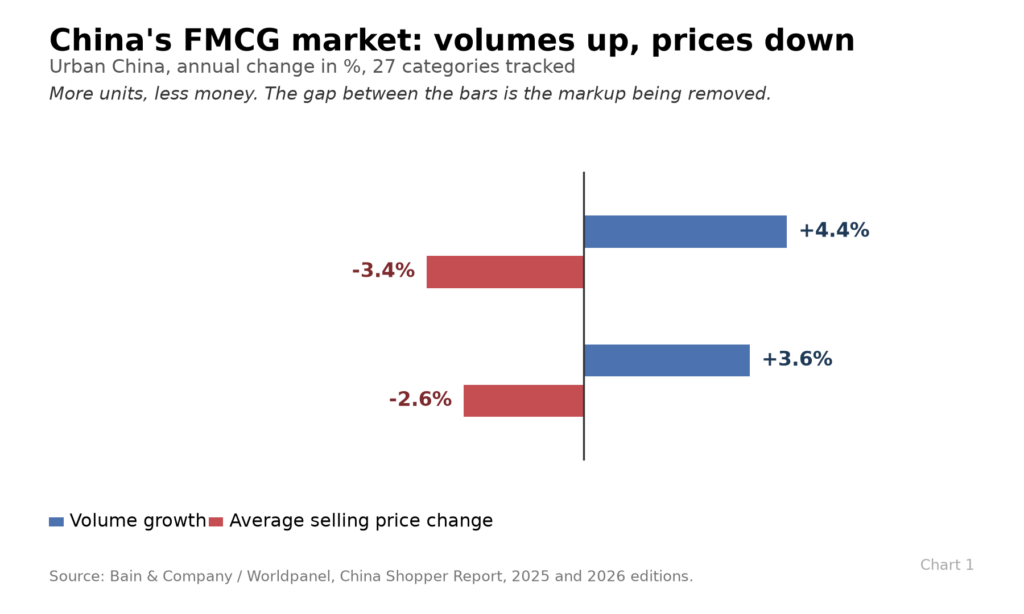
Look at the arithmetic rather than the headlines. If unit sales climb 4.4% and total revenue climbs 0.8%, then the price of the average basket fell. That is not a demand problem. Demand was healthy. It is a price problem, and specifically a problem for the layer of price that sits on top of the product — the part nobody can touch, taste, or test.
Bain & Company and Worldpanel have tracked this basket across 27 categories for fifteen consecutive years, and their read is unambiguous: Chinese consumers are actively substituting cheaper products for the ones they used to buy, lifting volumes while compressing value. By the first quarter of 2026 the split had widened further — units up 1.3%, revenue down 1.3%.
You can watch the market share move in the same dataset. In 2025, local brands took 3.5 percentage points of shampoo, 1.9 points of ready-to-drink tea, 1.5 points each of laundry detergent and juice, and 1.3 points each of instant coffee and colour cosmetics. Those are not small drifts in slow-moving categories; they are structural transfers, and they went to whoever priced closest to the functional floor.
Where the premium visibly broke
Luxury is where the audit produced its clearest verdict, partly because luxury’s entire business model is the premium.
In 2024, mainland China’s personal luxury market fell 18–20%, erasing years of growth and returning to 2020 levels. Watches and jewellery were hit hardest, with sales down more than 30%. In 2025 the market contracted a further 3–5% — a milder decline, but a decline nonetheless, and one that arrived while the rest of the consumer economy was growing.
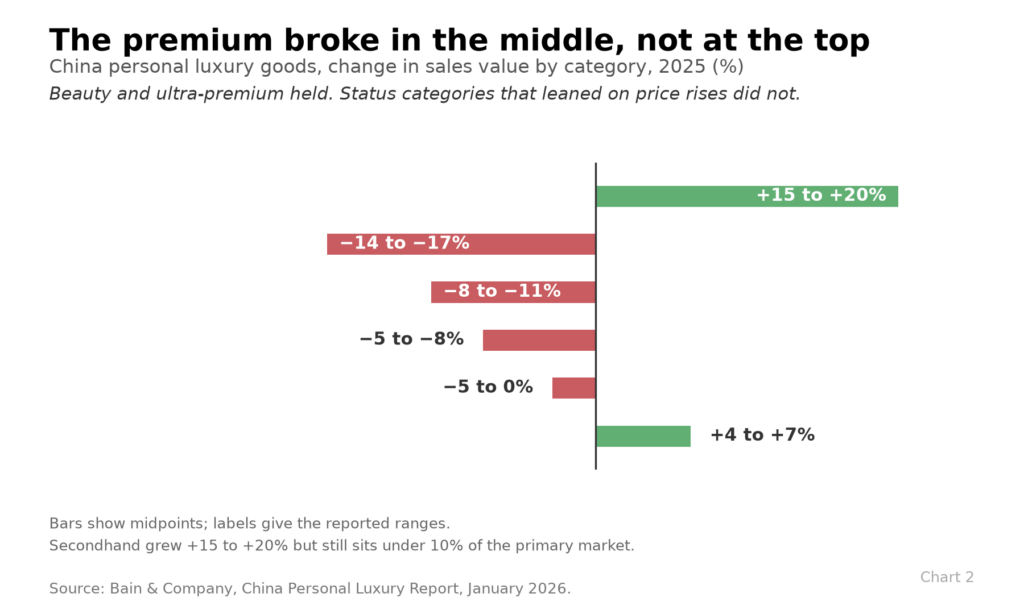
The category split in 2025 is the interesting part. Beauty rebounded 4–7%, driven by ultra-premium skincare and fragrance. Fashion fell 5–8%. Leather goods fell 8–11%. Watches fell 14–17%. Jewellery narrowed its decline to 0–5%. Secondhand luxury grew 15–20% while still sitting under 10% of the primary market.
Read that shape: a barbell. The very cheap end and the very expensive end held; the middle — the 3,000-yuan bag, the 2,000-yuan coat, the watch bought as an investment — collapsed. Bain’s Bruno Lannes put the mechanism in one sentence when he attributed the downturn partly to consumers’ “reluctance to accept frequent price increases by brands without well-justified value propositions.” Not a refusal to spend. A refusal to accept the justification.
There is a second, quieter signal in the same report. In 2025, 65% of Chinese luxury spending happened inside the mainland and 35% abroad — a reversal of the previous two years, driven less by patriotism than by price gaps narrowing. Consumers will still pay for luxury. They will not pay 4,000 yuan extra for the same bag in a different postcode.
Why price transparency ended the mystery
A brand premium is a toll booth built on an information gap. You did not know what the factory charged, what the material cost, or who else bought the same component. So you paid for the uncertainty, and the story filled the space where knowledge should have been.
China closed the gap, and not gently. 1688, Alibaba’s factory-direct marketplace, lists the factories themselves. Livestreams run inside production halls. Labels name the manufacturer, and the manufacturer has a storefront. 1688’s app now includes an image search that matches a photograph of a branded product to the factories making something equivalent — the platform says the tool lifted sourcing efficiency by about 50%. Its Yuanxuan line, marketed as “source-selected,” advertises brand-equivalent goods at roughly one-third of brand prices as a product promise rather than a rumour.
The mechanic is almost embarrassingly simple, and investment analysts describe it plainly: find the item you like in a store, read the label, look up who manufactured it, then buy the unbranded version online for a fraction of the price. That is the entire playbook. It requires no expertise. It requires a phone.
Which means the moat most brands were defending was not quality, or design, or even distribution. It was ignorance. Ignorance is no longer a durable asset in this market.
Why trust moved from the logo to the ledger
Trust migrated, and it migrated sideways — from the brand to the crowd.
A 2022 survey by the social survey centre of China Youth Daily, covering 1,126 respondents, found 75.4% had bought a pingti product. The stated reasons were revealing: 63.0% credited the rise of domestic brands, 54.1% better quality in the substitutes themselves, 49.9% said social commerce had dissolved the big-brand halo, and 45.2% pointed to maturing consumer attitudes. Only a minority framed it as belt-tightening.
Two years later the preference had hardened into a default. The 2024 survey of 1,200 consumers in 15 cities put overall preference at 57.2% — and at 69.3% among the post-1990 cohort, 72.7% among the post-2000 cohort. The people who will drive Chinese consumption for the next decade are the most pingti-native generation in the country’s history.
Loyalty numbers confirm what that implies. Euromonitor data cited by Daxue Consulting puts the share of Chinese beauty consumers who consistently stick to one brand at roughly 11%. Nine in ten are, by default, shopping across brands and substitutes. A “loyalty programme” aimed at that population is not a loyalty programme. It is a discount scheme with a membership card.
And there is a psychological engine underneath it that brands consistently underestimate: self-efficacy. Getting a genuinely good product for a fifth of the price produces a sense of mastery — of having beaten a system that was rigged against you. That feeling is durable. The glow of a new logo is not.
Why platforms turned a hunt into a habit
Here is the part that gets left out of most commentary: pingti did not spread because Chinese shoppers became thrifty. It spread because finding the equivalent stopped being work.
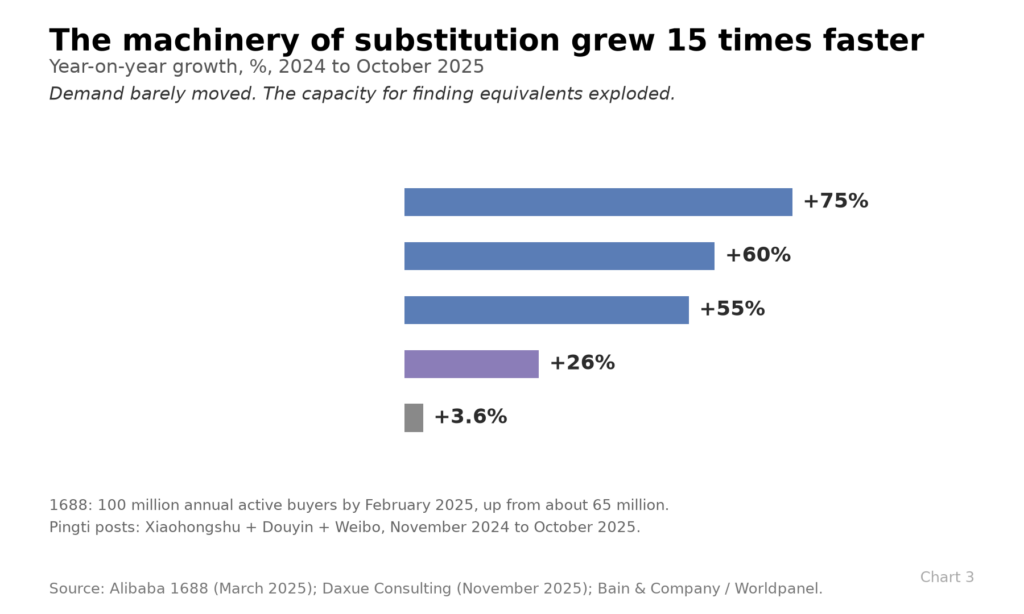
1688 is the clearest evidence. Annual active buyers passed 100 million by February 2025, up from roughly 65 million, a 55% increase in a year. Buyers using the dropship model — no inventory, ship direct from factory — grew 75%. Daily active users rose about 60%. The platform has aggregated around 600,000 vetted manufacturers, roughly a third of all above-scale factories in China. It also reports that AI tooling cut custom-production response cycles by around 70%, which is how a design idea now becomes a shippable product in days rather than quarters.
Meanwhile the conversation scaled alongside the supply. Across Xiaohongshu, Douyin and Weibo, pingti-tagged posts reached nearly three million between November 2024 and October 2025, up 26% year on year.
Now compare the growth rates. The infrastructure of substitution grew 55–75%. Shoppers’ actual consumption volume grew 3.6%. Demand did not summon this apparatus into being — the apparatus made a behaviour that used to be labour into a reflex. That asymmetry is the story, and it explains why pingti will outlast the economic conditions that triggered it.
They did not build a better shopping mall. They built a metal detector for markup.
Who is doing this — and why the maths favours them
Two groups dominate, and neither matches the stereotype of the struggling consumer.
The first is Gen Z, whose operating logic 1688 summarises as “it’s not that I can’t afford the big brand — it’s that the equivalent is better value.” What they drop is the logo. What they keep, and defend fiercely, is design, packaging, social currency, and the pleasure of being asked where they got it.
The second is the “new middle class,” whose formula inverts: budget down, quality and taste unchanged. They accept unbranded design and modest feature simplification, but not a visible downgrade. For them pingti is not a compromise. It is a reallocation — the money saved on the kettle goes to the holiday.
Geography matters too. In 2025, fast-moving consumer goods sales in tier-one cities fell 0.5%, while tier-four and tier-five cities grew 1.2% and 2.9%. Volume grew 2.1% in tier one and 5.8% in tier five. The audit is loudest where incomes are tightest and where the local retail mix has the fewest premium options — which is most of the country by population.
The four-way split: who pingti helps, who it kills
Not every brand faces the same exposure, and treating pingti as a single weather event is how companies misread it.
Logo-only premium. If your margin came from the mark itself, pingti is terminal. The product is replicable, the story is unverifiable, and the price gap is the only thing left to defend — with nothing to defend it. This is the segment being repriced fastest.
Earned premium. Beauty’s 4–7% rebound in 2025 is the counter-example. Ultra-premium skincare and fragrance grew while everything around them shrank, because the difference is sensory and testable: it sits on the skin, it lasts, it can be smelled. A premium that can be experienced survives the audit. A premium that can only be asserted does not.
Challengers. For a challenger, pingti is a weapon with a very short shelf life. Positioning yourself as the smart equivalent of the incumbent is the fastest route to volume in this market, and the fastest route to being somebody else’s incumbent.
Commodity players. The brands caught in the middle get squeezed from both ends: too expensive to be the equivalent, not differentiated enough to be the original. This is where most of the profit destruction is actually happening, and it is rarely discussed because those brands do not generate headlines. They just quietly lose shelf space.
The pingti paradox: today’s challenger is tomorrow’s target
The best-documented case of pingti eating its own creator is a hairdryer.
When Dyson defined the high-speed hairdryer at roughly 3,000 yuan, a Chinese startup launched a functionally comparable unit at 599 yuan — about a fifth of the price, with an in-house 110,000-rpm motor. By the first half of 2023 it held 64% of online unit share in the category against Dyson’s 12%, and around 40% of value share against Dyson’s 30.7%. It went from 130 million yuan in first-year GMV to roughly 3 billion within three years. During the 2024 mid-year shopping festival it moved 1.05 million units and booked about 530 million yuan in sales.
Then the logic turned on it. Industry average selling prices in the category fell 34.4% in 2024. Substitutes priced under 200 yuan reached 10.4% of sales by March of that year. White-label copies at under 100 yuan began moving millions of units on discount platforms. The company that won by being the cheap equivalent became, within about three years, the expensive original that somebody else was now undercutting.
This is the structural lesson, and it applies well beyond small appliances: pingti is a ladder, not a moat. The moment your differentiation is “same thing, less money,” you have handed the next entrant the blueprint.
The same dynamic is visible in categories where brands adapted rather than resisted. Adidas rebuilt its China business around local design teams, lower-tier cities, and more accessible price points, and posted 9% growth in China in the third quarter of 2024, its best quarter in nearly three years. Uniqlo’s China chief described the shift bluntly in July 2024: a “new set of consumer values centred on pingti.” In autos, German brands’ share of the Chinese market fell from 24.2% in 2019 to 14.6% in 2024, while Chinese brands climbed from 39.2% to 65.2%. Half-price positioning is now the default script at dealerships.
The bill arrives: quality, safety, and the return of the logo
Not every equivalent is equivalent, and this is where the movement has a genuine weak flank.
A product can match on the specs a shopper can see — motor speed, thread count, packaging — and fail on the ones that only surface later: adhesive quality, cell grade, seam lamination, down fill. The 2024 hairdryer case is instructive precisely because it is measurable: when the category’s average price fell by a third in a single year and sub-200-yuan units took a tenth of the market, something had to give, and it was not the marketing budget.
Consumers are not naive about this; they price the risk in. The same communities that publish equivalents also publish failure reports, and the six-month update is a respected genre. But the arithmetic is unfavourable: a good dupe saves you money once, while a bad one costs you twice — the purchase and the replacement — and quietly teaches you what the original premium was actually buying.
That is the counter-wave forming now. Every consumer who gets burned re-learns the value of the real thing, and the brands that can prove durability, safety, and service inherit that lesson. Pingti does not destroy trust in brands. It relocates trust to the brands that can survive being tested.
The legal line is blurry on purpose
Copying a look is not automatically unlawful. Copying a mark is. Everything commercially interesting happens in the space between those two sentences.
China is tightening that space quickly. A revised Anti-Unfair Competition Law took effect in October 2025, with enforcement guidance aimed squarely at online passing-off and misleading imitation. A revised Trademark Law was adopted in June 2026 and takes effect on 1 January 2027. Courts have already been applying both statutes to dupe marketing in the absence of explicit dupe-specific rules, in cases involving Huawei, lululemon, and Cartier — adapting trade dress and confusion doctrines to a phenomenon the drafters never anticipated.
The practical implication for a brand is uncomfortable but simple. The enforcement map for this category is being drawn right now, case by case, and the brands that wait for clarity will spend the next five years litigating from behind. The brands that move early — with design registrations on distinctive elements, evidence packs, platform complaint programmes, and pricing that removes the incentive to copy — will shape the doctrine instead of absorbing it.
Five things a brand can actually do
1. Rebuild the price ladder, downward, on purpose. Most portfolios have an entry tier that was designed when the entry price was 30% lower than the flagship. That is no longer low enough. A deliberate opening price point, with a real product behind it, is cheaper than losing the customer entirely.
2. Prove the delta in units a shopper can check. “Premium” is a claim. “Holds 12 hours at 40°C,” “third-party tested,” “two-year warranty, no receipt needed” are facts. Facts survive the audit; adjectives do not. The 2025 beauty rebound happened because the difference was physical.
3. Sell the layer that cannot be copied. A factory can replicate a product. It cannot replicate a service network, a trade-in programme, a fitting experience, a repair promise, an owner community, or fifteen years of reliability data. Those are the only assets that do not appear in a comparison video.
4. Show up where the comparison happens. Hiding from the equivalent does not stop it being found. Brands that publish their own factory story, their specification sheet, and their total cost of ownership are competing on the terrain where the decision is now made, instead of on a billboard the shopper has already stopped looking at.
5. Use the frame, if you can back it. A challenger can absolutely run the anti-brand playbook against an incumbent, and many are. But the claims have to be true, measured, and repeatable, because the same community that amplifies a good comparison will dismantle a dishonest one within a week.
What pingti will not kill
Pingti prices markup. It does not price meaning — which is why the panic is overdone in some quarters and underdone in others.
Identity still sells. The guochao wave made Chinese-ness a premium, and it did so while pingti was running in the opposite direction: same market, two different premiums, both alive. Gifting, weddings, festival ritual, first-job purchases, and the very top of the luxury market all involve a social function that a functionally identical substitute cannot perform. Nobody hands over a half-price equivalent at a wedding.
High-trust categories are also insulated. Where the downside of failure is health, safety, or money — infant formula, skincare for compromised skin, financial products, anything ingested — the equivalence claim has to clear a bar that most substitutes cannot. That is not sentimentality. It is rational risk pricing.
And the original survives as a reference. Every pingti needs something to be a replacement for. The expensive thing is not just the target of the comparison; it is the standard that gives the comparison meaning.
Where this goes next
Three forces will decide the next phase, and none of them favours the incumbent by default.
AI shopping agents will make the comparison automatic. When the query becomes “cheapest product that meets these specifications, delivered Tuesday,” pingti stops being a behaviour and becomes the default output of the interface. That is a discovery problem before it is a pricing problem: brands that are not structured to be read, cited, and compared by a model will be filtered out before a human ever sees them.
Proof marketing becomes the premium. The direction of travel is from story to evidence: certifications, published test data, ingredient provenance, service-level guarantees. The brands gaining share in 2025 did so on verifiable difference, not on louder claims.
The middle keeps emptying. The barbell persists: value at one end, ultra-premium at the other, and a thin, unstable band in between. Bain’s own 2026 outlook for luxury is modest growth, unevenly distributed, with spending consolidating around fewer brands. That is the shape of a market where the audit has become permanent.
The verdict
Pingti is not a discount trend, a youth fad, or an economic side effect. It is a pricing audit run by the largest consumer population on earth, conducted in public, with the results posted daily.
The premium that was real — the one you can feel, test, or rely on — is surviving and in some categories growing. The premium that was only ever a signature on a price tag is being arbitraged to zero, one comparison post at a time, and the brands that built their margin on the signature are discovering, late, that they never owned the thing they were charging for.
For anyone selling into this market, the question has changed. It is no longer “how much will they pay for our name?” It is “what can we prove that a factory in Dongguan cannot?” Answer that with specifics, and the margin holds. Answer it with adjectives, and you are already in somebody’s comparison video.