Cross-Border E-Commerce 2.0: TikTok Shop and the New China Exports
Something odd happened to China’s export machine between 2020 and 2026. It stopped shipping catalogues and started shipping desire.
Ten years ago the playbook was simple and brutal. A trader in Shenzhen bought five thousand units of something cheap, listed it on Amazon or AliExpress, fought for the buy box on price, then waited nine weeks for a container to clear Long Beach. The customer was a stranger the seller would never meet, and the platform kept the relationship.
Today a factory in Guangdong films a product for eleven seconds, drops it into a feed, and sells out of a warehouse that sits forty minutes from the buyer. No container, no trade show, no catalogue. The storefront is a video, and the video is disposable.
Everyone noticed the videos. Far fewer people noticed what actually replaced the container — or that the replacement is now being taxed, audited and repriced in real time.
What cross-border 1.0 actually was
Catalogues, containers, and a customer you never met
Cross-border 1.0, roughly 2012 to 2020, was an efficiency story. Chinese sellers won because they could get a product onto a virtual shelf at a price nobody else could match, and because the factory network sat closer to the listing than anyone else’s supply chain did. The brand, if there was one, was a logo on a product page. Distribution meant getting listed and then ranking.
It worked. It also capped itself. You can only win a search results page if somebody already typed a query. 1.0 could intercept demand. It could not manufacture it.
The seat-share illusion
Here is the number that should reframe the whole conversation. By July 2026, sellers registered in China made up 55.9% of the top 10,000 sellers on Amazon’s US marketplace, up from 42.5% in 2020. Sellers registered in the US held 40.5% of those seats.
Now look at the money. That American minority took 65.3% of the GMV. China-registered sellers took 28.6%. Inside the top 100, American sellers were 81.4% of the accounts and 93.2% of the revenue, at an average selling price of $47.62 against $22.03 for the Chinese cohort.
Marketplace Pulse, which publishes this tracker, is careful to point out that registration country is not ownership, and it is right to be careful. But the shape of the number is hard to argue with: China won the seats and lost the value. Twelve years of 1.0 produced a magnificent fulfilment machine and almost no pricing power.
Hold on to that ratio. It shows up again later, in a completely different place, and it is the same ratio.
The 2.0 stack, minus the hype
Layer one: the feed replaced the shelf
In 2.0, discovery happens before intent. Nobody searches for a folding Christmas tree. They watch one unfold in three seconds and decide they want it. That is a different economic engine: you are paying to manufacture attention rather than to intercept a query. Attention is cheap per impression and expensive per sale, which is why so many brands burn budget in the feed and never find out why.
Layer two: price and speed, straight off the factory floor
Temu and Shein industrialised the second layer: factory-direct, gamified, relentlessly cheap. The gamification matters more than most analysts admit. Spin-to-win wheels, coupon stacking, countdown timers — the point isn’t the discount, it’s the habit. You train someone to open the app the way people check a slot machine, and the price becomes the excuse rather than the reason.
Layer three: the supply chain that reacts in days
The moat was never the app. It is the three-hundred-unit test run. A trend surfaces on a Tuesday; a cluster of factories in Guangdong can cut it, shoot it, list it and ship it by Friday. Western brands plan seasons. Chinese sellers plan weekends.
That speed is the actual export. Everything else is packaging.
Layer four: the algorithm is the landlord
Distribution is rented. The landlord sets the rent, rewrites the lease, and can raise the price without a phone call. File that away — the story turns on this layer, and it turns inside the next few sections.
The livestream is not the business
Ask a Western marketer to describe TikTok Shop and you will get a picture of livestreams: hosts shouting, flash deals, a home shopping channel that learned to dance.
The data disagrees. In the first half of 2026, US TikTok Shop GMV split roughly 51% to the store tab, 40% to short video, and 8% to live. A year earlier, live was 14%.
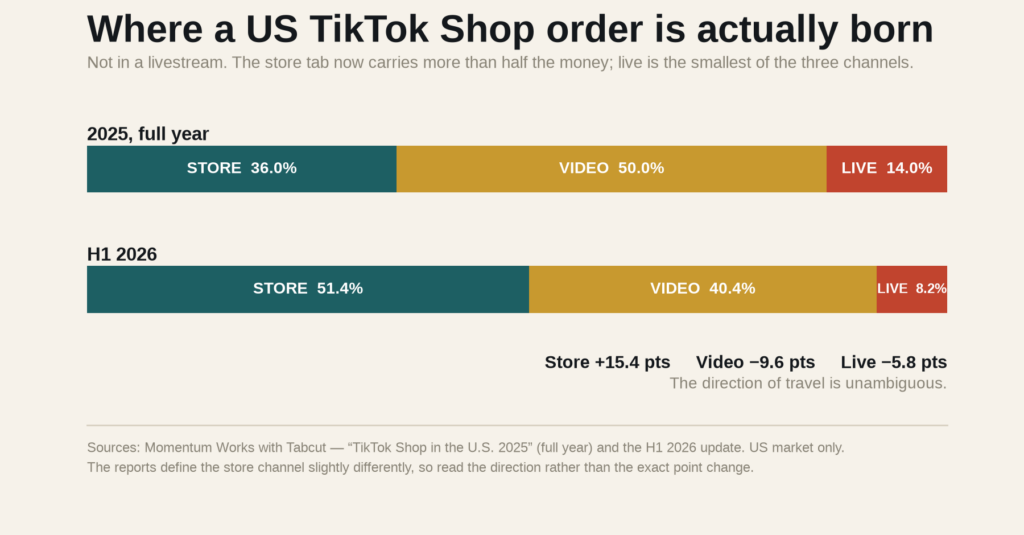
So the new China export is not a container. Fine. But it is not a livestream either. It is a short video that creates the want plus a shelf that closes the sale. Live is the campfire, not the shop.
That distinction is not academic. If you are budgeting for 2.0, put the money behind the video-and-shelf loop, and stop building studios.
What 2.0 builds, and what it breaks
Builds: demand creation at global scale. Chinese sellers now manufacture desire in front of consumers who never went looking for them, which is a capability 1.0 never had. It also builds speed as a product feature — replenishment in days is a customer-experience claim, not just a cost line.
Breaks: the catalogue assumption that nothing exists until it is searched. It breaks the wholesale layer, which is why the trade-show middleman is quietly disappearing from the supply chain. And it breaks the old sequence in which a company earns brand equity after it earns scale. In 2.0, scale arrives first, and sometimes it arrives instead of the brand.
Doesn’t fix: the two things 1.0 never fixed. Pricing power and an owned audience. More reach, same weakness.
The size of the machine, in customs numbers
China Customs put cross-border e-commerce at 2.84 trillion yuan in 2025, up 4.8%, roughly $418 billion. Exports were 2.27 trillion yuan, up 5.4%, equal to 8.4% of all goods exports. Imports came to 570.2 billion yuan, up 2.7%. Consumer goods were 97.3% of what left the country.
Two details matter more than the headline.
Growth decelerated. Export growth of 5.4% was the slowest since 2019, and that reading predates Europe’s new duty.
And the machine is geographically lopsided. Goods sourced from Guangdong alone accounted for 51.1% of cross-border export volume, the first time the province cleared half. The top five provinces produced 82.8% of it.
On the demand side, meanwhile, one platform has become the story:
TikTok Shop did $4.4 billion in 2022, $16.3 billion in 2023, $33.2 billion in 2024 and $64.3 billion in 2025. It then booked $50.3 billion in the first half of 2026 alone, and Momentum Works projects $123.5 billion for the full year. US GMV was $15.1 billion in 2025, up 68%, and $11.8 billion in H1 2026, up 103% — enough to push the US past Indonesia as the largest single market on the platform.
The old channel is being rebuilt inside the new one, too. Amazon Haul, launched in November 2024 as a Temu clone, reached roughly $2 billion in US annual GMV with 3,287 active sellers — 97.5% of them registered in China. Same supplier base, different storefront.
Then the door closed
For five years the model ran on a regulatory courtesy: goods under $800 entered the United States duty-free. Everybody in the industry knew it was a subsidy. Almost nobody priced it as one.
2 May, then 29 August
The US ended de minimis for China and Hong Kong on 2 May 2025, initially at 120% and later at 54%, then extended the end to every country on 29 August 2025, with a flat duty floor of $80 per parcel.
The floor is the detail that killed the arithmetic. An $80 duty on a five-dollar blouse is a sixteen-hundred-percent tax. Economists writing for the National Bureau of Economic Research estimated broker and processing fees alone at about $23.19 per package — roughly 17% on an average parcel, and more than four times the price of a cheap top shipped on its own. For the average American household, about $136 a year.
Europe’s €3, and the fee behind it
The EU Council abolished the €150 threshold on 11 February 2026. From 1 July 2026, a flat €3 duty applies per item category inside a parcel, running until the customs data hub goes live around 2028, with a roughly €2 handling fee following in November 2026. About 5.8 billion low-value parcels entered the EU in 2025. That number was the argument.
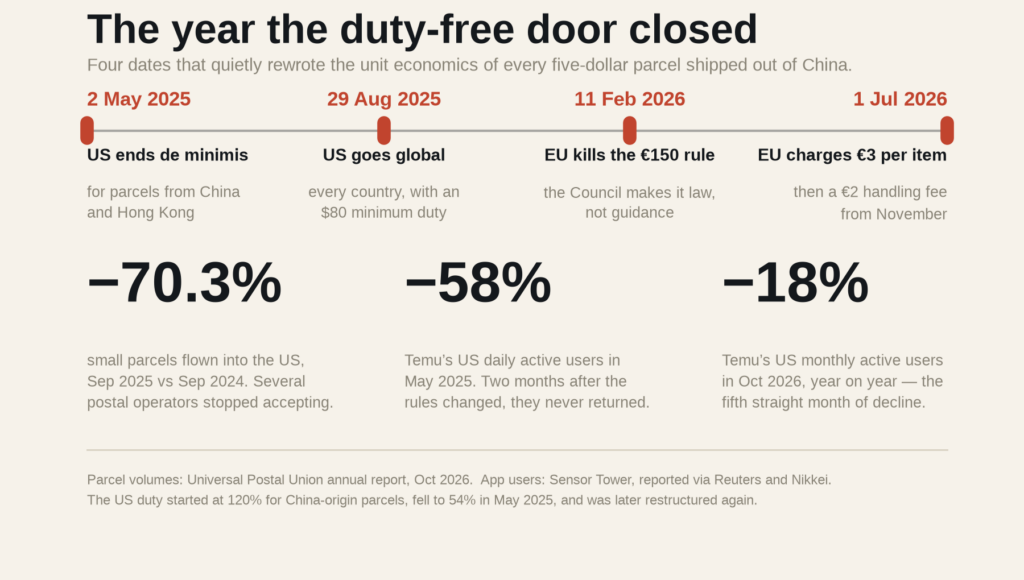
The Universal Postal Union measured the aftermath: parcels arriving in the US fell 70.3% year on year in September 2025. Several national postal operators stopped accepting US-bound mail entirely. Into the EU the drop was around 30%, smaller because Brussels gave the trade a runway to re-price.
Who blinked first
Temu went local, and paid for it
Temu’s US daily active users fell 58% in May 2025. It cut advertising, stopped most China-direct shipping into the US, and rebuilt around local sellers and local warehouses. By late 2026 more than a third of its US assortment came out of US warehouses, against a model in which roughly three quarters had been China-managed.
It never fully recovered. Temu’s US monthly active users were down 18% year on year in October 2026, the fifth consecutive monthly decline, and the US share of its global traffic slid from 26% to 16% as Europe and Latin America absorbed the difference.
Read that as a trade, not a defeat. Temu swapped a low-margin arbitrage for a costlier, more defensible retail model. The costs did not vanish. They changed owner.
Shein’s listing was the verdict
Shein listed in Hong Kong on 1 September 2026 at a valuation of about $26.5 billion. In 2022 it carried a private valuation near $98 billion. The shares fell as much as 10% on day one.
The financials explain the reset better than any analyst note. Revenue grew 8% in 2025 to $41.85 billion while net income fell from $3.37 billion to $2.06 billion. In the first quarter of 2026, revenue grew 1.1% and the company posted a $99 million loss. The US was 22.5% of sales, down from about 30% in 2023.
That is what happens when a company built on duty-free small parcels has to file customs paperwork like everybody else. The market repriced the model, not the merchandise.
The re-intermediation nobody wants to admit
2.0 was sold as independence: sell direct, own the customer, cut out the middleman. In practice the middleman got swapped for a bigger one.
On 22 January 2026, TikTok’s US operations moved into a joint venture, TikTok USDS JV LLC, with American and international investors holding 80.1% and ByteDance 19.9%. Oracle, Silver Lake and Abu Dhabi’s MGX each took 15%. The venture was valued around $14 billion, and investors reportedly paid about $10 billion in fees to the US government for the privilege of owning it.
Here is the part that matters if you sell on the platform: the venture took the data, the moderation and the recommendation algorithm. ByteDance kept the global advertising business and TikTok Shop’s commerce operations. The storefront changed landlord. The commerce engine did not.
You can read that two ways. Optimistically, TikTok’s US future is now legally settled, which helps anyone whose revenue depends on it. Pessimistically, the seller’s position is exactly what it was: a tenant, paying rent set by an algorithm nobody can audit.
What this actually means if you sell outside China
Stop paying for the price war
If your 2026 plan is to undercut a Guangdong factory on a commodity SKU, you have already lost, and the loss will be slow enough to feel like progress. The $47.62 against $22.03 split is the cleanest evidence available: the sellers who win the price fight do not win the money. Compete on what does not ship by the container — trust, taste, service, warranty, a reason to come back.
Steal the demand mechanics, leave the margin model
The part of 2.0 worth copying is the loop, not the price. Cheap content, fast test, an honest read on what moved, replenish what worked. Most Western teams still run that loop in quarters; the model runs it in weeks. You do not need a race to the bottom to run it. You need a smaller first order and a faster kill decision.
Compliance is a channel decision now
Duty treatment changed the shape of the business. A €3 charge per item category turns a twelve-item parcel into a different economic object than twelve single-item parcels. DAP versus DDP is no longer a logistics footnote; it is a pricing strategy and a conversion decision. If your finance team still treats landed cost as an afterthought, that is the leak.
Buy the asset the model keeps skipping
TikTok Shop’s US top 10,000 sellers are 57% China-registered, with a median price of $19 against $30 for US-registered sellers. Same pattern as Amazon, different platform, same gap — because it is literally the same gap. No owned audience, no brand equity, nothing that survives the next algorithm update.
Build the list, the community, the repeat-purchase rate. Those are the only assets a customs notice cannot reprice.
The second act is already visible
The best counter-argument to “China can only export cheap goods” comes from companies that stopped competing on freight.
Roborock booked RMB18.7 billion of revenue in 2025, up 56.5%, with 56% of it earned overseas. IDC put its global robot-vacuum shipment share at 17.7%, number one, on 5.8 million units. Anker passed RMB30.5 billion in revenue. Insta360 holds roughly 66% of the global panoramic camera market, with 69% of revenue outside China.
None of them won by being cheapest. They won by owning a technical claim — navigation, charging, stabilisation — and then exporting it. That is a brand, not a listing.
The pattern, if you are looking for it
The exporters moving up are the ones whose advantage is engineering and product definition rather than warehouse proximity. The ones stuck at a $19 median are the ones whose only claim is “same thing, less money”. Both cohorts are Chinese. Only one of them is a business that survives a tariff.
Honest caveats
Three things could make this analysis wrong.
Concentration is fragile. On TikTok Shop US, the top 748 sellers account for about half of cumulative sales, and more than half of all shops record no sales at all. A marketplace where the median seller earns nothing is a marketplace whose seller base can evaporate in a quarter.
Regulation is unfinished. The US–China truce runs only to 10 January 2027, a proposed $60 billion reciprocal tariff package is still unfinalised, and Washington has signalled a shift from IEEPA tariffs to Section 301. Any of that can reprice the model again, quickly.
And the numbers carry definitions. A “China-registered seller” is not a Chinese-owned brand. Channel-mix percentages move with methodology. Anyone quoting these figures as precise should be treated with suspicion, including me. The direction is the signal. The decimals are decoration.
The takeaway
Cross-border 2.0 is China rebuilding an export machine around attention instead of catalogues: a feed that manufactures the want, a supply chain that answers in days, and a warehouse that now sits closer to the buyer than the buyer’s own high street.
It won the transaction. It created demand at global scale, and it did it faster than any retailer in history. What it has not won is the relationship — and the two datasets in this piece, Amazon and TikTok Shop, tell the same story twice, six years apart. Seats are cheap. Pricing power is not.
The 2025–2026 duty shock did not kill the model. It promoted it. The arbitrage players are becoming ordinary retailers with local inventory and customs declarations, which is a lower-margin, more boring business. Boring is survivable.
The brands that come out of this decade will be the ones that pair China’s speed with something a customs form cannot tax: a reason to choose you that is not the price.