The Reporting Gap Behind the AI Ad Boom: Why Brands Are Buying a Channel They Cannot See
Here’s a fact that should have been a headline and wasn’t: in August 2026, when Similarweb published the first dataset showing that 26% of ChatGPT answers carried a sponsored placement, the ads had already been running for six months.
The timeline is almost too neat. US pilot in February. Self-serve buying opened in May. Thirty-one European markets by late August. A reported billion-dollar annualised run rate by the end of that month — under 200 days from a standing start.
The measurement arrived on 17 August. The money arrived in February.
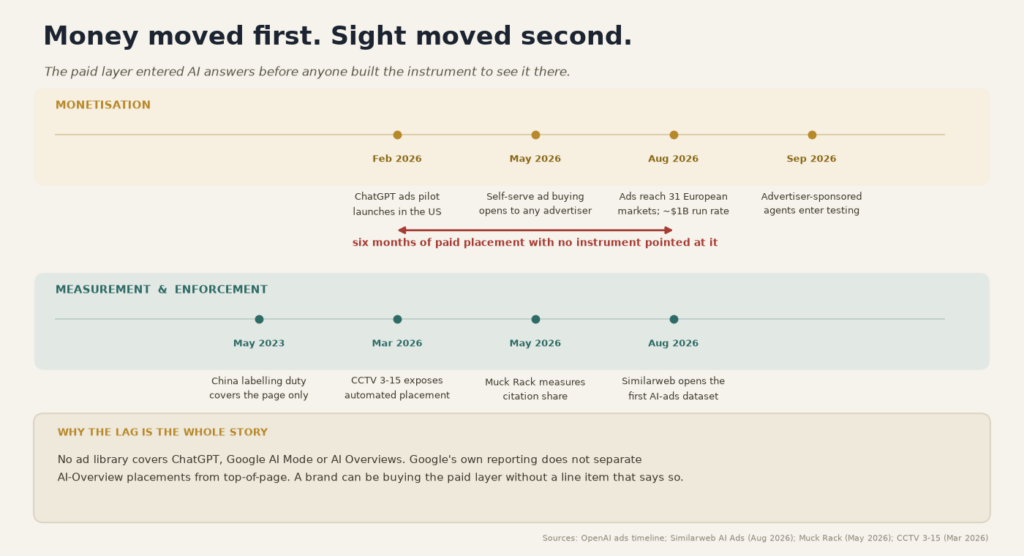
That gap is not an accident of scheduling. It is what happens when the same company owns the surface, sells the inventory and keeps the books.
The reason measurement is late is that nobody required it
In every previous advertising channel, the measuring apparatus arrived early — and not out of virtue. It arrived because someone had to send an invoice, and an invoice requires a number both sides accept. Newspapers had circulation audits a century ago. Search had impression counts from the first auction. Social had third-party verification within a few years.
In each case the instrument was built by the buyer or the regulator, because the seller had no incentive to build it and every incentive to be vague.
AI answers broke that pattern by collapsing the three roles. A single vertically integrated platform owns the conversation, the placement and the reporting. It can bill internally, at scale, without ever exposing a queryable record of what ran, who paid, or in what context. No ad library covers ChatGPT, Google AI Mode or AI Overviews — nothing equivalent to the archives that make Meta and Google’s own ad systems externally inspectable.
So the opacity is not a missing feature. It is the default state of a channel whose seller never needed to prove anything to anyone.
This is why two contradictory numbers can both be true
The same blindness explains a statistics fight that has been running all year. One widely cited study finds paid and advertorial content accounts for 0.3% of AI citations. A narrower audit of buying-intent queries finds 25.4% of cited sources carry a commercial disclosure.
Both are honest. Neither can see the layer that matters most, because a placement inside an answer — a labelled chip, a sponsored agent — is not a page and does not appear in either dataset. The instruments were pointed at the web, while the money moved into the interface.
The part that should worry a media buyer
Google’s own reporting does not separate AI-Overview placements from conventional top-of-page inventory. Which means a brand can be buying the paid layer right now, at real cost, with no line item that says so.
That is the discovery worth sitting with. The problem is not that the ads are hidden from users — they are labelled, and the labels are honest. The problem is that they are hidden from the people paying for them.
The lag is the story. A channel becomes governable at the moment it becomes observable, and AI advertising is being monetised roughly half a year ahead of being observable. Every brand currently spending there is, in the strict sense, buying sight unseen.