The Old Soft Article Found a New Reader: How Paid Placement Learned to Feed the Model
“Soft Articles” Became an AI-Source Strategy: How China’s Paid News Placement Pivoted From Persuading Readers to Feeding Answers
Somewhere in the last two years, the Chinese paid news placement — the 软文, or “soft article” — quietly acquired a second audience. The first audience was always a human being scrolling a news feed. The second audience is a retrieval system that does not scroll, does not get bored, and does not know it is being sold something.
That change is easy to miss because nothing about the artifact changed. Same length. Same byline. Same “industry observer” framing. Same fee paid to the same kind of agency. What changed is who consumes it and what consumption now means. For decades, a soft article had to survive a reader. The reader might notice the flattery, might check who wrote it, might simply not care. That friction was the placement’s real cost, and it was expensive.
The answer engine removed the friction without removing the payment. And that, more than any algorithm update or model release, is the structural story of Chinese PR in 2026.
What a soft article actually is, without the euphemism
Let’s define it precisely, because the industry’s own vocabulary tends to blur it.
A soft article is paid content that is shaped like editorial. A brand — or the agency it hires — arranges for a favourable piece to appear on a media domain, presented in the grammar of news or review rather than the grammar of advertising. It borrows the credibility of the surrounding publication and spends it on a claim the brand wanted made.
The definition that survives translation
Western PR people hear “soft article” and reach for “native advertising.” That is close but not right. Native advertising is a format with a business model attached and, in most mature markets, a label attached. The soft article is older, more industrialised, and historically less fussy about labels. It grew up inside a media economy where “media lists” were sold by the article, where pricing was quoted per placement per tier, and where the distinction between a journalist’s judgment and a client’s preference was frequently a matter of negotiation rather than principle.
The numbers here are not a cottage industry. The China International Public Relations Association put the country’s PR industry at roughly RMB 87.3 billion in 2025, up 4.1% — slower than preceding years, with profits compressing and what the association calls “involutionary” competition persisting. Digital work accounted for 78% of sample firms’ business. Meanwhile the audience these placements chase has moved: CNNIC counted 602 million generative-AI users in China at the end of 2025, up 141.7% year on year, and by the first half of 2026 its follow-up report put the figure past 700 million, with 76% of users employing these tools to answer questions.
Put those two facts side by side. A shrinking-margin industry whose clients increasingly live inside AI answers. You can predict what happened next without being told.
Why the editorial shape is the product
Here is the part that gets lost in ethics debates. The editorial shape is not decoration. It is the mechanism.
A reader who knows they are looking at an ad applies a discount. Research on sponsorship disclosure in native advertising has documented this repeatedly: disclosure activates what persuasion researchers call persuasion knowledge, and persuasion knowledge suppresses the outcome the advertiser wanted. The whole point of the soft form is to arrive before that discount is applied.
So the soft article is a device for postponing scepticism. Everything else — the pricing, the media tiers, the “objective analysis” voice — is infrastructure around that one trick.
The reader changed hands
Now look at what happened to the chain.
The old chain had a gate
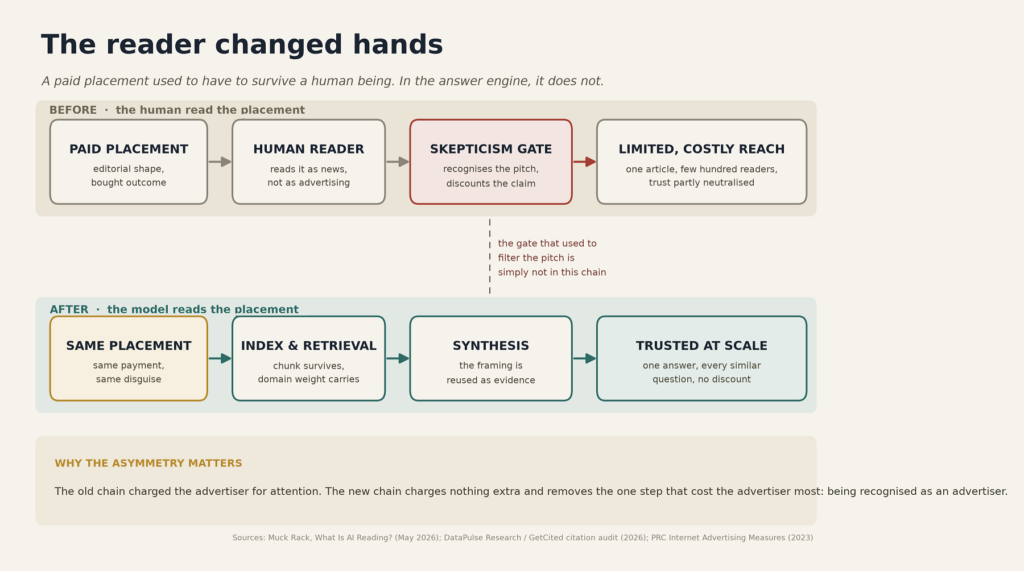
Originally the sequence ran: paid placement → human reader → scepticism → some residual persuasive effect. The gate was the third step. It was imperfect and easily defeated, but it existed, and it cost the advertiser something to get through.
The new chain has none
The current sequence runs: paid placement → crawl and index → retrieval → synthesis → answer, delivered to millions. The gate is not there. Not because it was defeated, but because it is not part of this architecture.
An assistant does not experience an article as an advertisement. It experiences it as a span of text with a topic, an entity, and a citation-worthy shape. Whether the text was bought is not a property that survives the trip. The model has no mechanism for knowing, and — more to the point — no instruction to ask.
That is the entire pivot. The placement did not get better at persuading. It got routed around the one participant who could refuse.
Two numbers that should not be compared
At this point a reasonable objection appears, and it comes from the most-cited study in the field.
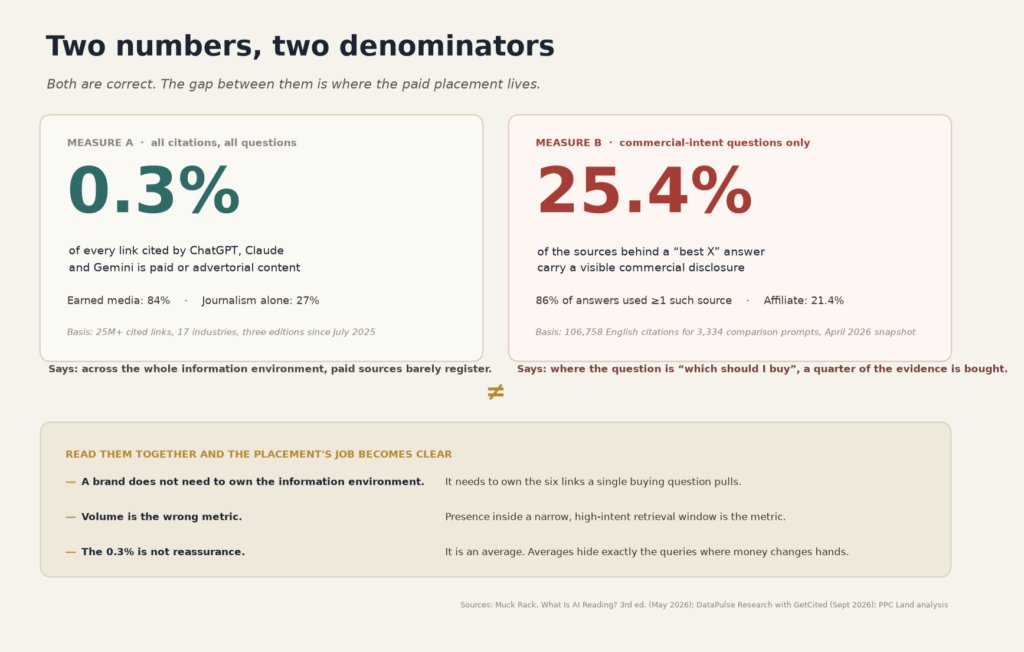
Muck Rack’s What Is AI Reading? series, in its May 2026 edition, analysed more than 25 million links cited by ChatGPT, Claude and Gemini across 17 industries. Its headline findings have held steady across three editions since July 2025: earned media accounts for 84% of citations, journalism alone for 27%, and paid and advertorial content for 0.3%.
Read casually, that last number destroys the thesis of this article. Paid placement is a rounding error. The models have, in effect, voted for earned credibility. Several PR firms have built entire pitch decks on this.
The 0.3% is real, and it is the wrong denominator
It is a real measurement. It is also measuring something different from what people think it measures — and it is being read with the denominator of a different question.
Muck Rack’s share is computed across all citations for all prompts. That is the right denominator if you want to describe the information environment. It is the wrong denominator if you want to describe a purchase decision.
For that, look at what DataPulse Research and GetCited did in April 2026: 3,334 English-language “best X” comparison prompts, run against ChatGPT, Google’s AI Overview and Perplexity, producing 106,758 citations, with every destination page checked for visible commercial disclosures. The result: 25.4% of the sources cited behind a buying question led to pages carrying a declared commercial interest. Affiliate content alone was 21.4%. And 86% of the answers used at least one such source.
A German-language parallel dataset, published earlier, ran 29%.
Three caveats, stated plainly, because this number will be abused if it is not qualified.
First, the two studies do not measure the same thing. Muck Rack counts a content format (“paid/advertorial”). DataPulse counts a disclosure on the destination page. Neither measures undisclosed placement — which is, inconveniently, the entire subject of this article. Unlabelled soft articles are invisible to both methods. Both figures are floors.
Second, GetCited is a Berlin generative-engine-optimisation agency that sells placement into exactly the layer it measured. That is a conflict of interest, and it cuts both ways: the firm had every incentive to make the commercial layer look large, and also every incentive to keep its methodology defensible. Read the number as an industry participant’s estimate, not an audit.
Third, the German and English editions reported different figures for overlapping data, which the trade press noticed. Treat the precise decimal as soft and the order of magnitude as hard.
Where the money actually shows up
With those caveats in place, the shape of the finding is robust and it is uncomfortable.
The commercial share is not evenly distributed. It concentrates in categories where a purchase decision is imminent and comparison is the natural query. Consumer electronics ran at 41%; education at 13%. Concentration among publishers was extreme: ten outlets supplied roughly a quarter of all commercially disclosed citations in the English set, and most were affiliate-funded review brands.
So: the placement does not need to own the web. It needs to own the six links that one buying question pulls.
How the machine reads a soft article
The mechanism deserves more precision than “it gets scraped.”
Retrieval is not reading
A large-scale audit of Google’s AI Overviews — 55,393 trending queries over 40 days, 98,020 extracted factual claims — found that roughly 11% of generated claims were not supported by the pages cited, mostly through omission rather than contradiction. It also found that nearly 30% of the domains cited in AI Overviews did not appear on the first page of ordinary search results for the same query. The generative layer draws from a candidate set the ranking algorithm never showed you.
That matters for placement strategy in a way most agencies have not internalised. You are not competing for rank. You are competing for inclusion in a retrieval pool whose selection logic is partly opaque and demonstrably different from the one SEO was built for.
What actually gets absorbed
A separate measurement of citation behaviour across ChatGPT, Google’s AI surfaces and Perplexity — 602 controlled prompts, 21,143 citations — found that citation breadth and citation depth diverge. Some engines cite many sources shallowly; others cite few and lean on them hard. The pages with the highest influence tended to be longer, more structured, semantically aligned, and dense in extractable evidence: definitions, numbers, comparisons, procedures.
Structural engineering alone has been measured at roughly a 17% citation-rate improvement across six engines, holding content constant. A 2026 survey of 45 studies in the field reached a sobering conclusion about all of this: topical relevance and context position are the most reproducible levers, and generic heuristics transfer poorly between engines and across competitive fields.
Translation for anyone selling soft articles: a well-shaped placement works, a generic one does not, and the advantage decays as your competitors do the same thing.
The Chinese version of this is not subtle
If any of the above sounds like an abstract worry about Western affiliate content, the Chinese market ran the experiment in public.
The regulation that already exists
The rules were never silent on this. China’s Internet Advertising Measures, in force since May 2023, require internet advertising to be identifiable, and explicitly extend the labelling duty to promotional content dressed as knowledge-sharing, experience-sharing or product review where a purchase link is attached. The Advertising Law goes further: mass media may not publish advertising in the guise of news reporting. The sanction for an ad that cannot be identified as an ad is an order to correct plus a fine of up to RMB 100,000 on the publisher.
In September 2026, a further instrument took effect: the multi-channel content distribution rules issued jointly by the cyberspace administration, public security, culture and tourism, market regulation and broadcast authorities. It requires firms that produce and distribute content on behalf of account holders to register, obtain any relevant licences, file with provincial cyberspace authorities, and disclose their affiliation on the accounts they operate. It also prohibits fabricating background, plot or persona for misleading marketing.
On paper, then, the paid-origin problem is covered. Twice.
The 2026 broadcast that settled the argument
In March 2026, CCTV’s annual consumer-rights programme demonstrated what the paper coverage misses.
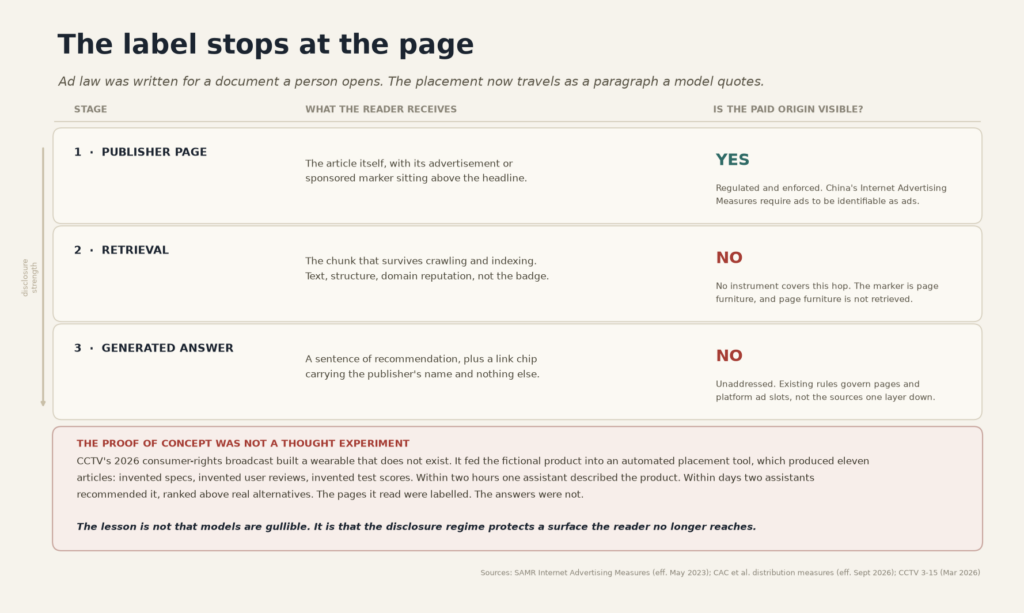
The team invented a wearable that does not exist. They fed it into an automated placement system, which generated eleven articles — invented specifications, invented user reviews, invented test rankings. Within two hours, one assistant described the product back to a user, reproducing the fabricated claims almost verbatim. Within days, after the remaining articles went live, two assistants recommended it, ranked above real alternatives.
Every one of those source pages was, by the program’s account, ordinary self-published content of the kind the rules were designed to catch. The pages were the problem the law anticipated. The answers were not.
The regulator’s response was immediate, and it was aimed at the software vendor. But the underlying mechanism is not a vendor problem. It is an architecture problem, and it predates the vendor by several years: academic work on retrieval poisoning demonstrated in 2024 that five carefully constructed texts, inserted into a corpus of millions, could achieve attack success rates approaching 90% against a retrieval-augmented system.
Five documents. That is the unit of manipulation now.
Why the disclosure regime loses at the hop
Worth being blunt about the legal logic, because it explains why compliance theatre will not save anyone.
Advertising-identifiability rules were written for a document a person opens. The disclosure lives in the page furniture — a badge above the headline, a bar under the navigation. Page furniture is not retrieved. It is not chunked, not embedded, not cited. What survives the crawl is the argument, stripped of its provenance.
So the label does its job perfectly and still fails, because the reader the label was built for is no longer the reader that arrives. The law protects a surface; the placement travels as a paragraph.
No current instrument governs that hop. Neither does any platform policy, because platform ad policies govern the platform’s own ad slots — the sponsored chip next to an answer — not the commercial character of the sources one layer beneath. Those are different surfaces with different owners and, so far, different rules. Industry measurement frameworks are only now beginning to separate organic AI visibility from paid, and they explicitly defer the paid question.
This is not a gap anyone planned. It is a gap created by a change in who reads.
The scale asymmetry
Here is the arithmetic that made the practice spread faster than the ethics could keep up.
One placement, read by humans, reaches hundreds or low thousands, with attrition at every step, and the effect fades as the article ages out of feeds.
One placement, cited in an answer, is served to every user who asks a similar question, in the same words, for as long as the retrieval pool holds. There is no fatigue, no scroll-past, no “I’ve seen this ad before.” And because answers are assembled per query rather than per reader, a single well-shaped citation can surface across thousands of differently-worded questions that resolve to the same intent.
The asymmetry is not that the new channel is bigger. It is that the new channel has no marginal cost per impression and no scepticism gradient.
The trap: what it costs when it works
Now the part the pitch decks leave out.
If a placement gets cited, the brand has not acquired an asset. It has acquired a liability with a delayed settlement date.
The second-order risk nobody prices
The exposure is not “the article gets taken down.” It is that the answer gets audited. When researchers, journalists or a competitor trace a confident AI recommendation back to a page that turns out to be paid, the finding is not “this publisher took money.” The finding is “the AI said this, and it was bought.” The brand becomes the subject of a story about AI being manipulable, and it does not get to be a footnote in that story.
This is a different risk class from ordinary reputational exposure, because the damage lands on the trust in the channel as well as on the brand. Regulators who cannot easily police ten thousand pages can very easily make an example of one answer.
There is also an operational blindness problem. Very few organisations can currently see where their placements are being cited. The IAB’s framework, published in August 2026, found more than 20 vendors selling AI-visibility measurement with little methodological consistency, and McKinsey’s CMO survey work found only 16% of brands tracking AI search performance systematically — while estimating that laggards could lose up to half their organic traffic. You cannot manage an exposure you cannot observe, and most brands are not observing.
Two ways to play the same game
The uncomfortable conclusion is that “is this ethical?” is the wrong question. The practice is a channel. Channels are neutral. Conduct is not.
The honest version
Write content that is genuinely useful, factually accurate, and disclosed where disclosure is required — and let it be cited because it is the best available answer. This is slower, less controllable, and it works. It is also, notably, the only version whose returns compound: a citation earned on merit survives model updates, because the reason for the citation was the content, not the trick.
The version that borrows trust
Game the authority signal. Place disguised, inflated claims on domains that carry weight. Accept that the mechanism is misrepresentation and that the settlement date is unknown.
The two paths produce identical short-term dashboards. They diverge on the second audit, and the second audit always comes.
What to measure instead of placements
If placements are now inputs to an answer rather than impressions in a feed, the old metrics are decorative. “Placements secured” and “estimated reads” describe a chain that no longer exists.
The useful frame is the one the IAB published in August 2026, which decomposes AI visibility into four layers: presence (does the brand appear at all), prominence (where in the answer), portrayal (what is said, and whether it is accurate), and persuasion (whether the answer actually moves anyone). It is a hierarchy — you cannot influence a decision from a position of absence — and it has a useful discipline built in: fewer than 50 queries is exploratory, not directional, and directional is not decision-grade.
Apply that honestly and the question changes from “did we place the article?” to “which answer changed, on which engine, for which prompt, and did the change survive three weeks?” That is a harder question with a real answer, which is why most teams still prefer counting placements.
Two other numbers worth watching, with their limits stated. Seer Interactive’s tracking found average organic click-through rates on AI-Overview-affected queries falling 61% and paid click-through falling 68% between mid-2024 and late 2025; brands cited inside the overviews saw organic CTR up 35% and paid up 91%, though the study’s author cautioned that causality was not established and that better-known brands are simply more likely to be included. Direction, not proof.
And note the direction of travel on the platforms themselves: sponsored placements were recorded in 26% of ChatGPT responses shown to free-tier users in August 2026, and OpenAI began testing advertiser-sponsored agents in September. The labelled layer is arriving. The unlabelled layer beneath it is the one still ungoverned.
What I would actually do
Four things, in order.
Audit your own citation layer before you add to it. Pick twenty buying-intent questions in your category. Ask them, in the language of your market, across the engines your buyers actually use. Record which sources get cited, and check those sources for disclosures. You will learn more from that afternoon than from a quarter of placement reports — and you may discover you are already being cited from pages you did not buy.
Treat disclosure as a positioning asset, not a compliance cost. In a retrieval pool where every source looks equally authoritative, being the one source that is verifiably independent is a differentiator. Earned credibility is measurable: the Muck Rack data has consistently favoured it, and even the sceptical read of that data does not overturn the direction.
Stop buying volume and start buying position. The concentration figures are unambiguous: a quarter of the commercial layer came from ten publishers. If your budget is spread across two hundred low-weight domains, you are buying the wrong thing. Fewer, better, more extractable.
Assume the citation is public. Before approving any placement, ask a single question: if a journalist traced this answer back to this page and read it aloud on air, would we be fine? If the answer requires an explanation, the placement is a liability with an unknown maturity date.
The part nobody wants to hear
The soft article did not die. It found a reader that cannot be lied to in the way humans can be lied to — because it does not evaluate intent at all. It evaluates shape.
That is the whole trade. You can give the machine a shape that earns the citation, or a shape that steals it. Both work. Only one survives being looked at.
And the trust paradox sits underneath all of it: the more successful the practice becomes, the more placement-dense the answers get, and the less the public trusts the answers — and the brands inside them. Every brand currently enjoying an unexplained citation is drawing down a reserve it did not build and cannot replenish alone.
The 0.3% is a comfort only if you never ask what question it was the answer to. Ask the question your customer asks, and the number changes. Ask it honestly, and you will find the placement sitting right there, dressed as evidence.
That was always the trick. The difference now is who is reading.