72% of Retailers Now Charge for Returns. The Math Is Half-Blind.
Why most large US retailers now charge you for sending something back — and why the number that justifies the fee is the one they never measure.
Charging a customer for a return used to be a last resort. In 2025 it became the default. Among large US merchants, 72% now charge for at least one return option, up from 66% a year earlier — a shift tracked in the National Retail Federation and Happy Returns 2025 Retail Returns Landscape, which surveyed 358 e-commerce professionals at retailers turning over more than $500 million. A further 15.8% of annual sales, or $849.9 billion, came back as returns. The fee is no longer a tactic. It is infrastructure.
The Number That Makes the Case
Ask retailers who introduced a fee whether it worked, and they answer cleanly: 53% say their return rate fell, 52% saw more shoppers switch to an exchange, 43% recovered direct fee revenue, 42% saw fraud decline. That is a coherent story, and it fits neatly on one slide.
The Number That Never Reaches the Slide
The same survey asked about the other direction. 47% reported more customer complaints. 37% lost customers outright. 34% watched average order value slip. And 24% — roughly one in four — saw overall sales decrease.
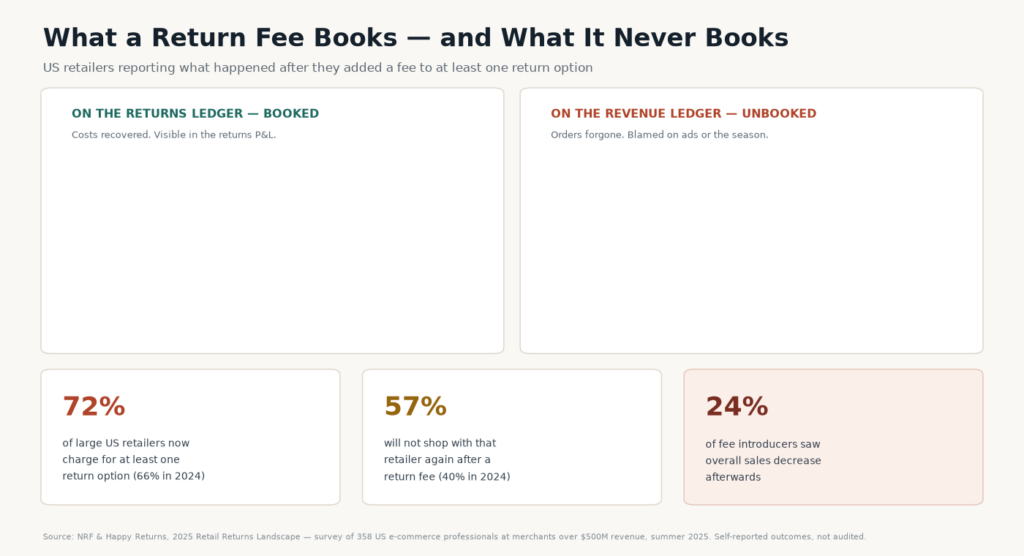
That last figure is the one worth sitting with. A quarter of the retailers who made returns less pleasant sold less afterwards, and the survey cannot tell you which of them knew it was coming.
Why the Loss Keeps Disappearing
Here is the mechanism nobody draws on a whiteboard. A return fee posts to the returns ledger, right next to shipping and restocking. It is visible, countable, and owned by one team with one target.
The orders it costs never post anywhere. They arrive as a marginally softer conversion rate, which gets attributed to creative fatigue, a slow fortnight, or the ad auction getting more expensive. So the fee is defended with a number while its cost is quietly absorbed into somebody else’s budget line. Nothing about this is dishonest. It is just how ledgers are built: they record transactions, not the transactions that failed to happen.
The Asymmetry Is an Accounting Artifact, Not a Strategy
Blue Yonder’s 2025 Global Consumer Retail Returns Survey, covering more than 6,000 shoppers across the US, UK, France, Germany, Australia, New Zealand and the Middle East, found 84% would stop shopping at a favourite retailer if rules tightened, and two-thirds had already held back a purchase because of them. Baymard’s latest checkout research adds the smaller, sharper signal: 13% of people who abandon a cart name an unsatisfactory return policy as the reason.
Put a fee against processing that already costs retailers around a fifth of the order’s value — the Pitney Bowes BOXpoll figure, a 2022 survey of 168 US merchants still cited as the industry benchmark — and the question stops being whether the fee recovers cost. It becomes whether it recovers more than the shoppers it frightens off.
But Don’t Overcorrect Into Free Returns Forever
The reflexive answer — make returns free and endless — does not survive contact with evidence either. A World Bank randomised field experiment in Senegal tested three quality signals on solar lamps: third-party certification, warranty, and money-back guarantee. Certification and warranty lifted demand. The money-back guarantee did nothing.
That result is not a refutation of risk reversal; it is a boundary condition. Those buyers doubted the lamp would last, not that it would work. A return promise answers the second question and stays silent on the first. Generosity only signals something when it addresses the uncertainty the buyer actually holds.
Keep the Fee, Kill the Blindness
None of this argues that return charges are wrong. In categories where reverse logistics genuinely eats the margin, a fee may be the honest option. What it argues is that the decision deserves measurement on both sides.
Before you ship a fee, instrument the conversion effect deliberately. Model recovery against a 2%, 5% and 10% conversion drop, then watch checkout completion for four weeks after launch. For many mid-market retailers the fee wins comfortably at 2% and loses at 10% — which means the entire verdict rests on a number almost nobody tracks.
Return policies stopped being terms and conditions somewhere around 2023. They are merchandising now. And merchandising does not get to hide in the logistics P&L.