The Ledger Behind China’s Review Economy: Why Inflated Reviews Are Self-Executing
In China, a review is not advertising. It is a contract — and it is written in the buyer’s favour.
Consider what shoppers actually do here. In one widely reported case, a buyer purchased a supplement carrying more than two thousand positive reviews, used it for two weeks, felt nothing, and posted the discrepancy. She did not file a complaint. She published. That post did more damage than any competitor’s campaign could have, because it did not attack the product. It attacked the reviews.
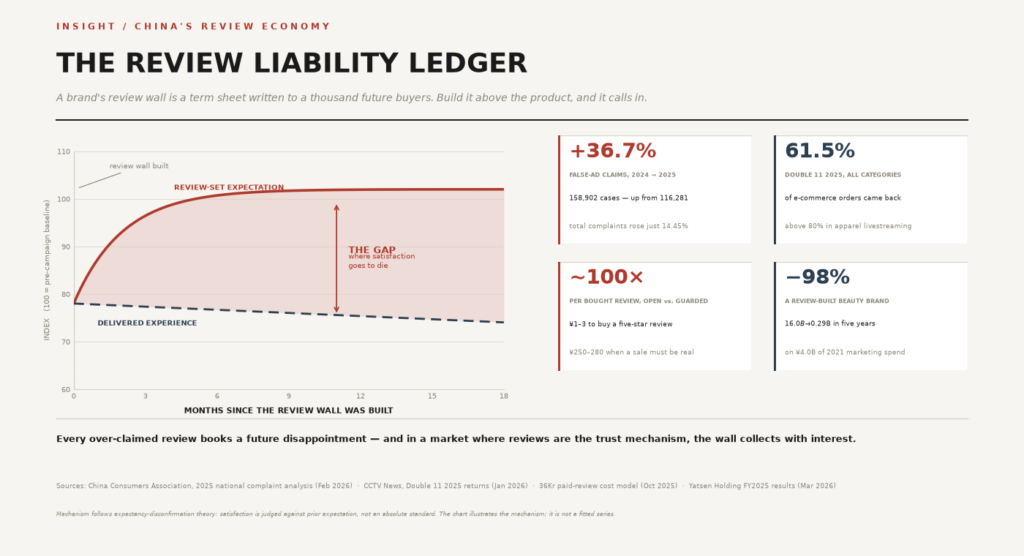
That is the whole mechanism in miniature, and it runs on a piece of consumer psychology that predates e-commerce by four decades. Satisfaction is not judged against an absolute standard. It is judged against what you were promised. Raise the promise without raising the delivery and you have not improved the product — you have lowered it. Every inflated review is a small loan against a future you have not built yet.
Now look at the ledger. China’s consumer complaint volume rose 14.45% in 2025. False-advertising complaints rose 36.7%, reaching 158,902 cases. Those numbers describe a market that has stopped politely absorbing the gap between claim and delivery — and an enforcement apparatus that has started pricing it. Beijing has closed or delisted more than four hundred platforms and apps built to sell fake reviews, and cleared 4.82 million pieces of related content. The State Administration for Market Regulation investigated 1,932 online unfair-competition cases in 2025 alone.
Which means the arithmetic that made review inflation rational has flipped. A bought five-star review costs one to three yuan on an open platform. Make a real purchase mandatory, publish the transaction trace, and the same review costs roughly 250 to 280 yuan — a hundredfold jump. Research on this cost gap estimates contamination in health categories at 15% to 40% before such safeguards, falling by 70% to 80% after. The shortcut still works, briefly. It just no longer works cheaply.
The brands that die this way rarely die of bad products. They die of a review wall built one storey above what they could actually ship — and in a market where reviews are the trust mechanism rather than a support act, the wall does not merely stop converting. It becomes the evidence.
Return rates are the honest meter. China’s e-commerce return rate hit 61.5% during Double 11 in 2025; apparel livestreaming ran above 80%. Some of that is sizing and some is impulse, but a meaningful slice is disappointment with a promise that overshot. Returns are a review you cannot delete.
The counterargument deserves a hearing: inflated reviews do convert, which is precisely why brands keep buying them. But that gain is borrowed, and China’s review system charges interest faster and more publicly than the loan was ever worth.
So treat the wall as a liability schedule, not a trophy cabinet. Seed reviews that match what you can reliably deliver. Watch the gap between promised and experienced through returns and complaints, not through star averages. And when the wall sags, fix the product — never re-inflate the reviews, because that is the move that turns a wobble into a collapse.
The wall you built will either compound trust or collect on it. You choose which, at the moment you decide what to promise.