The Commission Behind the Answer: Why China’s AI Assistants Became Merchants
For two years, the promise was that Chinese AI assistants would change how people find things. They ended up changing something narrower and far more lucrative: who gets paid when a thing is bought.
What shoppers actually hand over
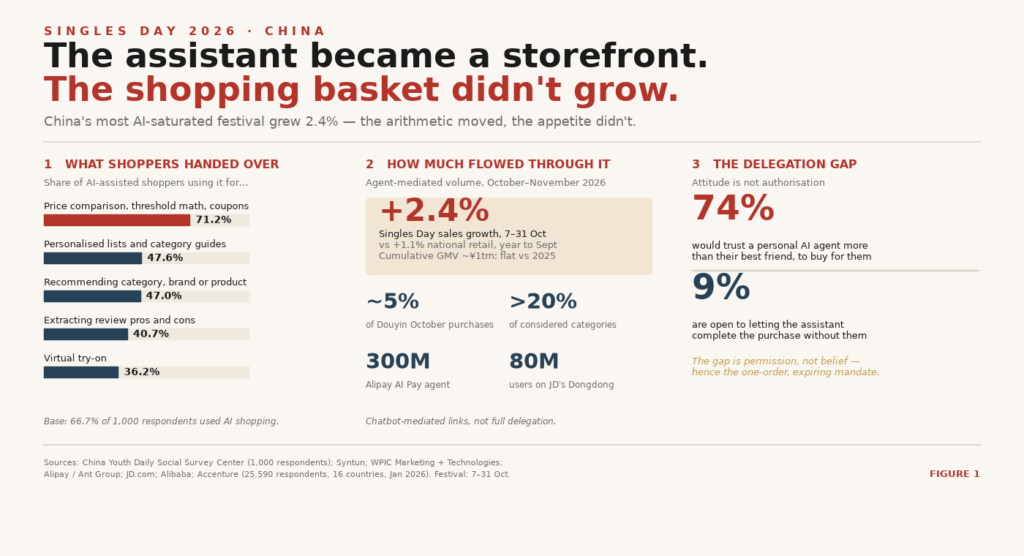
A China Youth Daily survey of 1,000 respondents found that 66.7% used AI at some point in their Singles Day shopping. Ask what they used it for, and the answer is telling: 71.2% for price comparison, threshold math and coupon stacking. Only 47% for recommending a brand or product.
The delegation begins with arithmetic, not taste. Consumers handed over the spreadsheet, not the judgement.
The number that refused to move
On Douyin, roughly 5% of October purchases ran through chatbot links — and more than 20% in considered categories such as supplements. JD’s Dongdong assistant drew close to 80 million users, more than triple last year. Alipay’s AI Pay has processed 300 million agent transactions and supports 95% of general agent frameworks, including a 120 million-transaction week in February.
Then the total: early festival sales grew 2.4% between 7 and 31 October, against 1.1% growth in national retail sales for the year to September. Cumulative GMV sat near ¥1 trillion, roughly level with 2025.
So the assistant did not create appetite. It captured the aisle.
Why the economics flipped
An assistant that answers earns from attention — ads, subscriptions, placement. An assistant that transacts earns from the transaction itself. Same conversation, different bill.
Once payment became native rather than a redirect, the platform’s revenue stopped depending on whether you scrolled and started depending on whether the order closed. That is why, within roughly twelve months, Alibaba wired Qwen into a four-billion-item Taobao catalogue, Meituan and ByteDance pushed their assistants toward checkout, and Ant Group rebuilt its payment stack around agents. Not because users demanded it. Because a commission outearns an impression.
The permission problem
Accenture surveyed 25,590 consumers across 16 countries: 74% said they would trust a personal AI agent more than their best friend to buy on their behalf. Only 9% were open to fully autonomous shopping.
Belief is not authorisation. China’s response was institutional rather than persuasive. Alipay’s delegated-payment feature issues a mandate for a single task — one instruction, one authorisation, void after use, capped at ¥1,000. The trust gap was engineered around, not argued away.
What it means for brands
If the assistant is the shelf, the contest is stocking, not ranking. A brand that wins the coupon calculation enters the shortlist the assistant generates. A brand that only wins the impression may never appear in the comparison at all.
That is the quiet transfer of power: not spending, but discovery control.
The takeaway
The merchant assistant is not a smarter chatbot. It is a toll booth on the last metre of the funnel. The 2.4% tells you the booth is open. It does not tell you the traffic grew.