Insight — The Economics Behind Why One AI Citation Is Worth More Than a Thousand Keywords
There’s a number that gets quoted at marketing conferences with a straight face and no follow-up question: an AI answer cites sources, so get cited. That’s the whole strategy. Get in the list.
The number that never gets quoted is the one sitting next to it. In March 2025, Pew Research Center tracked the actual browsing of 900 American adults across 68,879 Google searches. When an AI summary appeared, people clicked an ordinary result on 8% of visits instead of 15%. And the links cited inside that summary? They were clicked on 1% of visits.
One percent. The citation is, by traffic standards, worthless.
So why does every brand in your category suddenly have a GEO line item? Because the value was never in the click. And once you see where it actually sits, the whole discipline reorganises itself.
The scarcity premium
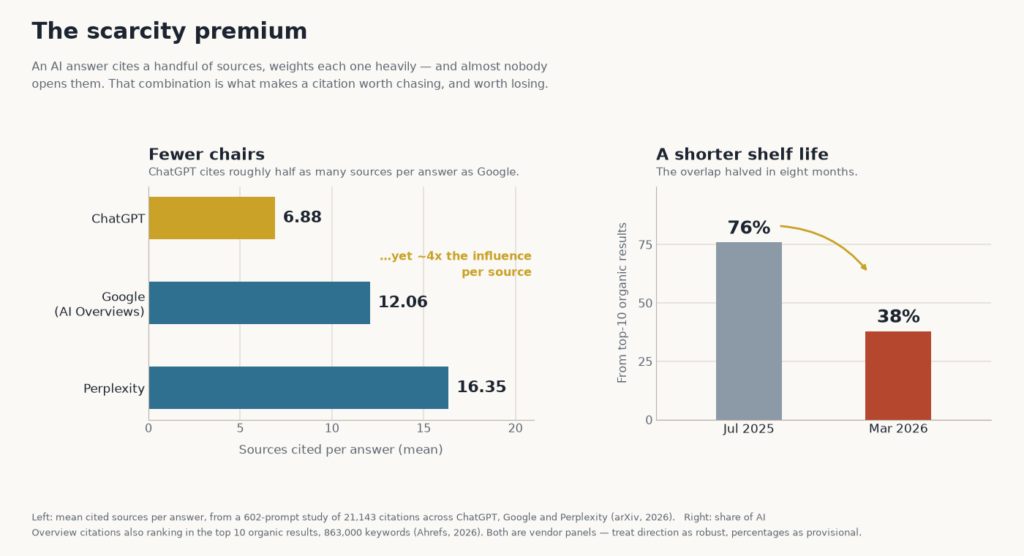
Start with supply. A 2026 study of 602 prompts and 21,143 citations pulled the numbers apart: ChatGPT cites 6.88 sources per answer, Google 12.06, Perplexity 16.35. Google also expanded its list — Gemini 3 pushed AI Overviews from 11.55 sources per answer to 15.22, replacing 42.4% of previously cited domains in the process.
Now compare that to what a brand used to compete for. Google’s first page has ten organic slots, plus ads, plus a map pack. A category with forty credible players could plausibly expect a third of them to be visible somewhere in the top twenty. Under AI search, an answer cites seven to fifteen sources and speaks in one voice. It doesn’t present your claim next to a competitor’s and let the reader adjudicate. It presents a synthesis, with your claim either inside it or absent.
That is the mechanism, and it inverts the usual SEO instinct. Search optimised for occupancy — how many queries can I appear on, how many pages can I rank. AI search optimises for inclusion — am I one of the seven things this machine decided to trust? Occupancy rewards breadth. Inclusion rewards being unambiguously the best available evidence on a narrow point.
Which is why the brands doing this well are getting narrower, not broader. One page that is the definitive answer on a specific constraint beats forty pages that gesture at the category.
The part that makes it strange
Here’s where it stops behaving like normal marketing economics.
A 2026 study across ChatGPT, Google and Perplexity found the platforms are almost inversely structured. ChatGPT cites the fewest sources — 6.88 per prompt — but its average per-source influence score ran roughly four times higher than the others. Perplexity cites 16.35 and spreads that influence thin across them.
Think about what that means for how you allocate effort. On Perplexity you’re competing to be one of sixteen voices in a chorus, each barely audible. On ChatGPT you’re competing to be one of seven, and being one of those seven does something — it moves the answer.
And then the really uncomfortable part: the citation you win may not be yours by next quarter. Ahrefs tracked 863,000 keywords and found that the share of AI Overview citations drawn from top-10 organic results collapsed from 76% in July 2025 to about 38% by March 2026. Not because anyone did anything wrong. Because the model underneath changed.
So the asset isn’t the citation. The citation is a receipt. The asset is whatever makes a system keep choosing you across model swaps — and that is the only durable thing in this entire discipline.
What running it actually feels like
I’ve watched teams do this badly, and the failure is always the same shape. They treat GEO as a content volume problem. More pages, more briefs, more output, because that’s what fifteen years of search taught them to value.
Then the monthly audit comes back with a column nobody anticipated: mentioned, but never cited.
That column is brutal, because it’s mostly your best work. You’re in the answer — the model knows you exist — but the sentence it formed came from a Reddit thread, a review site, or a distributor’s page. You’re renting your reputation from pages you can’t edit. And here’s the detail from the Chinese side of this that ought to be a warning to everyone: one large study of Chinese generative search found about 13% of brand mentions in answers couldn’t be matched to anything in the contemporaneous citation pool. The model was naming things it never cited. The receipt doesn’t always exist.
The teams that get somewhere stop counting mentions and start asking a different question: which single page, if it were the only thing a model could read about us, would produce the right answer? Then they go build that page, and go find the three independent places that will corroborate it. Slower. Smaller output. Much harder to put in a dashboard.
Why this ends up being about trust, not traffic
Step back and the economics resolve cleanly.
Traditional search was a distribution business. You paid — in content, in links, in ads — for a stream of visits, and you converted some fraction. Value flowed through the click. Volume was the lever, because more visits meant more chances.
AI search is a credibility business. Value flows through the sentence the model writes about you, and that sentence reaches everyone who asks, regardless of whether they click. The traffic is near zero and the persuasion is near total. Which means the return on being cited isn’t measured in sessions — it’s measured in how many buying conversations started with a preference you didn’t have to pay to install.
That’s why the 1% click-through rate isn’t a problem. It’s the whole business model. If people clicked, you’d be back in a funnel business, optimising landing pages. They don’t. They read the summary, believe it, and arrive at your competitor’s checkout already persuaded.
The brands still measuring this in sessions will conclude it doesn’t work. The brands measuring it in what the answer says about them will quietly own the category’s default position — and won’t be able to prove it with a traffic chart, because there isn’t one.