Monopoly vs Fragmentation: Why One Super-App Beats Ten Apps
Here’s a small experiment. Think of a jacket you saw in a video last week. Now go buy it.
In one version of the internet, this takes about nine seconds. The video, the product page, the payment, the delivery tracker — all of it lives inside a single app you already have open, signed into, and funded. You tap. You’re done. You never see a password field.
In the other version, you screenshot the video, open a shopping app, search for a jacket you can only describe, get served three near-misses, find the right one on a retailer’s mobile site, create an account you will never use again, fail a card verification because the billing address doesn’t match, switch to a laptop, and finish the purchase there. Total elapsed time: nineteen minutes. Total number of companies that now hold a fragment of your data: five.
Both are the same transaction. Only one of them is designed.
That gap — not the technology, not the talent, not the ad budgets — is what separates China’s app economy from the West’s. And the strange part is that the West keeps calling the gap “choice.”
What a Super-App Actually Is — and What It Isn’t
A super-app is not an app with many features. Plenty of those exist and most of them are worse than the focused tools they replaced. A super-app is an app where the handoff between functions disappears — where identity, payment, and social graph are shared infrastructure rather than four separate checkouts.
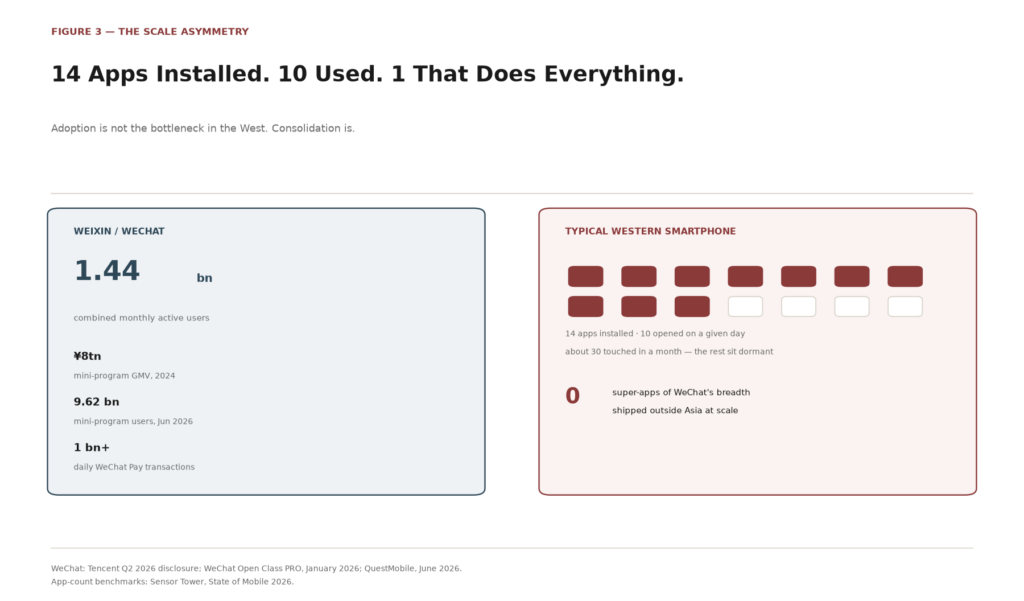
WeChat is the reference case because it is the one with numbers attached. Weixin and WeChat reached 1.439 billion combined monthly active users in the second quarter of 2026, according to Tencent’s own disclosure. Inside that base sit roughly 4.3 million mini-programs — lightweight apps that run inside WeChat without an app-store install — which handled more than ¥8 trillion in gross merchandise value in 2024 and still counted 962 million monthly users in June 2026. WeChat Pay clears more than a billion commercial transactions on an average day.
Read that last figure slowly. A billion transactions a day is not a feature. It’s a utility, the way electricity is a utility. Nobody opens a separate “electricity app.”
The distinction matters because it reframes the whole argument. The question isn’t whether WeChat is a nice product. It’s whether the integration layer — one identity, one wallet, one session — is economically valuable. It plainly is. What’s contested is whether Western markets can have it without also having the concentration that came with it.
The West Ships Ten Apps to Do One Job
Now look at the other side of the ledger. The average smartphone holds around 80 apps. Users open roughly ten of them on a given day and touch about 30 in a month, per Sensor Tower’s State of Mobile 2026. The rest are dormant — installed, updated, occasionally permission-granted, never opened.
So the fragmentation isn’t hypothetical. Consumers have already voted with their attention: they use a tiny handful of apps and ignore the rest of the pile. That is the behavior of people who want fewer doors, not more. The market gave them eighty doors anyway.
And the doors don’t talk to each other. Your social app doesn’t know what your shopping app knows, which is why the jacket ad follows you for eleven days after you already bought it. Your wallet holds a card your retailer’s checkout can’t autofill. Your courier app has your address; your retailer made you type it again last Tuesday.
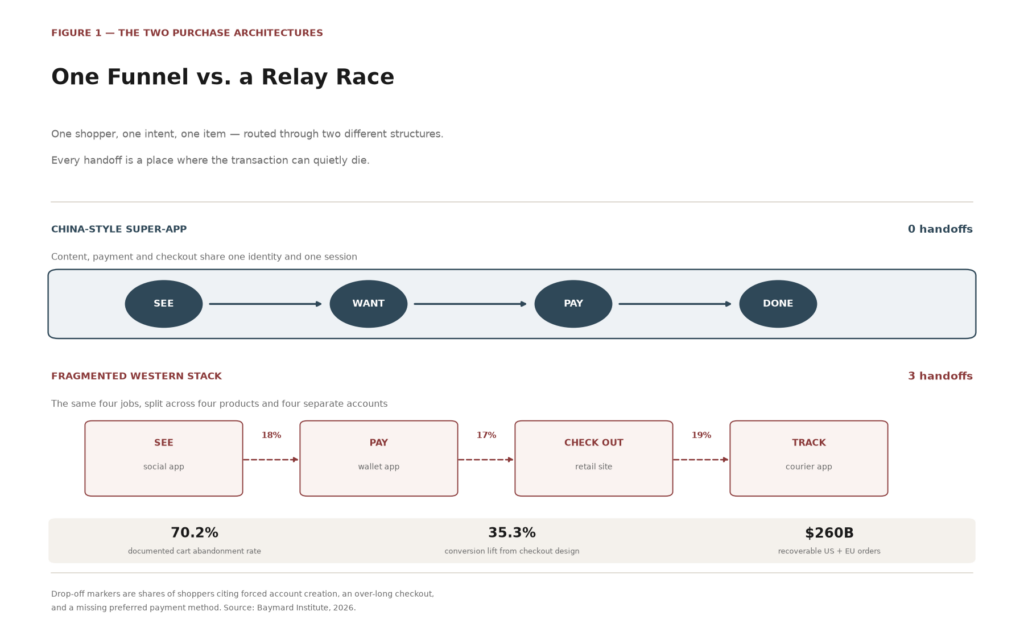
This is what the outline of this piece called the relay race — and it’s worth seeing the two architectures side by side, because the asymmetry is structural rather than stylistic.
Why Integration Wins on the Numbers
Strip away the ideology and integration does three things that fragmentation cannot.
It removes the exit points. Baymard Institute’s meta-analysis of 50 studies puts the average documented cart abandonment rate at 70.22% — roughly seven carts in ten — and that figure has hovered near 70% for over a decade. The fixable causes are almost comically mundane: unexpected costs, forced account creation, a checkout “too long or complicated,” missing payment methods. Baymard estimates that better checkout design alone could lift conversion by 35.26%, worth about $260 billion in recoverable orders across the US and EU. Every one of those friction points is a boundary between systems. A super-app has fewer boundaries because it has fewer systems.
It converts identity from a cost into an asset. One login isn’t a convenience feature; it’s the difference between a session that persists and a session that restarts. Thales’s 2026 Digital Trust Index, which surveyed 14,300 consumers across 13 industries, found that 57% had trouble accessing a website in the past year and 68% abandoned or switched providers because of slow performance or a complicated sign-up. Not bad products. Bad doors.
It compounds. Commerce feeds the social graph, which feeds the payment graph, which feeds content distribution. Tencent’s short-drama product is the cleanest proof available: “Green Bubble,” a mini-program that launched in July 2026, reached 156 million monthly users by September and 89.68 million weekly users in the first week of October — a 44.1% week-over-week jump. ByteDance’s standalone Hongguo app took roughly three years to reach 168 million daily users. Green Bubble used a carrier it already owned.
That is not better product design. That is a distribution advantage that cannot be purchased, only inherited.
Friction Is a Line Item Nobody Budgets
Marketers talk about acquisition cost constantly and almost never about handoff cost. Yet handoffs are where the money goes.
Consider what a Western customer actually does between “interested” and “paid”: switches apps, re-authenticates, re-enters card details, re-confirms an address, sometimes switches devices entirely and starts over. Mobile abandonment runs near 80%, against roughly 66–68% on desktop, per Baymard and Dynamic Yield panel data — a gap that persists even though mobile carries most ecommerce traffic. The gap isn’t intent. It’s typing.
Then there’s the quieter tax, the one paid by the brand rather than the buyer. Your funnel is assembled from ten vendors, each with its own identifier for the same human being. Attribution breaks at every seam. You buy a customer data platform to stitch identity back together, then buy another tool to reconcile what the first one couldn’t see. The integration you didn’t get for free, you now rent — permanently.
The Integration Tax, Measured
Here the numbers get uncomfortable, because the martech market is essentially a monument to the cost of stitching.
The 2025 marketing technology landscape catalogued 15,384 solutions across 49 categories — up 9% from 14,106 the year before, and roughly 100× the 150 products listed in 2011. In the same cycle, 1,211 products were retired, 84% of them because the company had shut down. Growth and churn are now happening simultaneously.
And the budget line that funds it is shrinking, not growing.
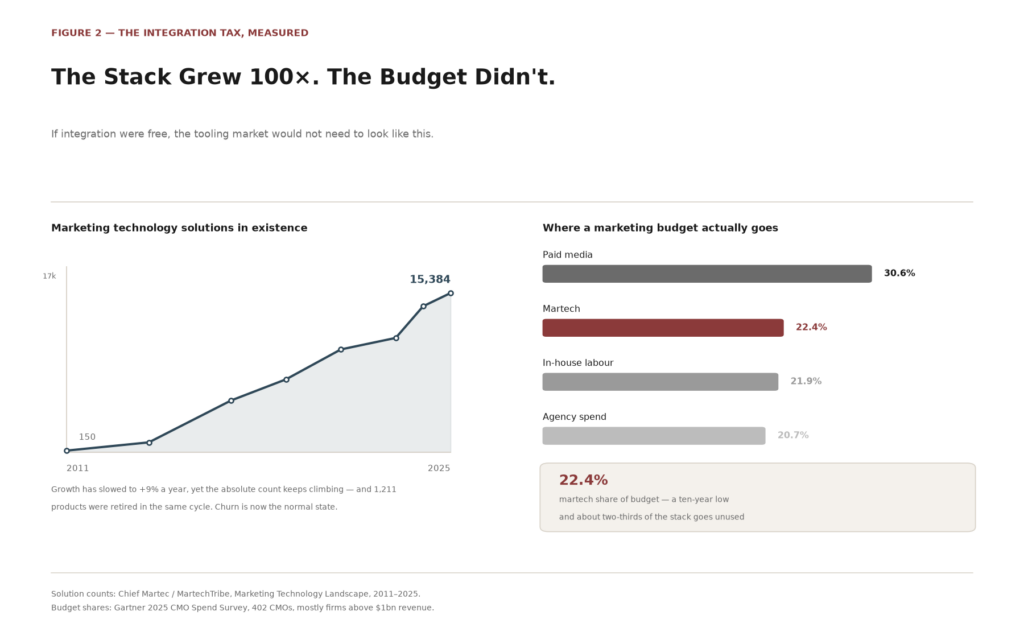
Put those two facts together and the picture inverts. The West didn’t under-invest in integration. It over-bought substitutes for it and then discovered the substitutes don’t integrate. Martech’s share of budget hit a ten-year low precisely while the stack got bigger, because the stack was never the point.
The Counterargument: The Fears Are Legitimate
Everything above could be read as an argument for consolidation. It isn’t, and it would be dishonest to pretend the objections are mere squeamishness.
The fears are real and specific. A single company holding messaging, payments, commerce, and identity is a gatekeeper with pricing power and no exit — leaving means abandoning your contacts, your wallet, and your service history simultaneously. Ask anyone who has been locked out of an account they use to pay rent. Concentration also means single-point-of-failure risk: one authentication outage, one policy change, one ownership dispute, and a meaningful slice of daily life stops working.
There is a competitive argument too. Many apps competing on the same job produces price pressure, specialisation, and innovation that a bundled product rarely bothers with. Specialists are better at their one thing. That’s not nothing.
The Conflation Error
But notice what the objections are actually about. They’re about who owns the integration, and how it is governed. They are not about whether integration itself is valuable.
Those are separable questions, and the West has spent fifteen years treating them as one. “We don’t want one company to control everything” quietly became “therefore fragmentation is healthy” — and an entire architecture of friction got defended as a civic virtue rather than audited as a cost centre.
The honest position is neither “monopoly good” nor “choice good.” It’s narrower and less satisfying: integration is worth a great deal, concentration is genuinely dangerous, and the only serious policy question is how to capture the first while constraining the second. Regulated interoperability is one answer. Mandated data portability is another. Neither is a super-app. Both are attempts to get the benefit without the owner.
The West hasn’t seriously tried, largely because it never separated the two ideas.
Why the West Can’t Just Copy It
There’s a harder constraint that gets skipped in most comparisons, and it isn’t cultural.
A super-app depends on mini-programs — third-party software running inside the host app, monetised without an app-store cut. In China, that was possible because the Android ecosystem fragmented and Google Play never took hold. In the West, Apple and Google sit astride distribution and have historically treated in-app app stores as a non-starter.
That wall is now cracking, unevenly. Under pressure from the EU’s Digital Markets Act — and a €500 million fine in April 2025 — Apple revised its European terms in August 2026: the per-install Core Technology Fee gave way to a 5% commission on transactions in apps distributed outside the App Store, in-app purchase dropped to 26%, and developers gained the right to combine Apple’s payment system with their own from October 1. Apple also runs a Mini Apps Partner Programme that legitimises lightweight in-app software, at 15%.
So the regulatory opening exists — in Europe, partially, and nowhere near globally. Meanwhile X has been building toward the everything-app thesis for years, launching X Money in 2026 and experimenting with peer-to-peer tipping, while explicitly backing away from being a crypto exchange. It is a real attempt. It is also a payments feature bolted onto a social feed, which is the opposite sequence from WeChat’s: messaging first, then payments, then everything.
The order matters. WeChat’s payment layer rode an infrastructure gap — a population skipping cards for phones. Western consumers already have cards, tap-to-pay, and four wallets. There’s no vacuum to fill, which is exactly why the attempt is harder than it looks.
What This Means for Marketers
Three practical consequences, in rough order of how soon they’ll bite.
First, audit your handoffs, not just your channels. Most funnel models assume a continuous journey. Yours isn’t continuous — it’s four systems making introductions. Pull the abandonment data by step, not by campaign, and you’ll usually find the leak sits between two vendors rather than inside either one.
Second, stop paying for integration twice. If your stack has more than a handful of overlapping tools, you are funding the fragmentation problem with the budget that was supposed to solve it. The 46% unused-licence figure is not an industry embarrassment; it’s a line item you can claw back.
Third, understand whose integration you’re renting. In China, the platform integrates the journey and hands you the funnel. In the West, no platform will — so the website, the CRM, the community, the app become your integration layer, built and owned by you. That’s more work and worse unit economics at small scale. It’s also the only durable asset you’ll have when a platform changes its rules.
The Uncomfortable Part
A super-app is not automatically a better society, and integration is not automatically a public good. WeChat’s dominance coexists with real gatekeeping, and its own time-share lead has already been chipped away by a rival. Integration doesn’t make a market fair. It makes a transaction cheaper.
But cheaper transactions are not a rounding error. They are the difference between a customer who completes a purchase and one who closes the tab and forgets. Seven in ten carts are abandoned. Thirty-five percent more conversion is sitting in checkout design alone. The West has spent a decade buying tools to bridge seams it could have avoided, and calling the seams freedom.
The lesson isn’t “one app good.” It’s narrower, and it’s harder to market: integration is valuable, concentration needs governing, and the West has been too busy defending the second to notice it forfeited the first.