Boring Marketing Wins — Especially Now
Open the agenda for any marketing conference in 2026 and count the words. Agents. Generative. Multimodal. Real-time personalization at scale. Somewhere near the bottom, if you are lucky, a session titled something like Back to Basics will be scheduled against the coffee break, because that is where the attendance math puts it.
Here is the awkward part. The brands quietly outperforming their categories right now are not the ones with the loudest AI stack. They are the ones that kept doing the unglamorous work while everyone else rebuilt the website around a chatbot. Clear positioning. The same promise, repeated past the point where the internal team got bored of it. A handful of channels run properly instead of twelve run badly. Measurement that traces back to revenue rather than to a dashboard nobody opens.
That is boring marketing. And in a market saturated with spectacle, boring has become the scarce input.
What boring marketing actually is
Let me define the term before it gets hijacked. Boring marketing is not lazy marketing, and it is certainly not cheap marketing. It is the set of practices that have survived every technology cycle since mass advertising began: knowing precisely who you are for, saying one distinctive thing, saying it for years, measuring whether it moved the business, and taking care of the people who already bought.
It reads as boring for two reasons. First, it is old, and novelty is what our industry rewards with applause. Second, it does not produce a screenshot. You cannot post a slide of “we held the same positioning for 36 months and our mental availability rose four points.” You can post a slide of a hologram.
The distinction that matters strategically is what each approach optimizes. Spectacular marketing optimizes for attention this quarter. Boring marketing optimizes for memory that compounds across quarters. One is a rental. The other is an asset you own.
Where the money actually lands
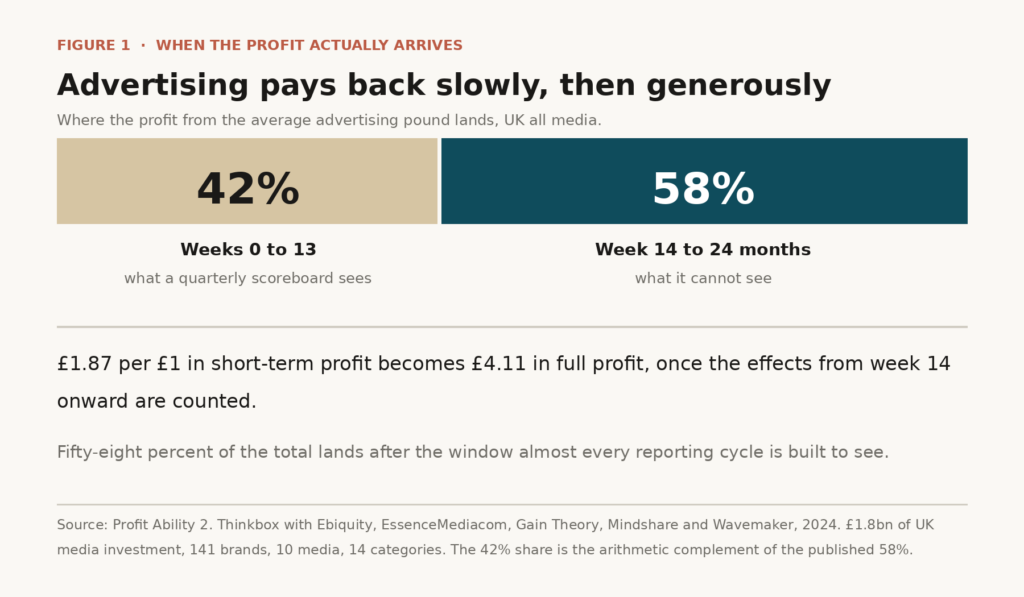
The most useful number in marketing effectiveness is also the least quoted on a Monday morning status call. Profit Ability 2 analysed £1.8 billion of UK media investment across 141 brands, 10 media and 14 categories. Short-term profit return averaged £1.87 per pound invested. Once sustained effects are counted, the figure rises to £4.11.
Now notice the timing. Fifty-eight percent of advertising’s total profit generation happens after the first thirteen weeks. Only forty-two percent arrives inside that window.
So the reporting most teams optimize against captures well under half of what the money actually does. The majority is invisible to anyone whose scoreboard resets monthly, which is nearly everyone. This is not an argument against performance marketing. It is an argument that performance marketing is being asked to prove something it structurally cannot see.
There is a second detail worth carrying around. In the same study, TV accounted for 54.7 percent of full profit payback while taking only 43.6 percent of the investment, and 63 percent of all profit generated beyond the first week. Generic paid search, meanwhile, delivered the highest immediate payback and then faded fast. Read that as a division of labour rather than a verdict on channels. One side harvests demand that already exists. The other side manufactures the demand that gets harvested later.
Why AI made consistency the scarce input
The standard assumption is that AI commoditizes execution, so the fundamentals matter less. The evidence points the other way. AI collapsed the cost of variation and left the cost of coherence exactly where it was.
The novelty treadmill
When every brand can generate a striking campaign in an afternoon, striking stops being a differentiator. The Interactive Advertising Bureau’s September 2026 outlook update captures the shift cleanly: 76 percent of media buyers now name optimizing content for AI-generated answers as their single biggest area of increased focus, up from 69 percent in January for using generative AI inside campaigns. The question moved from how do we use AI to how do we reach a consumer who decides with AI. Nobody holds a durable lead in that race, because everyone is running on the same tools.
The same study found 38 percent of buyers rank low-quality AI-generated content, the industry’s “AI slop”, among their two biggest investment challenges. That is not a technology problem. It is a discipline problem wearing a technology costume.
What a model cannot fake
A model can produce a thousand on-brand variations. It cannot produce fifteen years of the same promise arriving in the same visual language. That accumulation lives in human memory, and memory is built by repetition, not by variety.
Jenni Romaniuk’s work at the Ehrenberg-Bass Institute on distinctive assets describes the mechanism precisely. An asset only becomes a mental shortcut when it is famous enough to be recognized and unique enough to be attributed to one brand. That pairing is built through repeated co-presentation over years. Change the elements too often and you do not refresh the brand, you demolish the structure and start pouring concrete again.
This is why Procter & Gamble’s Marc Pritchard keeps returning to the same line. “Repetition is how ideas wear in, not wear out,” he told the ANA Masters of Marketing in 2025, and repeated it at Cannes in 2026, where his summary of the AI question was blunter still: robots don’t build brands, people do. P&G is not a sentimental company. It is the world’s largest advertiser, and it has concluded that the scarce variable is not creative volume.
He has a case study to go with the slogan. P&G’s SK-II drifted into content that was entertaining and fun but no longer reflected what the brand was actually precious for. Growth suffered. The brand rebuilt itself around craft and consistency, and returned to double-digit growth.
The audience has already voted on AI slop
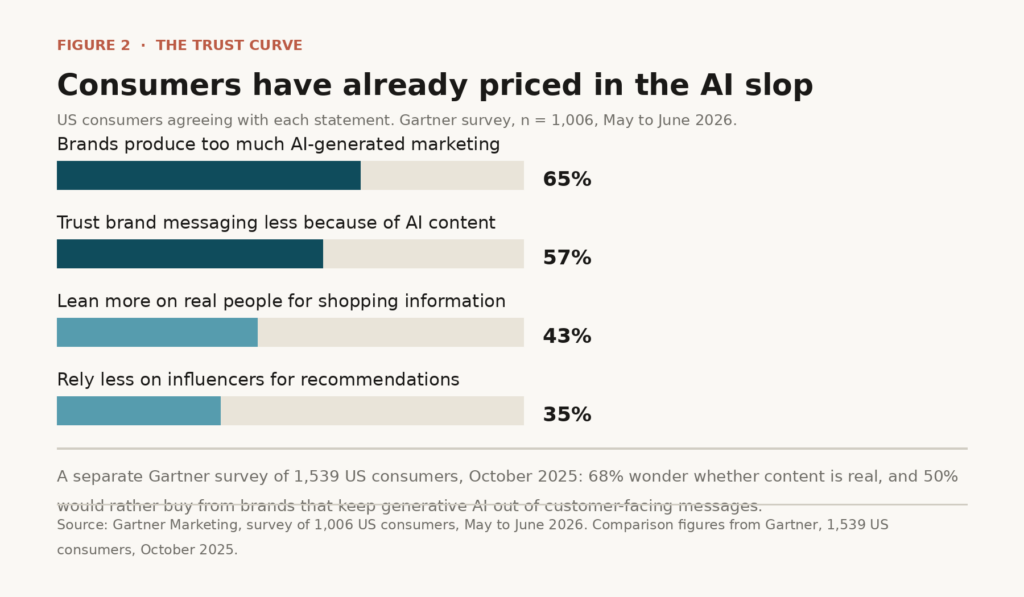
Gartner’s 2026 consumer research is uncomfortable reading for anyone whose content plan is a throughput target. In a survey of 1,006 US consumers, 65 percent said brands are producing too much AI-generated content, and 57 percent said that content has made them trust brand messaging less.
The second-order effects are more interesting than the headline. Thirty-five percent now rely less on influencers because of AI-generated content, while 43 percent say they lean more on real people for shopping information. The audience is not rejecting the technology. It is re-pricing its sources.
An earlier Gartner survey of 1,539 US consumers, fielded in October 2025, adds a sharper edge: half said they would rather buy from brands that keep generative AI out of customer-facing messages, advertising and content. Two thirds said they frequently wonder whether what they are looking at is real.
Put those together and you get a strange market. The capability that was supposed to buy efficiency is quietly taxing credibility. And credibility is the thing boring marketing has always been in the business of manufacturing.
Boring, done well: five operating instructions
Abstract virtues are useless without operating instructions. Five things, in order of how much they hurt.
1. Positioning that survives a reorg
Most brands do not have positioning. They have a description of their product category with an adjective attached. Real positioning answers one question without hedging: who is this for, what does it do better than the alternative, and what is it deliberately not.
The test is whether a new marketing director could change it without commissioning research. If they could, it was never positioning. It was a preference.
2. Consistency as a budget line, not a virtue
Consistency does not survive on good intentions. It survives on a document with asset rules in it, a review process, and someone whose job is to say no.
The structural pressure runs the other way. NIQ’s CMO Outlook for 2026 found that only 55 percent of marketing leaders allocate 60 percent or more of budget to long-term brand building, down from 59 percent a year earlier, while 84 percent now treat ROI as their primary basis for allocating budget. Worse, only 69 percent say their CEO and CFO support long-term brand investment, down from 80 percent.
So protect the boring part explicitly. Ring-fence the share of budget that does not have to justify itself in a fourteen-day attribution window, and write down what it is for. Unprotected consistency always loses to a tempting launch.
3. Own three channels, not thirteen
Channel proliferation is where boring discipline usually dies. Salesforce’s tenth State of Marketing report, drawn from 4,450 marketing decision-makers, found 75 percent already using AI while 84 percent still admit to running generic campaigns. The tooling improved. The relevance did not.
Fewer channels, run at genuine depth, beat a broad shallow mix almost every time, because competence is what produces the marginal return. Pick the three where your buyers actually spend attention, learn their creative grammar, and treat the rest as experiments with expiry dates.
4. Measure the business, not the dashboard
The gap between marketing metrics and finance metrics is not a reporting inconvenience. It is a credibility problem, and it is the engine of what Gartner calls the brand doom loop. In a survey of 426 senior marketing leaders, 84 percent of companies were found to underinvest in brand measurement, lose confidence in the results, and consequently attract less funding again next year. Companies caught in that loop were half as likely to exceed growth targets. Companies with a strong brand strategy, by contrast, were twice as likely to beat their growth goals.
The exit is unromantic. Pick a small set of measures that connect to commercial outcomes, track them the same way every quarter, and build a story a CFO can repeat without translating.
5. Keep the customers you already paid for
Acquisition gets the budget and the applause. Retention gets the incremental margin. The 95-5 research from the Ehrenberg-Bass Institute and LinkedIn’s B2B Institute shows that in most categories only about five percent of buyers are in market at any moment, which means acquisition spend is largely a bet on timing. Existing customers do not require you to win a timing lottery.
This is the least fashionable item on the list and usually the fastest to pay back.
The crossover test that settles the argument
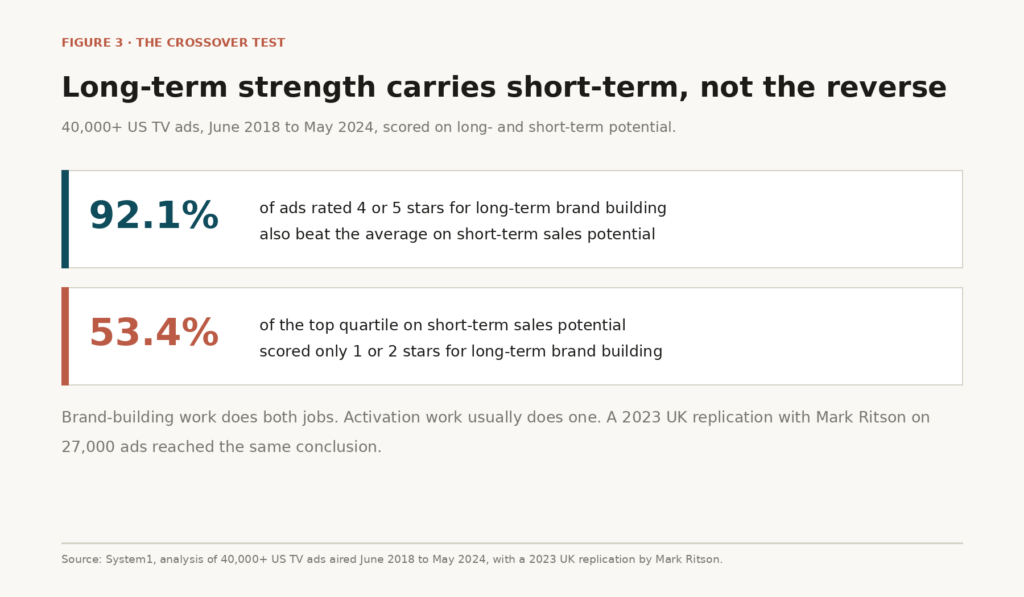
If you only remember one number from this piece, make it this pair.
System1 analysed more than 40,000 US television ads broadcast between June 2018 and May 2024, scoring each on a Star Rating for long-term brand growth and a Spike Rating for short-term sales potential. Of the ads rated four or five stars for long-term brand building, 92.1 percent also achieved an above-average Spike Rating.
Then they ran the test in the other direction. Of the ads in the top quartile for short-term sales potential, 53.4 percent scored only one or two stars on long-term brand building. A 2023 UK replication with Mark Ritson on 27,000 ads reached the same conclusion.
Brand-building work does both jobs. Activation work usually does one. If you have to be wrong on one side, that data makes the choice fairly clear, and it is the opposite of what most quarterly plans assume.
Ninety-five percent of your market is not shopping
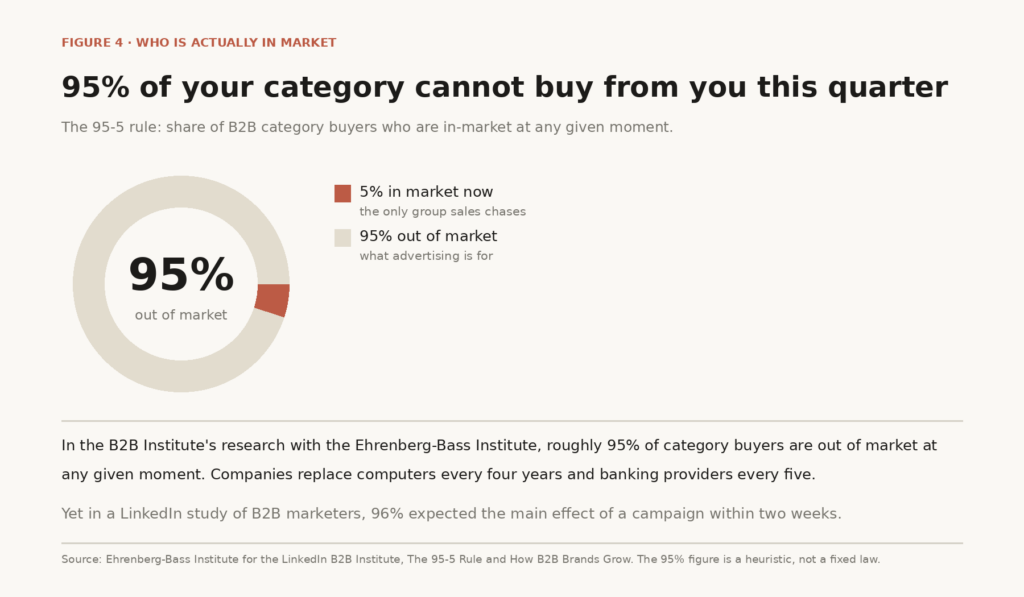
Here is the fact that makes the novelty argument collapse under its own weight. In the B2B Institute’s research with the Ehrenberg-Bass Institute, roughly 95 percent of category buyers are out of market at any given time. Companies tend to replace computers every four years, banking providers every five. Even consumers buy a new car about once a decade.
And yet, in a LinkedIn study of B2B marketers, 96 percent expected to see the main effect of a campaign within two weeks. That is not optimism. It is a category error, and it explains why so much budget goes to intercepting the five percent who are ready instead of building memory among the ninety-five who are not.
Worth being precise here: 95 percent is a heuristic, as John Dawes at Ehrenberg-Bass has stressed, not a law of physics. The direction of the argument survives the imprecision. If most of your market cannot buy this quarter, then the campaign with a two-week scoreboard is measuring the wrong audience on the wrong clock.
Steelmanning the other side
The case for novelty is not stupid, and pretending otherwise would make this argument easy to dismiss.
Yes, a purely unremarkable brand can be invisible. Yes, some moments genuinely require a stunt to earn a hearing. And yes, AI represents a real capability shift, not a fad.
The rebuttal is about hierarchy, not prohibition. Novelty is a tactic inside a boring strategy. The flash exists to pull attention toward the fundamentals, and then the fundamentals have to be there to receive it. A brilliant campaign pointing at unclear positioning wastes the attention it earned. That is the most expensive failure mode in marketing, and it is common precisely because the campaign is the fun part.
There is a budget corollary too. The long-standing 60:40 split between brand building and activation is a guide, not a commandment, and category ratios vary widely. But current behaviour has drifted far from it: WARC reports that nearly 70 percent of marketing budgets now go to short-term performance activity, even though most marketers say the ideal split is closer to even.
Make the core boring, and let interesting be the surface.
A ninety-day starting sequence
Boring advice fails when it stays philosophical, so here is the operational floor.
Write one page stating who the brand is for, what it promises, and what it refuses to be. Do not committee it. Then audit your last twelve months of output and count how many distinct messages you sent. If it is more than three, you have a consistency problem rather than a creativity problem. Fix that before buying another tool.
Next, cut one channel. Not the worst performer by last-click. Cut the one where you have never achieved genuine competence. Reinvest the hours, not just the money, into the two or three that matter.
Then set up one measurement that will still be running in eighteen months, and report it the same way every quarter whether the number is good or bad. Consistency in reporting is what earns the right to be believed.
Finally, look at your retention curve. If the cost of keeping a customer is not visibly lower than the cost of acquiring one, your boring engine is leaking.
The takeaway
In an industry drunk on novelty, the counterintuitive advantage belongs to brands doing old things exceptionally well. Sharp positioning. Relentless consistency. Measurement that connects to money. Real care for people who already chose you.
AI is genuinely useful here, but its highest return is not in generating spectacle. It is in accelerating the boring: faster testing, cleaner measurement, tighter execution, less friction between an idea and its hundredth consistent expression. That is a duller sentence than a keynote about autonomous agents, and it is the one that shows up in the profit line four years from now.
Everyone else is chasing the new thing. That is precisely why the old thing, done properly, is the least crowded position in the market.