INSIGHT — The renewal runs before the review: the quiet economics of shelfware
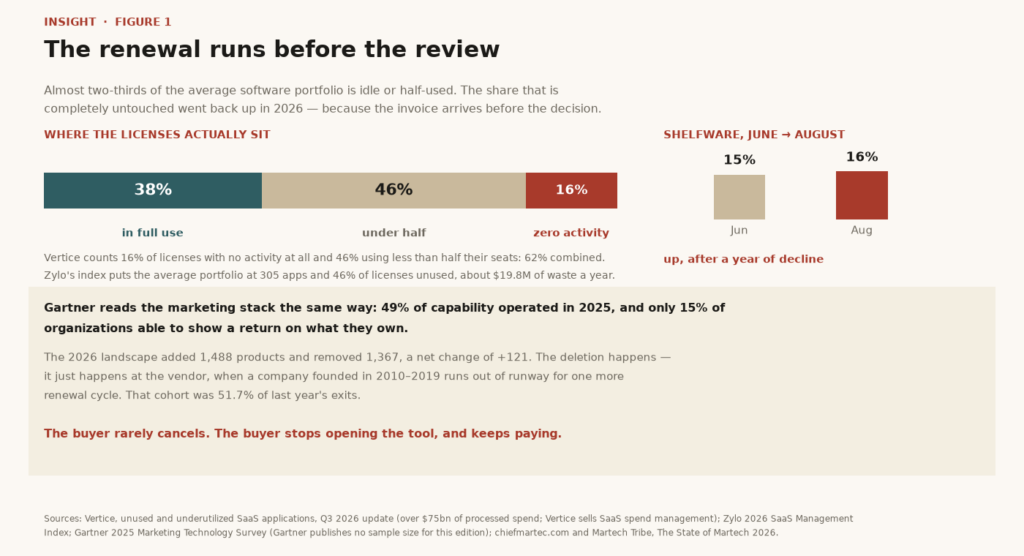
Here’s a number that shouldn’t be possible. Vertice, analyzing more than seventy-five billion dollars of processed software spend, found that in August 2026 the share of licenses with zero activity went up — from 15% to 16% — after a year of steady decline. Not underused. Not lightly touched. Never opened at all. Bought, integrated, forgotten, and still on the invoice.
That’s the small anomaly worth pulling on, because it hides the answer to the question everyone asks about martech consolidation: if half the stack is dead weight, why doesn’t anyone cancel it?
The asymmetry that does all the work
Adding a tool and removing a tool are not opposite operations. They’re different jobs with different owners, different timelines and wildly different social costs.
Adding takes about twenty minutes and one person’s judgment. A director with a card can trial something for a few hundred dollars a month without a conversation. Nobody is harmed. The tool is instantly useful in the demo, which is when the decision gets made.
Removing takes a quarter of unglamorous work, several meetings, and an act of political will. Someone has to tell a colleague that their tool is going away. Someone has to verify that no campaign, workflow, dashboard or integration quietly depends on it. And the saving — real, but dispersed across a budget nobody experiences directly — is invisible to whoever absorbs the conflict.
So the asymmetry runs in one direction, permanently, and it compounds. Add cheaply, remove expensively. Do that forty times and you have a stack nobody planned.
Why the deletion happens at the vendor instead
This is where the martech numbers and the SaaS numbers stop being separate stories.
In 2026 the martech landscape added 1,488 products and removed 1,367. The net change was +121 — a rounding error on fifteen thousand. But look at who left: 51.7% of the exits came from vendors founded between 2010 and 2019, the cohort with the longest time since funding, the thinnest runway, and the least patience for one more renewal cycle that might not come.
That’s the mechanism. The customer didn’t cancel. The customer kept the tool and stopped opening it. The vendor ran out of time.
You can see it twice over in the spend data. Vertice puts 16% of licenses at zero activity and another 46% using less than half their provisioned seats — 62% combined, up from 61% the quarter before. Zylo’s index, drawing on more than forty million licenses, puts the average organisation at 305 applications with 46% of licenses unused, roughly nineteen point eight million dollars a year in waste.
And Gartner’s read on the marketing stack specifically has the same shape: 49% of capability actually operated in 2025, against 58% in 2020. Only 15% of organisations qualify as high performers — the ones that hit their strategic goals and can show a positive return on what they own.
Field notes: what a stack audit actually feels like
I’ve watched this meeting more than once. It goes like this.
The inventory comes back longer than anyone expected. The ops lead reads out the list and there’s a pause after every fourth name while someone asks, “wait, we still pay for that?” Then the interesting part: almost nothing gets cancelled. Not because people disagree that it’s waste. Because the people in the room all understand the same three things.
First, the loss is concentrated and the gain is diffuse. Whoever loses their tool feels it personally and immediately. The saving is spread across a line item nobody owns. Predictably, the person facing the concentrated loss argues hardest and longest.
Second, nobody wants to be the one who switched off the thing that broke. Cancelling a tool that appears unused carries a small chance of disaster and a large certainty of being blamed. Doing nothing carries neither.
Third, the audit has no owner. It’s a week of work that maps to no one’s objectives and makes enemies on the way through. So it gets scheduled for next quarter, indefinitely, until a budget cut forces it — and then it goes badly, because a cost-cutting frame turns every tool into territory to defend.
What this actually implies
Two things, and neither is “cut more tools.”
The first is that flat headline growth in the martech landscape is not evidence of stability. 62% of licenses sitting idle or half-used means the installed base is enormous, expensive and largely decorative. The pressure isn’t coming from a shortage of products. It’s coming from the discovery that you already bought everything you need and operate about half of it.
The second is that consolidation is being done to marketing teams rather than by them. When a vendor folds, the decision gets made for you — mid-contract, mid-quarter, with whatever migration window the acquiring party feels like offering. The teams that come out of this intact are the ones that ran the boring audit while it was still a choice.
Set a calendar reminder thirty days before each renewal. Four questions: who logged in this month, does another paid tool already do this, who is the named owner, and what actually breaks if it goes? Most stacks come back with two or three clean cuts on the first pass.
That’s not a cost-cutting exercise. It’s the only way to find out what you’re really paying for.