Why the “Marketing Lost Its Soul” Essay Gets Rewritten Every Eighteen Months
There’s a genre of essay that gets published roughly every eighteen months. It opens with a confession of love for marketing as it once was, laments what data and algorithms have done to it, and closes by asserting that the soul has departed. I’ve read dozens. I’ve written a version of it myself.
Here’s what took me embarrassingly long to notice: the essays don’t change. The technology in the indictment changes. TV. Digital. Data. AI. But the structure — the muscle memory of the argument — is identical, down to the sentence where the writer remembers a mentor who cared about ideas.
That repetition isn’t laziness. It’s a mechanism, and the mechanism explains why this particular claim survives every attempt to test it.
The structural reason: nobody can grade the claim
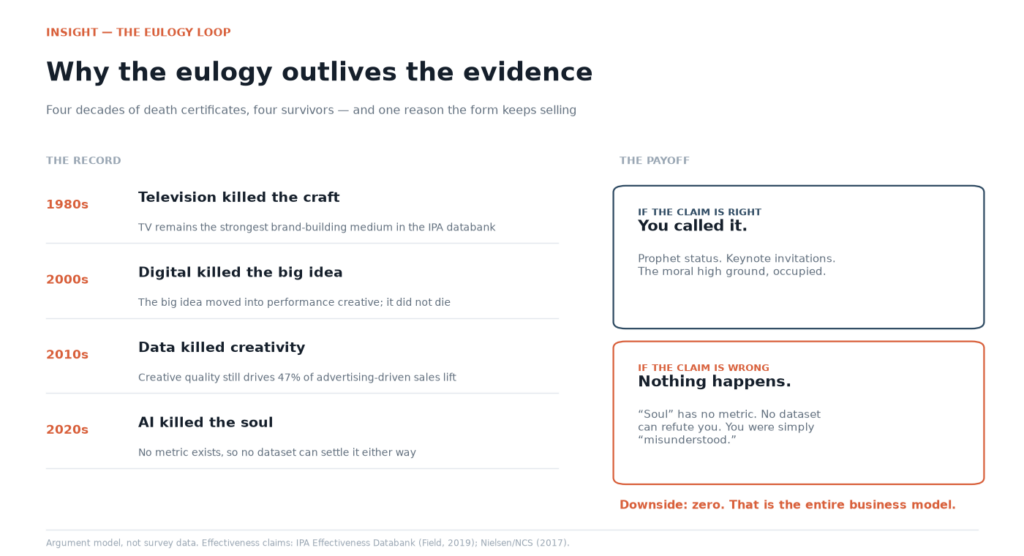
Most marketing claims are falsifiable, which is why they die. “TV is more efficient than digital” can be tested and has been, repeatedly. “Data kills creativity” can be tested, and largely wasn’t.
“Soul” cannot be tested at all. There is no soul metric. There is no soul dashboard, no soul lift study, no soul MMM decomposition. The word refers to something real — the felt quality of a brand’s intent — but it doesn’t resolve into a number anyone can check.
So when the claim is right, the writer is a prophet. When the claim is wrong, nothing happens, because there is no instrument capable of returning a verdict. The downside is zero. That asymmetry is the whole business model, and it’s why the form persists across every technology cycle while other, more specific claims quietly disappear.
Compare that with the claims that did get tested. Peter Field took the creativity question to the IPA Effectiveness Databank — nearly 600 cases across 1996 to 2018 — and the answer came back in numbers: creatively awarded campaigns ran about twelve times more efficient in the years to 2008, four times across 2006 to 2018, and roughly at parity by the 2018 award year. That finding was uncomfortable, widely argued over, and therefore alive. Falsifiable ideas get eaten. Unfalsifiable ones get reprinted.
The second engine: the trappings are more visible than the substance
There’s a second mechanism, and it’s the one I find more interesting because it operates on the writers rather than the readers.
Marketing’s visible surface — the ads, the awards, the aesthetic, the mystique — is what practitioners fall in love with. It’s what they see on the way up. The invisible surface — objection handling, retention flow, the returns policy, whether the chat queue clears on a Sunday — is where the actual connection gets made, and almost nobody develops an emotional attachment to it in their twenties.
So when the visible surface is dismantled, the loss feels total. It feels like the soul left. What actually happened is that the wardrobe was replaced while the body stayed in the room, and the people who loved the wardrobe couldn’t see past it.
This is why the lamenters are usually right about the loss and wrong about the diagnosis. The 2025 Lions State of Creativity data gives the complaint real substance: 51 percent of more than 1,000 marketers say their consumer insight is too weak to support bold work, 57 percent say their brands can’t react quickly to cultural moments, and only 13 percent call their companies creative-risk friendly. Something is genuinely being starved. It just isn’t the soul — it’s the conditions that let bold work get funded.
The third engine: nostalgia is a claim about the writer
I’ll say the quiet part. These essays are partly autobiography. The writer is describing the moment they stopped being able to do the job the way they learned it, and that moment gets narrated as a decline in the industry rather than a change in the person.
That’s not cynicism, and it isn’t a reason to dismiss the genre — some of my favourite pieces in marketing are elegies, and the best of them are honest about the grief. But it does explain the emotional gradient. The essays are warmest when the writer was young and the work was unaccountable to a dashboard.
What the mechanism implies
If the repetition is structural rather than evidential, then more data won’t end the argument. Deploying a better effectiveness study against “the soul is gone” is like producing a receipt to prove you’re in love. The frame doesn’t accept the evidence.
What does move the conversation is reframing the claim into something testable. Not is the soul gone, but is the connection measurably weaker — and then answering with the instruments that exist. Purchase intent against spend. Creative impact scores. Star ratings against share growth. Brand recognition against the cost of the media.
On those measures the picture is genuinely alarming, and genuinely mixed: spend up 33 percent against intent up 17 percent since 2023, fewer than one in five ads clearing the three-star line that predicts share growth. That’s a real crisis with real numbers, and it’s much more useful than a eulogy.
The lament survives because it’s unfalsifiable, warm, and career-enhancing. The measurement survives because it can be wrong. Given the choice, I’d rather work with the thing that can embarrass me.