The Economics Behind Live Commerce: Why Conversion Was Never the Problem
Every explanation for why live commerce works in China and stalls almost everywhere else rests on the same assumption: that Chinese viewers are persuaded more effectively. That they trust the host more, respond to scarcity more, or treat shopping as a form of entertainment. If that were true, you would expect to see it in the numbers as a conversion gap.
You don’t. The gap is somewhere much less glamorous.
The Three Numbers That Don’t Fit the Story
In 2022 McKinsey surveyed frequent live-commerce users across four regions and asked a straightforward question: of all the shows you attended, how often did you buy something during or after?
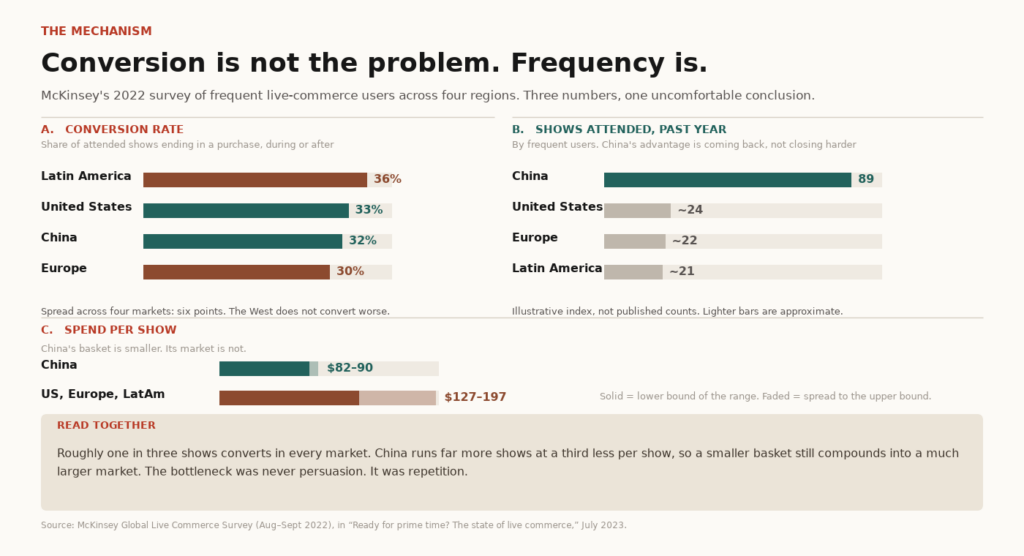
The answers came back almost identical. Latin America: 36%. United States: 33%. China: 32%. Europe: 30%.
Six points separate the best market from the worst, and the United States sits above China. Whatever is happening to American viewers during a livestream, it is not that they are unmoved. When they show up, they convert at roughly the same rate as anyone else on earth.
So the difference must be in how often anyone shows up. And here the same survey produces a second number that does the real work: Chinese frequent users attended far more live-commerce shows in the past twelve months than their counterparts in the US, Europe or Latin America. The categories they bought differed wildly — groceries dominate in China at 54% of purchases, a category that doesn’t appear in any other region’s top five — but the frequency of the habit is what separated the markets.
The Third Number Is the One That Reframes Everything
Here is where the story inverts. You would assume a market four times the size runs on bigger baskets. It runs on smaller ones.
Chinese frequent users spent roughly $82 to $90 per show. In the United States, Europe and Latin America the figure was $127 to $197. Chinese viewers were spending somewhere between a third and a half less per session than everyone else.
Read those three findings side by side and the mechanism becomes almost embarrassingly plain. Convert at the same rate. Show up far more often. Spend less each time. The output is a market that dwarfs the others, built not on superior persuasion but on repetition of a smaller, cheaper act.
This is the economics of frequency, and it behaves nothing like the economics of conversion. A conversion-led model optimises the show: better host, better script, better offer, higher average order value. A frequency-led model optimises the return trip: how little friction stands between one session and the next.
What Actually Lowers the Cost of Coming Back
If frequency is the engine, then everything that reduces the cost of a repeat visit is the fuel — and that reframes the entire Chinese stack.
In-platform checkout is not a convenience feature. It is what makes a $85 purchase rational on a phone at 9pm, because the alternative to one thumb is a login, a card entry, and a decision deferred to tomorrow. Payment that lives inside the video doesn’t increase desire; it prevents desire from decaying during the handoff.
The creator economy is not primarily a reach story either. Millions of sellers, from mega-hosts down to small key opinion consumers with a few thousand followers, each hold a narrow audience that returns on a schedule. A niche seller can be credible about a niche product in a way no generalist host ever could, and credibility is what makes the second visit likely rather than the first purchase large.
And the algorithm matters for the same reason. Discovery stops being accidental channel-surfing and becomes a routine feed — the right product shown to someone already in the habit of watching. QVC’s own filings are candid that it paid for low cable channel positions so viewers would stumble onto it. Stumbling is a terrible basis for a habit.
McKinsey’s own conclusion supports this reading: when Chinese frequent users were watching shows for groceries, 100% reported buying during the show itself. For clothing and beauty, 99% and 100%. The purchase isn’t a considered follow-up. It happens inside the session, which only works if the session is cheap enough to attend casually.
Why the West Optimised the Wrong Variable
Western retail did not fail to notice live commerce. It failed to price the return trip correctly.
Meta launched live shopping in 2018 and shut it down by 2023. Amazon Live has run since 2016 without publishing results. Both treated the livestream as a conversion event grafted onto a platform built for search and feed — a place where the session ends when interest dips, not where it becomes a weekly appointment. In TikTok Shop’s US business, live selling accounted for only about 14% of GMV in 2025 and roughly 8% in the first half of 2026; short video carries the rest.
That is a market optimising for reach and click-through — the vocabulary of conversion — while the format’s actual leverage sits in whether someone comes back next Thursday.
The Uncomfortable Implication
For anyone building in this category, the McKinsey numbers suggest a different set of questions than the ones usually asked.
Not how do we make the show more persuasive, but how cheap is it for someone to attend again. Not how do we raise average order value, but can we afford to sell $85 worth of groceries and still make the session pay. Not who is the best host, but who will the audience still trust in six months, on their fourth visit.
Conversion is a solved problem. Every market converts at roughly one in three. The unsolved problem is repetition — and repetition is an infrastructure question that no amount of better content will answer.