Why the West Keeps Copying Live Commerce and Missing the Point
In 1977, a Florida radio station owner named Bud Paxson took payment for an unpaid advertising bill in electric can openers. He handed the box to his talk host, Bob Circosta, and told him to sell them on air. Circosta objected — he thought it was beneath a serious broadcaster. Then he described the can openers to his audience and asked them to call in. All 112 sold in under an hour.
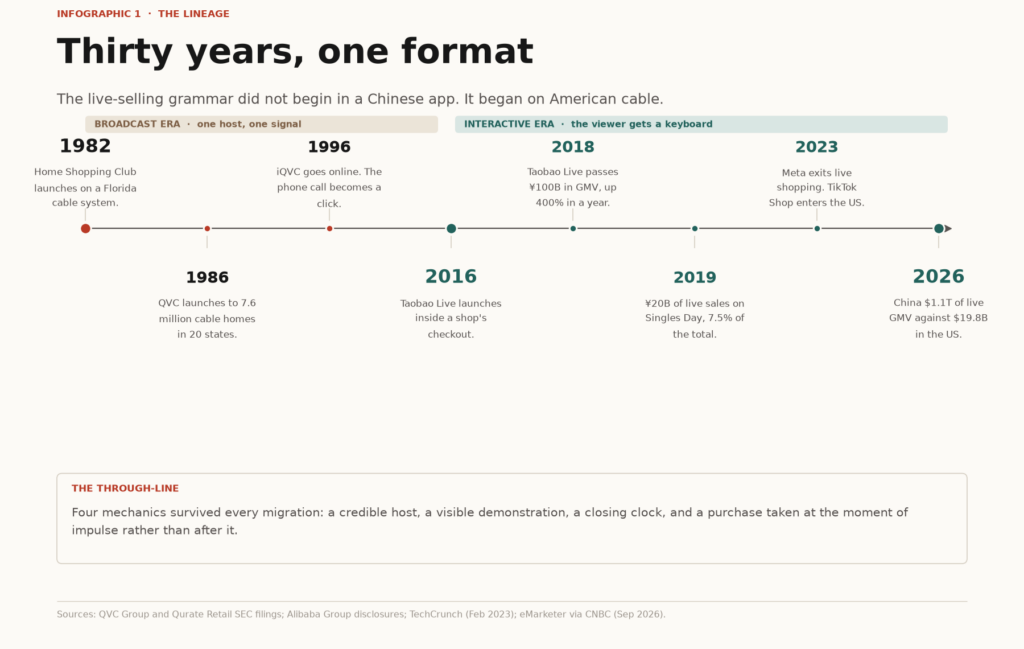
Five years later, Paxson and a financier named Roy Speer put that same transaction on cable television. By 1985 it was national. A year after that, a competitor launched with a slightly more polished proposition: Quality, Value, Convenience.
Everything China did to live commerce between 2016 and today is downstream of that hour of radio.
The Ancestor Was Not a Retail Channel. It Was a Conversion Machine.
QVC’s first broadcast went out on 24 November 1986 to 7.6 million cable homes across twenty states. By the mid-2010s it reached more than 100 million American households and operated in eight other countries. After absorbing its old rival HSN in 2017, the combined business booked $14.07 billion in revenue the following year.
It is easy to file all of that under nostalgia — the chintzy sets, the host with the earpiece, the jewellery close-ups. That reading misses what the format actually solved.
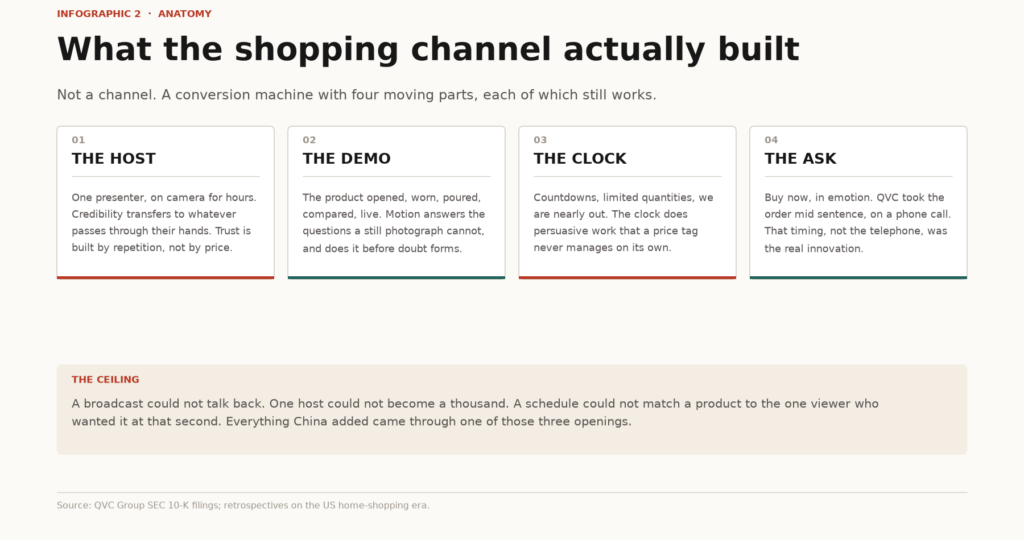
QVC built four things, and each of them addressed a specific failure of ordinary retail.
A host you trusted. Not a celebrity endorsement, not a logo. A person on screen for hours at a time, handling the product, taking calls, coming back the next day. That repetition is what converts a presenter into a known quantity. It is the same mechanism the communication theorist Donald Horton and his colleague R. Richard Wohl described in 1956 as a parasocial relationship — the one-sided intimacy a viewer develops with someone who has never met them.
A demonstration you could watch happen. A still photograph cannot show you how a knife cuts, how a foundation settles, how a vacuum handles pet hair. Motion can. QVC’s whole schedule was built on the assumption that seeing a thing used is more persuasive than reading about it.
A clock. Limited quantities, a countdown, a host saying the colour is nearly gone. The clock does persuasive work that a price tag cannot, because it converts an open-ended decision into a closing window.
An ask placed inside the moment. This is the part everyone forgets. QVC did not run an ad and hope you would visit a store later. It took the order while the desire was still live, with an 800 number on screen and an operator waiting. In 2011 the company’s own filing noted that automated voice systems handled around 34% of its orders — a number that only makes sense if the ordering moment was the selling moment.
Then the Ceiling
The format had three structural limits, and all three were limits of broadcast, not of the idea.
A viewer could not talk back. If you had a question about the sizing, you called a phone line that was already at capacity, or you waited for the next scheduled airing of that product. Feedback existed in the aggregate — units sold, call volume — but not in the conversation.
One host could not become a thousand. Trust was centralised in a small roster of presenters, which meant it could not be delegated to the long tail of sellers who might have sold to a specific niche.
A schedule could not find the one viewer who wanted that product at that second. QVC’s answer to this was channel surfing — the company’s filings are candid that it paid distributors for low channel positions partly because viewers stumbled onto it while flicking. Discovery was accidental, not algorithmic.
The interesting thing is that QVC knew. By the late 1990s it had launched iQVC, and by the 2010s it was describing itself as a video commerce company with a live stream on its own website. It saw the direction. It just could not rebuild itself around the three things it lacked.
2016: Same Play, Different Rails
Taobao Live went live in April 2016. It was, deliberately, not a new idea. Alibaba’s own framing at the time was that live video was an upgrade to the storefront — a way to make a shop feel like a person rather than a grid of images. The shopping cart sat in the corner of the stream from day one.
The first two years were modest. 2018 was the inflection: Taobao Live moved roughly RMB 100 billion in gross merchandise value that year, up around 400%. In 2019 it passed RMB 200 billion, and on Singles Day alone it drove RMB 20 billion — about 7.5% of the group’s RMB 268.4 billion for the festival.
By 2025, according to the white paper published jointly by the State Administration for Market Regulation’s research centre and the Chinese Academy of Social Sciences, China’s live commerce GMV exceeded RMB 5 trillion, close to a third of all online retail. The sector’s user base reached an estimated 660 million people. Between 2019 and 2024 the market grew more than twelvefold, and in 2024 it accounted for 80% of the increment in e-commerce.
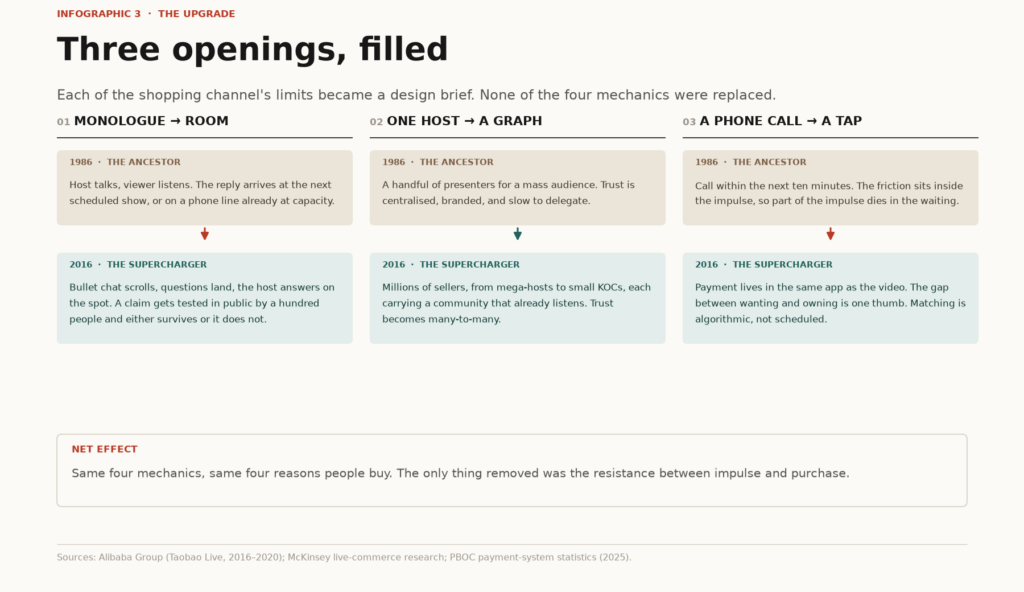
Three things made that possible, and none of them was the livestream itself.
Supercharger One: The Viewer Got a Keyboard
QVC’s monologue became a room. Bullet chat scrolls continuously; questions land; the host answers in real time. A product claim is tested in public by hundreds of people simultaneously, and it either survives that or it does not.
This matters more than it sounds. A live comment section is not a customer service channel — it is a credibility mechanism. The audience polices the seller in real time, which raises the cost of overclaiming, which in turn makes the credible seller more valuable. QVC’s hosts were accountable to a compliance department. Chinese live sellers are accountable to the room.
Supercharger Two: One Host Became a Graph
Instead of a small roster of presenters, China built a creator economy in which millions of sellers — from mega-hosts with eight-figure followings down to small key opinion consumers with a few thousand loyal viewers — each carry a community that already listens to them.
That is a structural change in the shape of trust. QVC’s trust was one-to-many: a single host brand extended across a mass audience. China’s is many-to-many: a dense mesh of smaller trust relationships, each one narrow and deep. The second configuration reaches places the first cannot, because a niche seller can be credible about a niche product in a way no generalist host ever could.
Supercharger Three: The Phone Call Became a Tap
Here the numbers are stark. By the end of 2025, China’s online payment user base stood at 1.017 billion people — 90.3% of all internet users — and mobile payment penetration was around 86%, the highest in the world. The People’s Bank of China recorded 231.5 billion mobile payment transactions that year worth RMB 571.97 trillion.
When payment lives inside the same application as the video, the distance between wanting something and owning it collapses to a thumb movement. QVC’s version of that distance was a phone call, a queue, and a card read out loud. It was not a large distance. It was large enough.
Why the Lineage Matters: It Explains a Habit, Not a Funnel
Here is where the usual account goes wrong.
The standard explanation for China’s live commerce dominance is that Chinese consumers trust live sellers more, or that they are more price-sensitive, or that they treat shopping as entertainment. All three contain something true. None of them is the mechanism.
The mechanism is frequency.
McKinsey surveyed frequent live-commerce users across four regions and found something that should have ended the debate. Conversion — the share of shows a user attended and then bought during or after — was essentially identical everywhere: 36% in Latin America, 33% in the United States, 32% in China, 30% in Europe.
Read that again. American viewers who watch a live shopping show convert at a slightly higher rate than Chinese viewers do. The conversion mechanics are not broken in the West. They work fine.
What differs is how often anyone shows up. Chinese frequent users watched far more shows in the past year than their American, European or Latin American counterparts. And they spent less per show — roughly $82 to $90, against $127 to $197 elsewhere. China’s market is not bigger because each transaction is larger. It is bigger because the behaviour is routine. Between 63% and 78% of Chinese frequent users buy one or two items per show, across categories. Groceries, clothing, beauty: the purchase happens inside the broadcast, not after it.
That is a habit, and habits are built by infrastructure. A habit needs a place to happen, a low enough cost per attempt, and a payoff that arrives immediately. QVC had a place and an immediate payoff but a high cost per attempt — you had to be home, at the television, at the scheduled hour, with a phone. China removed the scheduling, removed the friction, and put the store inside the thing people were already staring at.
The Ancestor’s Own Ending
There is a detail in QVC’s recent numbers that is worth sitting with.
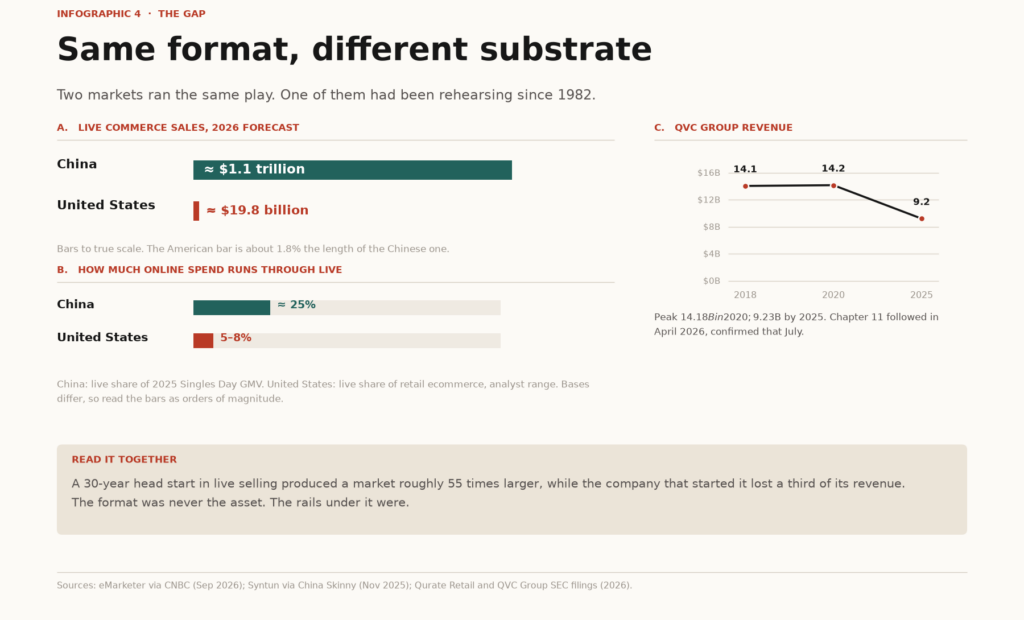
The company’s revenue peaked at $14.18 billion in 2020 and fell to $9.23 billion by 2025. In 2025, 97% of its sales came from repeat buyers, even as its active customer base shrank from 8.1 million in 2023 to roughly 7 million by September 2025. Nearly three-quarters of its 2024 shoppers were women over 50, with an average age near 60.
QVC filed for Chapter 11 on 16 April 2026. The plan was confirmed on 20 July and became effective on 6 August.
Meanwhile its existing customers were still spending heavily — an average of $1,620 each across 31 orders in the twelve months to September 2025. That is a remarkable figure. It is also the whole problem in one line: the people who already loved the format loved it enormously, and no new people were arriving.
QVC’s own diagnosis, announced in 2022, was that it would reinvent itself as a live social shopping company. It partnered with TikTok Shop, set a target of $1.5 billion in run-rate revenue from social platforms within three years, and now runs more than 200 hours of live programming a week across seven TikTok accounts. By the accounts of TikTok’s own US commerce leadership, it has become one of the platform’s better-performing merchants.
So the ancestor did eventually climb onto the new rails. It arrived roughly a decade after the descendants had already built the road.
The Copying Problem
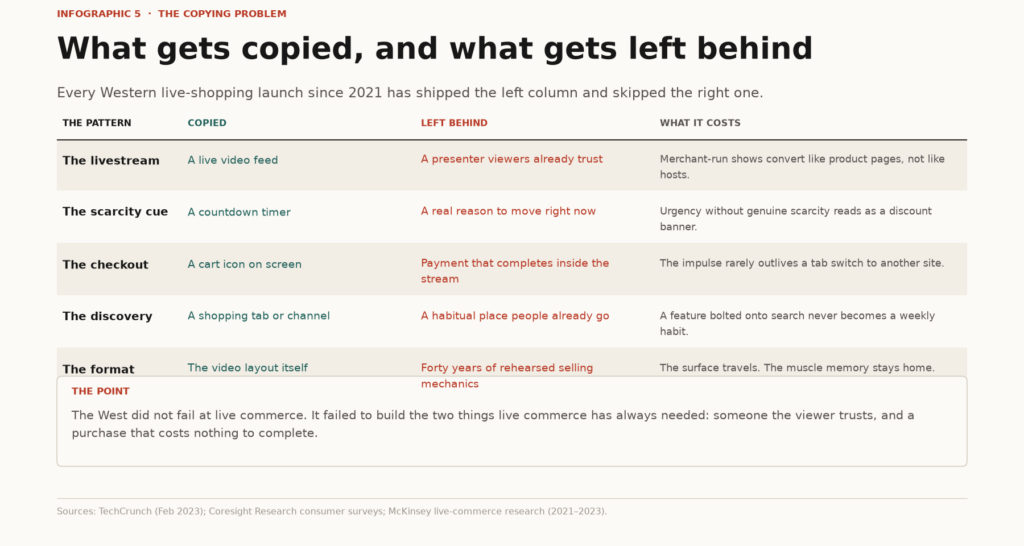
The West’s live commerce record since 2021 reads less like a failure than a series of well-funded misunderstandings.
Meta launched live shopping on Facebook in 2018, extended it to Instagram in 2020, then shut both down — Facebook in October 2022, Instagram in March 2023 — and redirected the effort into advertising and short video. Amazon has run Amazon Live since 2016 and has never published numbers, which is its own kind of statement. TikTok Shop, the one genuine success, opened in the US in 2023 and doubled its US live sales in the first half of 2026 against the same period a year earlier, with sessions up more than 60% and broadcast hours up more than 80%.
Against that, the total US live commerce market is forecast at about $19.8 billion in 2026, up roughly 35% from $14.6 billion. China’s is expected to exceed $1.1 trillion.
That is a gap of about 55 times, in a market that has now been trying for a decade with the full weight of American platform capital behind it.
And the shape of the American success is telling. On TikTok Shop in the US, live selling accounted for only about 14% of GMV in 2025, and by one analyst estimate 8.2% in the first half of 2026 — the rest came from short video and the shop tab. Whatnot, the live auction app that started with collectible cards, reached $8 billion in GMV in 2025 and a $20 billion valuation in August 2026, largely by refusing to be a general marketplace at all.
The West is not building QVC’s descendants. It is building short video with a cart attached, and a few vertical auction houses.
What QVC Would Recognise
Set a 1986 QVC producer in front of a Taobao Live room and they would recognise almost everything that matters. The host working a product for hours. The demonstration. The countdown. The instruction to buy now.
What they would not recognise is the audience talking back in real time, the thousand small sellers each holding their own community, the algorithm routing a specific product to a specific person, and the fact that the purchase requires no phone call at all.
The uncomfortable conclusion is that the West did not fail to copy China. It failed to finish what it started. The shopping channel proved, four decades ago, that a trusted host plus a live demonstration plus an immediate transaction is a more powerful sales mechanism than a static listing. Then the internet arrived, and Western retail spent twenty years optimising for the opposite: faster search, fewer clicks, shorter sessions, less time on site.
Live commerce is what happens when you stop optimising for speed and start optimising for presence. China built a payments and platform layer that made presence cheap. The West built a payments and platform layer that made absence efficient.
What Is Actually Worth Building
If you are a Western brand or retailer looking at this, the useful lesson is not to launch a livestream. It is to be honest about which of the four mechanics you can actually supply.
Ask whether you have a host who will still be credible in six months, or a rotating cast of agencies. Ask whether your stream shows the product doing something, or shows a person describing it. Ask whether the clock is real — actual limited stock, not a manufactured countdown that resets. And ask, most importantly, whether the purchase completes inside the stream or sends the viewer somewhere else, because that last one determines whether the impulse survives.
The brands getting traction in the US are the ones that answered those questions honestly. Beachwaver built its TikTok Shop business to roughly $1 million in 2026 so far, about a quarter of it from live, by running hundreds of sessions a year with the founder herself on camera. Whatnot built a live auction format where the clock is genuinely real, because an auction’s clock always is.
Neither of those is a copy of Taobao Live. Both are recognisably QVC’s grandchildren.
The Takeaway
Live commerce looks like a Chinese invention and is not. It is a 1982 Florida shopping channel, rebuilt on rails that did not exist then: real-time conversation, a distributed creator economy, and payment that costs nothing to complete.
The lineage matters because it tells you which parts are load-bearing. A trusted host, a visible demonstration, a real clock, and a transaction taken at the moment of impulse — those four things have survived every migration of the format across forty years and three technologies. Everything else is packaging.
QVC spent four decades proving that those four mechanics work, then lost a third of its revenue watching other people build the infrastructure that would have let them scale. The West’s live commerce problem is not that it lacks China’s playbook. It is that it forgot it wrote the first draft.