“Growth Hacking” Was Always Just Marketing With Better PR
There was no hack. There was a rename.
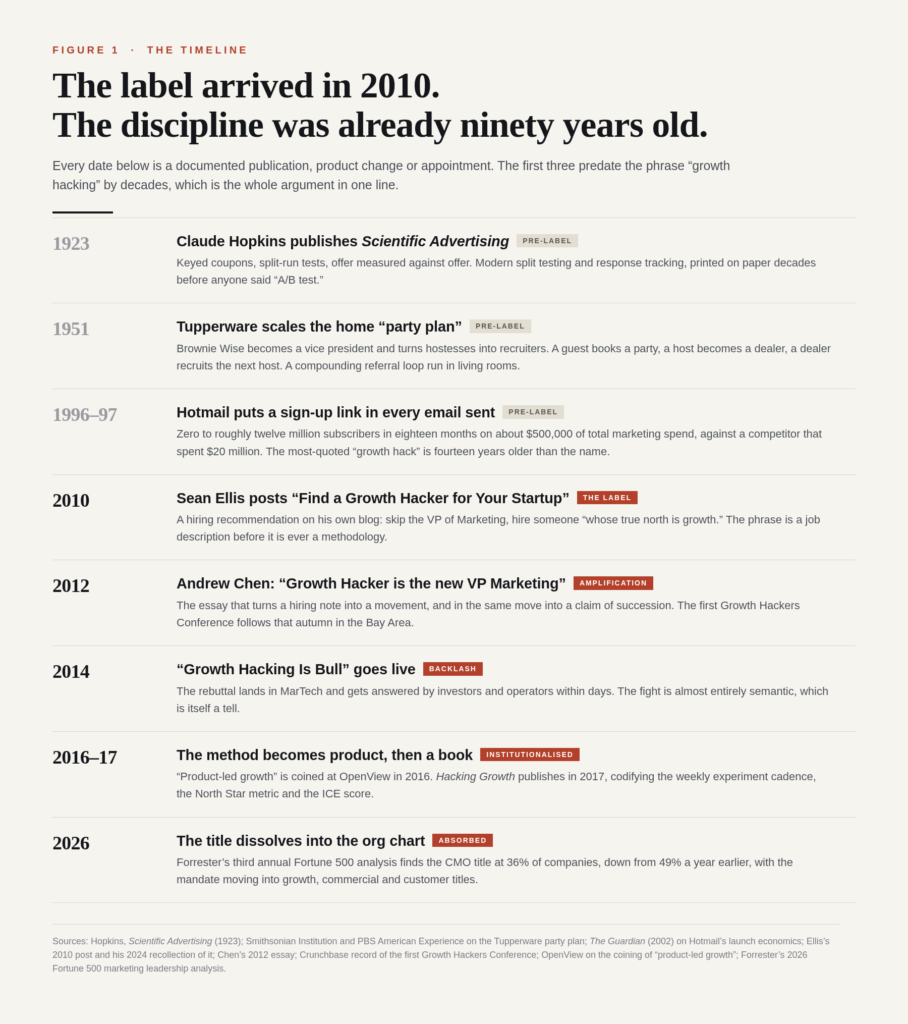
In 2010, a consultant named Sean Ellis wrote a blog post recommending that startups hire someone “whose true north is growth” instead of a vice president of marketing. Two years later, an investor named Andrew Chen turned that hiring note into a movement with an essay declaring the growth hacker the new VP of marketing. Within eighteen months there was a conference with five hundred attendees. Within four years there was a backlash, a book, and a job title on every second LinkedIn profile in San Francisco.
Nothing in the toolkit was new. The referral loop had been running in American living rooms since 1951. Keyed split testing was printed in a book in 1923. The most-quoted growth hack of all time — a sign-up link in every email sent — shipped in 1996, fourteen years before anyone called it one. What was new was the packaging, and the packaging was aimed at a very specific audience that had nothing to do with customers.
That is the argument. What follows is the evidence, the bill, and the question you should ask the next time someone sells you a revolution.
The word was a hiring ad
Here is the part people forget: “growth hacking” did not begin as a methodology. It began as a recruitment problem.
What Ellis actually wrote
Ellis had been the first marketing hire at Dropbox, LogMeIn, Eventbrite and Lookout. When he consulted for other startups, he kept running into the same obstacle: the founders wanted a marketing leader, but the job description for a VP of Marketing — strategic plan, team management, brand architecture — described work that a company with eight employees did not yet have. In his 2010 post, he proposed an alternative. Hire someone whose entire job is to find “scalable, repeatable and sustainable ways to grow the business,” and judge them on that alone.
Read the original language and something odd surfaces. It is not a theory of marketing. It is a specification for a person, written by a guy who needed to fill a seat. Ellis later told the Economic Times that he wrote it as a recommendation, and that the phrase only “took off” after Chen picked it up about six months later.
What Chen turned it into
Chen’s 2012 essay is where a hiring note became an ideology. His growth hacker was “a hybrid of marketer and coder,” someone who answered the customer-acquisition question with A/B tests, landing pages, viral factors and email deliverability. His headline claim was the provocation: the growth hacker is the new VP of Marketing. The subtext was blunter still — that coding and technical chops were now essential to being a good marketer, and that the traditional marketing leader was fading.
Note what the essay actually did. It did not discover a new discipline. It re-priced an existing one. Everything in Chen’s list — testing, landing pages, deliverability, referral mechanics — was already standard practice for direct-response marketers who had been running keyed coupons and mail-order tests for the better part of a century. The novelty was the claim of succession, and the fact that it was written in the vocabulary of engineering rather than the vocabulary of advertising.
That distinction matters, because it tells you who the message was for. Not customers. Founders, engineers and the investors who funded them — people who reflexively distrusted “marketing” and would happily fund “growth.”
Why the rename worked
Marketing had a credibility problem, not a capability problem
In 2010, “marketing” carried baggage that had nothing to do with its actual methods. It meant Mad Men, inflated budgets, unmeasurable spend, and the vague promise of “brand awareness” that no CFO could audit. The discipline’s best practitioners had been quietly doing rigorous, measurable work for decades. The label had simply stopped signalling that.
So the industry did what any brand does when its positioning goes stale. It relaunched under a new name. Samuel Scott made this point in a 2014 essay titled, without much diplomacy, “Growth Hacking Is Bull” — arguing that the term was a rebranding exercise by a startup culture that had spent a decade mocking online marketing and then discovered it needed it. Developer DHH was less diplomatic still, calling it “a cool-sounding euphemism for making the doer feel good about using the same old sleazy marketing tricks.”
You do not have to accept the insult to accept the diagnosis. When a discipline changes its name and its price simultaneously, the change is usually positional, not substantive.
The audience was never the customer
Watch where the energy went. The first Growth Hackers Conference ran in the autumn of 2012 in Menlo Park. By the third edition, five hundred people filled the Computer History Museum in Mountain View to hear practitioners from Facebook, LinkedIn, Twitter and Square. A Udemy course followed. A community followed. Within three years the term had its own canon, its own celebrities, and its own conference circuit.
No customer was in that room. Founders and operators were. The rebrand was B2B positioning executed on the marketing profession itself — and by any honest measure, brilliantly done. It made an old discipline feel like a new science and gave its practitioners a title they could put on a business card without apologising.
Put the hacks on the table
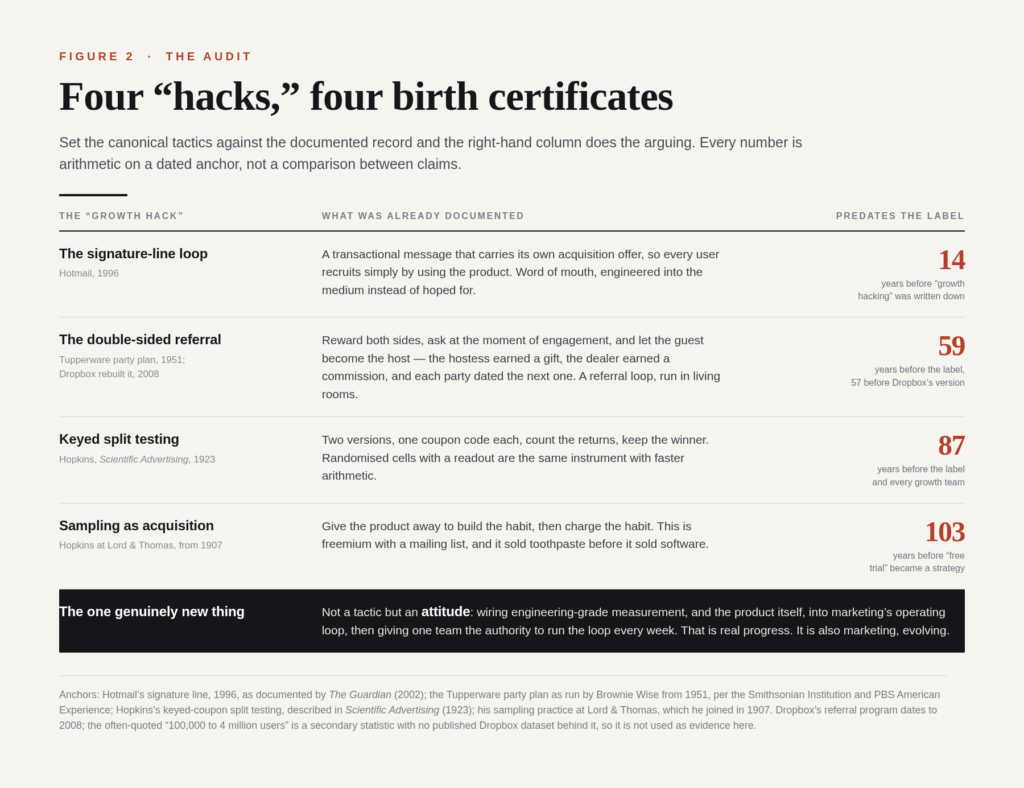
Now the audit. Take the canonical tactics and hold them against the documented record. Not against a claim. Against a date.
Hotmail, 1996
The origin story of growth hacking is a signature line. Every message sent from a Hotmail account carried a link inviting the recipient to get a free account too. That is it. That is the hack.
It worked spectacularly: roughly twelve million subscribers in eighteen months, on total marketing spend of about half a million dollars, against a competitor that spent twenty million over the same stretch and got nowhere near. The Guardian called it the first viral marketing campaign; Sabeer Bhatia and Jack Smith ran it in 1996, when the idea of turning a transactional message into an acquisition channel was genuinely strange.
Strange, but not new in kind. Mail-order businesses had been paying for “tell a friend” coupons for most of the century. What Hotmail added was distribution — the loop ran inside the product instead of inside an envelope. Fourteen years later, someone put a name on it.
The referral loop, 1951
Here is the one that should end the argument. In 1951, Earl Tupper made a businesswoman named Brownie Wise a vice president of a new division and put her in charge of a party plan. Guests came to a hostess’s living room. The hostess earned a gift for hosting. The dealer earned a commission — thirty per cent of what she sold. Then the evening ended with the dealer dating the next party through a guest, and, often, recruiting that guest as a dealer.
A guest becomes a host, a host becomes a seller, a seller recruits the next host. By 1954 the sales force was twenty thousand people, ninety-five per cent of them women, and the Smithsonian credits Wise with industrialising the model.
Set that beside Dropbox’s double-sided referral, the one every growth deck cites. Reward both sides. Ask at the moment of engagement. Make the reward the product itself. Let the invited party arrive feeling gifted rather than pitched. It is the same structure, minus the living room and plus a database. The intervening fifty-seven years changed the venue and the instrumentation. They did not change the mechanism.
One correction while we are here. The famous Dropbox figure — one hundred thousand users to four million in fifteen months — gets repeated everywhere and traced nowhere. There is no published Dropbox dataset behind it. It is circulation, not evidence, and it should stop being used as proof of a tactic whose actual lesson is that the product has to be worth referring.
Testing, 1923
Claude Hopkins published Scientific Advertising in 1923. In it he describes running two versions of an ad, keying each with a different coupon code, counting the returns, and keeping whichever version paid. David Ogilvy later said nobody should be allowed near advertising until they had read the book seven times. The book is credited as the original description of split testing and coupon-based response tracking.
Randomised cells with a dashboard readout are that instrument with faster arithmetic and a nicer chart. The statistics got better. The logic did not move.
The one thing that was genuinely new
I have spent two thousand words dismantling a term, so let me be fair to it. Something real happened in those years, and pretending otherwise would be its own kind of dishonesty.
What changed was not the tactics. It was the attitude — specifically, three things braided together. First, engineering-grade measurement moved from the media plan into the operating rhythm: test weekly, instrument everything, treat a failed experiment as data rather than a defeat. Second, the product itself became a channel, so that activation and onboarding and pricing were no longer downstream of marketing but part of it. Third, one team was given authority across the whole journey, rather than an acquisition team handing off to a retention team that had never met them.
That braid is genuinely valuable. It is also, precisely, marketing done with more discipline. Ellis said as much himself, years later: growth hacking is about running smart experiments to drive growth, and marketing is about experimentation to move growth as well. When the coiners of a term describe it that way, you are not looking at a new field. You are looking at a field that got better at self-examination.
And this is what the word “hack” obscured. A hack is a shortcut. The reality was a volume business in which most attempts produce nothing.
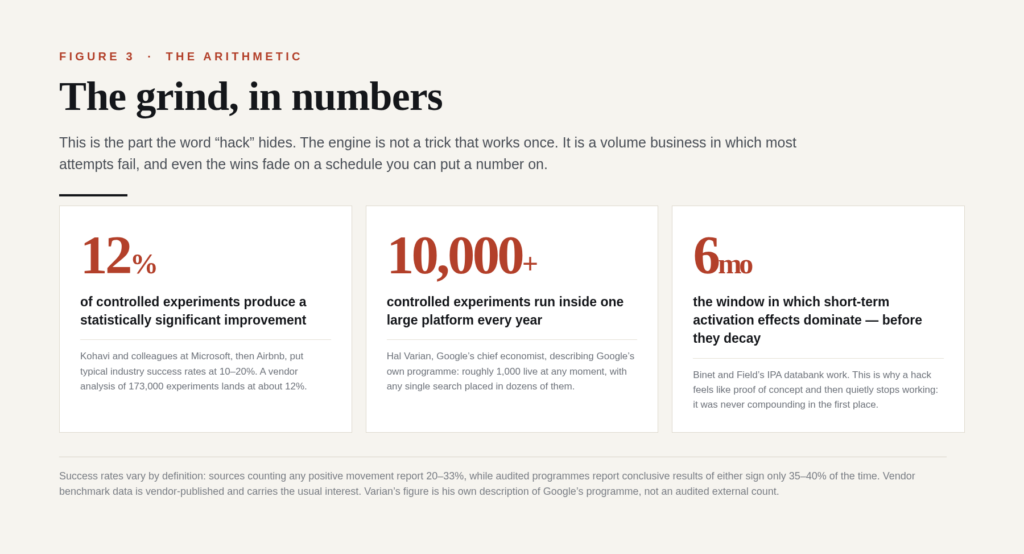
Google’s chief economist has described a programme of roughly ten thousand controlled experiments a year, about a thousand live at any moment, with any single search placed in dozens of them. Across the industry, typical success rates run somewhere between ten and twenty per cent — meaning the overwhelming majority of well-designed tests confirm that the original was fine. That is not a hack. That is a factory, and the factory’s output is mostly null results.
The bill
Every rebrand has a cost, and this one was paid in two currencies.
The silver-bullet tax
“Hacking” promised a trick. A trick implies that the work is short, that the answer is hidden, that someone with the right cleverness can skip the queue. Founders believed it, and a generation of startups spent money looking for the one channel, the one growth loop, the one obscure integration that would do the work of a decade.
The ones who actually won were grinding. Hotmail’s loop only worked because the product was free and useful and the loop cost nothing to run. Dropbox’s loop only worked because people were already recommending it unprompted. Ellis’s own account of the method is almost aggressively boring: analyse the funnel, generate ideas, score them, test weekly, keep what works, discard the rest, repeat forever. There is no shortcut in that sentence. There is a schedule.
The uncomfortable corollary: the companies that learned the wrong lesson most thoroughly were the ones with the least margin for error. A silver-bullet search is expensive when you cannot afford one bullet.
The brand and performance split
The second cost was structural, and it is measurable. Growth, as practised, was optimised for what could be attributed inside a quarter. That is exactly the kind of growth that can be “hacked” — and exactly the kind that starves everything slower.
The IPA databank work by Les Binet and Peter Field puts the optimum split at roughly sixty-forty in favour of brand building. In 2014, the average communications budget was spending thirty-one per cent on short-term activation. By 2016 it was spending forty-seven. The line had been crossed and the crossing was accelerating, and their wider finding is the sting: short-termism lifts short-term return on investment while suppressing profit growth.
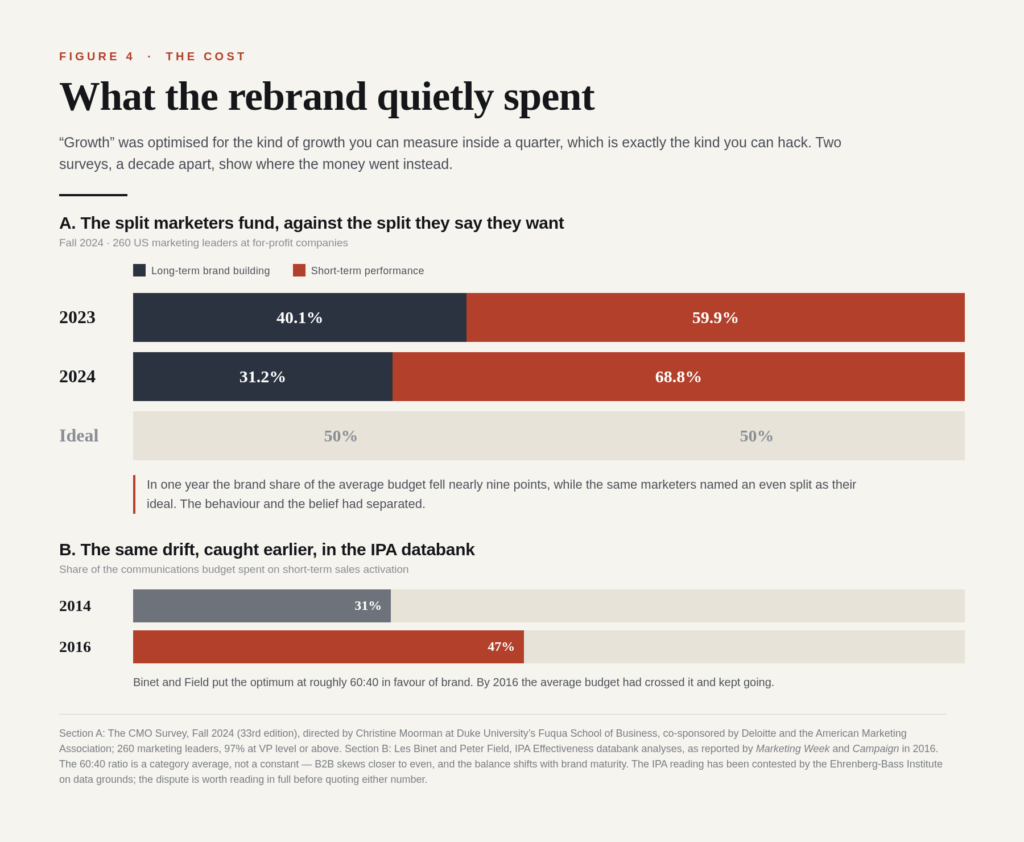
The 2024 CMO Survey — 260 US marketing leaders, nearly all at VP level or above, run out of Duke’s Fuqua School with Deloitte and the American Marketing Association — makes the same point more starkly. Brand building took 31.2 per cent of budget, down from 40.1 per cent a year earlier. Short-term performance took 68.8 per cent. Asked what split they considered ideal, the same respondents said roughly fifty-fifty.
Read that gap carefully. It is not ignorance. It is a revealed preference produced by an incentive structure: performance is attributable, brand is arguable, and a growth mandate with a quarterly scoreboard will always resolve that tension the same way. The rebrand did not create short-termism. It gave short-termism a word that sounded like virtue.
A caveat, because these numbers get quoted as law. The sixty-forty ratio is a category average, not a constant — B2B skews closer to even, the balance shifts as brands mature, and the Ehrenberg-Bass Institute has attacked the underlying awards dataset as unsound. The direction of the finding has survived a decade of that fight. The precision has not.
Watch a label die
The most instructive part of the story is the ending, because it repeats on a schedule.
By the middle of the 2010s, the method had gone mainstream and the title had started to evaporate. Experimentation, referral loops and acquisition data became table stakes. Companies built growth marketing teams, then product-led growth teams, then just hired growth marketers and expected everyone to do the work. Once every marketer is supposed to do the thing, nobody needs a special name for the person who does it.
Growth hacking, then growth marketing, then product-led growth
Each successor was the previous one with the sharp edges filed off. “Growth marketing” widened the remit from acquisition to the whole lifecycle and dropped the implication of sorcery. “Product-led growth,” coined at OpenView in 2016, took the single most defensible idea from the original movement — that the product is the channel — and made it the whole thesis. Ellis and Morgan Brown’s 2017 book codified what remained into something teachable: a weekly cadence, a North Star metric, an ICE score, a forty-per-cent “very disappointed” test for product-market fit.
That is the normal life of a marketing idea. Name, hype, absorption, disappearance into the org chart.
2026 and the disappearing CMO
You can watch the same cycle run right now on a bigger stage. Forrester’s third annual analysis of Fortune 500 marketing leadership found the CMO title in use at 36 per cent of companies, down from 49 per cent a year earlier, with senior marketing leaders on the executive team or reporting to the CEO at 52 per cent, down from 58. The mandate did not vanish. It moved — into chief growth officer, chief commercial officer, chief customer officer.
Boards stopped asking whether they needed a CMO and started asking who owns growth. That is the 2010 rebrand, run again at C-suite scale, by people who have never read the 2010 blog post. And in the AI era the pattern is already visible a third time: a genuine capability, wrapped in a title, sold to the people who hold the budget, with the promise of a step change that the underlying work does not actually offer.
The question worth keeping
So here is what survives, and it is not the tactics. It is the diagnostic habit.
When the next label arrives — and it will, probably within eighteen months, probably with the word “agent” in it — ask three questions. Is there a documented practice here that predates the name? Who is the audience for the naming, customers or budget-holders? And what does the promised shortcut cost me if the underlying work turns out to be the same patient grind it has always been?
Most of the time the answers will be: yes, the budget-holders, and more than you think. That is not cynicism. It is how you keep a good idea from being spent on a bad promise.
The honest version of the growth-hacking story is more flattering to marketers than the myth is. A group of operators looked at a discipline that was being done badly and held it to a higher standard — measure it, instrument it, test it weekly, own the whole journey. Then they named that standard after themselves, sold it to founders, and let the name do the persuading. The standard was right. The name was PR. And the profession’s oldest failure mode is confusing the two.
Growth was never hacked. It was earned, slowly, by people running the loop again on Monday.