It’s Not That AI Can’t Write. It’s That Nobody Clicks.
If AI can write a competent article for pennies, and half the web’s new pages are already machine-written, you’d expect the share to keep climbing until humans were a rounding error. That’s what a capability curve looks like.
It isn’t what happened. Graphite’s May 2026 measurement put the share of primarily AI-generated articles at 50% — then found it had plateaued there since early 2025. It hit 36% twelve months after ChatGPT launched, 48% at twenty-four months, crossed 50.9% in one quarter, and settled back to 49.9%. The line went flat with the tool still improving.
So the ceiling isn’t technical. Something pushed back.
The first answer is wrong, and everyone still gives it
The comfortable explanation is quality: AI writing isn’t good enough yet. It’s a bad explanation. It contradicts the evidence from every direction. In the Harvard Business Review study run with Ipsos, 3,000 consumers couldn’t reliably identify AI-made ads — only about a quarter could. The work was convincing; it still underperformed 14% on short-term sales and 17% on brand equity.
Saying “AI isn’t good enough” also can’t explain the plateau’s shape. A quality ceiling would produce a slow, uneven climb as the models improved. What actually happened looks like a switch being thrown: publishers discovered the payoff wasn’t there, and stopped.
That’s the mechanism. Not a limit on what machines can produce, but a limit on what producers were willing to keep paying for.
The price signal nobody budgeted for
Run the experiment long enough and it returns a verdict. Graphite’s companion study found that while half of new content is AI-made, only 14% of articles ranking in Google’s top twenty are — and 7% of the pages holding position one. In ChatGPT and Perplexity citations, 82% are human. Ahrefs, analyzing 600,000 pages, found a correlation of 0.011 between a page’s AI share and its rank. Statistically, that is nothing.
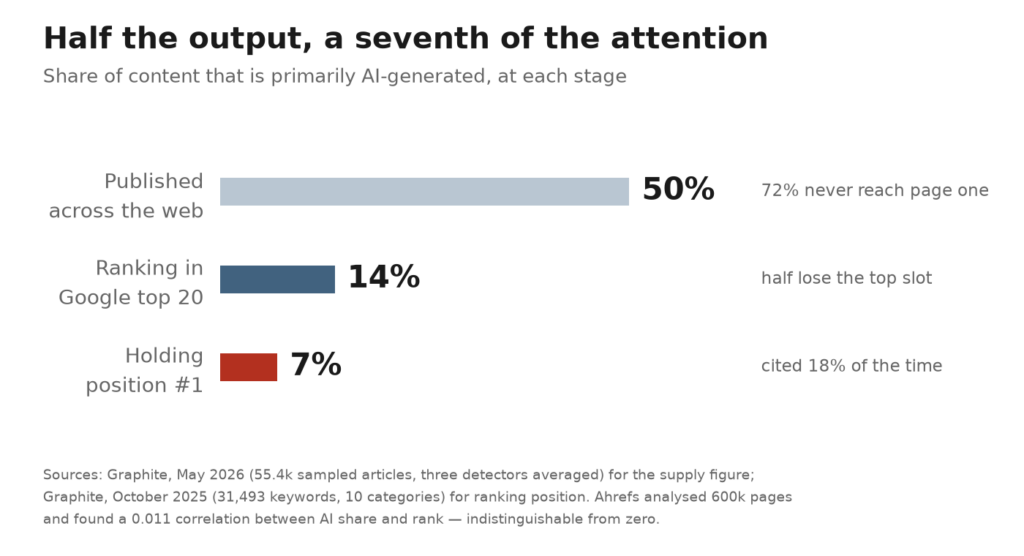
Put those two curves on the same axis and the plateau explains itself. Every publisher that tried the strategy paid the same tuition: full production cost saved, full distribution benefit forgone. Not because Google punished them — the data says it didn’t — but because a link that ranks seventh earns roughly nothing, and a page nobody clicks still costs money to host, index, and maintain.
Fifty percent is where the expected return stopped covering the residual cost. Volume didn’t become unattractive because it got more expensive. It became unattractive because the return fell below the threshold where anyone bothers.
Where the flood actually went
Here’s the part the aggregate number hides. The 50% is an average across the whole web, and averages conceal a split.
Look at Graphite’s category breakdown and the split becomes visible. Food: 4.5% of ranking pages are AI-generated. News: 4.7%. Travel: 6.5%. Productivity: 14.1%. Crypto: 13.3%. Tech: 10.8%.
The pattern isn’t about which topics models write well. It’s about which topics have a reader whose judgment matters. Restaurant reviews and breaking news get evaluated by people who can tell. Software comparison pages and crypto explainers get skimmed by people who mostly can’t — or don’t care.
So the flood didn’t recede. It sorted. It moved out of the layer where being indistinguishable is fatal, and into the layer where being indistinguishable is fine. Two webs now sit on top of each other: a thin visible one that has to earn attention, and a thick invisible one that only has to exist.
Why this equilibrium is quietly unstable
Fifty percent looks like a resting point. It isn’t, and the reason is structural rather than statistical.
The visible layer is getting more expensive to maintain, not less. Ziff Davis told investors in November 2026 that Google referrals fell 37% year over year — after a 23% drop the year before. Its content was cited inside AI answers roughly 2.7 billion times a quarter, near ten times its click volume. The work still has to be done by humans, and now returns a tenth of the traffic.
Meanwhile the invisible layer keeps thickening, because it’s nearly free. Nothing forces it to stop. It just stops mattering.
Field note
I’ve watched three teams run this in the last eighteen months. All three ended in the same place, arrived at differently: they stopped asking “how much can we publish” and started asking “which of these pages would a competitor be embarrassed to have written.” The answer was usually a third of the archive. What surprised them wasn’t the number — it was how little traffic they lost deleting it. The pages that mattered were never the ones made quickly.
The flood stopped at half because half was never the point. The point was always the same small set of pages that a person wrote for a reason.