Why Your Analytics Estate Only Grows: The Economics of One Click vs. Four Gates
Ask a data team how many dashboards their organisation owns and you will usually get a number and an apology. Ask why the number keeps rising and you will get a story about demand, self-service, and empowering the business. Both answers are sincere. Neither is the interesting one.
The interesting fact is that almost nobody in the analytics industry has ever measured its own output. As one practitioner admitted in a 2026 column after a fruitless search for a credible figure on unused dashboards: for an industry that sells measurement, we are oddly bad at measuring ourselves.
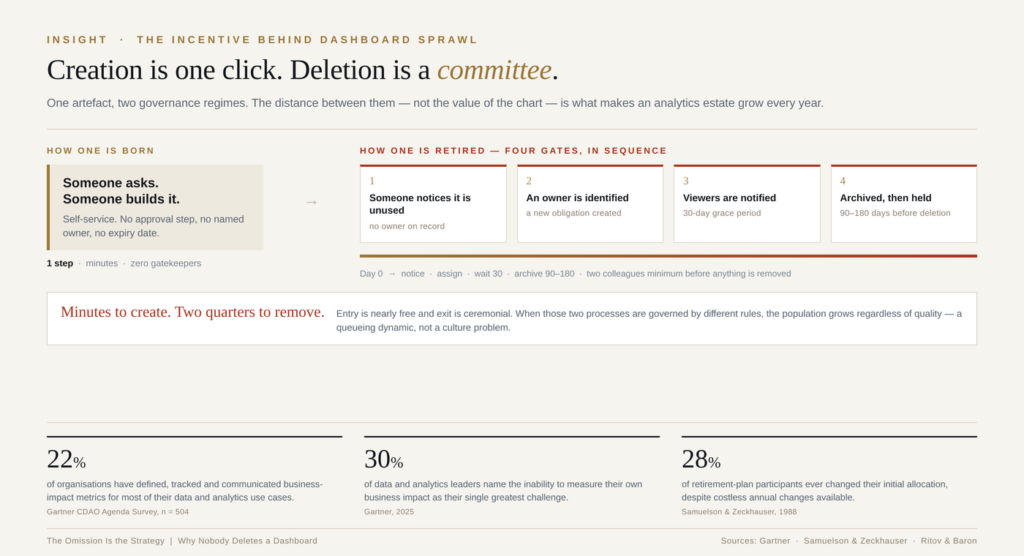
We do, however, measure something adjacent, and it is worse. In Gartner’s survey of 504 data and analytics leaders, 30% named the inability to measure the impact of their own work on business outcomes as their single greatest challenge — the top answer, ahead of funding, talent, and technology. And only 22% had defined, tracked and communicated business-impact metrics for most of their use cases. The analyst quoted in the release put it without decoration: there is a massive value vibe around data, but few who can substantiate it.
So here is the anomaly worth explaining. An industry that cannot demonstrate its own return has nonetheless grown its estate continuously for fifteen years. That should be impossible if it were purely a value story. It isn’t one. It’s an attrition problem, and attrition has a mechanism.
The mechanism is asymmetric friction. Creating a dashboard takes one person, one click, and zero approvals. Retiring one takes a named owner, a notification to every viewer, a grace period, an archive window, and a second colleague willing to sign off. Look at any published governance playbook and the count is explicit: thirty days of notice, ninety to 180 more in archive before deletion is even permitted. Sixty days of ceremony to remove what took an afternoon to build.
When entry is nearly free and exit is expensive, the population grows regardless of quality. That is not a culture problem. It is a queueing problem, and it resolves the way all such problems do — toward accumulation.
But the friction is not an accident, and this is the part most analyses miss. It is a rational response to a real asymmetry: deleting a dashboard you were right about costs you nothing, and deleting one that a colleague still needed costs you a visible, attributable, personally embarrassing error. So organisations build elaborate protections against the second outcome and almost none against the first. Every safeguard is individually defensible. Collectively they make removal the only decision in the building that requires consensus.
The psychology has a name, and it is not a metaphor. Omission bias is the documented tendency to decline an action that carries some risk, even when inaction carries a substantially larger one. Ilana Ritov and Jonathan Baron demonstrated it in 1990 with a clean, uncomfortable case: people refuse to vaccinate a child when the vaccine itself can cause death, even when the disease it prevents is far more likely to kill. The harm you permit feels categorically different from the harm you cause.
A stale dashboard follows exactly this geometry. Keeping one is harm you permit — diffuse, unattributed, invisible. Deleting one is harm you cause — specific, attributable, and remembered at the next performance review. The bias then compounds in the other direction too. Samuelson and Zeckhauser, in the paper that established status quo bias, tracked 850,000 retirement-plan participants and found that only 28% ever changed their initial allocation — despite costless annual rebalancing. Inertia does not need a reason. It needs only a default.
Which means the dashboard estate is not a record of what the business needs to know. It is a record of what nobody has yet been willing to be blamed for removing.
The fix, then, is not another governance framework. It is to make omission as legible as commission. Attach an owner at creation, not at retirement. Give every dashboard an expiry date on the day it ships. Publish a quarterly list of zero-view assets, with names. And flip the default: require a reason to keep, not a reason to delete.
The most expensive thing in a mature analytics estate is not the platform licence. It is the decision nobody is willing to be responsible for making: that this chart, whatever it once meant, is now noise. And the reason it survives is not that anyone values it. It is that everyone has quietly agreed not to be the one who says so.