Why Marketing Headcount Shrank but Capability Didn’t
Marketing teams are getting smaller. That part is not news. What is news is that they are not getting smaller by doing less — they are getting smaller by changing what a team is. The permanent, full-time department is being pulled apart into two layers: a small core of salaried owners who hold strategy, brand and context, and a rotating outer layer of freelancers, fractional leaders and boutique agencies engaged for as long as a problem takes to solve. The freelance marketing economy is not a cost-cutting episode. It is a restructuring of where marketing work lives.
1. The budget did not shrink. It got re-sorted.
Start with the constraint everyone in marketing now works inside. Gartner’s 2025 CMO Spend Survey put average marketing budgets at 7.7% of company revenue — flat for a second consecutive year, and far below the 11.2% recorded in 2018. Half of the CMOs surveyed reported budgets at 6% of revenue or below. In the 2026 edition of the same survey, the figure moved to 7.8%. That is not a recovery; it is a floor.
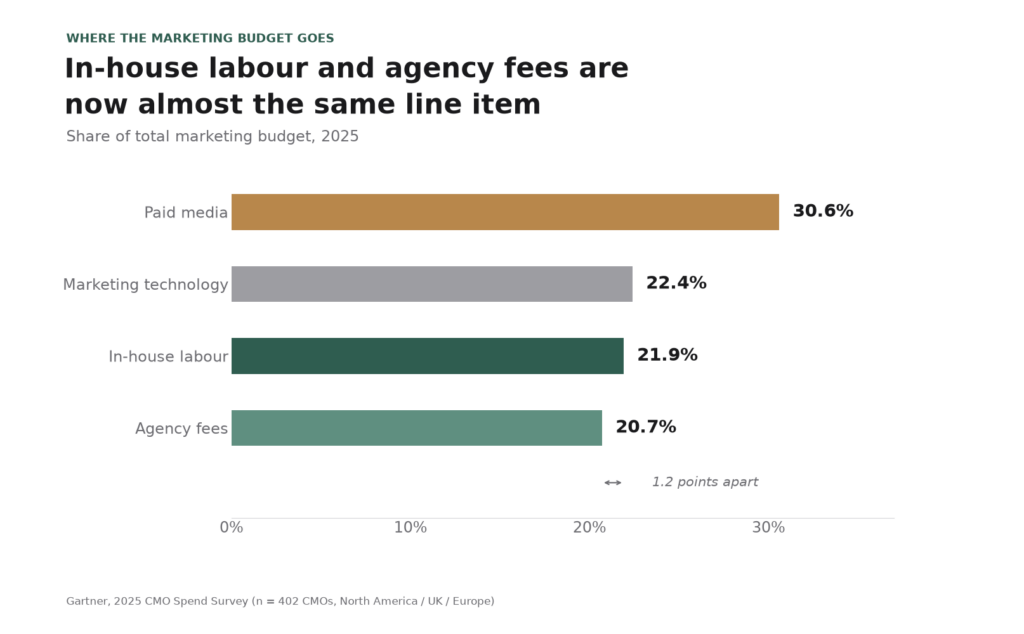
Here is the part most team-structure commentary skips. Within that flat number, the composition has been quietly rewritten. Paid media now takes 30.6% of the marketing budget. Martech takes 22.4%. In-house labour takes 21.9%. Agency fees take 20.7%.
Three years earlier, agency fees were a materially bigger line than labour. Today the two are 1.2 percentage points apart. In-house labour has been cut, agency rosters have been cut, and paid media has been protected — 39% of CMOs said they planned to trim agency spend, and 39% said the same about labour costs, mostly by collapsing overlapping roles.
That single 1.2-point gap is the whole story in miniature. When the money for permanent staff and the money for external partners converge, the decision stops being “build or buy” and becomes “which specific work deserves which specific arrangement.” That is the question the elastic team answers.
2. Gartner’s own data says the opposite. Both are true.
If you have read anything about the freelance marketing economy, you have probably met a stat claiming freelancers now make up 30% to 70% of enterprise marketing teams. It comes from a February 2026 Adweek report citing Assemble, a workforce platform with a network of more than 50,000 senior marketing freelancers. The report says the share was around 10% before 2022. Delta, MassMutual, ServiceNow and Colgate are named as companies assembling external teams that stay for multiple quarters.
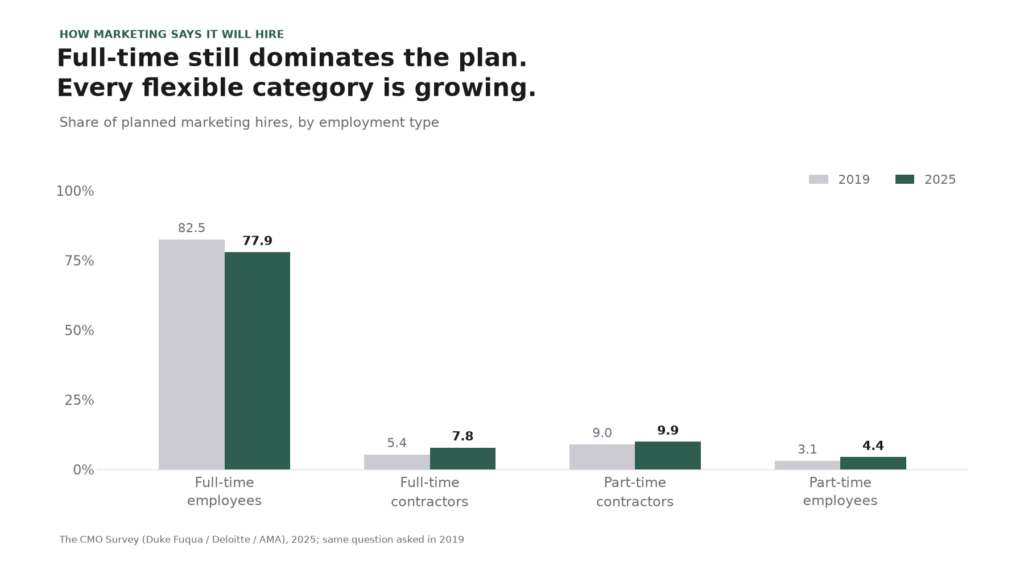
Now hold that next to The CMO Survey, which asks marketing leaders to distribute 100 points across the types of marketing employees they plan to hire in the coming year. In 2025, they allocated 77.9 points to full-time employees. That is down from 82.5 in 2019 — a real shift, but hardly a collapse. Full-time independent contractors went from 5.4 to 7.8. Part-time contractors from 9.0 to 9.9. Part-time employees from 3.1 to 4.4.
So one source says full-time is 78% of hiring intent, and another says contractors are 30% to 70% of the team. They cannot both be describing the same thing, and neither is lying.
The reconciliation matters more than either number. Hiring intent is not team composition. The CMO Survey measures the flow — who you add this year. Assemble measures the stock — who is on the team right now, including people engaged through procurement, through agencies, through talent platforms, on statements of work that never pass through an HR requisition. A company can hold its full-time headcount flat or shrinking while its total marketing capacity grows, because the growth is happening in a channel the headcount report does not see.
There is a second, less comfortable explanation. Assemble sells a platform for exactly this model. Its own revenue grew 400% in 2025, which tells you demand is real, but it also means the 30-to-70% figure is a vendor describing its own market. The range is wide enough to be almost un-falsifiable: 30% and 70% describe very different organisations.
The honest reading is that the two-layer team is real and spreading, concentrated among large enterprises with mature procurement, and much less visible in the survey data than in the org charts. If your company still runs a 90% full-time department, you are not behind. You are normal. The frontier is elsewhere.
3. The supply side showed up first
A restructuring only works if the talent exists. It does, and the numbers explain why the model became possible rather than merely desirable.
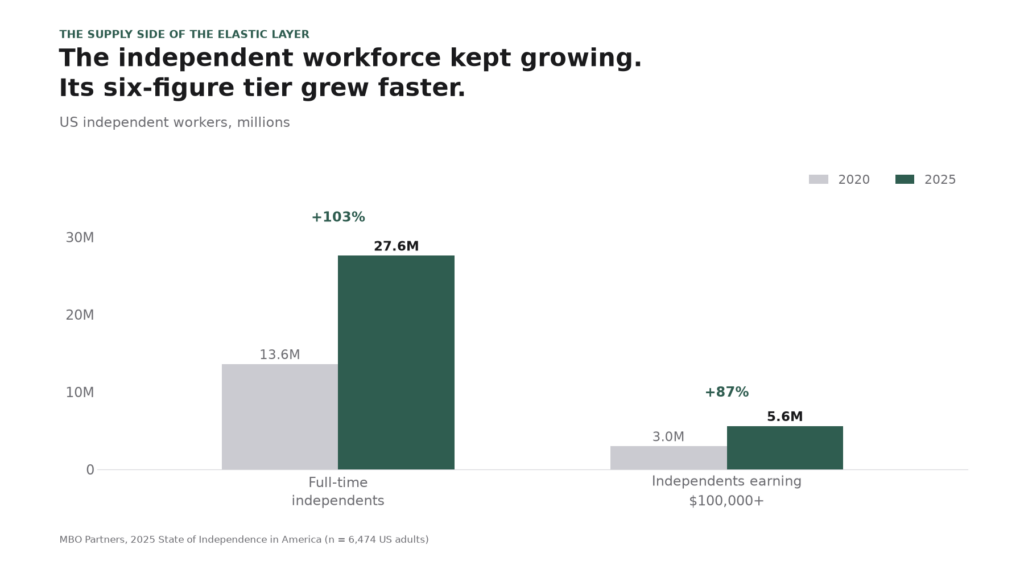
MBO Partners’ 2025 State of Independence study counted 72.9 million Americans working independently. Within that, 27.6 million work independently full time, and 5.6 million earn more than $100,000 a year — a 19% jump from 4.7 million in 2024 and roughly double the 3.0 million recorded in 2020.
Two details in that study matter for anyone building a bench. First, 63% of independents say the choice is fully voluntary — this is not a pool of people who failed to get hired. Second, 74% use generative AI in their work, up from 65% the year before. A senior freelancer in 2026 is not a lone craftsperson with a laptop. They are a small, AI-equipped operating unit.
That is what changed. A fractional CMO who can run analysis, draft, and produce a board-ready deck with AI leverage is a genuinely different economic proposition than the same person was five years ago. The elastic layer became credible at the exact moment budgets made it necessary.
4. Why the middle of the org chart is what disappears
Look closely at what actually gets cut. Gartner found 39% of CMOs planning to reduce labour costs by “simplifying overlapping roles, eliminating headcount and centralising critical responsibilities.” The operative word is overlapping.
The roles that vanish in a lean restructure are rarely the most senior or the most junior. They are the middle: the coordinator who moves briefs between people, the manager who supervises execution but does not set direction, the generalist who covers many functions adequately and none decisively. AI has taken a large bite out of exactly this layer of coordination work — not by replacing the person, but by making the coordination cheap enough that the person’s remaining value no longer justifies a salary line.
What survives is a core defined by two properties: ownership and context. Someone has to decide what the brand is and is not. Someone has to know why the 2024 campaign failed, which analyst the CFO trusts, and what the founder will veto without discussion. None of that is documentable in a brief. All of it walks out the door with a departing employee and cannot be re-hired on a statement of work.
This is the asymmetry nobody puts on the savings spreadsheet. The elastic layer is excellent at absorbing work. It is structurally bad at holding memory. A freelancer can deliver a flawless campaign and still leave the organisation dumber than they found it, because the reasoning behind the choices went into their head, not into the company’s.
5. The economics are real, and smaller than the pitch
The cost case is usually stated as a headline: contract talent is 30% to 40% cheaper than the full-time equivalent. That figure circulates widely and traces back to consulting analyses of contingent workforce models. It is directionally right and practically misleading.
What you actually save is narrower. You avoid benefits, payroll overhead, and the cost of carrying someone through slow periods. What you do not avoid is the coordination cost — and that cost goes up, not down, when the team is external. Someone inside has to write the brief, run the review, chase the invoice, and re-explain the brand for the eleventh time. Gartner’s own finding is blunt here: the three lowest priorities among CMOs were investing in team productivity through training, setting clear shared performance goals, and adopting new ways of working. The operating model that makes an elastic team function is precisely the thing nobody is funding.
So the savings are real but they land in one column and the costs land in another, and the two are usually owned by different people. That is not an accounting error. It is an incentive problem, and it is why so many lean teams feel efficient on the spreadsheet and chaotic in the room.
6. The fractional leader is not a cheaper CMO
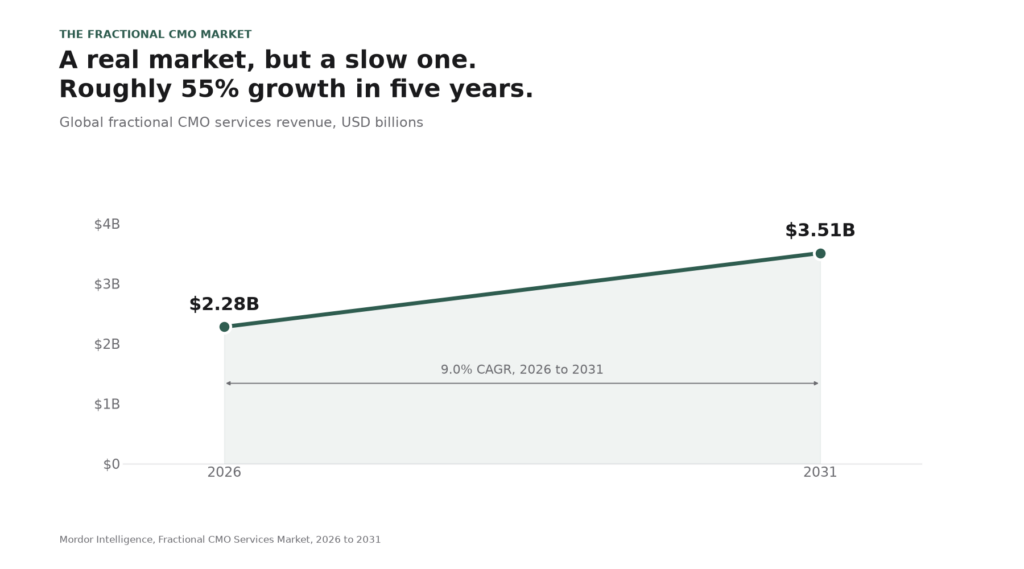
Fractional marketing leadership has become a genuine market. Mordor Intelligence sizes global fractional CMO services at $2.28 billion in 2026, growing to $3.51 billion by 2031 — a 9.0% compound annual rate.
Read that number twice, because it is the most useful corrective in this entire article. A 9% growth rate is a healthy, maturing niche. It is not a revolution. If fractional leadership were replacing the CMO role at scale, you would see a market growing at 30% or more, and you do not.
The strategic framing in that report is more interesting than the size. The largest service segment is strategy, governance and use-case design at 36.1% of the market, growing at 10.2%. Companies are not buying fractional CMOs primarily to run campaigns. They are buying them to make decisions — to install a structure, choose a positioning, set a measurement frame — and then to step back.
That is a fundamentally different product from interim management. An interim executive fills a seat temporarily and is judged on continuity. A fractional leader is judged on the quality of a specific set of decisions and the durability of what they leave behind. Confusing the two is how companies end up paying senior rates for someone who spends their days in status meetings.
7. What actually breaks first
Three failure modes recur in lean, elastic teams, and none of them appear in the business case.
The context tax. Every new engagement starts from zero. The freelancer does not know the brand’s history, the failed experiments, the internal politics. So the core team spends the first two weeks of every project rebuilding context that a full-time employee would have absorbed over years. On a single project this is invisible. Across twelve engagements a year it is the largest hidden cost in the model.
The consistency drift. A rotating cast produces a rotating voice. Without codified brand governance — tone rules, vocabulary, visual constraints, explicit do-nots — each freelancer interprets the brand slightly differently, and the aggregate output reads like four different companies. The lean team does not fail because the work is bad. It fails because the work is good and inconsistent.
The accountability vacuum. Freelancers deliver scope. They do not own outcomes. When a campaign underperforms, the honest answer is often that nobody was accountable for the result — only for the deliverables. This is the risk that most damages the model internally, because it gives finance a reason to distrust the whole arrangement.
None of these are solved by hiring better freelancers. They are solved by the core, which is the point that keeps getting missed: the leaner the outer layer, the more the inner layer has to do.
8. A working model: five practices that separate the good from the messy
Design the core around ownership, not seniority. The question is not “who is senior enough to keep” but “which decisions must never be outsourced.” Brand positioning, budget allocation, and the final call on creative are usually three. Most teams keep fifteen.
Build the bench before the need. The difference between elasticity and panic is whether you already know who you would call. Cultivate three to five trusted specialists per critical function, give them small paid work when you do not strictly need it, and keep them warm. This is a deliberate cost, and it is cheaper than the alternative.
Write briefs that survive without you. A self-contained brief states the objective, the audience, the constraint, the definition of done, and the reason this matters now. If a brief requires a meeting to understand, it is not a brief. This is the single highest-leverage investment in the model, and almost nobody does it well.
Codify the brand into rules, not documents. A 60-page brand book goes unread. A one-page list of ten tone rules, five banned phrases, and three non-negotiable visual constraints gets followed. Governance that is short enough to be used beats governance that is complete enough to be admired.
Pair every external engagement with a named internal owner. Not a manager — an owner, with the authority to say no and the responsibility for the outcome. This is the mechanism that converts a rotating cast into a team with memory, because the owner accumulates the context the freelancers cannot hold.
9. Where this goes next
The constraint that shapes the next two years is not talent supply. It is AI, and the way it is being funded. Gartner’s 2026 survey found CMOs allocating 15.3% of marketing budgets to AI initiatives, while only 30% report mature AI readiness. Organisations with mature readiness allocate 21.3% and, notably, carry larger marketing budgets overall at 8.9% of revenue.
That gap between 15.3% and 30% readiness is where the elastic layer will be reshaped. As AI absorbs routine execution, the work that remains for external specialists is increasingly judgment work: choosing the positioning, diagnosing why the funnel leaks, deciding which of forty AI-generated variants is actually on brand. That is a more senior, more expensive, smaller bench than the one built for execution.
Which means the freelance marketing economy will likely get narrower before it gets broader. Fewer generalist freelancers, more specialists with real judgment, higher rates per engagement, longer engagements. The 30-to-70% teams will not keep growing in headcount terms; they will keep growing in seniority terms.
And the model that wins will not be the one with the smallest core. It will be the one whose core is small, senior, and genuinely accountable — with a bench trusted enough to be given real problems, and governance tight enough that a rotating cast still sounds like one company.
Summary
Marketing budgets have flatlined at roughly 7.7–7.8% of revenue since 2024, and within that flat total the split between in-house labour (21.9%) and agency fees (20.7%) has nearly converged. That convergence is the trigger for the restructuring: teams are no longer choosing between permanent staff and external partners, but assigning specific work to specific arrangements. The evidence for how far this has gone is genuinely contested — The CMO Survey shows full-time still taking 77.9% of planned hiring, while Assemble’s 2026 data describes contractor shares of 30–70% at some Fortune 500 firms. The gap resolves once you separate hiring flow from team stock. What is not contested is that the model works only when the core is deliberate: ownership retained, context held, briefs written, governance codified, and every external engagement paired with a named internal owner.