Why Greenhushing Persisted: The Incentive Behind Silence
Firms answered a compliance risk by cutting the one activity that generated revenue. The reason isn’t cowardice — it’s an accounting asymmetry.
The anomaly worth explaining
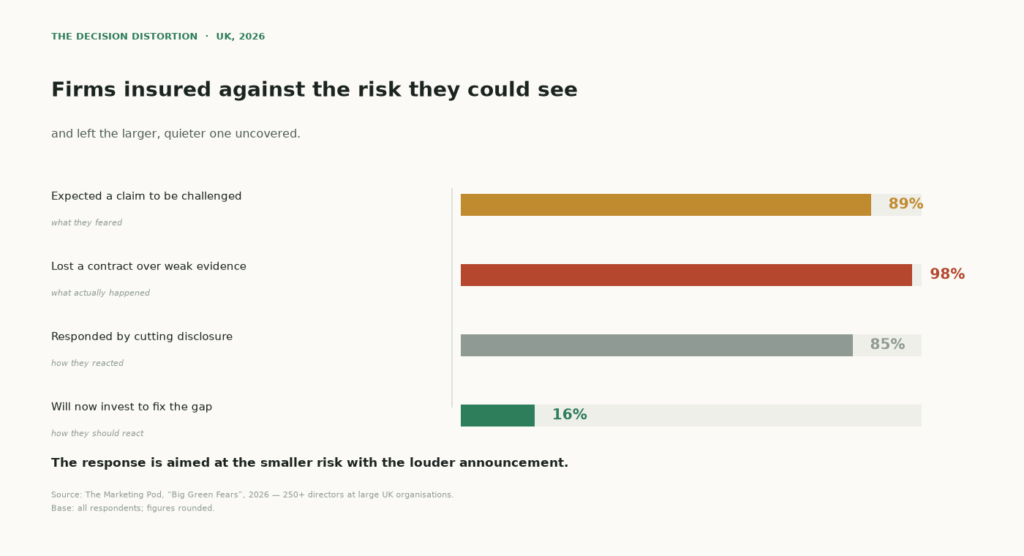
In 2026, large UK organisations were handed a clear, published compliance problem: environmental claims had to be substantiated, and the regulator could now fine them directly, without a court, up to 10% of global turnover.
They responded by reducing their external sustainability communications. Eighty-five per cent of them.
That reads as rational risk management until you reach the next two numbers in the same survey. Ninety-eight per cent of those organisations had already been excluded from a contract, or lost a tender, because they could not evidence their credentials. And only 16% planned to invest in closing that gap over the following eighteen months.
The population most punished for having no evidence was the population least willing to build any. Silence was not a pause before investment. It was a substitute for it.
The asymmetry that produces the behaviour
The explanation isn’t cultural. It’s structural, and it sits in how the two risks get priced inside a company.
A fine is legible. It has an authority, a decision date, a named legal owner, a disclosed figure, a line in the risk register. It arrives as a discrete event someone can argue about in a board meeting. When a brand manager asks what happens if we keep this claim, somebody can answer with a number.
A lost tender is illegible. It has no authority, no date, no owner. It surfaces as a polite email about alignment with sustainability criteria, and it gets attributed — by everyone, including the seller — to price, relationship or fit. Its counterfactual is unknowable: you cannot prove you would have won. So it never reaches the risk register at all. It reaches the pipeline review, gets logged as a loss, and is forgotten by the next quarter.
Two risks, one considerably larger, and only one of them countable. Organisations will always insure against the countable one.
Why the response was cheap instead of expensive
There’s a second asymmetry underneath: the cost of each remedy.
Cutting external communications costs almost nothing. It’s a decision, not a project. No data, no auditor, no lifecycle assessment procurement, no cross-functional governance. One approval achieves it, and the benefit is immediate and visible — the ads that would have drawn a complaint no longer exist.
Building substantiation is expensive and slow. It needs evidence files, verification, supplier contracts with audit rights, and the political labour of aligning sustainability, legal and commercial teams around a claim all three can defend. Its benefit is invisible, because it shows up as a tender you win and therefore never hear about.
Cheap and legible beats expensive and invisible. That isn’t a compliance failure. It’s ordinary capital allocation.
The signal this sends to buyers
The consequence is that silence functions as a negative credential. A procurement team asking for evidence in 2026 isn’t testing your marketing; it’s testing whether a file exists. When the answer is nothing, the buyer doesn’t infer prudent. The buyer infers unknown — and unknown loses to a competitor with a worse footprint and better paperwork.
That’s the inversion worth remembering. The crackdown didn’t reward the cleanest companies. It rewarded the most documented ones. And documentation is the one asset greenhushing destroys.
The takeaway
Firms didn’t misjudge the law. They priced it correctly against a risk they could count, and ignored a larger one they couldn’t. Correcting that means moving substantiation out of the legal budget and into the commercial one — because that’s where the loss actually lands.