Why AI Citations Disappear and Come Back
Here’s the fact that ruins every dashboard in this category. Ahrefs tracked roughly 37,500 citations across five AI engines, every day, for 20 days. Somewhere between 50% and 83% of the citations present on day one were gone by day two.
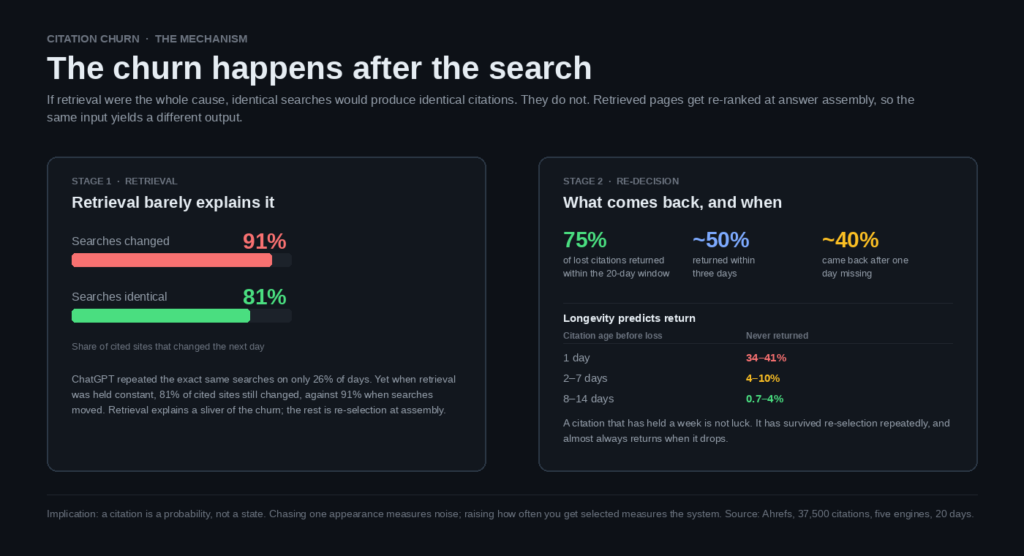
And then — this is the part nobody quotes — about 75% of the ones that vanished came back inside the study window. Roughly half returned within three days.
Real loss is rarer than the churn suggests. Depending on the engine, only 20% to 27% of sites cited on day one disappeared and never returned.
So what’s actually happening? Two mechanisms, and the industry’s tooling only measures the first.
Mechanism one: retrieval changes. But it barely matters.
The intuitive explanation is that the engine searched differently, so it found different pages. That’s true. ChatGPT repeated its exact searches on only 26% of days.
But look at the natural experiment inside those numbers. When ChatGPT’s searches changed, its cited websites changed 91% of the time. When its searches stayed identical — same queries, same retrieval set — its cited websites still changed 81% of the time.
Sit with that. You hand the model a frozen set of pages and it produces a different answer anyway.
Retrieval explains the gap between 91 and 81. Ten points out of ninety-one. Everything else — the other four-fifths of the churn — is happening after the pages have already been retrieved.
Mechanism two: re-decision at assembly
Retrieval assembles a candidate pool. Then the model decides, again, which candidates to actually cite — and that second decision is where the instability lives.
This explains something that otherwise looks like a bug in the data. Gemini and Copilot looked wildly unstable until Ahrefs noticed that 64% and 53% of their answers cite nobody at all. Strip out the empty answers and all five engines converge on the same 50–60% churn rate. The instability wasn’t the platform. It was a second decision quietly firing.
It also explains why brand mentions outlive citations. On Google’s tools and ChatGPT, 12–16% of brand-cited pairs lost the link but kept the name the next day. The model still knows who you are. It just chose a different document to point at.
Why the durable ones are durable
One pattern in the data behaves less like volatility and more like physics. The longer a citation survives, the likelier it returns.
| Citation age before first loss | Never came back (AI Overviews / AI Mode / ChatGPT) |
|---|---|
| 1 day | 34% / 41% / 35% |
| 2–7 days | 8% / 10% / 4% |
| 8–14 days | 4% / 2% / 0.7% |
Ahrefs called it the Lindy effect, and the framing is more than literary. A citation that has held for a week has been re-selected by the model dozens of times — through different candidate pools, different retrieval sets, different days. That isn’t luck. It’s a repeated verdict.
A one-day citation is the opposite. It’s a single observation of a stochastic process, and a third of the time it never shows up again.
What this does to your dashboard
If citation is a probability rather than a state, then most AI-visibility reporting is measuring noise and calling it a trend.
Three changes follow. Measure frequency, not presence — count how many of the last seven days you appeared, not whether you appear today. Don’t blame your last page edit for a dip; a citation missing for a day is indistinguishable from normal operation. And give a lost citation two to three weeks before you intervene, because the median comeback takes three days and the odds of return are strong.
Ahrefs put it bluntly: citations may not be a great KPI at all. Brand mentions are more stable, because the model’s belief about who you are changes far more slowly than its choice of which document to quote.
That’s the real insight hiding in the volatility. The thing you’re trying to win isn’t a link position. It’s a standing decision the model keeps making about whether you are worth naming — and that decision is stable in a way the citations never are.