What Actually Gets You Cited by AI Search (That We Can Prove)
An evidence audit of what GEO can prove, what it merely asserts, and how to tell the difference
The claim that started this
Somebody, somewhere, is right now selling a “GEO score.” It comes in a dashboard, it has a number with a decimal point, and it tells you your content is 63.4% optimized for AI search.
Ask what the number measures and the conversation gets vague. Ask whether anyone outside the vendor has tested it, and it gets quieter still.
This is the strange state of generative engine optimization in late 2026. The discipline has real research behind it, real datasets, real controlled experiments. And yet most of what gets sold under its name has never been tested at all. The two live side by side, wearing the same clothes.
So let’s do something unfashionable: sort the field into two piles. Things we can observe, measure, and repeat. And things we’re guessing at. You’ll notice the second pile is bigger than the industry’s confidence suggests.
Why speculation fills this particular vacuum
The models that decide AI Overviews and AI answers don’t publish their ranking logic. There’s no equivalent of a patent filing you can read, no Search Console report that breaks out AI-feature impressions by ranking factor. Google’s own documentation is almost aggressively unhelpful on this point: it states plainly that a page must be indexed and eligible to appear with a snippet, and that “there are no additional requirements to appear in AI Overviews or AI Mode, nor other special optimizations necessary.”
That’s it. That’s the guidance. And into a gap that wide, folklore rushes in.
It doesn’t help that the answers are non-deterministic. Ask the same question twice, minutes apart, and you can get different sources. Ahrefs measured this across 43,000 keywords and found AI Overviews have a 70% chance of changing between consecutive observations, with cited content persisting 2.15 days on average. Nearly half the cited sources — 45.5% — are entirely new on the next look.
If the output moves on its own, then any single before-and-after screenshot can “prove” any tactic. That’s not evidence. That’s a coin landing heads and calling it causation.
The part where honest research gets genuinely hard
Here’s the trap most GEO content falls into. It runs a clean experiment — rewrite a page, watch citations go up — and reports a win. But between those two observations, three other things changed: the platform shifted its model, the source pool rotated, and a competitor published something better.
Ahrefs’ citation-stability study makes the scale of that noise concrete. Tracking roughly 37,500 citations daily for 20 days, they found 50% to 83% of day-one citations were gone by the next day. Only 6.6% of Google AI Overview citations survived all 20 days. ChatGPT: 4.0%.
And here’s the kicker — about 75% of the citations that disappeared came back within the study window. Half returned within three days.
So a citation vanishing isn’t a signal. It’s Tuesday.
What we can actually observe
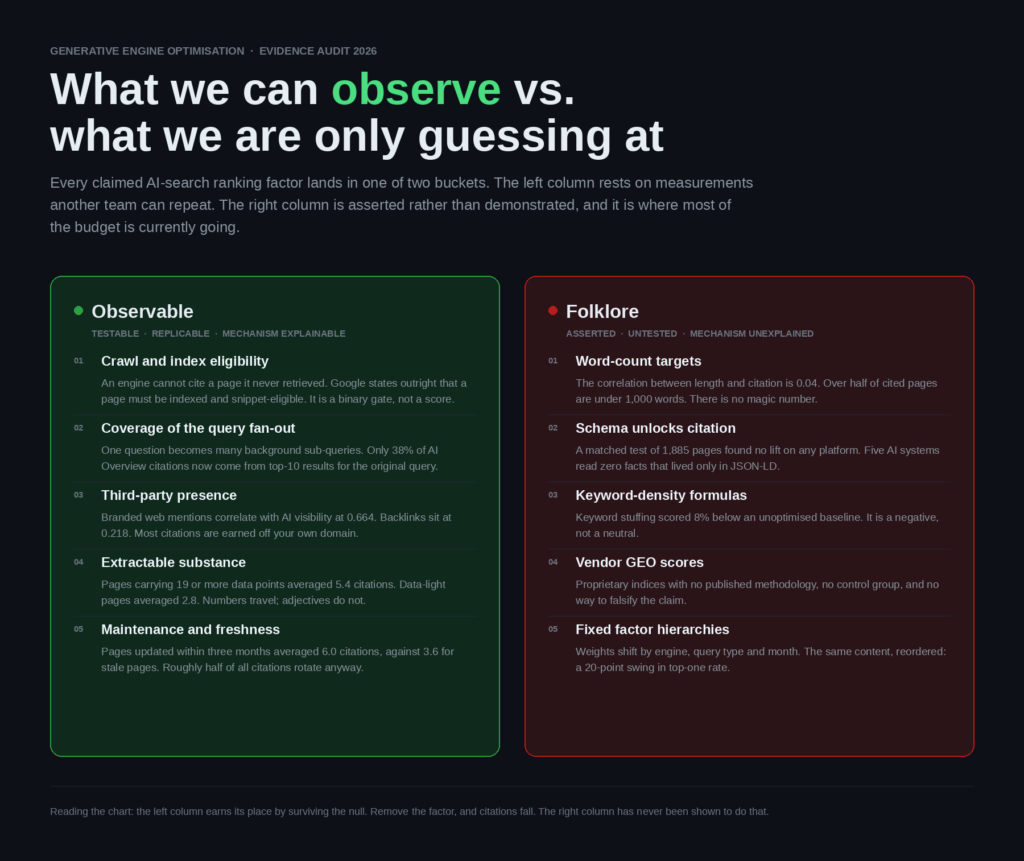
Five factors survive scrutiny. Not because they’re intuitive, but because someone tested them and the result held.
1. Crawl and index eligibility is a gate, not a score
Google’s documentation is blunt: to be shown as a supporting link, a page must be indexed and eligible to appear in Search with a snippet. No snippet eligibility, no citation. Full stop.
This sounds trivial until you audit a real site. An inherited noindex, a template-level nosnippet, a robots rule nobody remembers writing — I’ve seen all three silently exclude entire sections from AI answers. It’s the least glamorous factor on this list and the one most often broken.
The corollary matters too. Being legible to a model is not the same as being chosen by one. Most AI-visibility budgets are currently disappearing into that gap.
2. You’re competing against the fan-out, not the keyword
This is the finding that should have reorganised everybody’s dashboard, and mostly hasn’t.
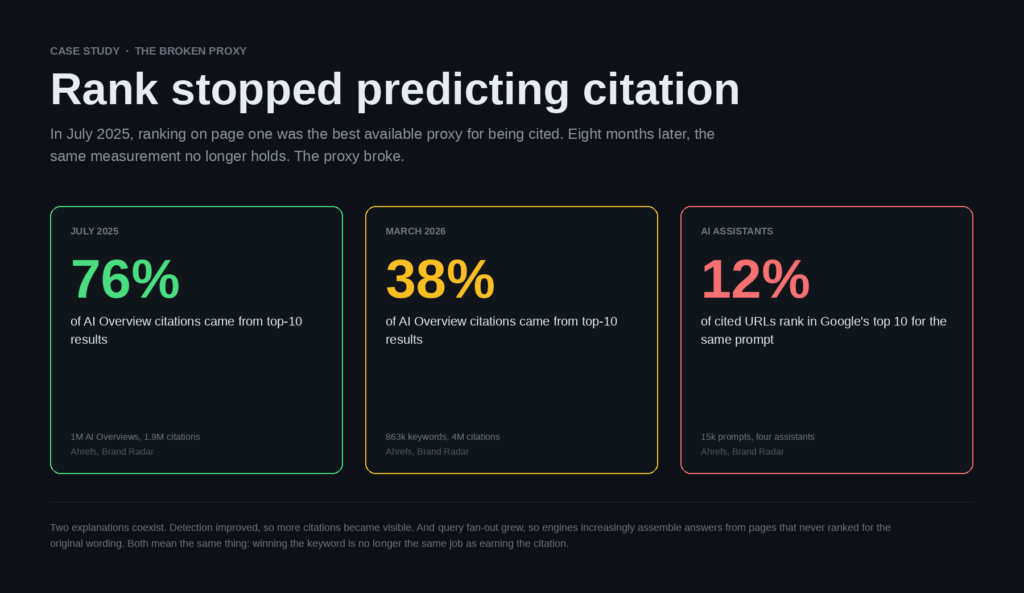
In July 2025, Ahrefs analysed a million AI Overviews and 1.9 million citations. 76.1% of cited pages also ranked in Google’s top 10 for the same query. Ranking on page one was, for practical purposes, the same job as getting cited.
By March 2026, across 863,000 keywords and 4 million AI Overview URLs, that figure had fallen to 38%. The remaining citations split almost evenly: 31.2% from positions 11–100, and 31.0% from beyond position 100 entirely. A separate BrightEdge analysis put top-10 overlap nearer 17%.
What changed? Query fan-out. One question gets split into a cluster of background sub-queries, and the engine assembles an answer from pages that answer those, not necessarily your head term.
The honest caveat: Ahrefs attributes part of the drop to improved citation detection, so the two datasets aren’t strictly comparable. But the direction is confirmed independently. In a separate study of 15,000 prompts, only 12% of URLs cited by ChatGPT, Gemini, and Copilot ranked in Google’s top 10 for the same prompt. Roughly 80% didn’t rank anywhere.
3. Presence off your own domain carries more weight than links on it
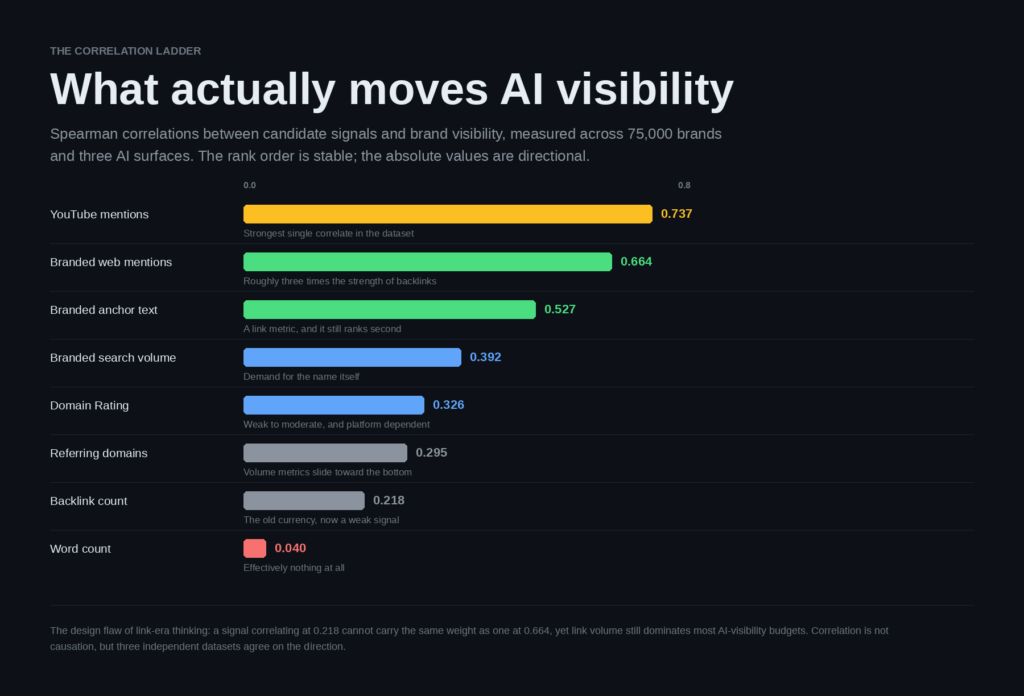
Ahrefs analysed 75,000 brands and correlated candidate signals against AI visibility. The ranking is uncomfortable for anyone raised on link building:
| Signal | Spearman correlation |
|---|---|
| YouTube mentions | 0.737 |
| Branded web mentions | 0.664 |
| Branded anchor text | 0.527 |
| Branded search volume | 0.392 |
| Domain Rating | 0.326 |
| Referring domains | 0.295 |
| Backlink count | 0.218 |
| Word count | 0.04 |
Backlinks land at 0.218. Branded mentions at 0.664 — roughly three times stronger. And the distribution is brutally uneven: brands in the top quartile for mentions averaged 169 AI Overview mentions, against 14 for the next quartile. Around 26% of brands recorded nothing at all.
SE Ranking’s study of 129,000 domains points the same way from a different angle. Referring-domain count was their strongest predictor, with a threshold effect at 32,000 domains where average citations jumped from 2.9 to 5.6. So links aren’t dead. They’re functioning differently — less like a ladder with no ceiling, more like an entry ticket. Past the gate, another thousand links buys you far less than fixing what the page actually says.
4. Extractable substance beats prose
The single most replicated content finding in this field: pages carrying specific, attributable data get cited more.
SE Ranking’s 216,524-page analysis found pages with 19 or more statistical data points averaged 5.4 ChatGPT citations, against 2.8 for data-light pages. Pages with expert quotes: 4.1 versus 2.4.
But before you add a stat to every paragraph, look at what the origin study actually measured. The Princeton/IIT Delhi GEO paper (KDD 2024) rewrote pages nine ways and scored each on Position-Adjusted Word Count, which credits a source for surviving into the answer and for landing early in it. Baseline was 19.3. The ranking:
- Quotation addition: 27.2 (+41%)
- Statistics addition: 25.2 (+31%)
- Fluency optimisation: 24.7 (+28%)
- Citing outside sources: 24.6 (+27%)
- Keyword stuffing: 17.7 (−8%)
Notice two things. Citing sources ranks fourth — not first, despite how the paper’s “up to 40%” headline is usually quoted. And keyword stuffing scored below doing nothing at all.
Also notice the limits. The study ran on GPT-3.5-turbo and Perplexity in 2023. On Perplexity’s live product, the gains shrank: quotation addition delivered about 22%, statistics about 9%. Read the percentages as proof the pattern exists, not as a rate you can bank.
5. Freshness and maintenance are load-bearing
Pages updated within three months averaged 6.0 citations in SE Ranking’s data; stale pages averaged 3.6.
That’s partly a freshness signal and partly a survivorship effect — pages people maintain are usually pages people care about. Either way, the operational implication is the same, and it’s not the one content teams want to hear: static content treated as a permanent asset is a losing position in AI search.
What we are still guessing about
Now the other pile. Each of these arrives with a confident number attached. None survives contact with a control group.
The word-count target
Somebody is always publishing a study saying AI prefers 10,000 words. Ahrefs tested it properly: 560,346 AI Overviews, 1,677,876 cited URLs, 174,048 pages with extractable content.
The Spearman correlation between word count and being cited was 0.04. Effectively zero. And 53.4% of cited pages were under 1,000 words.
Word count is not a lever. Write the length the question requires and stop negotiating with a number someone invented.
“Schema unlocks AI citation”
This one deserves its own section, because it’s the most expensive piece of folklore currently in circulation.
Yes, there’s a correlation. Ahrefs analysed 6 million URLs and found AI-cited pages were nearly three times more likely to carry JSON-LD. That stat got screenshotted, shared, and turned into sprint tickets.
Then they tested whether it was causal. They tracked 1,885 pages that added JSON-LD between August 2025 and March 2026, matched each against control pages with similar pre-period citation levels that never added schema, and measured across Google AI Overviews, AI Mode, and ChatGPT using a matched difference-in-differences design.
Results: AI Overviews −4.6%. AI Mode +2.4%. ChatGPT +2.2%. The latter two are statistically indistinguishable from zero.
Why the gap between correlation and cause? Because sites that implement schema also invest in technical SEO, publish better content, and earn more links. Schema was riding the wave, not making it.
There’s a second finding worth knowing. In October 2025, searchVIU placed a product price only in JSON-LD and queried five systems. None of them extracted it. JSON-LD, hidden Microdata, hidden RDFa — all ignored during live fetch. They read what a visitor would read.
Google, for its part, lists “overfocusing on structured data” among the things you don’t need to do. And on 7 May 2026, they deprecated FAQ rich results entirely — quietly, via a documentation note.
Keep your schema. It’s cheap, it helps machines understand entities, and Product markup still matters for commerce surfaces. Just don’t bill it as the reason you’ll get cited. There’s one important exception: every page in the Ahrefs study was already being cited heavily beforehand. For pages AI can’t see yet, markup may still help with discovery — that question is open.
Keyword-density arithmetic
The GEO paper already answered this. Keyword stuffing scored 8% below baseline. In generative engines, the tactic that dominated fifteen years of SEO is a net negative. That single result should be enough to establish that GEO is not SEO with a new coat of paint — the two disciplines optimise in opposite directions.
Proprietary “GEO scores”
A number you can’t audit, from a methodology that isn’t published, validated against a benchmark that doesn’t exist. This isn’t measurement. It’s branding with integers.
Fixed factor hierarchies
The most underrated finding in this whole field comes from a benchmark called LIVE-GEO, published in October 2026. Researchers published GEO-rewritten product pages as live webpages — 80 fictional brands, 18 product categories — and let real generative engines rank them.
Two results stand out. First, the engines agreed on the top product for only 48.8% to 66.3% of brands. Second, and more alarming: the same content, with the candidate URLs presented in reverse order, moved one strategy’s top-1 rate from 73.8% to 93.8%.
A twenty-point swing from ordering alone. If your ranking factor can be overwhelmed by the sequence in which URLs were listed, it isn’t a ranking factor. It’s weather.
The five questions that separate fact from folklore
Run any claimed factor through this. It takes four minutes and saves quarters.
- Causal or correlational? Did the evidence show the factor causes citation, or merely co-occur with it? The schema story fails here and it took 1,885 matched pages to find out.
- Reproducible? Does it hold across queries, engines, and months? The 76% → 38% collapse is what non-reproducibility looks like.
- Independently validated? Or is the only evidence the vendor’s own marketing?
- Does it survive the null? Remove the factor. Do citations actually fall? This is the test almost nobody runs.
- Is the mechanism explainable? Can you say why it works without waving your hands?
Five for five, or it goes in the folklore pile.
What this means if you have a budget to defend
Optimise the observable factors. Eligibility, fan-out coverage, third-party presence, extractable substance, maintenance. They’re boring, they’re slow, and they’re the only ones with evidence underneath them.
Be suspicious of silver bullets. “Guaranteed AI ranking” is a phrase that should make you reach for your wallet to close it, not open it. Google itself says appearance in AI Overviews cannot be guaranteed by any specific action.
Run your own tests, properly. Pick 5–10 pages, match them against 5–10 controls with similar baseline citations, change one thing, and measure the difference between groups — not the before-and-after on the treated pages alone. Ahrefs published their methodology; you can run a smaller version this month.
And write down what you don’t know. The most useful document a marketing team can keep right now has two columns: “we have tested this” and “we believe this.” Most strategy decks collapse the two, which is how folklore gets budget.
The takeaway
GEO isn’t fake. There’s real research here — the fan-out findings, the correlation data, the citation-stability work. But the field has a confidence problem that outruns its evidence by a wide margin.
The factors you can actually observe are unglamorous and durable: crawl access, topical coverage that survives the sub-queries, presence in sources you don’t own, content with something specific in it, and a maintenance habit that treats pages as living things.
Everything else is a hypothesis. Some will turn out true. None of them are true yet.
The sophisticated practitioner doesn’t chase the newest ranking hack. They optimise what’s observable, test what’s testable, and stay honest about the rest — including in the slide where they ask for money.