The Citation Was Never the Point: What GEO Should Have Measured All Along
The first wave of generative engine optimization counted how often AI named your brand. That number was never the outcome — it was the receipt. Here is what to measure instead, and why the honest answer is harder than a dashboard.
The Metric We All Reached For
Open a GEO dashboard in 2026 and you will see a number. Citations this month: 412. Up from 288. Somebody screenshots it into a deck, and for about ninety seconds everyone in the room feels good.
Then someone asks the only question that matters. Did any of that change what a customer thinks, wants, or buys?
Silence. Not because the team is lazy. Because the dashboard was never built to answer it.
Citations became the default currency of generative engine optimization for reasons that are easy to sympathize with. They are countable. They are automated. They arrive in a clean weekly email. And they feel concrete in a way that “brand perception” never does — there is something deeply satisfying about a metric you can point at.
The trouble is that a citation is a means, not an end. It records that a machine mentioned you. It says nothing about whether the mention was accurate, whether it was flattering, whether anyone registered it, or whether it changed a single purchase decision. We built an entire discipline on the receipt and forgot to check whether the goods ever shipped.
The Vanity Metric Wearing a Lab Coat
Every era of marketing produces one of these. Impressions. Page views. Engagement rate. Time on page. Metrics that are cheap to collect, easy to move, and only loosely tethered to anything a CFO would recognize as value.
Citation count is generative search’s version of engagement. It looks like proof. It photographs well in a board deck. And like every vanity metric before it, it conceals the thing you actually need to know: whether the activity produced an outcome, or merely occurred.
There is a specific failure mode here worth naming, because it is the one that quietly kills budgets. It is the confusion of activity with outcome. “We appear in AI answers” is an activity statement. “Consumers who encountered us in AI answers were more likely to consider us” is an outcome statement. Most GEO reporting in 2026 is the first, dressed up as the second.
What the Click Data Actually Shows
Here is where the story gets more interesting than either side of the debate usually admits.
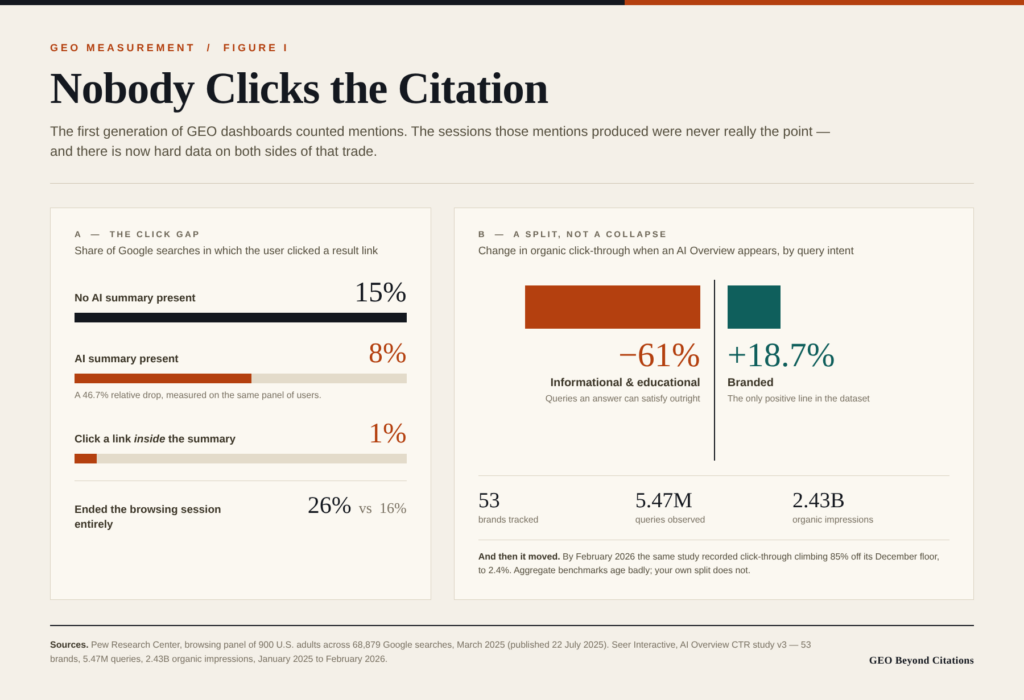
Pew Research Center tracked the actual browsing behavior of 900 U.S. adults through 68,879 Google searches in March 2025. When an AI summary appeared, users clicked a traditional result link in 8% of visits. When it did not, they clicked 15% of the time. Click a link inside the summary itself? One percent. And sessions ended outright 26% of the time with a summary present, against 16% without.
That last number is the one people skip past. The summary did not just reduce clicks. It finished the job. The user got what they came for and closed the tab.
Then there is the split that gets flattened into a single scary headline. Seer Interactive’s third iteration of its AI Overview study — 53 brands, 5.47 million queries, 2.43 billion organic impressions across January 2025 to February 2026 — found click-through on informational and educational queries down 61%. On branded queries, click-through rose 18.7%.
Read those two lines together and you have the whole strategic picture. AI answers are eating the queries a machine can satisfy outright. They are rewarding the queries where someone already knows your name and wants to go further. Discovery is being absorbed. Demand you created is being amplified.
The Counter-Evidence, Stated Honestly
Now for the part most GEO advocates would rather you skipped.
In 2026, Kevin Indig ran 632 tests across 12 sites looking for exactly the effect this article claims exists: AI visibility showing up later as branded search and direct traffic. Across the four brands where he had complete visibility data, he could not establish a reliable link.
That is a real result, from a careful analyst, and it deserves an answer rather than a shrug.
The answer is partly about time. Les Binet and Peter Field’s work on the IPA Databank found brand-building effects take roughly six months to overtake short-term activation effects. A study comparing one month against the next cannot see a six-month mechanism. It is not a flawed study; it is a study measuring at the wrong shutter speed.
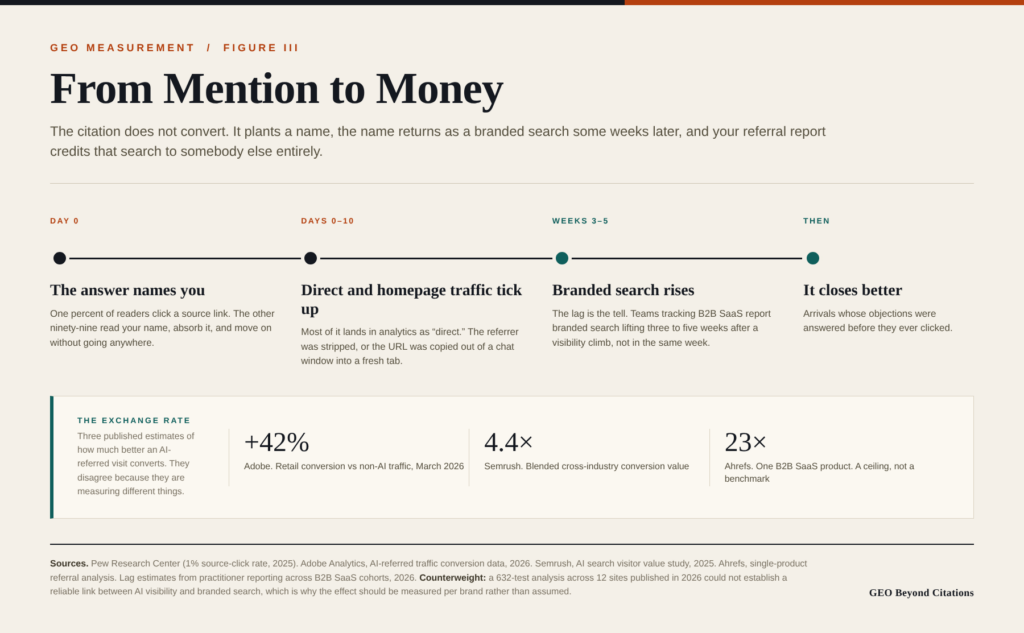
Part of the answer is about where the effect lands. Someone who types your name into a browser after reading an AI answer shows up in analytics as direct traffic. It carries no referrer that says “ChatGPT.” Practitioner estimates put a large share of AI-influenced visits — around seven in ten — into that bucket. Exclude homepages from that analysis and you have excluded precisely the page a person lands on after hearing a brand name.
And part of the answer sits in his own data, read brand by brand instead of averaged. One site showed a 0.72 correlation between AI share of voice and direct traffic, peaking at a three-week lag, and 0.59 with branded search impressions. Another showed 0.47 between its ChatGPT mention rate and direct traffic. The effect is there. It is just not uniform.
Which leads to the useful conclusion: the brand effect of AI visibility is real, but conditional. It depends on whether anyone recognizes your name when the machine says it. Measure it for your brand, on your prompts, in your category. Do not inherit somebody else’s average.
What Brand Lift Actually Means Here
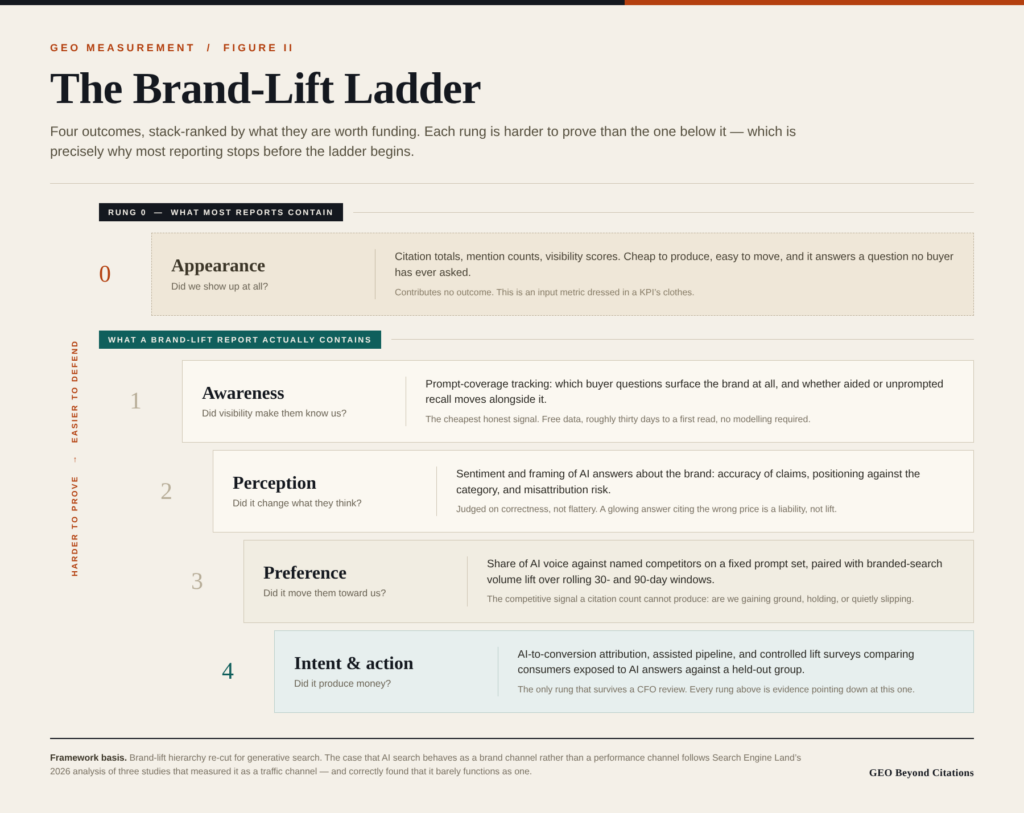
Borrow the oldest vocabulary in brand marketing and it fits surprisingly well. Brand lift in AI search is not one number. It is a ladder, and each rung is harder to prove than the one below it — and worth more.
Awareness. Did AI-search visibility make more people know you exist? Measured through prompt coverage — which buyer questions surface your brand at all — plus any movement in aided or unprompted recall.
Perception. Did it change what they think of you? Measured through the sentiment, accuracy, and framing of AI answers about your brand. Note the word accuracy. A glowing answer that misstates your pricing is a compliance problem, not lift.
Preference. Did it move them toward you? Measured through share of AI voice against named competitors on a fixed prompt set, plus branded-search volume lift.
Intent and action. Did it produce money? Measured through AI-to-conversion attribution, assisted pipeline, and controlled lift surveys.
Rung Zero: Why Most Reporting Never Leaves the Basement
Notice what is missing from that ladder. There is no rung for “did we appear.” Appearance is the floor beneath it, not a step on it. It is the precondition, the entry ticket, the thing that has to happen before anything else can.
Somewhere along the way, the entry ticket got promoted to the KPI. Citation totals, mention counts, and composite visibility scores now fill the top of GEO reports, and almost none of them connect to a rung. They describe the machinery, not the output.
The tell is simple. If a metric can go up while nothing about your business changes, it is not measuring your business.
How to Measure This Without a Data Science Team
You do not need a research department. You need discipline about four instruments, in ascending order of cost.
Branded search lift is the cheapest honest signal available and the most under-used. Pull a baseline of four to six weeks before a visibility push, then watch branded query volume and branded click-through over rolling 30- and 90-day windows. Two refinements matter more than they sound. First, instrument every variant of your brand name — spacing, misspellings, brand plus product — because tracking only the canonical spelling misses somewhere between 15% and 30% of the volume. Second, separate volume from capture. If branded searches rise but your own click-through on those terms does not, something is intercepting the demand before it reaches you.
Sentiment and framing turns “are we mentioned” into “how are we mentioned.” Score answers for accuracy first, tone second. Log misattributions. In regulated categories this is not a nice-to-have; it is the difference between visibility and liability.
Share of AI voice is the competitive layer. Fix a prompt set that mirrors real buyer questions, name your competitors, track per platform. The number matters less than the direction — you are asking whether you are gaining ground, holding, or quietly slipping.
Attribution and controlled surveys are the expensive end. Tag AI referrals properly, match them against CRM revenue, and where you can, run a held-out group that never sees the AI answers so you can subtract the baseline. This is the only rung that produces a number a CFO accepts without translation.
The Number Everyone Quotes, and Nobody Should
If you have read anything about AI referral quality, you have met the 4.4x figure. Semrush found AI search visitors converting at roughly 4.4 times the rate of traditional organic visitors, and it spread across the industry like a house fire.
It is not wrong. It is just not the only one, and the others tell a messier, more useful story.
Adobe Analytics — a dataset covering more than a trillion visits to U.S. retail sites — found AI-referred shoppers converting 42% better than non-AI traffic in March 2026, with 37% higher revenue per visit, 48% longer sessions, and 12% higher engagement. Same panel, twelve months earlier: AI-referred shoppers converted 38% worse. That is an eighty-point swing in a single year, and it is the most important sentence in this whole debate. The channel did not grow into a conversion machine. It matured into one.
Meanwhile, one Ahrefs analysis of its own funnel found AI referrals at 0.5% of sessions but 12.1% of signups — a 23x differential that is a category ceiling, not a benchmark.
So why the spread from 42% to 23x? Four reasons, and each is a question you should ask before quoting any of them. They compare against different baselines. They measure different things — conversion rate, revenue per visit, and signup share are three separate metrics. They cover different verticals. And they were measured in different years, in a channel that is still changing shape.
Why One Screenshot Proves Nothing
There is a measurement problem underneath all of this that rarely gets named, and it invalidates most casual GEO reporting.
Generative answers are not deterministic. Ahrefs tracked 43,000 keywords, each with at least sixteen recorded AI Overviews over a month, and found the answer changed between consecutive checks 70% of the time — an average lifespan of 2.15 days. Cited sources turned over 45.5% between checks. Named entities, which is where brands live, overlapped only 54%. And semantic similarity held at 0.95 out of 1.0.
Read that correctly and it is reassuring: the substance is stable, the surface churns. Read it carelessly and you will conclude your visibility collapsed because you checked on a Tuesday.
It gets worse when you compare platforms. BrightEdge ran tens of thousands of identical prompts across ChatGPT, Google AI Overviews, and Google AI Mode, and found they disagreed on brand recommendations for 61.9% of queries. Only 17% returned the same brands across all three. The disagreement is not evenly distributed either: “compare X versus Y” queries agree 80% of the time, while “best X for Y” queries — the ones buyers actually use to build a shortlist — agree just 23% of the time.
The engines do not even do the same job. ChatGPT names brands 3.2 times more often than it links them (2.37 mentions against 0.73 citations), recommending from learned association. Google AI Overviews links sources 2.4 times more often than it names brands (14.30 citations against 6.02 mentions), pulling from a live retrieved pool. “Get cited by AI” describes two entirely different competitions depending on which surface you mean.
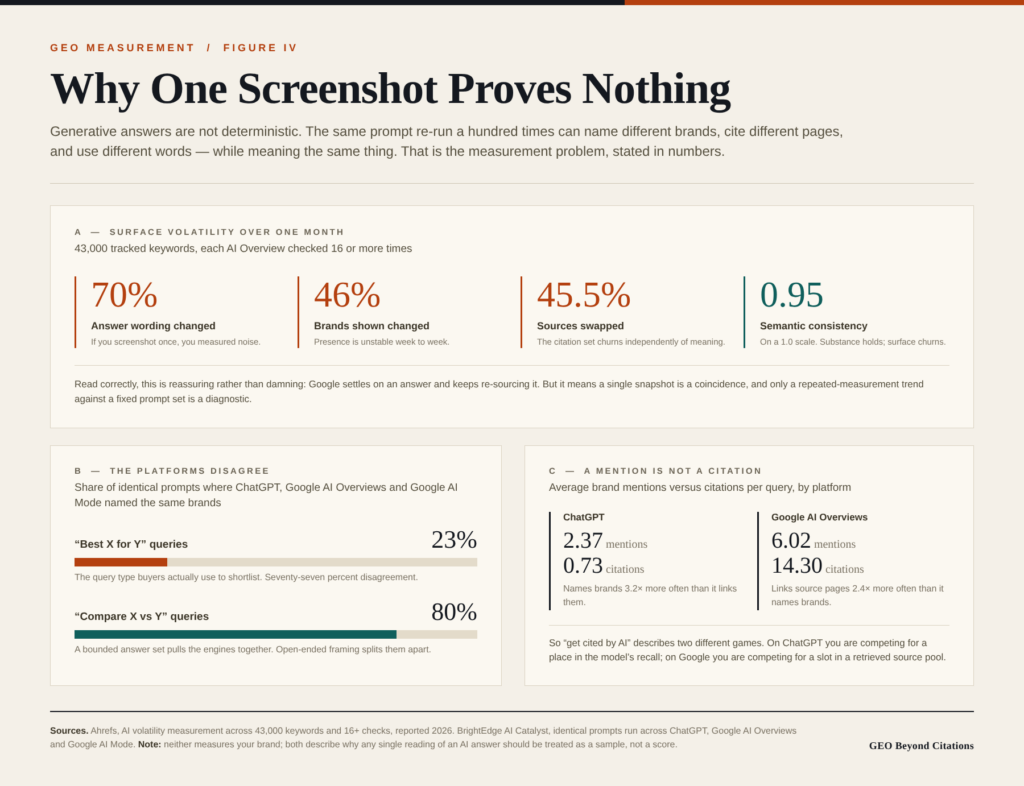
The practical consequence is blunt. Report trends from repeated measurement against a fixed prompt set, with ranges rather than points. A single screenshot is an anecdote with good typography.
The Metrics That Survive a CFO Review
Strip it down and the validity question is simple.
| Metric | Verdict |
|---|---|
| Count of AI citations | Vanity. No outcome attached. |
| Sentiment and accuracy of AI mentions | Meaningful. Measures the quality of visibility. |
| Branded search volume lift | Strong. Measures awareness and preference shift. |
| Share of AI voice in category | Strong. Measures competitive authority. |
| AI-to-conversion attribution | Gold standard. Measures commercial lift. |
| Direct and homepage lift post-exposure | Strong. Measures action, with caveats. |
This matters more in 2026 than it did in 2024, because the budget conversation changed. Gartner’s 2026 CMO Spend Survey put AI at 15.3% of the marketing budget, while only 30% of CMOs reported the maturity to scale it and 56% said they lacked the budget to execute strategy at all. Research from the World Federation of Advertisers and Ebiquity found just 14% of major marketers believe marketing and finance agree on what effectiveness even means.
Meanwhile the IAB surveyed 211 brand and agency investment decision-makers and found 45% naming the comparison of AI-driven and traditional customer journeys as their single biggest measurement problem. Eighty-six percent said they were already changing how they measure, or would within a year.
Translation: the money is moving, and the proof is not keeping up. Citations will not close that gap. A branded-search lift chart, with confidence intervals and a holdout, will.
The Demand Side Already Moved
If you want the strongest argument that this is a brand channel rather than a traffic channel, stop looking at click data and ask consumers.
Attentive surveyed more than 3,000 U.S. adults in 2026. Sixty-eight percent had used a general AI chatbot for at least one shopping task in the previous three months. Among those AI-assisted shoppers, 62% had bought a different product or brand than their usual choice because of a chatbot, and 71% said AI meaningfully affected which brands they seriously considered at least half the time they shopped.
And the number that should worry every brand not in the answer: in a Semrush survey of 2,338 U.S. adults, nearly 81% of people who shop with chatbots said they had decided against a purchase based on AI guidance. The same survey found 74% of all consumers would be at least somewhat less likely to buy if a chatbot surfaced mixed or negative reviews.
Notice what that last statistic is. It is not a lost click. It is a shortlist deletion, executed by a machine, inside a conversation you will never see, with no referrer to tell you it happened.
Be honest about the limits: these are self-reported figures from vendor-funded surveys, and the same Semrush study notes only 29% of consumers currently use chatbots for product research. But 29% of an audience measured in billions is not a rounding error, and self-reported influence is how brand channels have always been measured. Nobody dismisses television because the evidence comes from asking people.
Where This Is Actually Heading
Gartner predicted in early 2024 that traditional search volume would fall 25% by 2026. Fractl and Search Engine Land tested it against 1,010,848 high-volume keywords representing 35.4 billion monthly searches, and found 29% of that volume in measurable decline — four points past the forecast.
But the headline hides the finding that matters more. Lost volume and gained volume nearly balanced: 10.29 billion monthly searches declining against 10.31 billion growing. Search did not collapse. It redistributed. FinTech lost 37.7% while lifestyle lost 15.2%, because the split follows a simple rule. Where a chatbot can answer completely, the search disappears. Where someone still has to compare prices, check stock, or visit a site, it survives.
The same research found 18% of U.S. consumers have bought something on an AI recommendation without separately verifying it through search. Among Gen Z and millennials that rises to 20%, against 7% of boomers.
That is the shape of the thing. Not the death of search — the migration of the decision. And a decision that migrates into an answer is a decision that never touches your analytics.
What to Do Monday
Five moves, in the order I would make them.
Freeze a prompt set. Forty to eighty prompts that mirror how your buyers actually ask. Same prompts, same cadence, same competitors, every week. Everything downstream depends on this being stable.
Baseline your branded search before you touch anything. Four to six weeks of data, all brand variants, volume and click-through tracked separately. Without a real baseline, every later number is a story you told yourself.
Score answers for accuracy, not applause. Read what the engines actually say about your pricing, your claims, your category position. Fix what is wrong. You cannot build lift on a misstatement.
Attach AI referrals to revenue, not sessions. Tag them, match them in the CRM, report value per visit rather than visit counts. A channel this small in volume and this strong in intent looks like a failure on any volume chart.
Report the trend, with a range, and name the uncertainty. “Branded search up 14% over the exposure window, against 3% in a control cohort” is a sentence that survives a review. “Our citations doubled” is a sentence that buys you a follow-up meeting you will not enjoy.
The Takeaway
The first generation of GEO measured the receipt and called it the sale.
That was forgivable in 2024, when nobody knew what an AI answer would do to a business. It is less forgivable now, because the evidence has arrived and it points somewhere specific. AI answers suppress the informational click, lift the branded one, move brand consideration inside a conversation no analytics tool can see, and send the arrivals who do come at conversion rates several multiples above baseline.
None of that is captured by a citation count. All of it is captured by brand lift — measured rung by rung, reported as a trend, defended with a control group.
The teams that make that shift will be able to answer the only question that ever secured a budget. Not “are we visible,” but “what did our visibility do?”