What AI Sentiment Analysis Still Gets Wrong — and Why It Still Pays
Somewhere in your mentions right now, a customer is describing exactly what is wrong with your product. They are being specific, fair, and unusually articulate. They are also being ignored — not because nobody cares, but because nobody has read that far down the thread.
That is the gap AI sentiment analysis promised to close, and to a real degree it has. Machines can read emotional tone across millions of mentions without breaking a sweat. The question worth asking is no longer whether they can. It is whether the reading they produce is telling you the truth.
Why sentiment got complicated
Brands have always wanted to know how customers feel. For decades the honest answer was a survey: ask a few hundred people, extrapolate, and quietly accept that you were guessing at scale.
That compromise made sense when the alternative did not exist. What changed is not that feelings became more complex. What changed is that the room got loud enough to hear from a distance, and quiet enough in the places that matter to mislead you at the same time.
What the tool actually does
Strip away the vendor language and AI sentiment analysis is a text classification problem with ambitions. It takes unstructured language — reviews, replies, support tickets, survey comments, livestream chat — and assigns an emotional reading.
The early versions were embarrassingly literal. A lexicon told the system that “good” was positive, and the system believed it. Feed it “not bad at all” and it would score you a negative, because the word was sitting right there and nobody had taught it about negation. That era is over. Modern systems parse context, handle negation, weigh emoji, and increasingly operate on a specific feature rather than a whole document.
Which brings us to the part most explainers skip. Good sentiment analysis does not produce one score. It produces a set of readings: how people feel about the price, the shipping, the app, the support call, the return process. One sentence can hold two opinions, and they can point in opposite directions.
The clientbase is effectively everyone
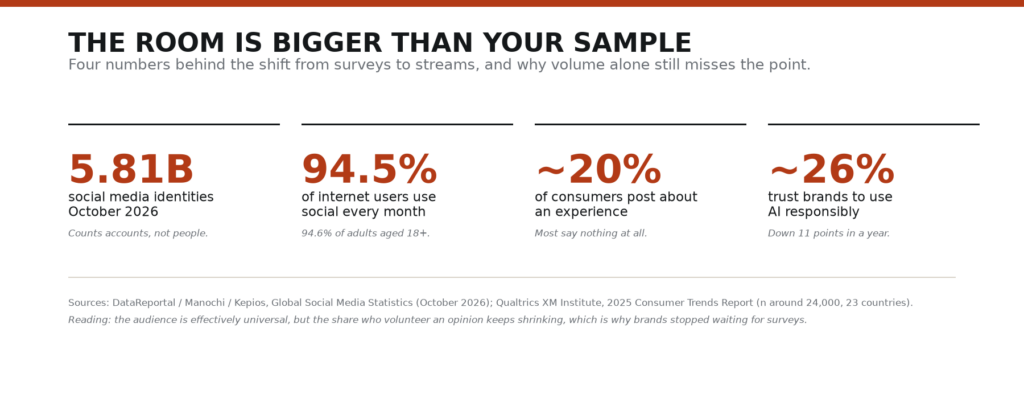
The arithmetic is no longer in dispute. DataReportal’s October 2026 figures put global social media identities at 5.81 billion, with social users now outnumbering non-users by more than two to one. Put differently, 94.5 percent of the world’s internet users use social media every month, and among adults aged 18 and over the figure is 94.6 percent.
Your customers are not writing reviews for you. They are writing them for each other, in public, in real time, whether or not anyone from your company is in the room.
That is the honest case for the technology. Not that AI feels empathy, but that the room is too large for a human team to walk through, and the conversation keeps moving while you read.
Three generations, none of them equal
There are three distinct generations of this work, and they are not equally reliable. Treating them as interchangeable is where most disappointment begins.
Generation one matched words to polarities. Fast, cheap, brittle, wrong in ways that were easy to predict.
Generation two used transformer models trained on labeled data. These handle negation and context far better, and they became the backbone of commercial tools. Their weakness is upstream: they inherit every flaw in the labeling.
Generation three is large language models, and here the marketing has run well ahead of the evidence. A 2024 study in Big Data and Cognitive Computing compared FinBERT, GPT-4 in a predefined configuration, and plain logistic regression on financial sentiment. Logistic regression reached 81.83 percent accuracy. The GPT-4 setup managed 54.19. The lesson is not that large models are bad. It is that a general model dropped into a specialized task without tuning can lose to a boring baseline.
Scale is not the same thing as skill. Anyone who has watched a confident model mislabel an obvious complaint already knows this in their bones.
Where it breaks first: sarcasm
“Oh great, another late delivery.” Read literally, that is praise. Read by a human, it is a complaint with a knife in it.
This is not a fringe problem. The iSarcasm dataset, built from tweets labeled by their own authors rather than by annotators guessing, showed that strong sarcasm detectors performed far worse than their published numbers suggested. The earlier benchmarks had been flattered by obvious examples — the computational equivalent of a test where the answers were circled.
Modern models have improved, especially when prompted to reason about intent rather than classify surface tone. But if your dashboard treats sarcasm as noise, you are not measuring sentiment. You are measuring vocabulary.
Where it breaks second: culture
An American reader sees enthusiasm in exclamation marks. A Japanese reader may see them as unserious. A WeChat smile emoji reads as warmth to one generation and cold dismissal to another — a documented mismatch, not a hypothetical one.
Multilingual models make this worse before they make it better. They tend to perform well on languages with abundant training data and quietly degrade elsewhere, which means a global dashboard can look complete while three of your markets are being scored by a model that is essentially guessing.
Ask any vendor a plain question: what is the accuracy in each of my markets, measured separately? If the answer is a single global number, that number is a work of fiction.
Where it breaks third: the average
“The product is great but the shipping was terrible.”
A whole-text classifier has to choose. It will usually pick one, and it will usually pick wrong, because the sentence is not confused. It is precise. It contains two opinions about two different things.
Aspect-based sentiment analysis is the fix, and it is the single most useful upgrade most teams have not made. Instead of one score per mention, you get one score per feature. The shipping complaint files under shipping, where operations can see it, instead of dissolving into a mildly positive average that nobody acts on.
The research here is consistent and unglamorous: fine-tuned models still beat large models on compound aspect tasks, and every model struggles in zero-shot and few-shot settings compared with a properly tuned one. Tuning is not optional decoration. It is the work.
The trade-off nobody wants to price
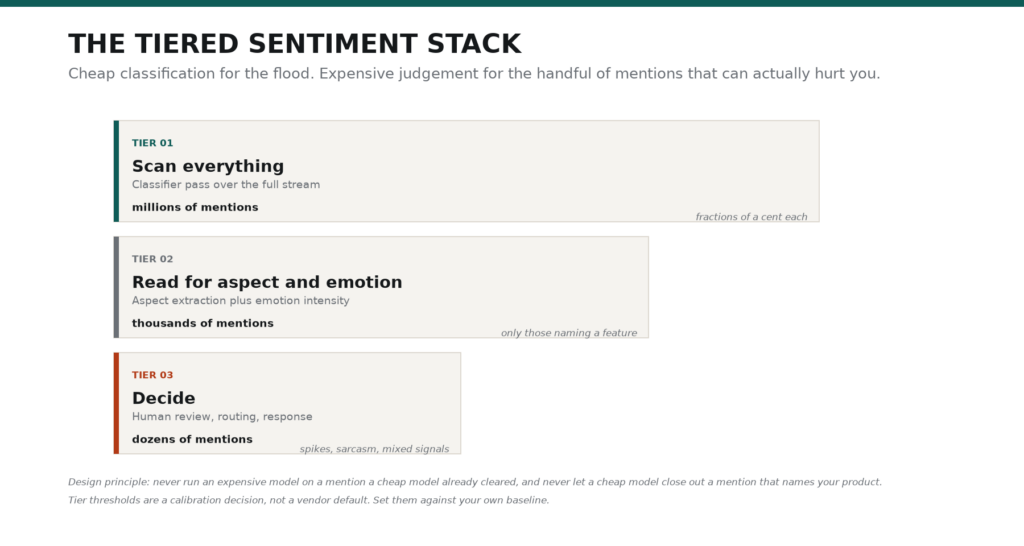
Here is the uncomfortable math. A crude classifier can process millions of mentions for almost nothing. A careful model, or a human reviewer, costs orders of magnitude more per item. You cannot run the expensive path on everything, and you should not want to.
The practical resolution is a tiered system, and it is considerably less glamorous than it sounds.
Tier one scans the entire stream for a rough signal. Tier two reads for aspect and emotional intensity, but only on mentions that survive the first pass. Tier three is human, and it exists for the small set of cases where being wrong is expensive: a spike, a sarcastic thread gathering momentum, a named executive, a legal exposure.
The failure mode I see most is a team that buys one tool, points it at everything, and calls the output truth. That is not a system. That is a firehose with a label on it.
The problem with silence
Now the part that should worry you more than sarcasm.
Qualtrics XM Institute research covering roughly 24,000 consumers across 23 countries found that only about one in five people post about an experience on social media, good or bad. Most tell nobody at all. The trend has moved in one direction every year since the study began: fewer people say anything, to anyone.
So the room you are reading is not the room. It is the subset that felt strongly enough, or was angry enough, or had the time to type. The quiet customers, the ones who simply stop buying, never appear in your sentiment feed. That is a sampling problem wearing a data problem’s clothes, and no model architecture solves it.
The same body of research found that around 26 percent of consumers trust brands to use AI responsibly, with comfort levels falling 11 points year over year. People are not neutral about being analyzed. Some of them are actively avoiding it.
The fix is dull: pair stream sentiment with signals that require nobody to speak — repeat purchase, churn, return rates, support contact volume, cart abandonment. Sentiment tells you what people said. Behaviour tells you what they did. You need both, because they disagree.
The crisis clock
When something does go wrong, the timeline is brutal and well documented.
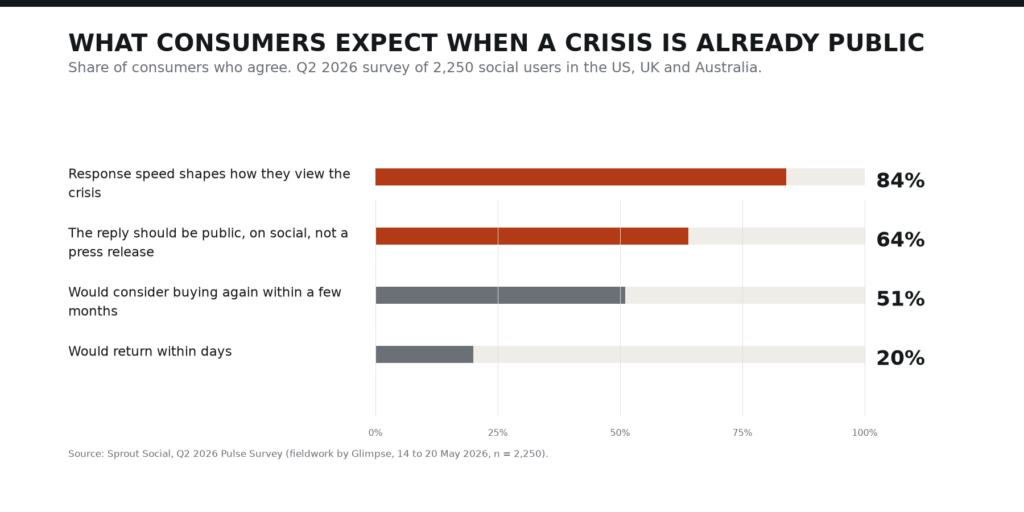
Sprout Social’s Q2 2026 Pulse Survey, fielded across 2,250 social users in the US, UK and Australia between 14 and 20 May 2026, found that 84 percent of consumers say a brand’s response speed directly shapes how they view a crisis. Nearly two thirds — 64 percent — say it matters that the brand responds publicly on social, rather than through a press release or a statement buried on the website.
This is where early detection earns its budget. The first signals of a reputational threat usually surface online long before they reach a newsroom. A system that flags an unusual cluster of negative mentions on a Tuesday morning buys you a Wednesday you would not otherwise have had.
The recovery numbers are genuinely encouraging, which is precisely why speed matters. The same survey found 51 percent of consumers would consider buying from a brand within a few months of a crisis being properly handled, and 20 percent within a few days. That is not forgiveness. It is a conditional second chance with an expiry date.
A score is not a signal
Here is a habit worth breaking this quarter.
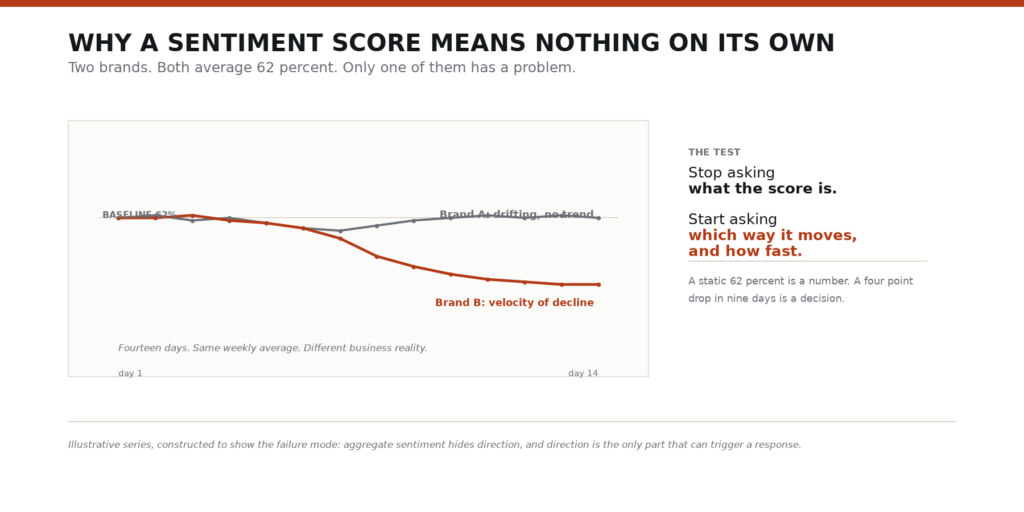
A sentiment score of 62 percent is not information. It is a number that needs a reference point. Was it 62 last month? Is 62 normal for your category? Did it fall four points in nine days, or drift there over a year? Those are completely different situations and they demand completely different responses.
The signal is the delta: direction and velocity. A gradual slide is a product problem with a long runway. A cliff is a communications problem with a short one. Your alerting logic should be built around change, not level.
Every brand also has its own baseline. An airline and a luxury skincare house do not share a definition of normal, and benchmarking against an industry average is a reliable way to feel fine while your own trend line quietly falls.
The playbook
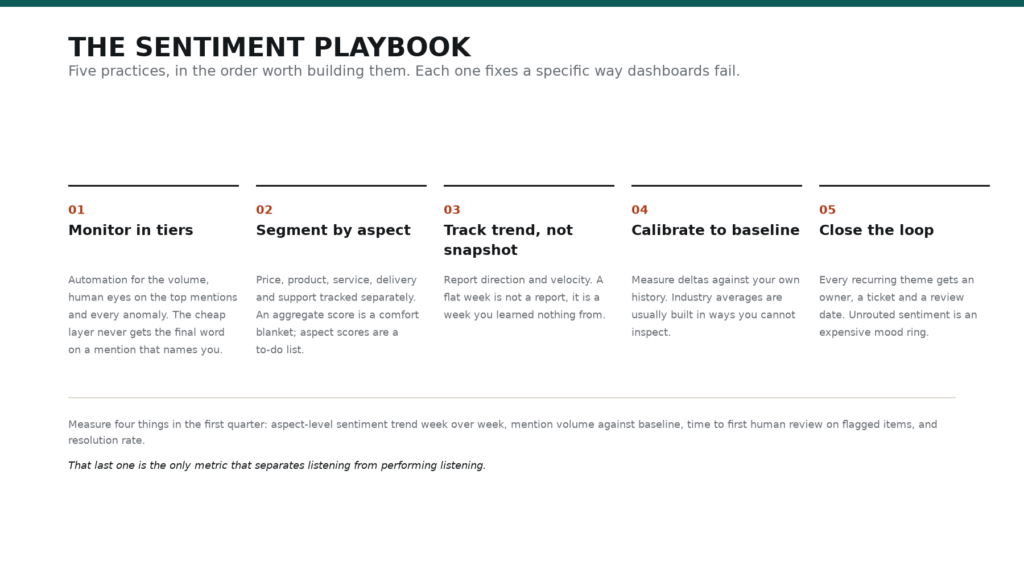
Five practices, in the order worth building them.
Monitor in tiers. Cheap automation for the full volume, human eyes on the top mentions and every anomaly. The cheap layer never gets the final word on a mention that names your product.
Segment by aspect, not by average. Price, product, service, delivery and support tracked separately. An aggregate score is a comfort blanket. Aspect scores are a to-do list.
Track trend, not snapshot. Report direction and velocity. A flat week is not a report. It is a week you learned nothing from.
Calibrate to your own baseline. Measure deltas against your own history. Ignore industry averages unless you can inspect how they were constructed, which you almost never can.
Close the loop. Every recurring theme gets an owner, a ticket and a review date. Sentiment that routes nowhere is an expensive mood ring.
What to actually measure
If I were rebuilding the metrics layer from scratch, I would track four things and ignore the rest for the first quarter.
Aspect-level sentiment trend week over week. Mention volume relative to baseline, because fifteen furious people and fifteen hundred mildly annoyed ones are different problems requiring different responses. Time to first human review on flagged items, which measures your organisation rather than your tool. And resolution rate — of the themes surfaced, how many were actually addressed.
That last number is the only one that separates listening from performing listening.
What happens next
Two shifts are worth watching.
Sentiment work is moving from scoring to reasoning: models that explain why a mention was classified a certain way, which makes human review dramatically faster and the whole system auditable.
The analysis is also moving closer to the moment of conversation, into support agents and chat interfaces, where reading emotion can change the response in real time rather than appearing in a report three days later.
Both are genuine improvements. Neither touches the underlying constraint, which is that a model can only read what somebody chose to write.
The takeaway
AI sentiment analysis made it possible to read the room at a scale no human team could manage. That is a real achievement and it is worth the money.
But scale is not insight, and a dashboard is not a decision. The brands that get this right use machines for the volume of listening and reserve human attention for the nuance that actually costs money to miss — the sarcastic thread before it becomes a hashtag, the shipping complaint before it becomes a churn pattern, the quiet customer who never said anything at all.
Read the room. Then walk into it.