1.4 Billion Users, One Contact List: Why Retention Became China’s Growth Channel
The short answer
Private domain is the audience you can contact again without paying for the impression a second time. You earn a contact, then keep it somewhere you control. Every message after that costs you labour instead of media budget.
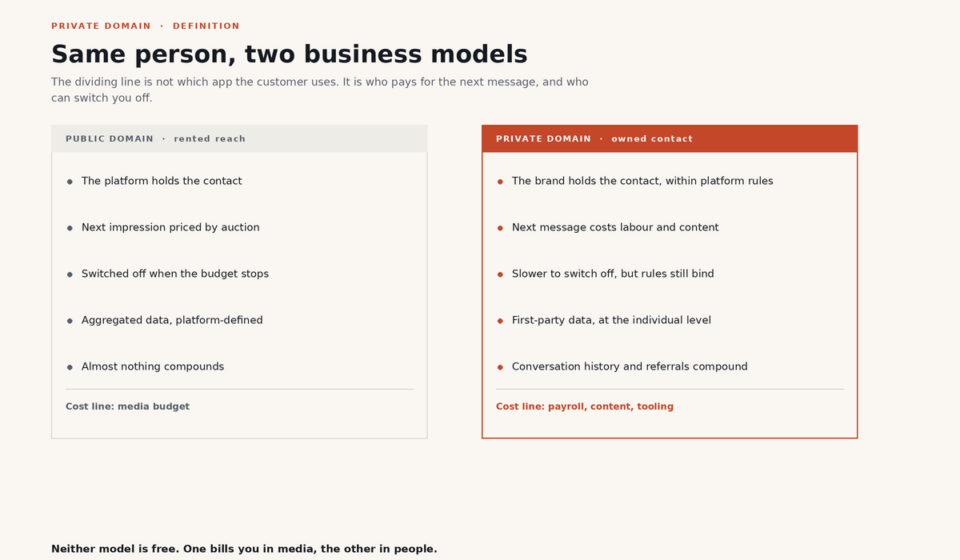
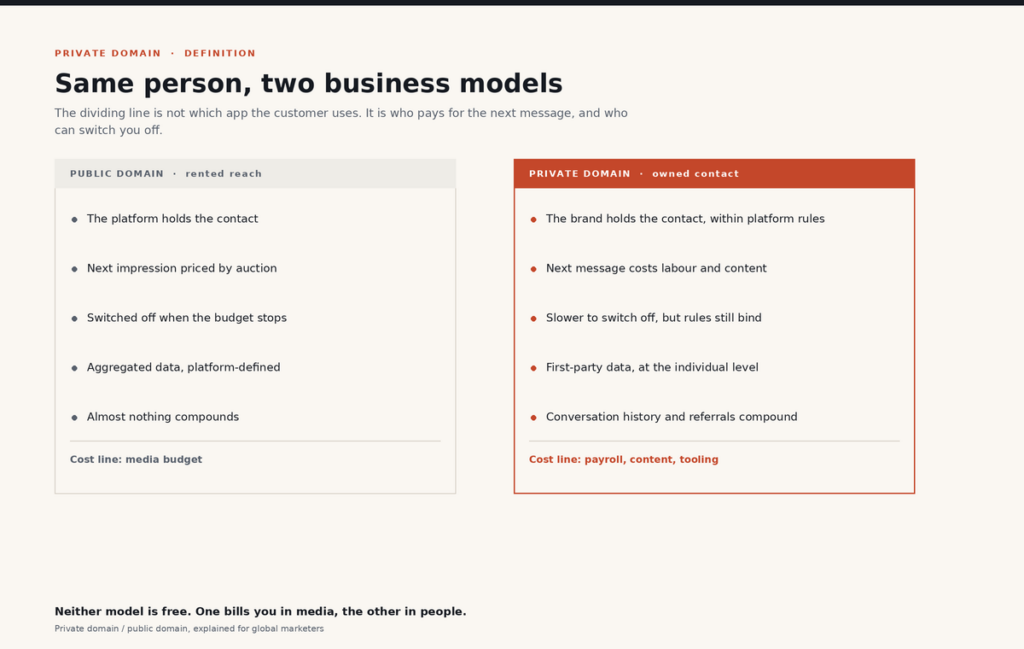
In China, that somewhere is almost always WeChat: a friend list, a group chat, a WeCom thread between a sales associate and a customer, a mini program someone opens from a message. Public domain is the mirror image: the feed, the search result, the livestream slot, the sponsored card. Reach you rent, priced at auction, switched off the moment you stop bidding.
That is the whole idea. What follows is why it hardened into a discipline in China, what the toolkit actually does, and where the costs hide.
Where the phrase came from
The Chinese term 私域流量, private domain traffic, became common currency in the late 2010s, when agencies and platform vendors needed a name for something brands had been doing since group chats existed: keeping customers where nobody charges per message.
It spread for an unglamorous reason. Ad prices on the big platforms kept climbing, and every finance team understood the pitch without a slide. Stop renting the same person over and over.
Notice the word “traffic” in the original Chinese term. It is a telling choice. Even the phrase frames people as a quantity to be stored and moved, which is one reason the practice attracts as much criticism as enthusiasm.
The real dividing line
Most explanations draw the line at the channel level. WeChat is private, Douyin is public. Roughly true, analytically useless, because channels change and the logic underneath does not.
The better question: who pays for the next message, and who can cut you off?
| Question | Public domain | Private domain |
|---|---|---|
| Who holds the contact | The platform | The brand, within platform rules |
| Cost of the next impression | Media budget, auction priced | Labour, content, tooling |
| Can you be switched off | Yes. Budget, ban, algorithm change | More slowly, but rules still bind |
| Granularity of data | Aggregated, platform-defined | First-party, at the individual level |
| What compounds | Very little | Conversation history, segmentation, referrals |
Two caveats sit under that table, and both matter more than the table itself.
First, “own” is doing a lot of work. A WeChat friend list is not a database you can export and walk out the door with. Tencent’s rules govern what you send, how often, and to whom. Brands that talk about owning the relationship are borrowing the language of property to describe something closer to a long lease with a helpful landlord.
Second, private domain is not free traffic. It is traffic whose marginal cost has moved from the media line of the P&L to the payroll line. That is a real advantage for retention, and a real trap for anyone who models it at zero.
A note on semi-private ground
There is an awkward middle ground here. An audience can live inside a public platform and still behave like a private one. A Douyin fan group, a brand account’s followers on Xiaohongshu, a paid membership inside an e-commerce app. You can message these people, but the platform owns the pipe, sets the rules and can throttle you whenever it likes. Treat that ground as rented land on a longer lease, not as property.
Why this became a system, not a tactic
Three structural facts explain the Chinese version. None of them require unusual cleverness.
One app already holds the audience
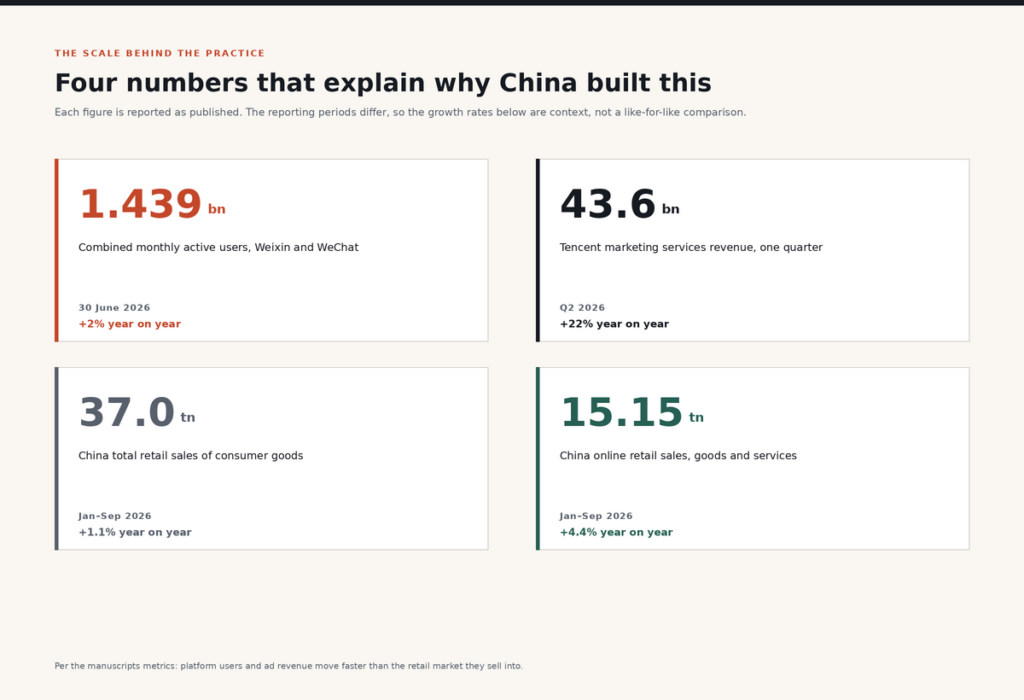
Tencent’s 2026 interim report puts combined monthly active users of Weixin and WeChat at 1.439 billion at the end of June 2026, up 2% year on year. A brand’s customers and its service team are already inside the same application. Nobody has to be moved.
The Western default looks different. A retailer there owns an email list, a website, an app and maybe an SMS programme, and those sit in different systems, each with its own consent state. In China one thread ties them together, which is why one operating model can cover most of the customer journey.
Growth is concentrated online
China’s total retail sales of consumer goods reached RMB 37.0 trillion in the first nine months of 2026, up 1.1% year on year, according to the National Bureau of Statistics. Over the same period, online retail sales of goods and services hit RMB 15.15 trillion, up 4.4%. Online sales of services grew faster still, at 5.3%.
Put those two growth rates side by side. Offline retail is close to flat. Digital channels are carrying whatever growth exists. When the only expanding pool sits behind a platform gate, position inside that pool gets expensive fast.
Advertising grows faster than the tills
Tencent’s marketing services revenue reached RMB 43.6 billion in the second quarter of 2026, up 22% year on year. China’s total retail sales, over the first nine months of the year, grew 1.1%.
Those two figures measure different things over different windows, so they cannot be divided into a neat ratio. Set side by side, though, they describe a market where reach is getting dearer while baskets are barely getting bigger. You can argue about the drivers. Ad load, auction density, AI-targeted inventory, a softer consumer. The direction is not really in dispute, and it pushes brands in exactly one direction: earn more from the customers you already have, because the next one keeps getting dearer.
The toolkit, in plain terms
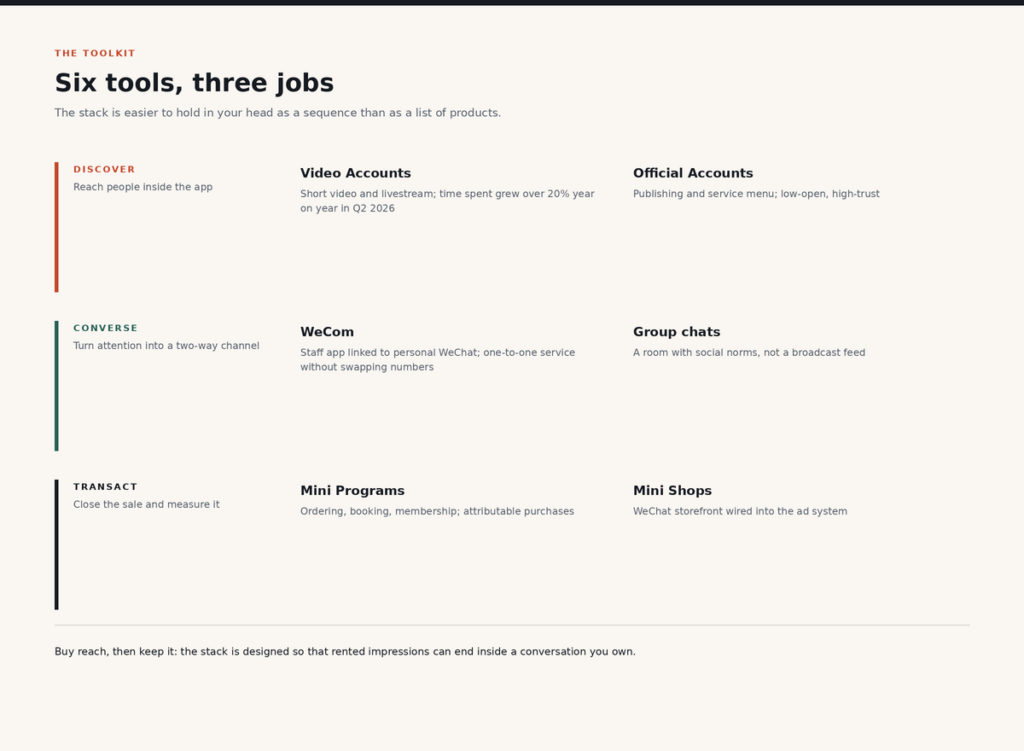
The Chinese stack looks exotic from the outside. Functionally it maps onto things most marketers already know.
WeChat Official Accounts
A publishing surface. Brands post articles, customers follow, and push notifications land in a folder most users open rarely. Reach is genuine, but it competes with every other account a person has ever subscribed to. Treat it as a service menu and a content library, not a broadcast channel.
WeCom / Enterprise WeChat
The workhorse, and the part Western teams underestimate. It is a separate app for staff, which connects to personal WeChat, so an associate can hold a one-to-one conversation with a customer without swapping personal phone numbers. Tencent’s own product documentation describes the function plainly: add WeChat users as contacts, run mini programs, and use WeChat Pay inside the app.
This is where most real private-domain work happens. Assigned customer ownership, scripted follow-ups, service history, and the ability to hand a customer from one colleague to another when someone leaves. If you learn only one tool in this stack, learn this one.
Mini programs
Lightweight applications inside WeChat. No download, no app store. They handle ordering, booking, membership, and measurement, because a purchase inside a mini program is attributable in a way a conversation is not.
Weixin Channels / Video Accounts
WeChat’s short-video and livestream surface. Tencent reported total time spent on Video Accounts grew more than 20% year on year in the second quarter of 2026. It matters for private domain because the video sits beside the friend list. A livestream can move a viewer into a group, a mini shop, or a private chat without ever leaving the app.
Mini Shops
WeChat’s own storefront format. Tencent has been wiring it into the ad system, describing closed-loop marketing that lets mini shops and mini games advertise more effectively across its properties. In practice this is the piece that finally makes rented reach and owned relationships one funnel instead of two competing projects.
Group chats and communities
The oldest tool and the most frequently mishandled. A group of three hundred people is not a channel. It is a room with social norms. Brands that treat it as a broadcast feed watch it go quiet within weeks, and usually blame the audience.
How the machine actually runs
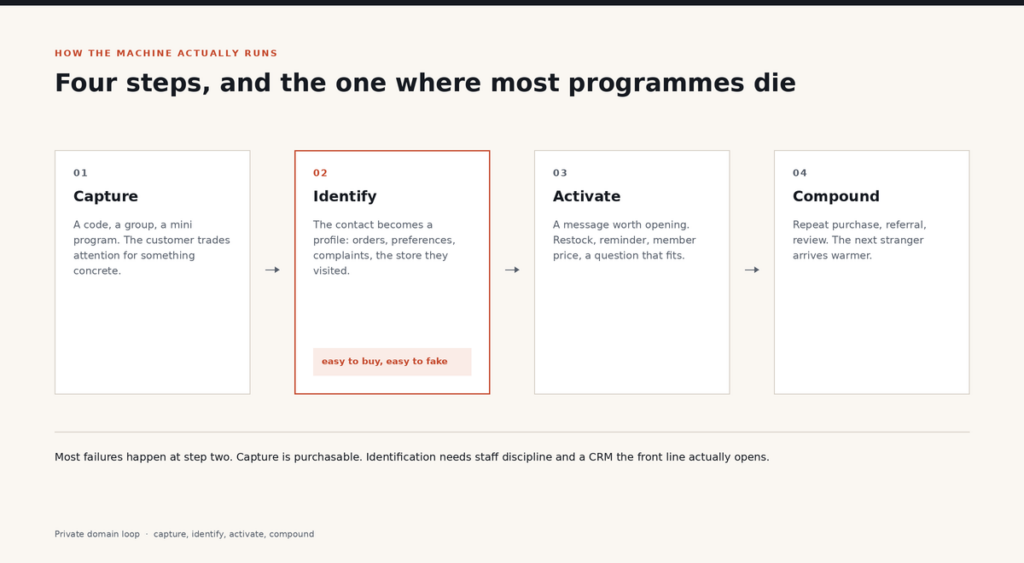
Strip out the vocabulary and a private domain becomes a four-step loop.
Capture. Someone scans a code, adds a contact, joins a group, opens a mini program. The exchange is usually explicit: a discount, a sample, a service booking.
Identify. The contact gets attached to a real profile. Purchase history, preferences, the store they visited, the last complaint they filed. Skip this and you have a mailing list with better chat features.
Activate. The brand sends something worth opening. A restock alert, an appointment reminder, member pricing, or a question from a person who remembers the last order.
Compound. The customer buys again, refers a friend, or leaves the review that makes the next stranger comfortable.
Most programmes fail at step two. Capture is easy to buy. Identification requires staff discipline and a CRM the front line actually opens.
How to tell whether it is working
Five numbers, in order of usefulness. Repeat purchase rate within ninety days, compared against a matched control. Contact-to-purchase conversion, which tells you whether the list is real or merely large. Response time on inbound messages, because a private channel that answers in two days is a public channel with extra steps. Referral rate, the only metric that proves customers would recommend you without a discount. And cost per retained order, which decides whether the payroll line is justified.
If you can only track one, make it repeat purchase rate against a control. Everything else is commentary.
What private domain is not
It is not a discount club. Coupon-driven groups train customers to wait, and the margin pays for the training.
It is not a substitute for brand. A private channel amplifies a preference that already exists. It rarely manufactures one. If nobody wants the product at full price in public, a group chat will not rescue it.
It is not a data free-for-all. China’s Personal Information Protection Law, in force since November 2021, imposes consent and minimisation requirements on consumer contact data, much as the GDPR does in Europe. The compliance culture differs. The obligation does not.
And it is not automatic. The most common misunderstanding among Western teams is that private domain means owning an audience. It means owning a queue of conversations that somebody has to answer.
The costs that never make the slide
Three of them, and they are dull on purpose.
Headcount. As a planning heuristic, budget one dedicated responder per thousand active contacts in consumer categories with frequent contact. Chinese retailers staff this the way Western retailers staff a checkout line, with schedules, quotas and scripts. That is the real media budget, relocated to payroll.
Content supply. A group that receives nothing dies. A group that receives four promotions a week dies faster. The rhythm that survives is mostly utility, with promotion as the exception rather than the engine.
Integration. WeCom, mini programs, and the CRM behind them have to speak to each other. When they do not, an associate ends up copying order numbers by hand, and the whole model quietly degrades into a chat app with extra steps.
Private domain, CRM, CDP: not the same thing
People use these interchangeably. They are different kinds of object.
A CRM is a system of record. It stores what happened. A CDP is a system of assembly. It stitches identities together so the record is complete. Private domain is a system of contact: the operational practice of talking to those people inside a channel you control, under rules somebody else sets.
You can run a spotless CRM and a dead private domain. The reverse happens more often than you would guess, and it is messier: lively group chats, no single view of the customer, and a finance team that cannot explain why revenue looks fine while the reporting does not.
What AI changes in 2026
Two shifts are worth watching, neither settled.
The first sits inside the channel. Tencent disclosed in its second-quarter 2026 results that it has begun a small-scale prototype test of Xiaowei, an agentic assistant inside Weixin, running on a model tuned for privacy protection and Weixin-specific tasks. If that pattern holds, the first reply to a customer question may eventually be a brand’s agent talking to a platform’s agent, with a human stepping in for the awkward cases. That raises a design question most teams have not asked yet: what does your private domain look like when the conversation starts machine to machine?
The second sits outside it. Buyers increasingly ask an assistant before they ask a search box. That changes what discovery means, and therefore what a private domain is for. The audience you keep becomes more valuable precisely as the moment of first contact moves somewhere you do not control.
What a marketer outside China should take from this
Not the tools. The tools are contingent: one app, one payment rail, one regulatory regime, one very specific set of platform rules.
Take the accounting logic instead. Plenty of Western budgets still treat retention as a rounding error beside acquisition, even though the arithmetic has been understood for a long time. A private domain is what happens when a company decides the second sale is a channel in its own right, staffs it, and measures it.
Take the discipline as well. The Chinese version works because somebody is on shift, answering. Copy the structure without the staffing and you get a newsletter with worse open rates and a support inbox nobody owns.
A quick test before you build anything: can you name the person who will reply to a customer at ten o’clock on a Tuesday morning? If the honest answer is “the marketing team, eventually,” you are not ready. Fix that first. It is cheaper than the tooling.
A thirty-day way to start
Week one. Pick one segment where repeat purchase already happens. Consumables, refills, service appointments. Do not pick your most exciting product. Pick the one people buy twice.
Week two. Choose one channel and one owner. One. Email plus SMS plus app push is a strategy document, not a start.
Week three. Write the first five messages. Make four of them useful and one commercial. Test on ten real customers before you automate anything.
Week four. Measure repeat purchase rate against a matched control group. If you cannot build a control, you cannot tell whether the channel worked, and you will end up attributing good weather to your own genius.
The bottom line
Private domain is a Chinese word for an old idea with new plumbing. The customer you can reach for free is worth more than the customer you have to buy again. In China the plumbing is WeChat, and the scale is what turned a habit into a discipline: 1.439 billion monthly users, a retail market where online is the only part still growing, and platform advertising growing faster than the shop tills.
The idea travels. The playbook does not. Build the staffing model before you build the funnel, and you avoid the most expensive mistake in this category, which is mistaking a contact list for a relationship.
Frequently asked questions
Is private domain just a loyalty programme with a Chinese name?
Close, but the difference is architectural. A loyalty programme is a points ledger attached to transaction history. Private domain is a contact channel where a human can start a conversation. Points cannot ask a customer why the last delivery arrived late.
Which channel should a brand start with?
Start with whichever channel already has a person talking to customers. In China that is WeCom. Elsewhere it is usually a service inbox or a business messaging line, not a newsletter. Start where a reply is expected, then expand outward.
What does private domain actually cost?
More than the pitch deck suggests, and less than paid media costs per retained customer. Budget staff time first, then tooling, then content. Teams that model it as free usually discover the cost at the worst possible moment, when the channel has already gone quiet.
Can a non-Chinese brand run private domain from abroad?
You can, but not casually. WeCom generally requires a verified Chinese entity, content is subject to Chinese platform rules and regulation, and customer expectations assume same-day replies. Agencies bridge the gap, with the obvious trade-off: the relationship gets intermediated again, which is the exact thing private domain was meant to avoid.
Does private domain survive the shift to AI answer engines?
The channel survives. The entry point does not. If an assistant answers the discovery question, brands need their products to be legible to those systems and their owned channels to be the place where the sale closes. Retention becomes more valuable, not less, as acquisition becomes more opaque.