Why the 1-in-6 Stays Unserved: The Incentives Behind the Invisible Audience
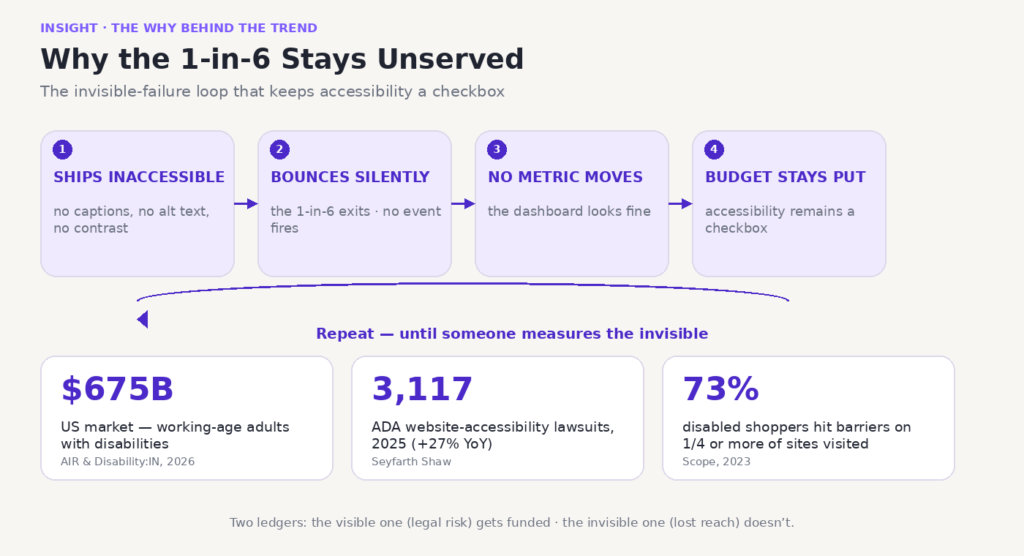
Campaigns fail loudly when they fail visibly — CTR drops, CPA climbs, someone loses a bonus. Inaccessible campaigns fail silently. Nobody sees the deaf person who closed the video, the screen-reader user who hit a wall of unlabeled buttons, the low-vision shopper who gave up on the checkout. Their exits don’t fire an event. They just don’t come back. So the data says everything is fine, and the budget stays put. That loop, more than any legal requirement, is why the 1-in-6 remains under-served.
Two ledgers, one that counts
Every marketing team keeps two ledgers, but only one of them is real to them. The difference is which numbers got measured.
The visible ledger: legal risk with a price tag
The visible ledger holds countable costs. Seyfarth Shaw counted 3,117 website-accessibility lawsuits in US federal court in 2025, up 27% from 2024 — legal risk you can quote in a meeting, price it, and budget against. That is why compliance gets funded: it is insurance, and insurance has a number.
The invisible ledger: opportunity nobody measured
The invisible ledger holds uncounted opportunity: the $675 billion US market among working-age adults with disabilities (AIR and Disability:IN, April 2026), the £274 billion purple pound in the UK (Scope). You cannot quote a number you never measured, so this ledger loses the budget argument every single time. The reach frame isn’t a slogan. It’s a demand to move lost reach onto the same spreadsheet as lawsuits.
The retrofit trap
There is also a cost-curve illusion at work, and it has two sides.
Built-in is nearly free
Accessibility built in from the start costs almost nothing: captions in the brief, alt text in the asset spec, contrast in the design system. It is a template, not a project.
Retrofit is where the expense lives
Accessibility added later is genuinely expensive — re-shooting, re-editing, re-designing, re-testing. Most teams only ever meet accessibility in its expensive form, because they only ever meet it as a retrofit. So “too expensive” is almost always a sequencing problem dressed up as a cost problem.
Why inclusion pays disproportionately
The same loop that hides exclusion also inflates the reward for fixing it.
Under-service creates a retention premium
Because this audience is chronically under-served — Scope found 73% of disabled online shoppers hit barriers on a quarter or more of the sites they visit — the brand that genuinely removes them wins loyalty that can’t be bought: 70% of disabled shoppers say they won’t return after a bad experience, and half of those who hit a problem while buying simply give up. The harder a segment is to reach, the cheaper its loyalty is to win.
The cost curve just moved
One more thing changed the arithmetic: AI now generates captions, alt text, and transcripts at scale, which kills the old excuse that doing accessibility properly is too expensive. The bottleneck moved from generation to verification — an incorrect alt text is worse than none, because it confidently misinforms. The economics flipped: the volume is cheap, and the human check is the non-negotiable line item. Teams that budget for verification, not just automation, are the ones who actually capture the reach.
The bottom line
The 1-in-6 stays unserved not because inclusion is expensive, but because its absence is invisible. Make the excluded audience visible in your measurement — count the people who never got through — and the incentive structure rewrites itself. The moment lost reach sits on the same ledger as lawsuits, accessibility stops being a checkbox and starts being the growth it always was.