The CMO Title Is Disappearing. The CMO Is Not.
Every year someone publishes the CMO tenure number, and every year the internet reads it as a verdict. Four point one years at the S&P 500. Shorter than the CFO. Shorter than the CHRO. Barely half the CEO. The implied story writes itself: marketing leaders keep failing, boards keep firing them, and the carousel keeps spinning.
That story is wrong. Not slightly wrong — structurally wrong, in a way that changes what a marketing leader should do about it.
The exit data contradicts the headline
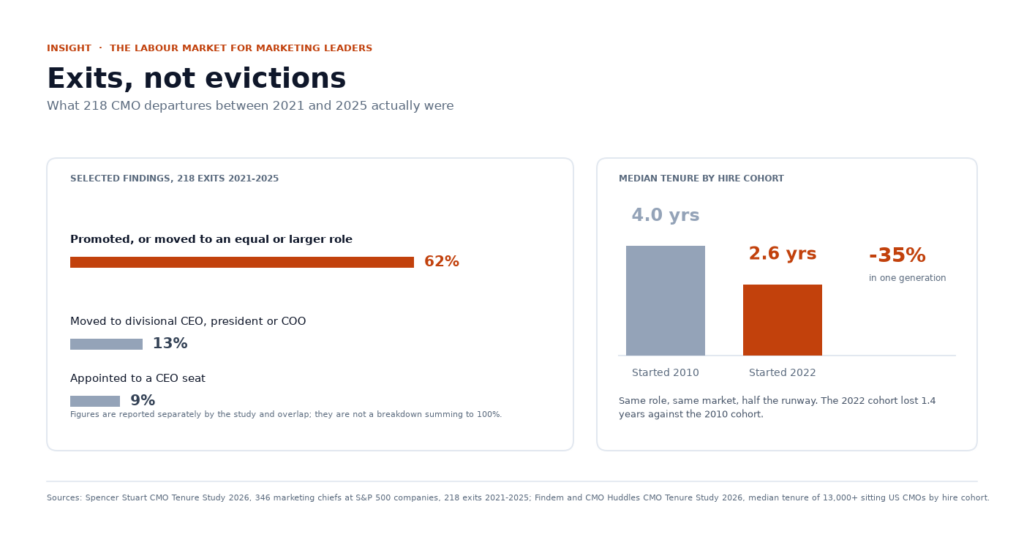
Spencer Stuart traced 218 CMO departures between 2021 and 2025. Sixty-two percent of those people were promoted internally or moved to an equal or larger role somewhere else. Nine percent went straight to a CEO seat, another 13% to divisional CEO, president, or COO. Among those who left their company entirely, 77% were in a new job within six months.
Sit with that for a second. The population being measured as “short-tenure failures” is, by a clear majority, a population of people getting promoted. The metric and the reality are pointing in opposite directions.
So why is the clock still getting shorter?
Here is the mechanism, and it has three parts.
One: the title became a launchpad
When a role reliably produces CEOs, it stops being a destination and starts being a corridor. Spencer Stuart found that 37% of Fortune 500 chief executives have some marketing background, and the CMO-to-CEO jump is most visible at consumer brands — precisely the sector with the shortest tenure at 3.5 years.
A corridor has high traffic by design. People leave because the next door opened, not because this one closed.
Two: the mandate got wider than the title
Forrester’s July 2026 research found that only 36% of Fortune 500 companies still use the CMO title, down from 49% a year earlier. Marketing chiefs on the executive committee or reporting directly to the CEO fell six points to 52%, the third consecutive annual decline.
Read that as decline and you miss what is happening. Companies are not deleting the function. They are re-labeling it — chief growth officer, chief commercial officer, chief customer officer — because the work now includes revenue, P&L ownership, in some cases investor relations. A title that under-describes the job gets replaced by one that fits.
Which means a chunk of “CMO turnover” is not turnover at all. It is reclassification. The person stayed; the job description changed shape around them.
Three: the compounding never gets to compound
This is the part with real costs. A hire who is promoted in year three delivers three years of brand investment and leaves before the compounding arrives. The next leader inherits an unfinished curve, rationally reallocates toward what shows a number this quarter, and resets the clock. Findem’s cohort data makes the drift visible: CMOs who started in 2010 had a median 4.0 years; those who started in 2022 had 2.6. A 35% compression while the brief got wider.
Individual careers benefit. Institutional brand equity does not. Both things are true at once, which is why the aggregate statistic can never settle the argument.
What this actually changes
Two practical consequences, and they are not symmetric.
For the candidate: stop treating a short stay as something to explain away. It is evidence, and the useful question is what you moved while you were there. “I was promoted out of the role in 26 months” is a stronger sentence than “I stayed four years,” provided you can name the number.
For the board: the mobile, promotable CMO is exactly the profile most likely to leave before brand investment pays back. If you want the compounding, you have to structure for it — sequenced milestones that reward the second and third year, not a monthly review that rewards the first.
The tenure number is not a thermometer. It is a description of a labour market where the best people keep getting promoted out of the seat you need them to hold.