Why In-Housing Produces Great Craft and No Compounding
Bring work in-house to compound.
That is the argument. Nearly every strategic case for an in-house agency rests on the same premise: the work gets better the longer it stays inside, because the team accumulates brand knowledge, customer data, and institutional instinct that no outside partner can rent you. Own the compounding core. That’s the advice.
Then look at what those teams are actually measured on.
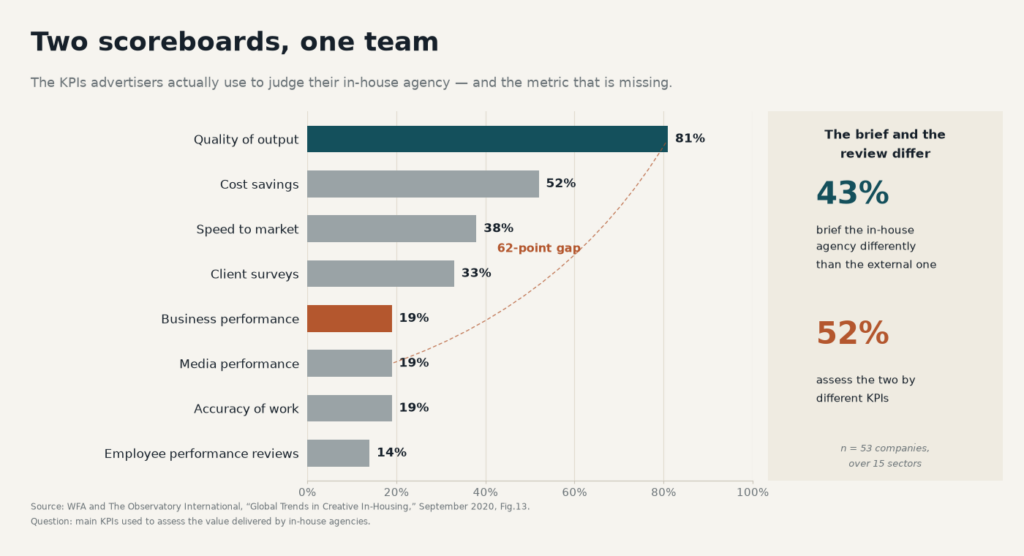
In WFA research covering 53 companies across more than 15 sectors, the top KPI used to assess an in-house agency was quality of output, cited by 81 percent. Second was cost savings, at 52. Third was speed to market, at 38. Business performance came in at 19 percent — tied with media performance and accuracy of work, and behind client surveys.
Eighty-one against nineteen. The metric that dominates is craft. The metric that describes whether the brand actually moved is an afterthought, cited by roughly one in five.
That is the mechanism. In-housing doesn’t fail because the talent isn’t good. It fails because the scoreboard rewards the wrong thing — and a team optimizes for its scoreboard with remarkable consistency.
Why the Scoreboard Looks Like This
The asymmetry isn’t stupidity. It’s structural, and it starts with what each model can actually be held to.
An external agency is judged on business outcomes because that’s all it can be judged on. It doesn’t share your P&L, doesn’t sit in your planning cycles, doesn’t see the second-order effects of a campaign six months later. So the contract reaches for the only currency available: did revenue move, did share move, did the pipeline fill. Crude, but pointed outward.
The in-house team faces the opposite problem. It sits inside the business, sees everything — and therefore gets measured on what is immediately legible to the people standing next to it. Was the asset good. Did it ship on time. Was it cheaper than the quote from the agency down the street. Proximity doesn’t sharpen accountability. It narrows it.
The WFA data shows the same split on the input side. Forty-three percent of advertisers said they brief their in-house agency differently from their external agencies. Fifty-two percent admitted they assess the two by different KPIs.
So the two teams are briefed on different terms, judged on different scoreboards, and then compared as if the comparison meant something. It doesn’t. It’s a rigged experiment that reliably produces the conclusion whoever commissioned it already wanted.
What This Predicts
If the scoreboard is craft, then in-housing will produce excellent craft — and little compounding. Which matches the pattern. Workloads rose for 82 percent of respondents, satisfaction ran at 87 percent, and yet in-house teams handled an average of only 37 percent of creative work, with 95 percent still using external agencies. A very good production shop sitting beside a very necessary strategic partner.
The fix is not more talent. It’s a harder question in the quarterly review: did this work change a business number, or did it change a slide? Until the in-house scoreboard includes something the CFO would recognize, in-housing will keep delivering exactly what it’s paid to deliver — good output, on time, beautifully measured, and strategically inert.