Why Instruments Outrun Arbitration
The economics behind a decade of measurement spending that never bought a decision.
Here is the strangest fact in marketing measurement. The instruments have never been better, and the decisions have never been worse served.
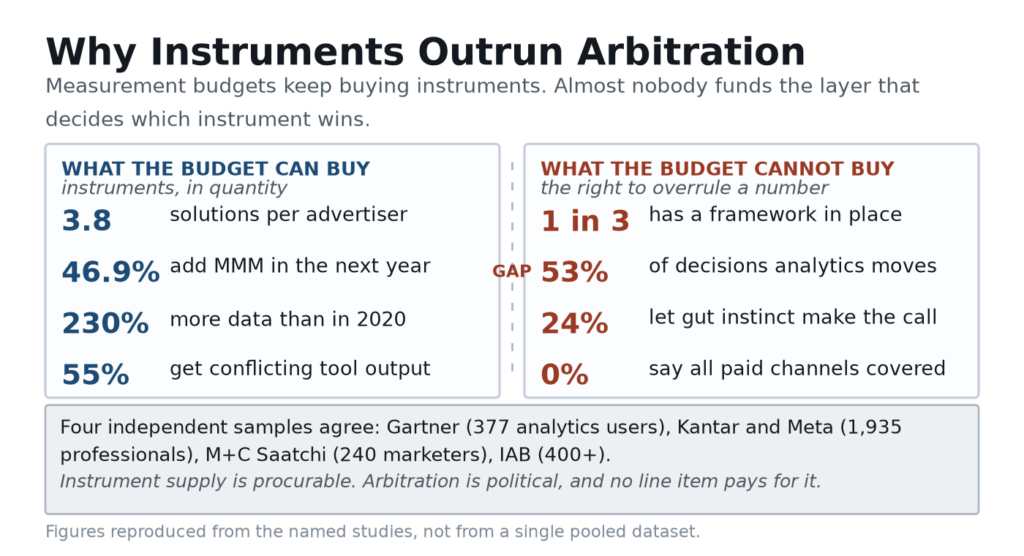
Advertisers now run an average of nearly four separate measurement solutions. Nearly half plan to add marketing mix modelling within the year. The data volume flowing through marketing teams is 230% higher than in 2020. And yet analytics influences 53% of marketing decisions, roughly a third of decision-makers are described by their own analytics teams as cherry-picking data to support conclusions they already held, and a quarter of the time the final call comes from gut instinct instead.
[Figure 1 — infographic placement: full width, immediately after this paragraph]
That gap is not a technology problem. It is an incentive problem, and it has a shape you can see once you stop counting tools and start counting who is allowed to overrule a number.
The gap is not supply. It is arbitration.
Every measurement purchase solves a supply question: do we have visibility into this channel, this audience, this increment? Vendors compete fiercely on that question, and they have largely won it. You can buy visibility into almost anything.
But a decision needs something the purchase cannot provide. When your marketing mix model says the creator programme contributed 8% of sales and your geo holdout says 2%, someone has to rule. That ruling is arbitration. It requires an agreed hierarchy of metrics, a written confidence tier beside each number, and a person authorised to say the model is wrong this quarter.
None of that arrives in a contract. It has to be built internally, argued over, and written down. It is also, awkwardly, political: declaring that a channel’s number is unreliable makes an enemy of whoever owns that channel.
Three things the budget cannot buy
Look at what the same research keeps finding on the other side of the ledger. Only about one in three marketers has an established measurement framework at all. In the Kantar and Meta study of 1,935 measurement professionals, 55% said they often get conflicting answers from different tools, and only 3% use MMM on its own as a decision input. In the IAB’s 2026 survey of more than 400 buy-side decision-makers, not one respondent believed all their paid channels were well represented in their models. Gaming was named underrepresented by 77%.
Read those together and a mechanism appears. Instruments multiply, disagreements multiply with them, and with no arbitration layer the disagreement gets resolved by seniority, by loudness, or by whoever prepared the deck. The instrument count rises while decision confidence falls, which is exactly the pattern the data shows.
This is not a failure of the tools. It is the predictable outcome of buying supply while refusing to fund arbitration. And it is why measurement budgets grow every year while the influence of measurement does not.
What funding arbitration actually looks like
It is unglamorous. One north star metric, chosen in writing. Four to eight decision rules that specify what happens when a number crosses a threshold. A confidence tag on every metric, so the room knows which numbers are measured and which are inferred. A kill list of metrics that inform nothing.
The whole thing costs a few days of senior attention a year. It cannot be bought, which is precisely why it survives contact with a vendor pitch, and why it compounds while tools depreciate.
The uncomfortable conclusion: if your measurement spend has been rising for three years and your decisions have not gotten faster, you have not been buying capability. You have been buying instruments and calling it a framework.