Why Blameless Culture Policies Keep Failing: The Cost-Benefit Asymmetry Nobody Prices
Every team I have sat with can explain why the retrospective got skipped, and the explanations are always the same three. The launch date moved. Two people were on leave. The deck was already two weeks stale and nobody wanted to reopen it.
All three are true, and all three are alibis. The retrospective does not get skipped because the calendar is crowded. It gets skipped because of who pays for it and who collects.
Run the ledger
Take the most valuable thing that happens in a good retro: somebody says, in front of their peers and their manager, that the call they argued for in February was wrong.
Now price that sentence.
The person who says it pays immediately and privately. They pay in the currency of perceived competence, in a room where competence is the thing being assessed. They pay in front of the people who will write their review. They pay whether or not the admission turns out to be useful, and they pay now.
The benefit lands somewhere else entirely. It lands on a team that will run a brief in eight or nine months, staffed partly by people who are not in the room, and it arrives as a slide in a document they may never read.
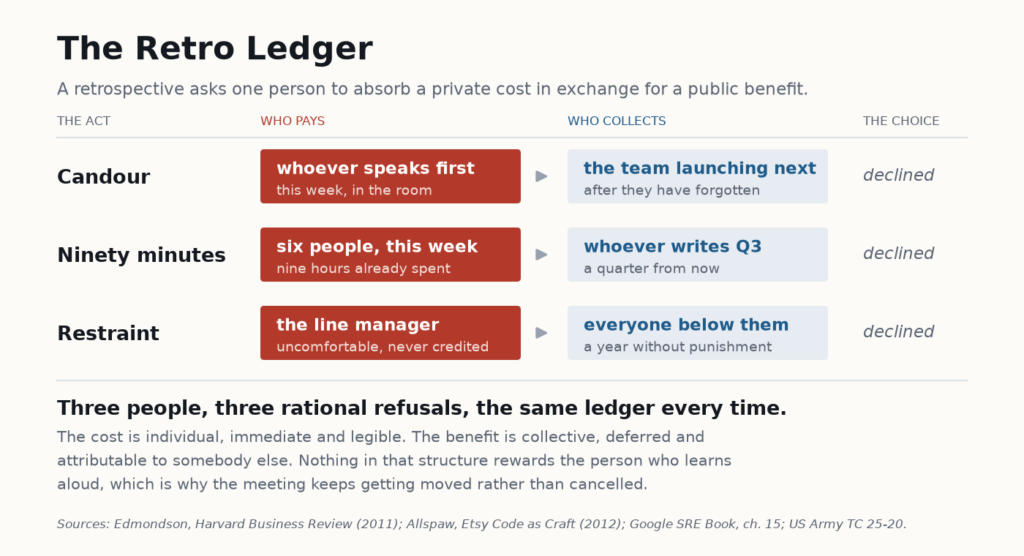
Cost: personal, immediate, legible. Benefit: collective, deferred, unattributable.
Any organisation that runs on that ledger will see the same behaviour, and it will not be a character defect. It will be arithmetic. When the private cost of an act exceeds the private benefit, the act does not happen, no matter how large the public benefit is.
The same ledger, three times
The pattern repeats wherever a review requires somebody to absorb a cost on behalf of a group.
The ninety-minute meeting. Six people spend nine hours so that a brief written next quarter — by someone who may not be in the room — will be slightly better. The people in the room pay in full. The beneficiary pays nothing and does not know they were subsidised.
The manager’s restraint. A team lead who declines to name a person in a failure review is quietly forgoing the most legible signal of managerial seriousness available to them. In exchange, everyone who reports to them gets a year of not being punished for candour. The manager absorbs the cost of appearing soft. The team collects the benefit. Nothing in the performance system records the transaction.
This is why blamelessness cannot be installed by policy. A policy changes the rules of the room. It does not change the ledger. If admitting error still costs the individual and still benefits the abstract future, a mandate will produce the vocabulary of candour with none of the content — and everyone in the room will know the difference.
What actually moves the ledger
Amy Edmondson’s framing is useful precisely because it reframes the question. Failures at the frontier of knowledge are not misconduct; they are the cost of buying information. Once a leader genuinely holds that view, the calculus for the person speaking changes — but only if the leader’s behaviour changes first, because the person speaking is pricing the leader’s reaction, not the policy document.
The interventions that work all do the same thing: they move cost or benefit closer together in time.
Google’s post-mortem guidance requires a written action plan with prioritised fixes and a named owner for every item. That is not bureaucracy. It is a mechanism for making the benefit visible, dated, and attached to a person the reviewer will meet again.
Etsy’s just-culture formulation goes further: post-mortem action items take precedence over shipping product. That single rule converts the review from a cost centre into the highest-priority work in the building, which is the only way the ledger flips.
The Army’s third third — follow-through — does the same job structurally. By making the review incomplete until the actions are closed, it removes the option of paying the cost and skipping the benefit.
The honest version
None of this makes the retro free. It still costs ninety minutes and it still costs somebody their comfort.
What it does is stop pretending that a team which keeps declining a bad trade is a team with a culture problem. They are reading the ledger correctly. Change the ledger — make the benefit land on someone in the room, and land within the quarter — and the same people will show up and say the hard thing.
Until then, expect the meeting to keep getting moved. It is doing exactly what it was priced to do.