Why AI Budgets Overshoot by 2.5× — and Will Again Next Year
Here is a number that should have ended a few planning meetings before they started.
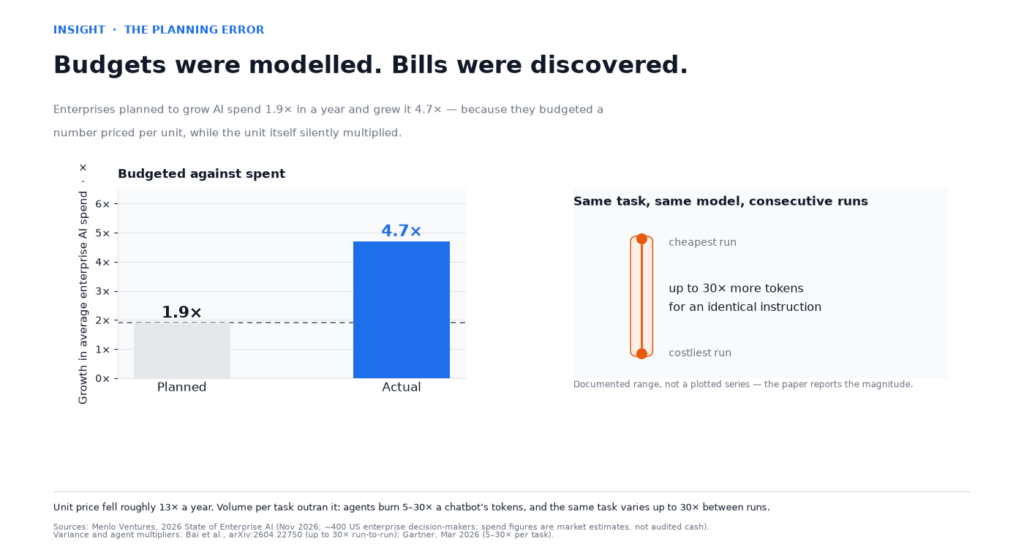
In a survey of close to four hundred US enterprise decision-makers, Menlo Ventures asked what organisations planned to spend on AI in the coming year and what they actually spent. The average firm planned to grow its AI budget 1.9 times. It grew it 4.7 times. That is a 2.5-fold overshoot on a line item that boards signed off on twelve months earlier, and it happened across the sample rather than in a handful of outliers.
Enterprise AI deployment spend went from 33 billion dollars to about 177 billion in a single year. Nobody approved that trajectory. It arrived.
Why the plan failed
The failure is not forecasting error in the ordinary sense. It is a category error, and it is worth being precise about which one.
Marketing and IT departments have spent thirty years budgeting software. Software cost is deterministic and seat-based: you know how many people need a licence, you multiply, you get a number that holds for twelve months. Budgeting a seat-based tool is arithmetic.
AI spend is metered by work. And work, in an agentic workflow, is stochastic. Research on token consumption in agentic coding found that consecutive runs of the same task, on the same model, with the same prompt, can differ by up to thirty times in total tokens. The same study found that models systematically underestimate their own consumption before running. The instrument generating the bill is the least reliable instrument for predicting it.
So the budget was built with the wrong mathematics. A deterministic ledger applied to a stochastic meter does not produce a forecast. It produces a floor.
Why it kept getting worse
Two forces compounded. Unit price fell roughly thirteen times a year, which made every individual call feel cheaper and therefore safe to multiply. And the shape of the work changed underneath the price list: agents now process about 80 percent of all tokens routed through OpenRouter, at roughly seven times human-driven volume, because an agent re-sends its entire context on every step of its loop.
Cheaper units, more of them, in a shape nobody modelled. The arithmetic of that combination was always going to break a spreadsheet.
What the CFOs already noticed
This is no longer a theoretical governance problem. Gartner’s 2026 CMO survey found 41 percent of organisations with consumption-based martech building real-time usage controls, roughly half continuously renegotiating contracts, and 24 percent re-engineering systems specifically to consume less. Those are not the behaviours of teams that trust a forecast. They are the behaviours of teams that have started watching a meter.
The lesson is narrow and unglamorous. AI is the first major marketing cost that behaves like a utility and the first that most finance teams budgeted like a subscription. The gap between those two things is the 2.5.