The Shortlist Is Decided Before You Arrive. Here Is How AI Gets You On It.
Every ABM pitch deck opens the same way. A scattergun on the left, a sniper on the right, and an arrow between them labelled “account-based marketing.” It is a lovely slide. It is also a lie we have been telling ourselves for about fifteen years.
Here is what actually happened. Account-based marketing did not fail because the strategy was wrong. It failed because the two things that make a missile a missile, namely knowing where the target is and being able to reach it, were both missing. You could build a beautiful list of target accounts based on firmographics and still have no idea which of them was shopping this quarter. You could know that a deal was live somewhere inside a 13-person buying group and still have no idea who to talk to. And you could write a genuinely brilliant message for one account, once, before your team ran out of Wednesday.
That is not a sniper. That is a scattergun with a laminated target list. Nicer stationery, same spread.
And the spread is expensive, because the decision is usually over before you get a turn.
What ABM Got Right, and What It Could Never Afford
Fit Is Not Intent
Firmographics tell you who looks like your customer. They tell you nothing about who is currently unhappy with their incumbent, who just hired a VP with a mandate to rip out the legacy stack, or who has budget sitting in a line item that expires in March.
The uncomfortable arithmetic here comes from the Ehrenberg-Bass Institute. In most B2B categories, roughly 5 percent of potential buyers are in the market in any given quarter, a figure John Dawes derived from how rarely companies change suppliers, about once every five years. Dawes is explicit that this is a heuristic, not a measurement. But the direction is not in dispute: at any moment, the overwhelming majority of your perfectly matched target accounts are not buying anything. A list sorted by fit is therefore a list sorted by appearance, not by readiness.
The Buying Group Grew Up While the Targeting Stayed Flat
Forrester’s 2026 study of roughly 18,000 business buyers puts the typical purchase at 13 internal stakeholders plus nine external influencers. When the purchase includes generative AI features, the buying group doubles compared with purchases that do not. Twenty-two people, then, in the ordinary case. More when the thing you sell sounds like a risk.
Now hold that against the average ABM sequence, which is addressed to one person and copied to their manager. You are not aiming at a target. You are aiming at a target’s receptionist.
Personalization Collapsed Into Mail-Merge
True one-to-one personalization has always been a staffing problem dressed up as a technology problem. It takes real research to say something a CFO has not already read on a competitor’s homepage. Multiply that by the number of accounts, and by the number of touches per account, and the economics stop working immediately. So teams did what teams do: they automated the field and called it personalization. “Hi {%first_name%}, I noticed {%company%} is hiring” is not a missile. It is a mail-merge wearing a costume.
The cost of that costume is measurable. Demand Gen Report’s 2026 ABM benchmark survey, which covers vendors and practitioners rather than academic samples, found 47 percent of respondents naming personalized content as the highest-ROI ABM tactic of all. They also found that only 29 percent say AI’s biggest contribution so far is personalization at scale. Read those two lines together and you get the whole problem: personalization is where the money is, and it is precisely where execution lags.
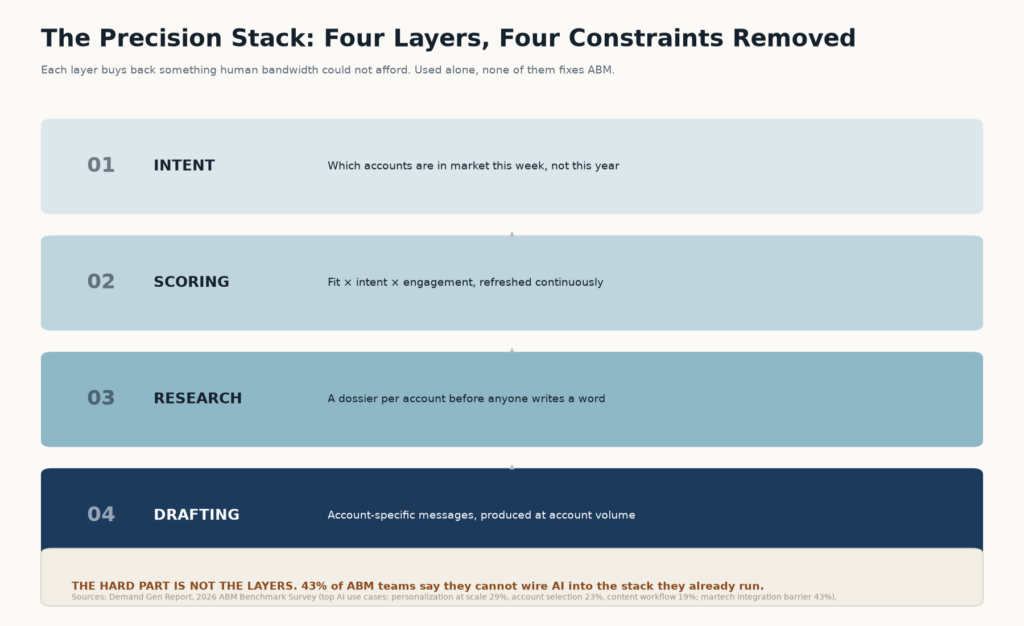
The Four Layers That Actually Remove the Constraint
Layer One: Knowing Who Is in Market This Week
Intent data is the first honest attempt at answering the question ABM always ducked. Not “does this account fit?” but “is this account looking right now?”
I want to be careful here, because this category is thick with confident numbers. Spend an afternoon reading vendor pages and you will find claims ranging from “about one in five flagged accounts is not actually in market” to figures so extreme that they can only be marketing for a competing data supplier. There is no neutral, peer-reviewed benchmark of B2B intent-data accuracy that I could find, and that absence is itself the most useful finding. Treat intent as a reason to look, not a verdict.
What separates good from bad here is not the logo on the dashboard. It is whether the signal came from observed behaviour or inferred behaviour. A company posting four job ads for the function you sell into has published a fact with a date on it. A topic-surge score is a model’s opinion about anonymous IP addresses. Both can be useful. Only one of them survives an audit.
Layer Two: A Score That Refreshes Faster Than the Buying Window
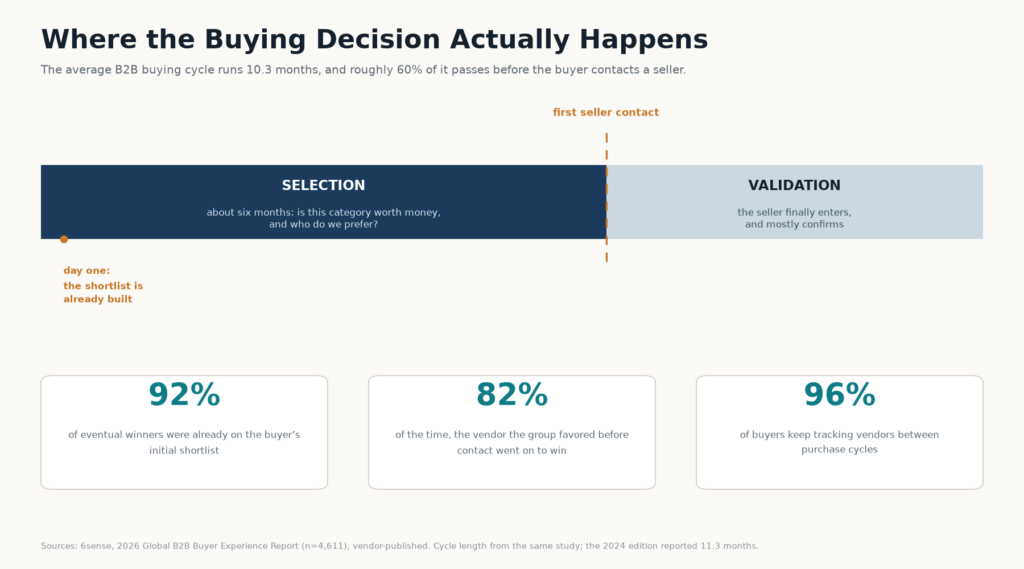
The window is short. 6sense’s 2026 buyer study, 4,611 respondents, found the average cycle runs 10.3 months, with roughly 60 percent of it consumed before the buyer talks to a seller at all. That means the period in which you can actually influence the shape of the deal is measured in weeks and months, not in annual planning cycles.
Quarterly scoring is therefore a category error. By the time your quarterly refresh lands, the shortlist has usually hardened. In the same study, 92 percent of eventual winners were already on the buyer’s initial short list, and when a buying group had a favourite before contact, that favourite won 82 percent of the time. Not because sellers are persuasive. Because the group had already finished deliberating and was simply looking for confirmation.
Layer Three: Research That No Human Team Could Justify
An account dossier is the least glamorous and most underrated part of the stack. Before anyone writes a single line of copy, someone has to know what the company announced last quarter, which division is under pressure, who the new hire reports to, what their competitor just did, and which of their public commitments your product actually helps them keep.
Historically this was a two-hour job per account, done well by your best rep and badly by everyone else. Now it is a fifteen-minute job you supervise, and the supervision is the part that matters. Gartner expects 40 percent of enterprise applications to include task-specific AI agents by the end of 2026, up from under 5 percent in 2025. That is a lot of agents. Gartner also expects more than 40 percent of agentic AI projects to be cancelled by the end of 2027, and estimates that of the thousands of vendors claiming real agentic capability, only about 130 actually have it. The lesson is not that agents do not work. It is that an agent pointed at a messy CRM will produce its mistakes faster than you can read them.
Layer Four: Drafts at Account Volume, Not Template Volume
Once you have a dossier, the copy almost writes itself, which is the good news and the trap simultaneously.
The good version: the agent drafts an opening paragraph that references the actual initiative, the human edits it until it sounds like a person who has thought about this account, and the message goes out at a volume no team could have sustained manually. The bad version: the agent drafts 400 variations of the same sentence, the human approves them in bulk, and you have rebuilt the mail-merge with better grammar and a larger compute bill.
The distinction is not technical. It is editorial. Someone has to own the sentence.
The Playbook, in the Order You Should Actually Do It
1. Write the ICP as Filters, Then Let Intent Do the Ordering
Intent cannot rescue a bad list. If your ideal-customer definition is vague, better signals just help you target the wrong accounts more efficiently. So build the universe first: revenue band, industry, tech stack, geography, whatever genuinely predicts success. That is your filter set, and it should be boring and explicit. Intent then does one job only, which is sequencing. It tells you who moves to the front of this week’s queue.
2. Score Weekly, and Treat the Signal as Perishable
A score that is three weeks old is a historical document. The buying group has moved, the champion may have changed jobs, and the competitor you were tracking has probably already presented. Refresh weekly, and build the routing so that a score change actually changes behaviour rather than just colouring a dashboard tile.
3. Route by Value: Humans on Top, Automation on the Tail
This is where most programmes quietly break. AI makes it cheap to touch every account, so teams touch every account, and the attention that should have gone to the twelve accounts that matter gets diluted across four hundred that do not.
Route deliberately. Top tier gets a named human, a real dossier and a custom point of view. Middle tier gets templated-but-relevant content with human review. The long tail gets automated nurture and a polite goodbye. McKinsey’s 2026 B2B growth survey found organisations that anchor ABM ownership in the sales process are five to ten percentage points more likely to sit in the top revenue-growth bands than those using shared or marketing-led models. Diffusion of ownership is not collaboration. It is usually just nobody’s job.
4. Write to the Situation, Not to the Field
The test is simple and slightly brutal. Cover the company name. Could this email have been sent to anyone else in the category? If yes, it is not account-based. It is segment-based with a merge field, and the buyer can tell, because they receive forty of them a week.
Write to the situation: the reorganisation, the earnings call language, the compliance deadline, the integration they are clearly struggling with. That is what a dossier is for.
5. Pick One Metric and Defend It
Account progression, in this order: engaged stakeholder, meeting held, opportunity created, revenue. That is the whole dashboard. It is unglamorous, it is slow to move, and it is the only thing that tells you whether the missile hit anything.
The vanity alternative, a rising tide of impressions, clicks and “account engagement score,” will always look better in month two and will always be wrong by month nine.
Where the Humans Still Are
If you read enough AI marketing copy, you would think the seller is being retired. The buyer data says something much stranger and more interesting.
Gartner surveyed buyers twice from the same fieldwork and found two numbers that look contradictory until you line them up. Sixty-seven percent prefer a rep-free buying experience. Sixty-nine percent turn to a sales rep to validate what AI told them. Both are true, because they describe different moments. Buyers want to do the research themselves, and then, at the point of commitment, they want a person to tell them the answer engine got it right.
Forrester found a similar split: 94 percent of buyers use AI somewhere in the process, but one in five came away less confident because the AI gave them something unreliable, and the share is higher among procurement, the very function that signs.
So the human role is not “relationship management” in the soft sense. It is verification, judgment and signature. AI starts the search. A person signs off.
The Four Ways This Goes Wrong
Hallucinated Facts in a High-Stakes Email
A wrong claim in a mass newsletter is embarrassing. A wrong claim in an email to a CFO at a target account is disqualifying, permanently, in about four seconds. The dossier is AI-generated, which means it can be confidently wrong. Verify every specific claim before it leaves the building. This is not a technology problem and no vendor will solve it for you.
Volume Creeps Back In
This is the most likely failure, and the least discussed. AI makes personalization cheap, so the temptation is to personalize more accounts rather than better accounts. Precision decays as volume rises, almost mechanically. The discipline is to keep your named-account list shorter than your capacity to actually think about each one.
Intent Data Is Only as Good as the Plumbing
Inflexion Group’s 2026 benchmarking study, based on 40 global enterprises plus 16 interviews and published by an ABM consultancy, found 60 percent of client-facing teams still lack a single source of truth for their data. Sixty percent. If your CRM disagrees with your marketing platform about who the account even is, no scoring model will save you.
Tool Sprawl
Demand Gen Report found 43 percent of ABM teams struggling to connect AI to the martech stack they already run. That is the single largest reported barrier, ahead of skills and ahead of proving ROI. Gartner’s 2026 CMO spend survey adds the punchline: marketing leaders are putting 15.3 percent of budget into AI while only 30 percent describe their organisation as having mature AI readiness. We are buying faster than we are wiring.
So What Should You Do on Monday?
Three things, none of them requiring a new licence.
First, audit the list. Take your current target accounts and mark which ones have shown any independent sign of activity in the last thirty days. If the answer is “almost none,” you do not have an intent problem, you have a targeting problem.
Second, pick your top twelve accounts and write down, in plain language, what each of them is trying to accomplish this year. If you cannot, you have found the real gap, and it is not a tooling gap.
Third, choose the one metric you will be judged on and delete every other ABM dashboard from your reporting.
The Bottom Line
ABM was never a bad idea. It was a correct idea running on insufficient information and insufficient bandwidth. AI supplies both: intent tells you who is actually shopping, scoring tells you where to point, research tells you what to say, and drafting lets you say it to more than nine accounts a month.
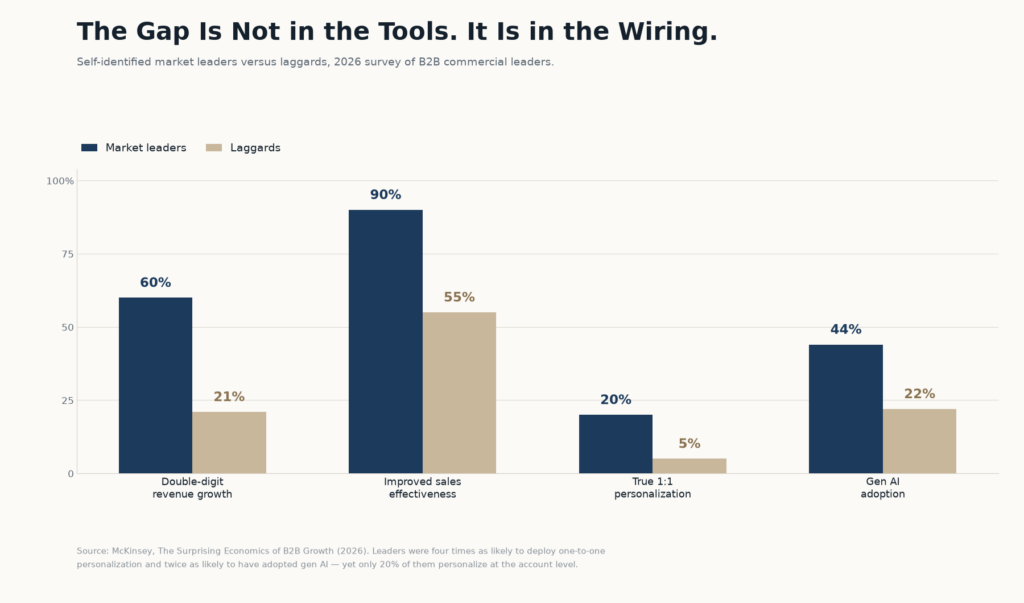
But look at what actually separates the winners. McKinsey’s 2026 survey found leaders were four times as likely to practise one-to-one personalization, twice as likely to have adopted generative AI, and more likely to give ABM clear sales ownership. Yet only 20 percent of those leaders personalize at the account level. Even the best are still mostly segmenting.
Which tells you where the advantage still sits. Not in having agents. In having the data, the process and the accountability to point them at something worth hitting.
AI aims. A human pulls the trigger. And the organisations that get the division of labour right will spend the next few years quietly taking accounts that their competitors merely targeted.