The Blind Spot Behind Every Quality Metric: What Ad Verification Never Learned to Measure
The uncomfortable discovery isn’t that AI-generated pages evade ad verification. It’s that they outperform real publishers on it — and the reason says more about how we measure media than about how fraud works.
Every check audits the audience, none audits the page
Ad verification grew up fighting bots. That origin story is still baked into its instruments. Invalid traffic asks: was a human present. Viewability asks: could that human have seen the ad. Domain lists ask: does this URL appear on a blocklist. Premium grading asks: does this inventory match the signals premium inventory usually produces.
Four different questions, one shared assumption. All four treat the page as a given and interrogate the audience instead. The page was never the subject. It was the stage.
That assumption held for fifteen years because the fraud of the era was faking people. Something that fakes the page instead slips through the entire instrument panel without touching a single sensor.
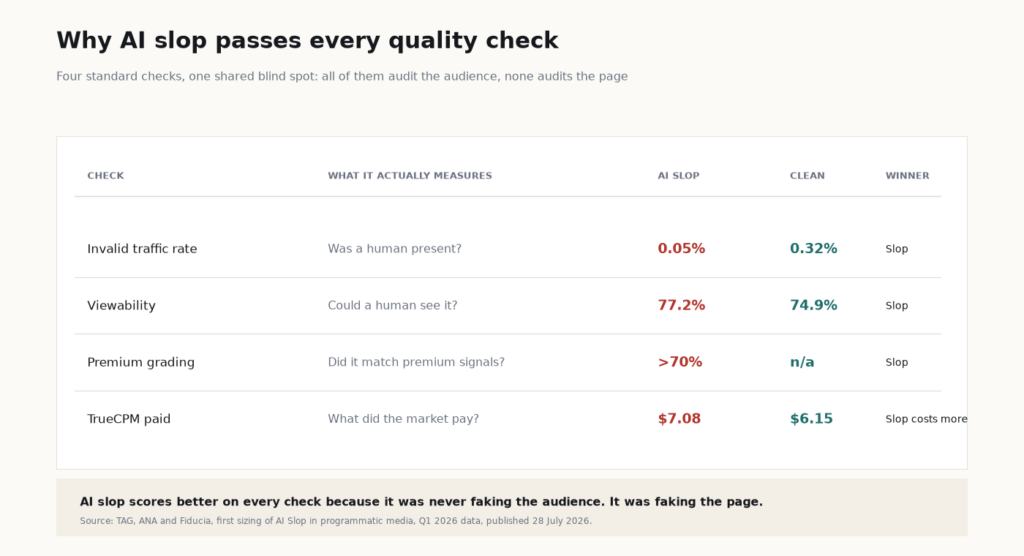
The scoreboard, inverted
TAG, working with the ANA and Fiducia, published the first statistically rigorous sizing of what the industry has started calling AI slop — content generated to harvest ad revenue rather than to be read. In Q1 2026 data it accounted for 1.3% to 2.4% of open web programmatic spend, against an MFA level of 1.1%. Small enough to dismiss.
Then look at how it scored. Invalid traffic rate of 0.05%, versus 0.32% for clean inventory. Viewability 77.2%, versus 74.9%. Graded premium more than 70% of the time. And it commanded a higher price than legitimate supply: a TrueCPM of $7.08 against $6.15.
Why the inversion happens
Three mechanisms do most of the work.
Slop is engineered to be clean. The operator controls page weight, layout, ad density and load behaviour at the template level. Across 11,552 identified domains, 30.0% showed templated-site patterns versus 1.2% for clean inventory. Meanwhile a real publisher carries editorial, comment threads, consent walls, third-party embeds and a video player that stalls. Slop is spotless the way an empty room is spotless.
Real humans generate suspicious noise. Legitimate audiences leave tabs open, scroll erratically, run ad blockers, bounce. That messiness reads to a fraud model as anomaly. A synthetic page whose only visitors are controlled, on-pattern and predictable reads as quality.
The pricing loop is closed. Premium grading is partly derived from viewability and invalid traffic. Slop scores well on both, so it grades premium, so it clears higher buying floors, so it gets bought, so it earns a higher TrueCPM. The scoreboard becomes the price.
The regulator found the same hole
In October 2025 the Media Rating Council ruled that domain-level, keyword-based verification could no longer be marketed as brand safety without measuring the actual images, video and audio inside the content, with a transition period running to roughly April 2026.
Read that as the same admission in regulatory language: we were classifying the URL, not reading the page.
The part nobody wants to sign
Here’s where it stops being an industry problem and becomes a Tuesday. When you finally locate slop in your buy, it is frequently the inventory that was hitting its delivery goal at the lowest cost. Cutting it raises your CPM and lowers your reported reach in the same report. Someone has to put their name on that trade.
That signature is the actual bottleneck. Not detection.
The check nobody runs
Add one metric to the panel: does this page have a reason to exist that isn’t advertising? Templated rate, authorship signals, page-level content reading. Verify the page, not just the people allegedly on it.