Digital Made Everyone Reachable. It Also Made Nobody Memorable.
For a decade, the smart money said in-person events were a legacy line item — too expensive, too hard to measure, too unscalable next to the cheap, trackable machinery of digital. Then the pandemic took the rooms away, and everybody discovered what they had actually been buying all along: the handshake. Not the badge scan. The handshake.
Events came back. But not as a nostalgia act, and not as the same trade show your predecessor booked in 2015. They came back leaner, smaller, wired into the CRM, and — crucially — as one of the few remaining channels where a buyer cannot scroll past you. This is the story of how a channel got written off, proven indispensable by its absence, and rebuilt on different terms.
1. The obituary that was written too early
Let’s be fair to the people who wrote events off. Their case wasn’t stupid.
Throughout the 2010s, digital channels got cheaper, faster, and — most importantly — attributable. You could trace a click to a form to a deal. An event gave you a lanyard, a stack of business cards, and a vague feeling that good things had happened. When the CFO asked what the booth returned, the honest answer was often a shrug dressed up as a slide.
So events lost the budget argument. Not because they didn’t work, but because they couldn’t prove they worked in the currency the era demanded. The industry’s own numbers still carry the scar: the Center for Exhibition Industry Research (CEIR), the research arm of IAEE, worked with Tourism Economics, an Oxford Economics company, to build its index — and by the fourth quarter of 2025 the composite sat about 2% below its 2019 level, with real, inflation-adjusted revenue more than 10% below. Only four of the fourteen sectors CEIR tracks had beaten 2019. The recovery was real. It was also lopsided.
What “too expensive, too hard to measure” actually meant
Both complaints were true. They were also both solvable. The expense was never a secret — it’s the reason events work. You pay for scarcity. A hotel ballroom, a plane ticket, three days out of a buyer’s calendar: those are expensive precisely because they’re not free, and things that aren’t free filter for people who care.
And the measurement problem? That was a tooling problem wearing a philosophy costume. It got fixed. We’ll come back to that.
2. What the pandemic proved by subtraction
Here’s the strange gift of 2020. When every event went online, marketers ran a controlled experiment nobody wanted and everybody needed.
The results were not a wash. Academic work has since put numbers on it. A study published in PNAS Nexus by Zajdela and colleagues, drawing on nine conferences and more than 12,000 pairs of would-be collaborators, found something precise and useful: formal interaction — the scheduled breakout, the assigned group — did more of the work in virtual settings, while informal interaction carried far more weight in person. Read that again. The thing that makes a conference a conference isn’t the keynote. It’s the corridor.
When the corridors disappeared, so did the collaborations, the serendipity, the accidental introductions that later turn into partnerships. Marketers felt the loss in their pipeline before they could name it.
3. The receipts: what the data actually shows in 2026
Let’s replace the anecdote with arithmetic.
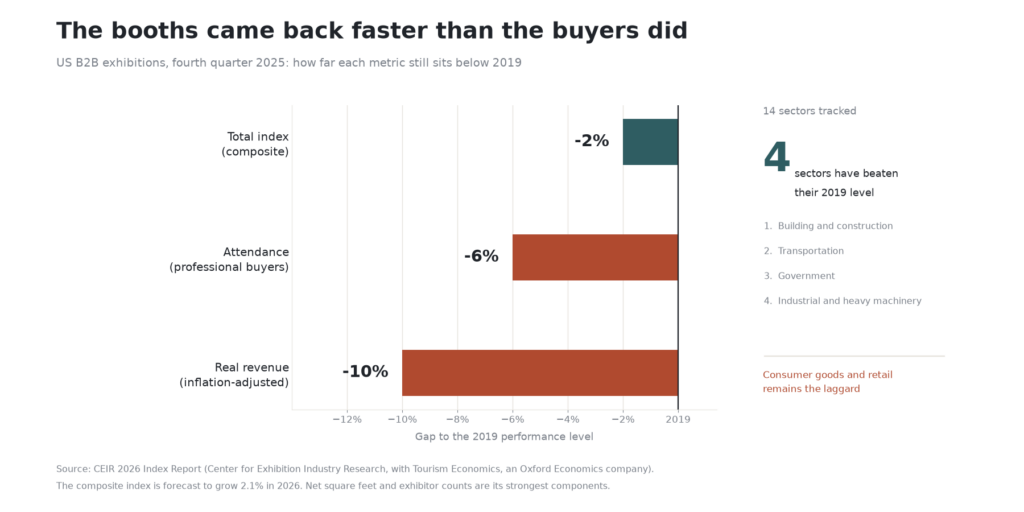
That chart is the whole argument in one image. Floor space came back. Exhibitor counts came back. Attendance didn’t — it’s still roughly 6% below 2019, and real revenue is further behind still. The booths returned before the buyers did. CEIR’s own forecast has the composite index growing 2.1% in 2026, which is not a boom. It’s a grind.
A $30 billion line item that never left
Now put that next to the spending. CEIR’s 2026 Marketing Spend Decision Report, a survey of 362 B2B exhibitors fielded in late 2025, found exhibitions taking 40.8% of exhibitors’ total marketing budgets — the single largest channel, larger than any digital line. Nearly half (47%) planned to exhibit at the same number of shows in 2026; 28% planned to add shows; 83% intended to keep their booth the same size.
And “How the Exhibit Dollar Is Spent 2026” pegs direct exhibitor spending in the US at about $30 billion, with exhibit space itself eating 40.5% of the budget — up from 37.9% in 2017. So the money didn’t leave. It got more concentrated on the floor.
Zoom out and the sector is genuinely large: the Events Industry Council, working with Oxford Economics, counted 1.65 billion participants worldwide in 2025 and $1.3 trillion in direct spending, 12.2% above 2019 levels, supporting 24.2 million jobs and contributing $1.8 trillion to global GDP. That study surveyed 1,605 organisers, venues and suppliers — skewed heavily North American at 86%, so treat the global figures as directional. But directionally, this is not a dying industry. It’s a $1.3 trillion one.
4. Why the second act is different
So events survived. Fine. Why are they strategically interesting now, in a way they weren’t in 2014?
Driver one: digital saturation made presence scarce
Every brand you compete with has a content team, a paid social budget, and an AI that writes their emails. The result is a wall of competent, forgettable material. When everything is digital, digital stops being a differentiator and becomes wallpaper.
A real room is now the scarce thing. That’s an inversion worth noticing.
Driver two: trust migrated inward, and rooms are where it gets built
Edelman’s 2026 Trust Barometer — 33,938 respondents across 28 countries, its 26th edition — found roughly 70% of people now hold what the firm calls an insular trust mindset: hesitant to trust those who hold different views, values or backgrounds. Trust has retreated to close circles.
Guess where close circles get made.
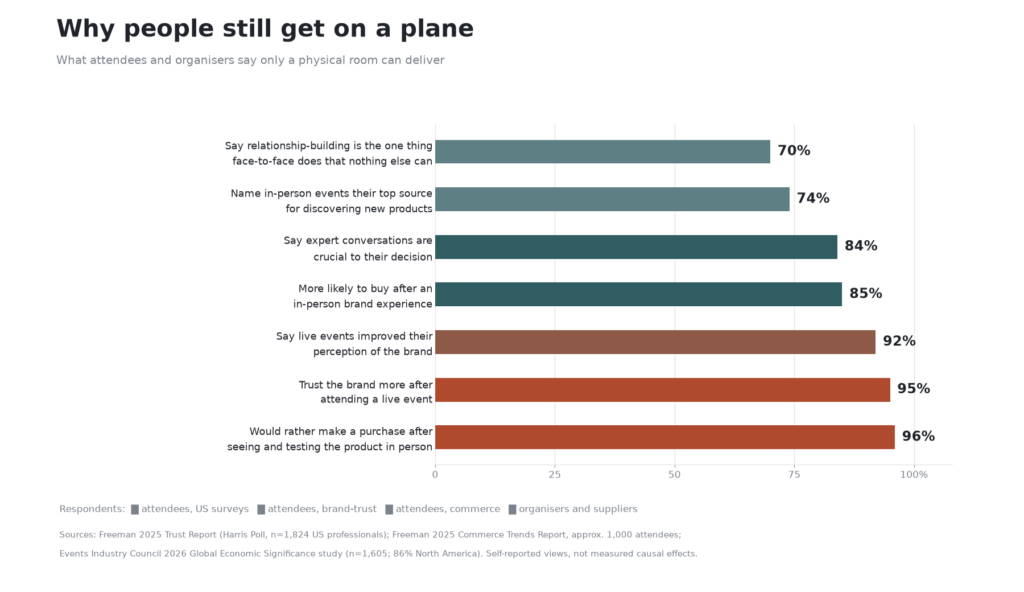
The Events Industry Council’s survey found 70% of respondents naming relationship-building through face-to-face interaction as the single outcome hardest to replicate by any other means. Another 12% pointed at community, trust and emotional engagement. On the brand side, Freeman’s 2025 Trust Report — fielded by The Harris Poll among 1,824 US professionals — found 95% trusted a brand more after an in-person event, 92% said live events improved their perception, and 85% said they were more likely to buy. Self-reported, retrospective, vendor-commissioned. Read it as sentiment, not as a measured sales lift. But the sentiment is remarkably consistent across every independent survey in the category.
Driver three: the measurement gap finally closed enough
This is the underrated part of the story. Events didn’t come back because marketers got romantic. They came back because events became defensible.
Forrester’s Q1 2026 State of B2B Events Survey — 417 event decision-makers globally, fielded January to February 2026 — found two-thirds of organisations have now wired their primary event platform into the wider sales and marketing stack, a 44% jump year on year. And here’s the payoff: 62% of organisations with a deep integration say they’re satisfied with event performance, against 37% of those without one. Same channel. Different plumbing. Different verdict.
Bizzabo’s 2026 benchmark work tells the same story from the other end: organisers who say proving event ROI is difficult fell from 70% in 2025 to 40% in 2026. That’s not because events got better. It’s because the data finally arrived.
Driver four: AI became the front door
Here’s the twist nobody put in the 2019 strategy deck.
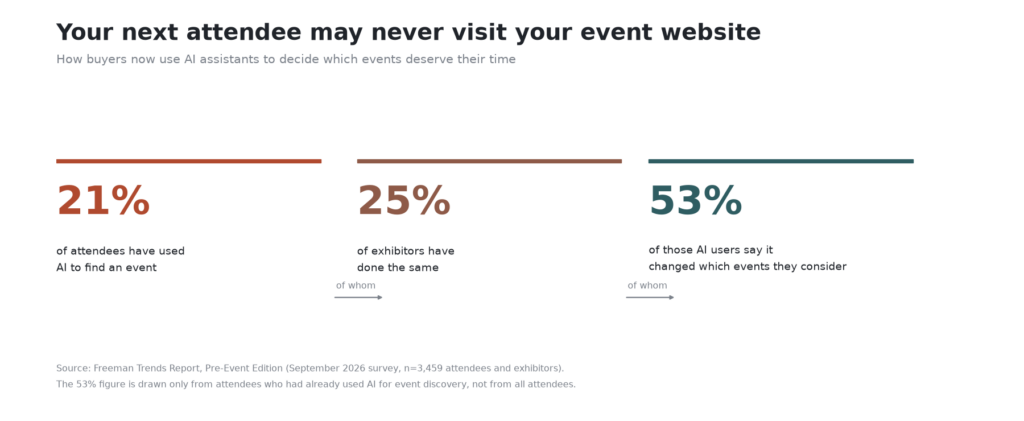
Freeman’s September 2026 pre-event research, covering 3,459 attendees and exhibitors, found 21% of attendees and 25% of exhibitors have already used an AI assistant to find events to attend. Among those attendees, 53% said AI changed which events they consider worth their time.
Sit with that. Your prospective attendee’s first touchpoint may now be a language model summarising your event — or, worse, summarising a stale page and concluding you cancelled. One organiser in Freeman’s research discovered exactly that: an AI had decided a relocated event no longer existed. It very much did.
Which means event marketing now has a generative-engine-optimisation problem, and most event websites — rebuilt on a fresh URL every year, with last year’s pages deleted — are structurally hostile to it.
5. The new playbook: five moves that define the second act
The old playbook optimised for footfall. The new one optimises for consequence.
Move 1: fewer events, better ones
Forrester found nearly 70% of organisations cutting the number of events they run while explicitly protecting the attendee experience. Only 18% planned more large hosted events; the growth is in intimate formats and sub-200-person gatherings. Bizzabo’s platform data shows the same: 40% of organisers planned more events in 2026, down from 66% a year earlier.
One event leader quoted by Forrester put it perfectly: “We’ll do fewer events, but if we’re in, we’re in.” That’s not retreat. That’s portfolio discipline.
Move 2: capture intent, not badges
The badge scan was always a lie about intent — it recorded proximity, not interest. The replacement is engagement data wired into the CRM in something close to real time: which session, how long, which demo, which question. Cvent’s research with Censuswide (901 marketers and event professionals) found 81% reporting audience trust increased after an in-person event; the teams that can show that in their pipeline are the ones whose budget survives the next review.
Move 3: treat the event as a production day, not a party
A single well-planned general session can yield a recap film, a dozen vertical clips, three executive soundbites, a sales-enablement video, and a photo library that outlives the campaign. Most teams capture a fraction of that because content capture gets planned after the experience is designed, not alongside it.
Design the content plan before the shot list. Name the owner before the event, not after. Otherwise the footage sits on a shared drive until it’s worthless.
Move 4: programme for what digital can’t do
Freeman’s commerce research found 84% of attendees saying expert conversations are crucial, and 96% saying that touching or testing a product makes them more confident advocating for it internally. Nearly one in four said their most important event offered no hands-on exposure at all — and 42% of those deprioritised the vendor because of it.
The rule writes itself: if you could do it on Zoom, don’t do it in the room.
Move 5: choose hybrid deliberately, or don’t choose it
Bizzabo’s platform data is blunt about this: 63% of events are in person, 33% virtual, 4% hybrid. Hybrid is not the default. It’s a specific tool for specific goals — and a livestream bolted onto a conference serves neither audience well. Meanwhile Forrester found virtual events genuinely rebounding, with the share of organisations planning more of them doubling year on year. The point isn’t hybrid. The point is choosing.
6. Where events win — and where they don’t
Be honest about the fit.
They win in B2B and high-consideration sales, where trust is the product and the deal takes nine months. They win in product categories that need hands, eyes and a demo. They win in community-led growth, where the event is the community’s annual physical form — and where the content engine keeps it alive the other 51 weeks.
They lose in mass-market, low-consideration consumer marketing, where reach and scale dominate and the unit economics never work. They lose when the only success criterion is same-quarter attributed revenue, because events pay back late. And they lose when nobody owns the follow-up — because an event without follow-up is just an expensive party with name tags.
7. The honest caveats
The cost squeeze is real
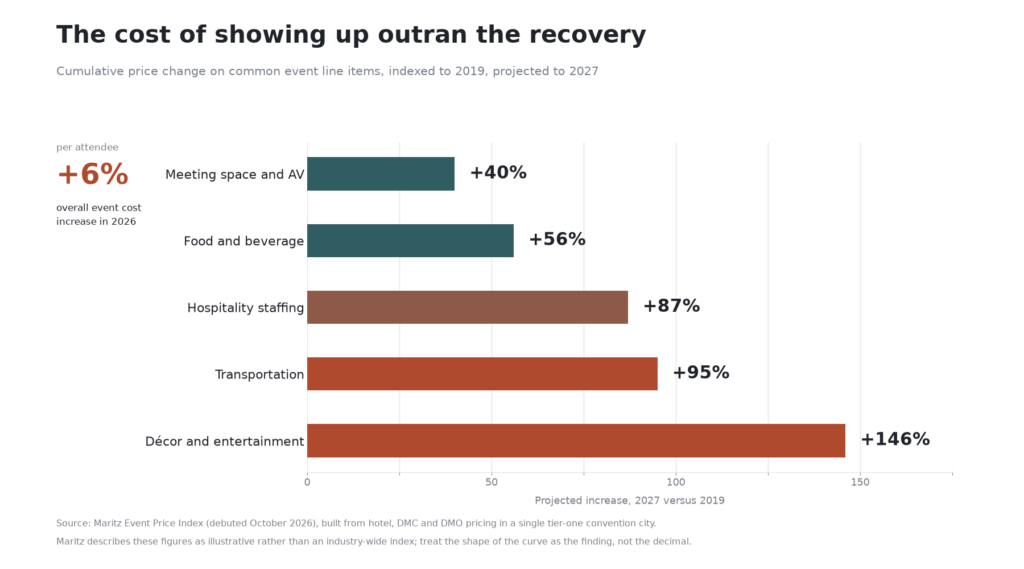
Maritz debuted its Event Price Index in October 2026, built from hotel, DMC and destination-marketing pricing in a single tier-one convention city. Projected 2027 versus 2019: décor and entertainment +146%, transportation +95%, hospitality staffing +87%, food and beverage +56%, meeting space and AV +40%. Overall per-attendee cost up about 6% in 2026 alone.
Maritz is careful to call these illustrative rather than an industry-wide index — one city, common inclusions. So don’t quote the decimals. Quote the shape: costs roughly doubled while attendance fell 6%. That’s the squeeze every field marketer is actually managing.
Hybrid done badly is worse than either format
A stream with no moderator, no chat, no reason to stay, and no separate agenda for the remote audience. If your virtual attendees are watching television, they’ll change the channel.
Event fatigue is coming back
When everyone re-invests at once, the calendar fills. The old disease — too many events, too few buyers — returns politely, and attendance spreads thinner across more dates.
Measurement improved. It isn’t solved.
Two-thirds of budgets are still flat or declining (Forrester). The share of organisations saying events perform well hovers around half, while only 38% of CMOs agree — an executive-level misalignment that no dashboard fixes. And a meaningful minority of teams still can’t connect event data to revenue at all.
8. What to do next quarter
Four things, in order.
Audit your event portfolio against consequence, not tradition. Rank every event by pipeline influence at 90, 180 and 365 days, not by badge count. Retire the ones that can’t clear the bar. You’ll cut more than you expect, and nobody will miss them.
Fix the plumbing before you fix the creative. If your event platform isn’t connected to your CRM, everything else is decoration. The 62%-versus-37% satisfaction gap is the cheapest performance upgrade available to you.
Ask an AI what it knows about your event. Then fix what it gets wrong. Structured pages, stable URLs, machine-readable dates and speaker lists, and never delete last year’s page — redirect it.
Design the content plan in the same meeting as the experience. Same room, same whiteboard, same owner. Otherwise you’ll spend six figures building a moment nobody captures.
The takeaway
Events didn’t die. They went quiet while the market over-rotated toward digital, and then came back the moment their value was proven — not by a campaign, but by subtraction.
The second act isn’t a return to the old trade show. It’s a leaner discipline: fewer rooms, better rooms, wired into the CRM, designed for what a screen can’t do, and captured so the value keeps paying out after the carpet is rolled up. It wins for a simple, slightly uncomfortable reason. In a world where every brand can reach everyone, constantly, and almost nothing is scarce anymore — a real handshake is.