The Incentive Behind the 7%: Why Chatbots Are Rewarded for Closing, Not Solving
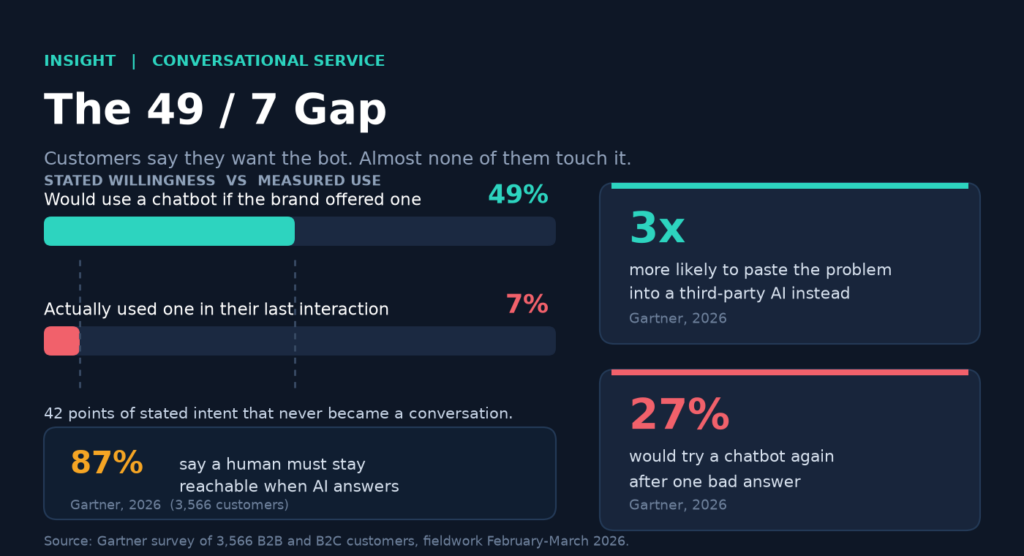
Ask 3,566 customers whether they would use a chatbot if a company offered one and 49% say yes. Then Gartner checked what those same people actually did during their most recent service interaction. Seven percent used one.
Forty-two points of stated intent, evaporating before the first message was typed. That gap is the most useful number in customer service right now, and it is not a measure of demand. It is a verdict on design.
So why. Four mechanisms, and none of them is “the technology isn’t good enough yet”.
The bot is a form wearing a chat bubble. The customer arrives mid-sentence, holding a photo of a cracked jar and one specific grievance. The bot’s first move is to request an order number. It is built around the company’s data schema, not the customer’s story, so the first thirty seconds are spent translating a human problem into an internal ticket.
Memory is asymmetrical. The assistant in the next tab remembers yesterday. The brand’s bot forgets the moment the session ends, so the customer re-explains a problem they have already explained twice. Roughly three times as many customers paste their issue into a third-party generative tool as into the brand’s own assistant.
The success metric points backwards. Deflection. A conversation that ends without a human counts as a win, even when the customer walks away unresolved. Teams get recognised for closing threads at ninety seconds, not for fixing the thing that caused the thread. Optimise for closure and you will get closure, including the kind where the customer closes the tab.
Risk asymmetry finishes the job. Only 27% of customers would try a chatbot again after one bad answer. Faced with that, every sensible team tightens the guardrails: fewer permitted topics, more verification steps, more polite hand-offs. Each constraint lowers the odds of a wrong answer and lowers the odds of a right one at the same time.
What you end up with is a channel that is technically capable and institutionally unwilling. Gartner projects agentic AI will autonomously resolve about 80% of common service issues by 2029. The recorded baseline today is 14% of issues fully resolved in self-service. The model was never the bottleneck. The mandate is.
Four changes move the number: an open field instead of a menu tree; memory that survives the session; permission to say “I don’t know, here is a person” in one turn rather than four; and a dashboard that counts a problem still solved at seven days, not a conversation closed at ninety seconds.
Seven percent is not a rejection of AI. It is a rejection of what we asked the bot to optimise for.