Your Next Customer Has No Eyes, Only Criteria
Something quietly decisive happened to online retail this year, and almost nobody wrote the headline correctly.
For two years the story was that AI assistants would become stores. You would ask, it would answer, and the answer would end in a receipt. Investors modelled it, merchants feared it, and a thousand conference slides promised that the checkout button was moving into a chat window.
Then the checkout button mostly moved back out.
OpenAI launched in-chat purchasing in late 2025, then spent early 2026 walking it back toward something narrower: discovery inside the assistant, payment on the merchant’s own rails. Google built an entire shopping protocol whose central promise is that the brand stays the merchant of record. Amazon sued to keep outside agents off its catalogue and blocked a rival’s assistant outright. The assistant, it turns out, is a magnificent shortlist and a mediocre cashier.
So the real shift is not that machines now buy things for us. It is that machines now decide what we are allowed to consider — and that decision happens earlier, cheaper, and far more invisibly than the moment of payment. Which raises the question every brand should be sitting with: if an agent narrows the world down to five options before you ever appear, what exactly have you been optimising for?
The forecast is enormous. The floor is where you actually stand.
Start with the numbers everyone quotes, because they are real and they are also routinely misread.
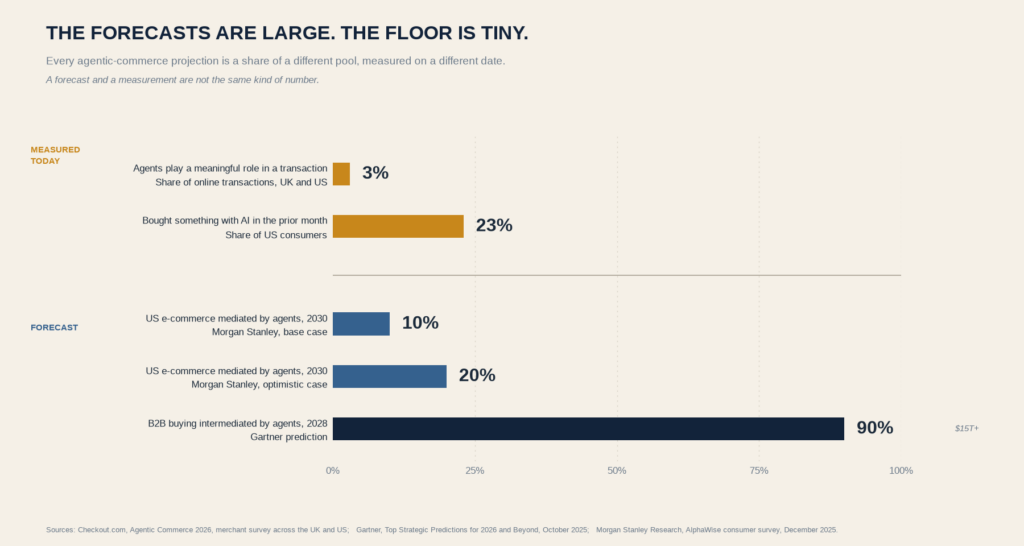
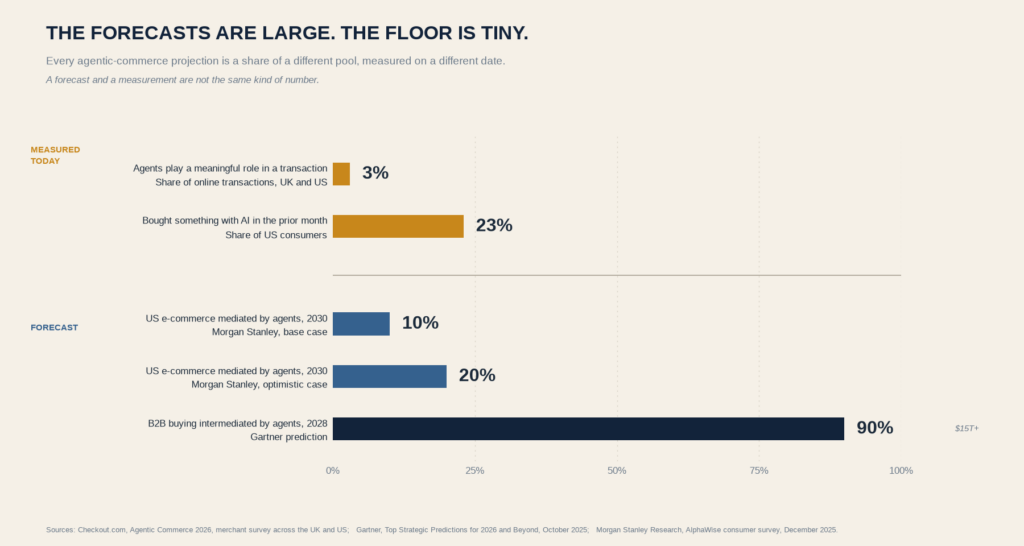
Morgan Stanley Research puts agent-mediated US e-commerce at somewhere between $190 billion and $385 billion by 2030 — call it 10% to 20% of the market. McKinsey sizes the global opportunity at $3 trillion to $5 trillion. Gartner’s headline is the loudest of all: by 2028, 90% of B2B buying will be intermediated by AI agents, moving more than $15 trillion.
Those are three different pools measured on three different dates. B2B purchasing is not consumer carts. Global goods are not US retail. A 2028 share is not a 2030 share. Stack them in one chart and you get a picture that flatters everybody and informs nobody.
Now put the measurements beside them.
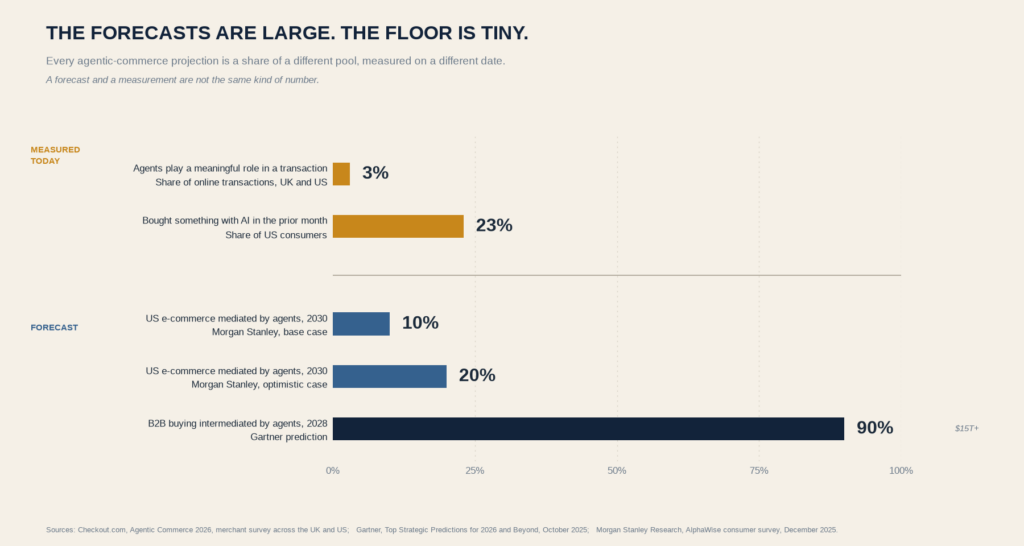
Merchants surveyed across the UK and US estimate that agents play a meaningful role in product selection and checkout in roughly 3% of online transactions today. In the same survey, 85% expected agentic commerce to drive at least a tenth of their volume within two years. Three percent is not nothing. It is also not a channel yet.
The consumer side is further along than the transaction side, which is the single most useful thing to understand about this moment. Morgan Stanley’s AlphaWise survey found that about 23% of Americans had already bought something using AI in the previous month. Adobe measured AI-referred traffic to US retail sites up 71% year over year in September 2026, after a 693% surge across the 2025 holiday season. People are using the machines to shop. The machines are just not closing the sale themselves.
That asymmetry — decisions moving fast, transactions moving slow — is where the money is, and where most marketing plans are pointed at the wrong thing.
What agentic commerce actually is, once you strip the hype
Strip away the vendor decks and you get a clean definition. Agentic commerce is what happens when software stops suggesting and starts executing: researching, filtering, comparing, and sometimes paying, against criteria a human set and then stopped supervising.
The useful way to picture it is a staircase, and McKinsey’s version of that staircase is the clearest one available. At the bottom, the agent answers questions. One step up, it filters and shortlists. Higher still, it acts inside a budget you approved. Near the top, it holds a standing goal — keep the household essentials under a set amount each month, never run out of baby formula, preserve an airline status at the lowest total cost across a year — and quietly manages your life against it. At the very top, agents negotiate with other agents, and procurement becomes a background service rather than a department.
Most brands are building for step two and planning for step four. Almost nobody has priced step three.
The reason this matters commercially is that each step changes what a brand is for. At the shortlist stage, you need to be parseable. At the standing-goal stage, you need to be predictable — the agent is not choosing you once, it is choosing you repeatedly, and it will drop you the first time a substitution goes wrong. Reliability stops being a customer-service metric and becomes a distribution channel.
The buyer of record is changing, and it is not who you think
Here is the part that unsettles marketing teams most. In an agent-mediated purchase, the entity that decides is not the entity that pays, and neither is necessarily the entity you have been advertising to.
There are at least three distinct buyers now. A consumer’s personal agent, acting on stated preferences. A company’s procurement agent, acting on specs and terms. And a platform agent — the assistant inside a search engine or retailer — acting on whatever query it was handed. All three read your data. None of them watch your brand film.
Which purchase types go first is no longer a matter of taste; it is settled by economics. Delegation accelerates wherever shopping is a chore with a verifiable outcome: groceries, consumables, refills, subscriptions, replacement parts, routine travel. McKinsey calls these low-regret purchases, and the phrase is doing real work — the buyer does not need to feel good about the choice, only to be confident it was not a mistake.
Delegation plateaus wherever the purchase is the point. Luxury, gifts, anything carrying identity. McKinsey’s luxury research found consumers expect 39% of their luxury purchases to be agent-mediated by 2030 — a striking number that still leaves the majority human — while luxury merchants expected 47% of interactions to be mediated. Note the gap: the industry expects to be automated faster than its customers intend to automate it. That gap is a pricing opportunity for anyone who reads it correctly, and a discount spiral for anyone who does not.
Five protocols, one wall, and a retreat nobody priced in
If you want to know how a market really feels, watch where the plumbing goes.
Google announced its Universal Commerce Protocol at the National Retail Federation in January 2026, co-developed with Shopify, Etsy, Wayfair, Target and Walmart, and endorsed by a coalition that reads like a payments-industry roll call — Adyen, American Express, Best Buy, Mastercard, Stripe, Visa, Zalando. At I/O in May it added a Universal Cart that spans Search, Gemini, YouTube and Gmail, checks compatibility, surfaces price history, and then — this is the detail that matters — lets the shopper either check out with Google Pay or hand the basket back to the merchant. Brands remain the merchant of record.
OpenAI took the narrower road: the Agentic Commerce Protocol, built with Stripe, open-sourced under Apache 2.0, with a checkout spec in which the merchant keeps its own payment processor, its own risk checks, its own order record. Then, in March 2026, OpenAI scaled the in-chat checkout experience back and pushed toward product discovery with merchant-led completion.
Read those two moves together and a pattern appears. The assistants did not win the checkout. They withdrew from it, and the merchants kept it.
Forrester’s Emily Pfeiffer put the number of Shopify merchants actually transacting through in-chat checkout at roughly thirty as of February 2026, against a public pipeline routinely described as over a million. Thirty. That is not a channel; that is a pilot with good PR.
Meanwhile Amazon went the other way entirely, blocking Meta’s Muse shopping agent in September 2026 and litigating against Perplexity’s browser, arguing that an agent acting for a user is not the same as the user acting. The company earned roughly $69 billion from advertising in 2025, most of it from placements that require human eyes on a page. An agent that reads the catalogue and skips the ads is an existential line item, whether or not it ever completes a purchase.
So the market has split into three postures: hosts who opened their catalogues, browsers who allow agents to look but not buy, and gatekeepers who shut the door. Which posture a retailer picks tells you more about its revenue mix than about its technology opinions.
The gate that actually decides your quarter
Now the uncomfortable part, and the reason this article exists.
Adobe scored the machine readability of US retail sites and found a pattern so perverse it deserves a name. Homepages scored 75%. Category pages scored 74%. Product pages — the only pages that carry the price, the variant, the stock status, the shipping terms, the return window, the reviews — scored 66%. The page that decides the comparison is the page an agent is least able to read.
The detail is worse than the average. Only 5% of sites state shipping terms in a machine-readable way. Only 4% state return terms. Those are the two facts buyers weigh most heavily when a substitute is on the table, and almost nobody publishes them in a form anything but a human can interpret.
Mirakl’s analysis of 427 product pages across 35 countries found the average page scoring 48 out of 100 on agent readiness. Exactly one page cleared 80. Reviews, ratings and Q&A — the social proof a language model leans on hardest — scored 22% of their potential, and more than a third of pages carried none at all.
The asymmetry cuts both ways, which is why this is a genuine strategic window rather than a compliance chore. Adobe’s data shows AI-referred visitors generating 83% more revenue per visit and converting 90% better than everyone else. That was not true a year earlier; in 2025 those same visitors converted worse. Something flipped, and the flip is about trust: once a shopper has let a model do the comparing, they arrive pre-sold.
The economics are brutal in the simplest possible way. An agent that cannot confirm you are in stock cannot recommend you. Presenc AI’s benchmarking found brands with complete schema and an exposed data endpoint were successfully extracted 94% of the time; brands serving plain HTML were extracted 23% of the time. The shortlist follows extraction almost mechanically.
Why product pages are the hardest page to fix
Here is the insight most playbooks miss, and it is the difference between a quarter of wasted effort and a real advantage.
Schema markup is downstream of recorded data. You cannot mark up a fact you do not have.
Most retailer critiques of product pages focus on prose: too much story, not enough spec. That is backwards. The richer your product copy, the larger the gap between what you have said and what a structured consumer can use — because the distinguishing detail was written as a sentence, and a sentence is invisible to a filter. Your best copywriter has been producing your worst machine-readable data for years, with your encouragement.
Which inverts the usual order of work. The instinct is to ship JSON-LD and declare victory. But markup only formalises the fields you already hold. If your category turns on a constraint you never recorded — the actual fabric weight, the true compatibility, the real lead time — schema will faithfully publish your ignorance.
So the sequence is: find the constraints a buyer in your category actually filters on, not the fields you happen to have; check which of those exist as values rather than as sentences; extract what is recoverable from copy you already publish; acquire what is missing entirely; and only then argue about markup. That is unglamorous, it lives with merchandising rather than with the content team, and it is where the advantage is currently sitting unclaimed.
The funnel did not disappear. It moved upstream.
Talk to a performance marketer and you will hear that funnels are dead. They are not. They have been relocated.
Four gates now stand between your brand and a person’s attention. The first is surfacing: can an agent reach you at all — crawlable pages, an accepted feed, a catalogue that is connected rather than merely published. The second is shortlisting: can it compare you against nine alternatives without guessing, which requires price, availability, variant, shipping and returns as values. The third is selection: does it choose you, on price position, fulfilment reliability and verified ratings. The fourth is confirmation: will the human sign off, on brand, reviews, guarantees, and a policy they can read in ten seconds.
Three of those four gates are machine-checkable. That is the genuinely new thing. Every drop-off is now measurable before a single impression is served to a human — which means the old argument about brand versus performance collapses into a simpler question: which gate are you losing at?
There is a measurement consequence most teams have not internalised. When 6sense finds buyers filling four of five shortlist places on day one and buying from that list 95% of the time, the decisive event happened in a session you cannot instrument. Your analytics will show a visit. It will not show the eleven brands that were eliminated before the visit existed.
The playbook, in five moves that survive scrutiny
Feed the machine before you feed the person. Structured, accurate, complete product data is the new creative. Not because creativity stopped working, but because it now works on a smaller share of the journey.
Publish trust as data, not as sentiment. Verified reviews in a structured format. Return windows as a value. Warranty terms as a value. A sustainability claim with a certificate an agent can locate and read. Mastercard’s own research makes the point bluntly: an agent looking for organic cotton or carbon-neutral delivery goes straight for the certificate, not the adjective.
Lower the cost of transacting with you. APIs for inventory, pricing and fulfilment. The agent prefers the path with least friction, and friction is a tax it will route around without a second thought. The protocol you support matters less than whether your data is legible to all of them.
Win the comparison, not the impression. The agent optimises against the criteria in the query. So know which attributes your category’s queries actually turn on, and be genuinely competitive there rather than merely present.
Keep the human confirmation loop. The people who sign off on high-stakes purchases are still people, and they still want reassurance. Forrester’s survey of nearly 18,000 business buyers found 94% used AI somewhere in their most recent purchase — and then went looking for a human, an analyst or a peer to validate what it said. One buyer in five came away less confident after the AI gave them something wrong. Gartner’s polling found 69% of buyers validating AI output with a sales rep.
Which is not a reason to relax. It is a reason to stop treating the sales conversation and the data feed as belonging to different departments.
Dual legibility is the only durable position
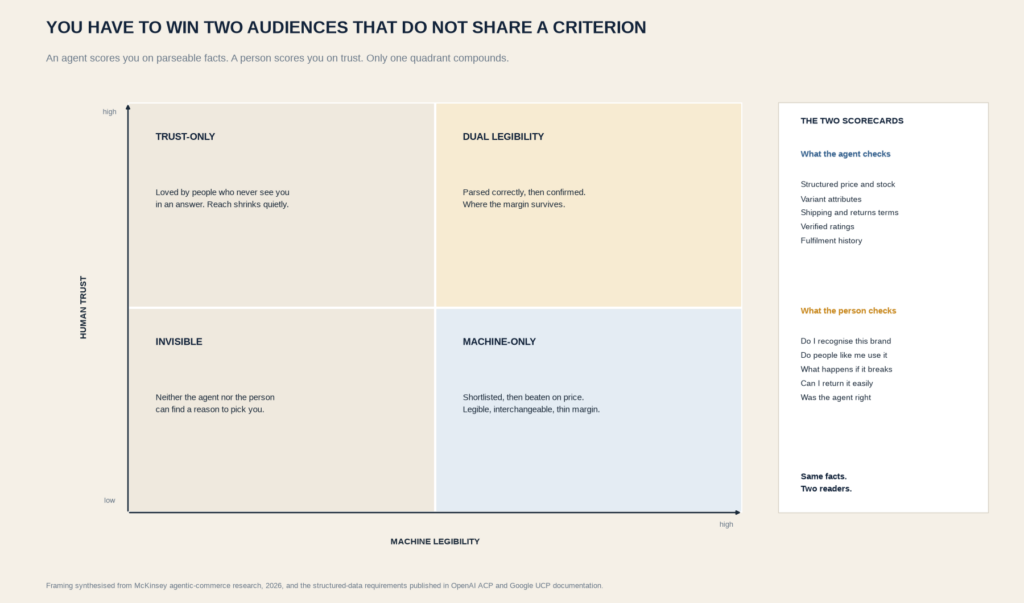
Put machine legibility on one axis and human trust on the other and the strategic options become embarrassingly clear.
Invisible: neither the agent nor the person finds a reason to choose you. Trust-only: loved by people who never see you in an answer, reach shrinking so gradually that it looks like a demand problem. Machine-only: shortlisted constantly, then beaten on price, legible and interchangeable and permanently thin-margined. Dual legibility: parsed correctly, then confirmed — the quadrant where margin survives.
The trap is assuming these are the same work. They are not, and they are not even read by the same reader. An agent checks price, stock, variant, shipping, returns, ratings, fulfilment history. A person checks whether they recognise the name, whether people like them use it, what happens when it breaks, and whether they can hand it back. Same facts, two scorecards, and you have to win both.
This is why the lazy version of agentic commerce strategy fails. Stuffing schema into a store nobody trusts produces the machine-only quadrant: maximum exposure to comparison, zero protection from it. Commoditisation is not a risk of agentic commerce. It is the default outcome for anyone who does half the work.
What this does to the marketing organisation
Three structural things, and none of them are comfortable.
A machine-facing function emerges, sitting parallel to creative rather than beneath it: commercial data, taxonomy, feeds, API enablement, structured policy. Call it data operations or growth operations, the label matters less than the reporting line. If it reports to whoever owns the website rather than whoever owns demand, it will lose every budget fight it needs to win.
Creative’s job moves downstream. This is not a demotion. It is a re-targeting. Creative still decides whether the human confirms — that is the fourth gate, and it is the one gate machines cannot close. But it has stopped being the discovery engine.
Measurement has to grow a new first step. Impressions, then agent inclusion, then agent selection, then human confirmation, then purchase. The gate nobody tracks today — considered by an agent — is upstream of everything in the current dashboard, and it is currently a black box. Forrester’s buyers validate AI output against editorial sources, which means the citation layer and the trust layer are the same layer, and it is measurable if you decide to measure it.
The honest caveats
Three risks deserve more attention than they get.
Removing the human can remove the loyalty. An agent that re-optimises every purchase will commoditise you unless you have built signal it honours: reliability, verified quality, terms it can verify. The loyalty programme of the agentic era is not points. It is a track record an agent can read.
Manipulation is a regulatory lightning rod. Agents that nudge, steer, or quietly reorder options on the user’s behalf are precisely what regulators are circling. Google’s AP2 spec leans hard on tamper-proof digital mandates and an auditable trail; Mastercard is pushing a know-your-agent identity framework and expects several G20 governments to issue formal guidance on agent registration before 2030. Building a clever agent that shades the truth is building a lawsuit with a launch date.
Accuracy compounds in both directions. The machine acts on your data. A stale price is a wrong sale. A misleading claim is a legal exposure that executes itself at scale. And the broader trust problem is real: Adobe found only 38% of product pages priced and stocked correctly in structured data, and Cloudflare’s own numbers show AI crawlers at roughly 5% of all requests — small, but the fastest-growing traffic category on the internet.
And timing. Agentic commerce is genuinely here and genuinely uneven. Treating a 2028 forecast as a 2026 planning assumption will burn budget; treating an obvious trajectory as hype will cost you the shortlist. The discipline is to invest in the layer that pays today — legible data, verified trust, low-friction integration — and let the transaction layer arrive when merchants, not platforms, decide it should.
The purchase you will not see coming
Agentic commerce does not kill marketing. It relocates it.
When an agent completes a purchase, the ad you ran matters less than the data you published. The brand you built matters only at the confirmation step — where it becomes decisive, because near-equal shortlists are broken by trust and nothing else. The winning position is not a better campaign. It is being the machine’s obvious, low-friction, well-signalled choice and the human’s confident sign-off, at the same time, with the same facts.
Two readers. One catalogue. Get the facts right once and you can serve both. Get them wrong and you will not even find out — because the agent will simply have moved on before your analytics registered that anyone was shopping.