Sold Before You Searched: How AI Shopping Learned to Read Weakness
The same system that makes buying effortless can make it extractive. What separates the two is not the model. It is the line you draw around it — and in 2026, other people started drawing that line for you.
On 28 October 2026, the Federal Trade Commission sent sworn information demands to nine companies: Delta, United and JetBlue; Lyft and Uber; DoorDash and Instacart; Target and Walmart. Forty-five days to respond. The questions were blunt. Which categories of personal data feed your prices? Who built the model? How was it validated? What, exactly, have you told customers?
Read the order template and you notice something uncomfortable. It also covers gig workers — how offers get assigned, how pay gets set, which jobs never appear in a given driver’s app at all. The FTC is no longer asking whether algorithmic pricing exists. It is asking what it does to people.
That is the moment worth marking, and not because the agency can outlaw anything. It can’t, and its own policy statement says so out loud. The moment matters because nine boardrooms now have to write down, under oath, the thing their investor deck calls “personalisation.”
So let’s talk about what personalisation does when the guardrails are missing.
Four mechanics, one mechanism
Strip away the branding and the manipulative version of personal shopping runs on four engines. They are not exotic. Most of them are already in production somewhere in your category.
Inferred pricing. The same item, a different number, derived from what the system thinks you will pay. The FTC’s staff study found pricing intermediaries serving more than 250 retail clients, and found that inputs ranged from a shopper’s location and demographics down to mouse movement and the contents of an abandoned cart. One documented hypothetical: a customer profiled as a new parent gets shown higher-priced baby thermometers on the first page of results.
Randomised price tests. Shoppers are assigned by chance to different prices, and the seller learns what the market will bear, item by item. This is the engine that produced the scandal described in the next section.
Interface steering. Preselection. Invented scarcity. A fee that appears at checkout. A cancellation path built to be abandoned. The European Commission’s behavioural research found 97% of the most popular websites and apps used by EU consumers deployed at least one such pattern, with hidden information and false hierarchy the most common, followed by preselection, nagging, difficult cancellation and forced registration.
Vulnerability targeting. Note the wording carefully, because this is where most commentary gets sloppy. The documented practice is not mind-reading and it is not affect detection. It is inference from behaviour. A rushed parent. A bereaved traveller. Someone whose phone has no competitor’s app installed and therefore, plausibly, has nowhere else to go. Regulators now write these examples into the record themselves.
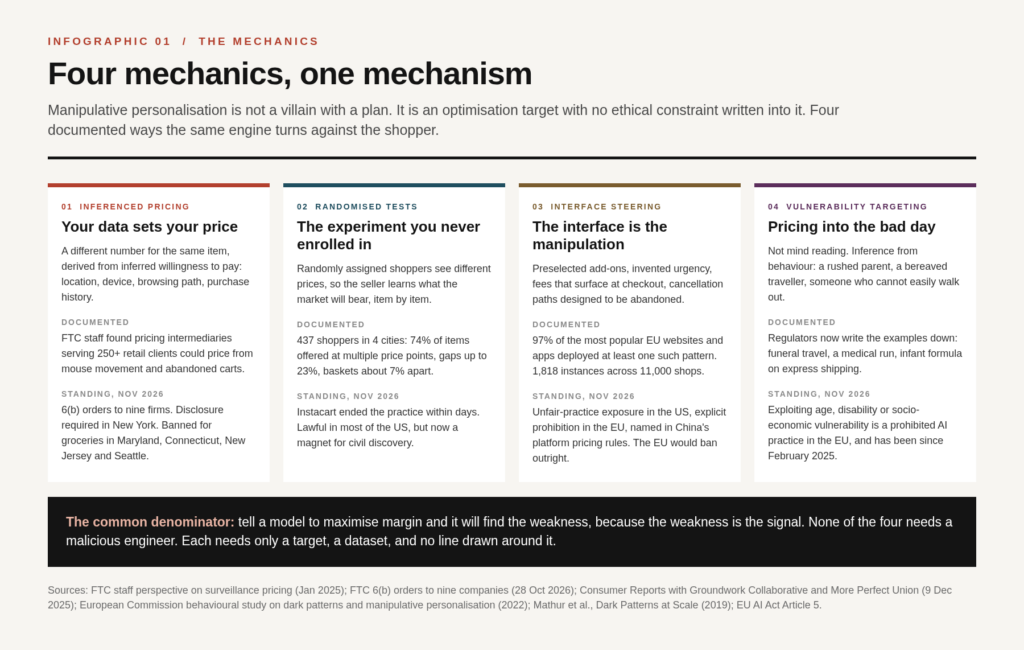
Here is the part that should worry you more than any single practice. None of these four requires a malicious engineer. Each requires a target, a dataset, and no line drawn around it. Tell a model to maximise margin and it will locate the weakness, because the weakness is the signal. That is not a bug in the technology. It is the technology working exactly as instructed.
The number that ended the argument
In December 2025, Consumer Reports, working with Groundwork Collaborative and More Perfect Union, ran a live test with 437 shoppers across four US cities. Same stores. Same items. Same moment.
Almost three in four grocery items were offered at more than one price. Between two shoppers looking at one identical item, the widest gap reached 23%. Basket totals for the same list diverged by about 7% on average, which the researchers extrapolated to roughly $1,200 a year for a family of four. Within days, the company at the centre of it ended the practice; within a week, a civil investigative demand had arrived.
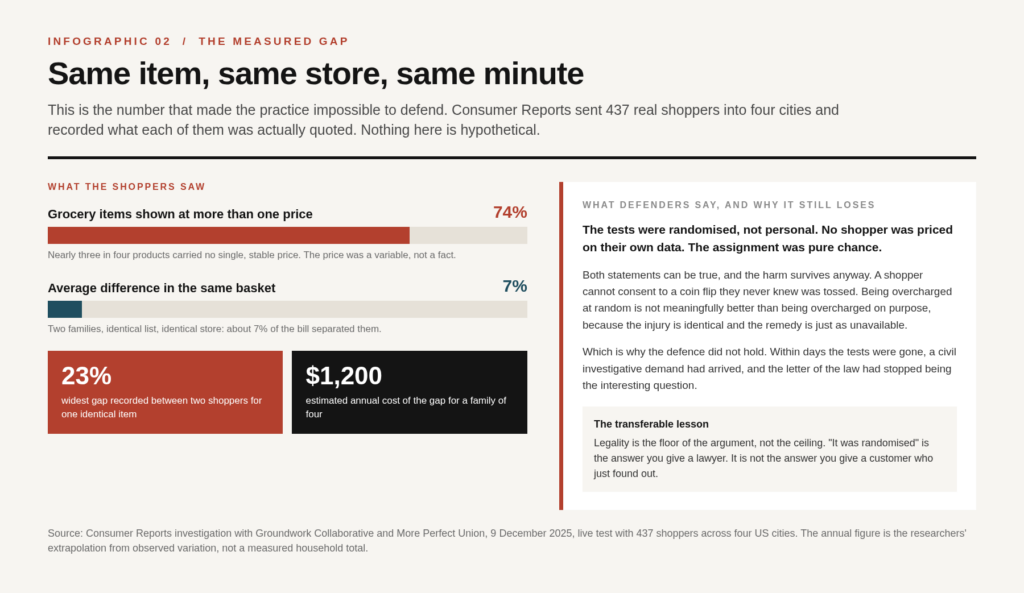
Now, the defence deserves a fair hearing, because it was not stupid. The tests were randomised. Shoppers were not being priced on their own browsing history. The assignment was chance, not inference. Both of those statements appear to be true.
And the harm survives them anyway. A shopper cannot meaningfully consent to a coin flip she never knew was being tossed. Being overcharged at random isn’t a gentler version of being overcharged on purpose — the injury is the same, and so is the remedy: none. When the Wall Street Journal and others went looking, they found the tell in the fine print. The vendor’s own product page conceded that some shoppers “may see slightly higher prices.” Slightly. At 23%, “slightly” is doing a lot of work.
Which is why the letter of the law stopped being the interesting question. Legality is the floor of this argument, not the ceiling. “It was randomised” is the answer you give a lawyer. It is not the answer you give a customer who just found out.
Why the incentive is not malice
It would be comforting if this were a story about bad actors. It isn’t. It’s a story about a dashboard.
Exploitative personalisation works in the short term. Price discrimination and scarcity nudges lift conversion and revenue per user, measurably, this quarter. Trust does not appear on that same report. Nobody files a variance note explaining that the retention gain was purchased with a reputational loan.
So the machinery selects for the dark nudge without anyone deciding to be dark. If your category defaults to it, the honest operator looks suboptimal on the spreadsheet, and the spreadsheet is what gets reviewed on Thursday. That is the whole trap. Not villainy — accounting.
The cost lands somewhere else. On the balance sheet of trust, where it compounds in the wrong direction and doesn’t show up until the quarter when it does.
Where the harm actually lives
Here’s a detail worth sitting with. The gap that does the damage isn’t the 23%. It’s the 7%.
A 7% difference on a grocery basket sounds like noise. It isn’t, for three reasons. It recurs weekly, so it compounds. It lands on essentials, which have no discretionary fat to absorb it. And it is invisible, which means the shopper cannot adapt — cannot switch, cannot negotiate, cannot even know to be annoyed. The injury of opaque pricing is not only the money. It’s the removal of agency from someone who thought they were comparing prices in a market.
There’s also a finding from the behavioural literature that should stop any marketer mid-sentence. In a set of six studies with nearly 4,000 participants, researchers tested whether consumers would accept differential pricing when it helped people — a discount for low-income shoppers. A substantial share of consumers paid real money to switch away from the store that offered it. Read that again. Consumers don’t merely dislike being charged more. They dislike being sorted.
Which tells you something that no amount of clever discount design will fix: the objection is to the sorting, not to the direction. If your personalisation strategy depends on customers being comfortable with being categorised, you are building on ground that isn’t there.
Eighteen months, one direction
The regulatory story is usually told badly — either as “nothing has happened” or as “everything is banned.” Neither is true. What actually happened is a very fast, very uneven convergence.
New York went first with disclosure: since November 2025, an algorithmic price built on personal data must carry the notice that it was set that way. Maryland then banned the practice outright for large food retailers, effective October 2026. Connecticut, New Jersey and Seattle follow in 2027, with Connecticut reaching all retail sellers and New Jersey reaching group pricing and personalised discounts, not just shelf prices. In China, a joint rule from three ministries took effect in April 2026 that bars undisclosed differential pricing built on willingness to pay, and requires dynamic pricing logic to be published. At EU level, the AI Act has treated exploitation of age, disability or socio-economic vulnerability as a prohibited practice since February 2025, and the proposed Digital Fairness Act would blacklist dark patterns outright and allow fines of up to 6% of worldwide turnover.
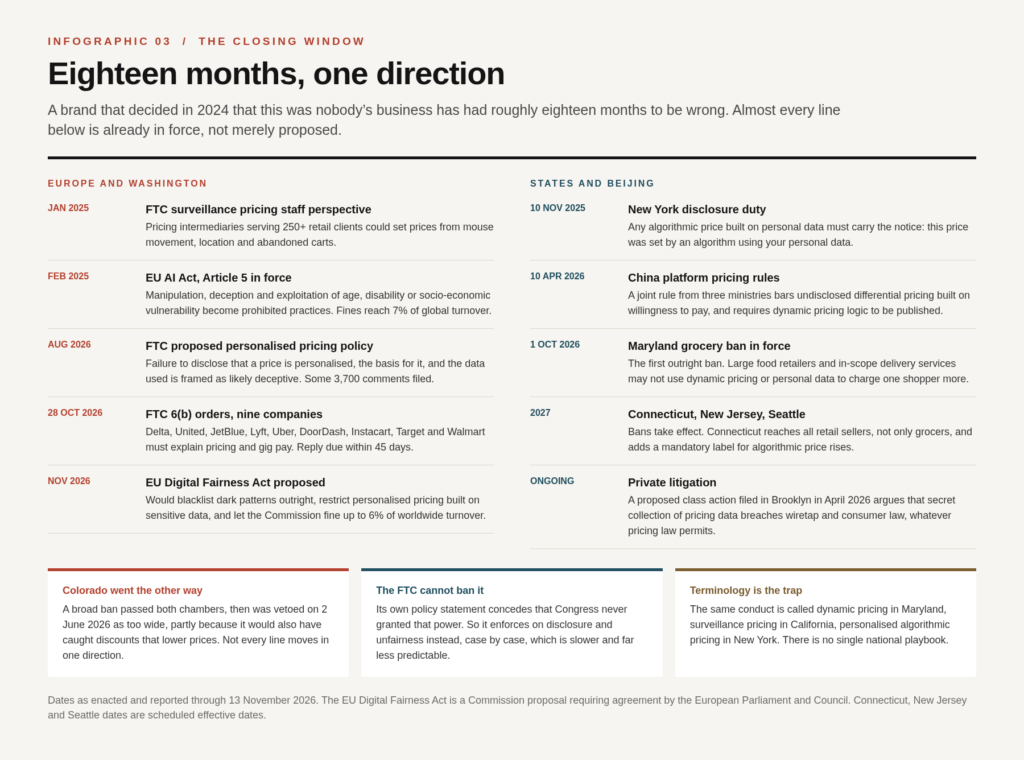
Two honest caveats, because the tidy version of this story is wrong. Colorado’s broad ban passed both chambers and was then vetoed in June 2026 — the governor’s objection being that it was wide enough to punish discounts that lower prices. And the FTC cannot prohibit personalised pricing at all; its August 2026 policy statement concedes as much and pivots to disclosure and unfairness instead. Case by case. Slower. Less predictable. Which is, for a brand, arguably worse than a clear rule.
The disclosure trap
Here is where I part company with a lot of well-meaning commentary, including my own first draft of this piece.
The consensus prescription is transparency: disclose that the price is personalised, disclose the basis, disclose the data used. The FTC has essentially adopted that as its enforcement theory, and the states are legislating it. It is a genuine improvement. It is also, on its own, insufficient — and the reason is structural rather than cynical.
Disclosure moves the information. It does not move the power. A shopper who is told that her price was set using her inferred willingness to pay, at the moment she is trying to buy medicine for a sick child, has been informed and is still cornered. Knowing why the trap closed does not open it.
That is why the more interesting regulatory move isn’t the disclosure duty — it’s the small number of places that banned the practice outright, or capped how often a price may move, or required that refusal be as easy as consent. Those are structural fixes. Disclosure is a labelling requirement. Both are legitimate; only one changes the outcome.
The practical implication for a brand: treat disclosure as the minimum, not the strategy. If your compliance plan begins and ends with a tooltip, you have optimised for the regulator and left the customer exactly where she was.
The five lines worth drawing
I’d rather give you decision rules than values, because values don’t survive a quarterly review.
One: personalise for relevance, never for extraction. The test is a single question. Are you helping them decide, or deciding for them? Recommendation survives that test. Steering doesn’t.
Two: publish the pricing logic. If price varies by person, say why and on what basis. Not as a legal footnote — as a positioning choice. Mystery pricing is the liability; explained pricing is a differentiator, and the fact that almost nobody does it is precisely why it works.
Three: ban the interface tricks outright. No preselection. No invented countdowns. No fee that appears at checkout. Cancellation as easy as signup. This costs you measurable conversion in the short term. That is the price of the moat, and it is cheaper than the alternative.
Four: show the reasoning, hand back control. When the system personalises a price or a recommendation, expose the why and let the customer adjust, reset or refuse. Control is what converts creepiness into credibility. It’s also the only mechanism that scales — you cannot manually review a million personalised prices, but you can give a million people a lever.
Five: audit every feature against one question. Would I want this done to me, to my mother, to my kid? Run it before launch, on the pricing model and the interface both. Kill whatever fails. Not because it’s illegal — often it isn’t — but because it will be the exhibit.
The agentic multiplier
Everything above assumes a human being staring at a screen, forming an impression, telling a friend. That assumption has roughly five years left in it.
Consumers now expect AI agents to execute about 15% of their purchases within five years, up from 9% a year earlier. Nearly half have already used or would consider using one. And what stops the rest is not price — it’s exposure: half worry about payment security, 46% about how their data gets used, 42% about the agent simply buying the wrong thing. A third want to approve every transaction.
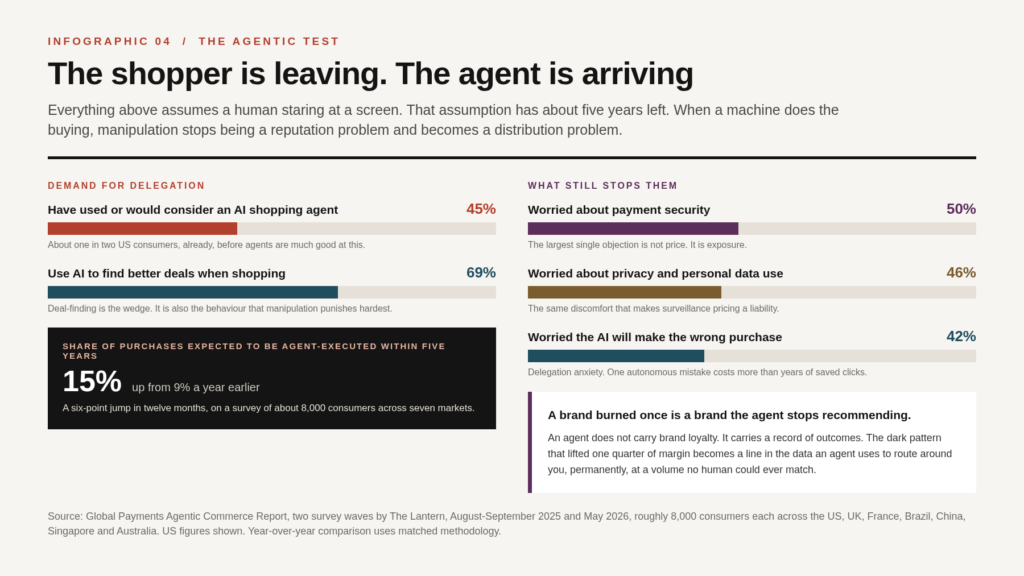
Now consider what a manipulative pricing engine looks like from the inside of that shift. A human holds a grudge for a while and then forgets, or gets a discount and comes back. An agent holds a record. It does not carry brand loyalty; it carries outcomes. The dark pattern that lifted one quarter’s margin becomes a line in the evidence an agent uses to route around you — permanently, at a volume no human could ever match, and without ever telling you why your share of consideration quietly fell.
This is the part most brand teams still haven’t priced in. Manipulation used to be a reputation risk, managed by PR. Under delegation it becomes a distribution risk, managed by nobody, because the mechanism is a model’s ranking that no one on your team can see.
What to do on Monday
Concrete, in order of urgency.
Run the data map before anyone asks you for it. For every price, discount and offer your systems produce, write down which personal-data categories feed it, who built the model, how it was validated, and what customers have been told. If you cannot answer in a week, you have your first project — and you now know the exact shape of the question a regulator will ask under oath.
Then rewrite the disclosure against actual practice, not against intention. Most disclosure failures are not lies. They are descriptions of a system that has since changed.
Then separate the two conversations. Relevance and extraction get decided by different people, with different incentives, and if pricing sits in the same room as the growth target, extraction wins by default. Give someone the authority to kill a feature that lifts revenue — and make sure that person is not the one being measured on it.
And keep one number on the dashboard that the dashboard can’t currently see: how many customers discovered a price they considered unfair. Not complained. Discovered.
The close
The manipulative nudge converts once. The trustworthy brand compounds for a decade. That sentence is easy to nod at and hard to fund, because the first half shows up in this quarter’s numbers and the second half shows up in someone else’s tenure.
But the record has now closed the easy escape routes. The evidence exists. The mechanics are documented. Nine companies are writing down their pricing logic under oath, and the disclosure duty is spreading faster than any reasonable person predicted in 2024. The choice is no longer whether to draw the line. It’s whether you draw it yourself, while it still reads as principle, or have it drawn for you, at which point it reads as a settlement.
In the age of AI, your ethics are your conversion strategy — not because that’s a nice thing to believe, but because the alternative now has a paper trail.