Why Two-Thirds of a Loyalty Reward Can Do Nothing
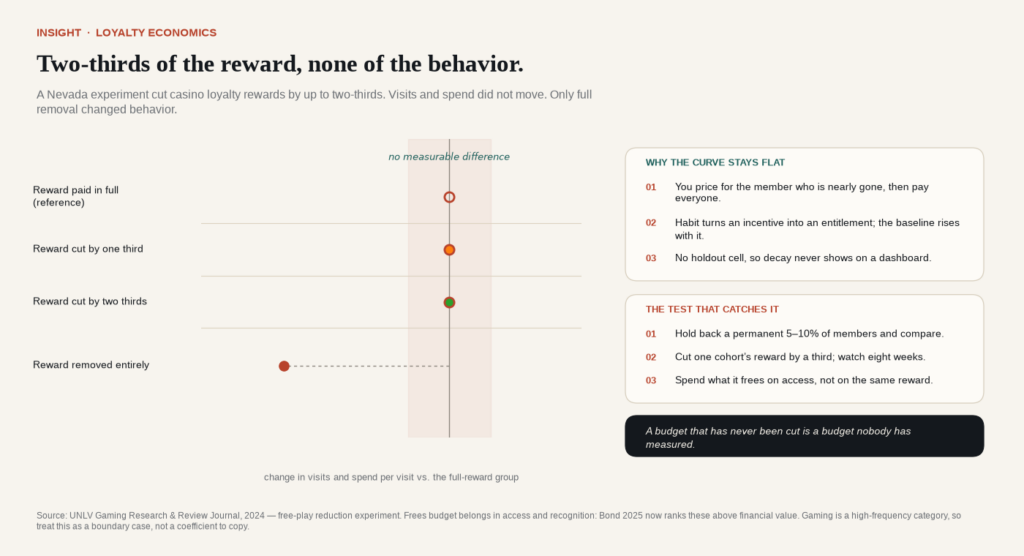
In 2024, researchers published a free-play experiment in the UNLV Gaming Research & Review Journal. Free-play is the casino industry’s loyalty currency: a cash-equivalent grant that programs hand players to keep them coming back. The study cut those allocations for groups of players — by as much as two-thirds — then measured visits and spend per visit against players who kept their full allocation.
Up to a two-thirds cut produced no measurable decline in either measure. Only the group that lost free-play entirely moved, and by roughly 20%.
Two-thirds of the money. None of the behavior.
One caveat before we build on it: gaming is a high-frequency, high-engagement category, so read this as a boundary case that exposes a mechanism, not a coefficient you can copy straight into a grocery app.
Why the curve is flat until it isn’t
Three forces, none of them about generosity.
You price for the marginal, and pay everyone. A reward level is set to move the member who is nearly gone. It is then handed, unchanged, to members who were never leaving. That portion is a subsidy, and the dashboard files it under engagement.
Habit converts incentive into entitlement. Once a reward is routine, the member’s reference point rises to include it. You are no longer paying to change behavior; you are paying to defend a baseline you created.
No holdout, no visibility. Subject lines get a control cell. Reward levels usually don’t. Without one, a program cannot separate “the reward worked” from “the reward was there.”
The same math is coming for personalization
This is where it stops being a casino story. AI personalization is an incentive in a cleaner costume: a stimulus aimed at a decision. Once the easy margin in targeting has been harvested, additional spend buys better-aimed dead money. Antavo’s 2025 report, which found an average 5.2x ROI across loyalty programs, is an average — the blended result of cells that still work and cells that were saturated years ago.
The 20% that was real
The useful half of the finding is the cliff, not the flat. Removing the reward entirely did move behavior. So the reward isn’t worthless; it is mispriced, and somewhere between “a third” and “zero” there is a floor where the price stops buying anything and starts buying everything. That floor is a measurement problem, not a modeling problem. You find it by cutting, in a cell, and watching for eight weeks.
What to do with this on a Monday
Hold back 5–10% of members permanently and keep comparing them to the rest. Not a campaign test — a standing incrementality cell. Then test downward rather than upward. And whatever the cut frees should not return to the same line: Bond’s 2025 data now ranks special access and personal experiences above financial value as the top driver of perceived worth, which is where the money came from in the first place.
The uncomfortable version
A loyalty budget that has never been cut is a budget nobody has measured. The reward is not dead. The spend around it is.