Shortest Seat, Highest Bar: How Marketing Leaders Get Hired in 2026
Something odd is happening in the CMO job market. Companies are hiring marketing leaders at a furious clip while simultaneously deciding they may not need one. Spencer Stuart tracks the second half of that sentence every year: the share of Fortune 500 companies with a CMO on the executive committee fell from 71% in 2023 to 66% in 2024. The role is not dying. It is being voted on, one seat at a time.
So here is the uncomfortable question. If the top marketing job turns over faster than almost any other in the executive suite, and a third of large companies have quietly folded it into something else, what exactly are the companies still hiring for? The answer turns out to be remarkably specific, and it is not “great ads.”
The Job Got Rewritten Before the Job Description Did
Here is the pattern worth noticing. A board writes a brief that says CMO. What it means is “fix the growth problem.” Those are not the same instruction, and the gap between them is where most of this drama lives.
The old brief rewarded a particular kind of proof: a sizzle reel, a distinctive campaign, a brand people talked about. That work mattered, and it still does. But it stopped being sufficient around the point when marketing budgets flattened, CFOs started attending the marketing review, and generative AI made it possible for anyone in the building to produce ten versions of an ad before lunch.
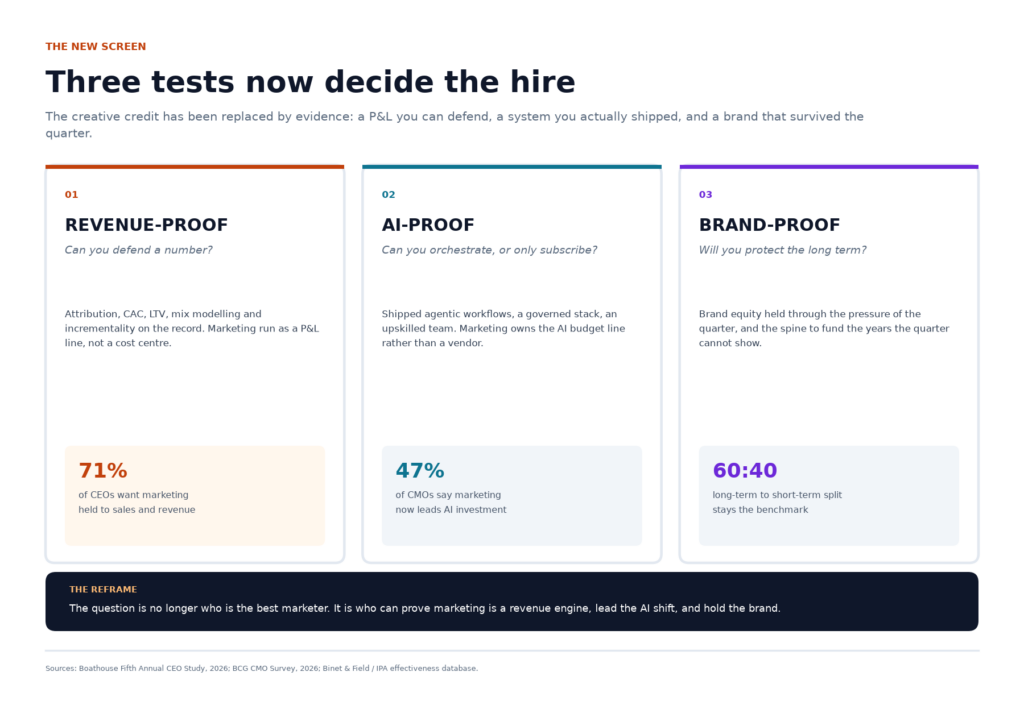
What replaced it is less glamorous and far harder to fake. Boards now want three specific forms of evidence, and they tend to want them in this order: can you defend a number, can you orchestrate an AI operating model, and will you hold the brand when the quarter starts screaming.
The Old CMO Was a Credential. The New CMO Is a Court Record.
Think about how anyone gets hired for a creative role. You show taste. You show a portfolio. The portfolio stands in for judgment, and judgment stands in for future results. It is a chain of inference, and it worked for decades because nobody could measure the last link.
What the creative credential used to buy
The credential bought patience. If you were the person who made the memorable campaign, the board assumed the commercial results would follow, and it gave you a couple of years to prove it. Reach, recall, sentiment — those were the numbers you brought to the meeting, and they were accepted because there was nothing better to bring.
What replaced it
The chain of inference collapsed. Attribution tooling, incrementality testing, and mix modeling got cheap enough to run in-house, which means the board no longer has to take your word for the causal link. It can ask for it, in detail, with a confidence interval attached.
Russell Reynolds analyzed hundreds of CMO job descriptions over twelve months and published the results in December 2025. Every single one mentioned the importance of revenue growth; 85% listed a demonstrable connection to revenue growth as a core competency. Not a nice-to-have. A competency. The same analysis found 95% of descriptions asking for both brand and performance expertise, which is a polite way of saying the specialist era is over.
That is a promotion in scope and a demotion in forgiveness. Wider remit, less runway.
The Seat Nobody Keeps
Average CMO tenure at S&P 500 companies is 4.1 years, against 5.0 for the C-suite as a whole, according to Spencer Stuart’s 2026 study of 346 named marketing chiefs. Only the COO sits shorter, at 3.3 years, and that is largely because the COO seat is where CEO candidates wait.
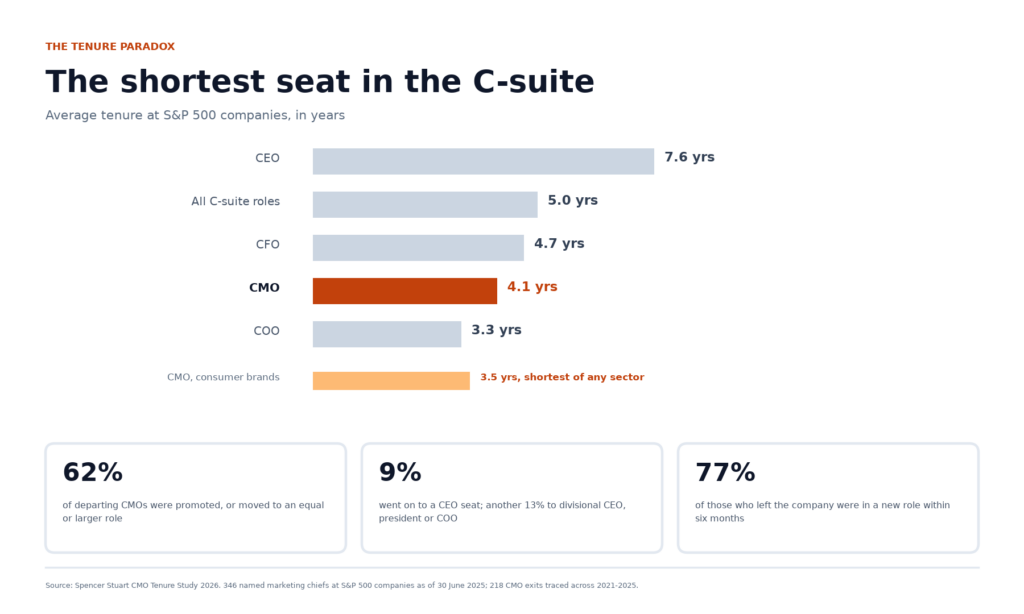
Read that number the wrong way and you conclude that marketing leadership is a revolving door of failures. Spencer Stuart pushes back hard on that reading, and the exit data supports the pushback. Of 218 CMO exits traced between 2021 and 2025, 62% were either promoted internally or moved to an equal or larger role elsewhere. Nine percent went to a CEO seat. Another 13% became divisional CEOs, presidents, or COOs. Among those who left their company entirely, 77% were in a new role within six months.
The exit is often the promotion. That is a different story from the one the headline number tells, and it should change how you read every “CMO churn” statistic you see this year.
Where the pressure concentrates
Consumer brands sit at 3.5 years, the shortest of any sector analyzed, followed by healthcare at 3.9. There is a certain logic to it: those are the categories where marketing is closest to the P&L, where the CMO is most visible, and where the CEO pipeline runs straight through the marketing chair. High visibility cuts both ways.
A second study sharpens the picture and complicates the first. Findem and CMO Huddles published a much larger analysis in September 2026 — more than 13,000 sitting US CMOs at companies with 100 or more employees — and found a median of 36 months in the current role, against 51 months for sitting CEOs. Within that sample, 30% had been in post under eighteen months while 33% had passed five years. The distribution is barbell-shaped, not bell-shaped. You either land and stay, or you are gone before you have finished diagnosing the problem.
Their cohort view is the part that should worry boards. CMOs who started in 2010 had a median tenure of 4.0 years. Those who started in 2022 had 2.6. That is a 35% compression in a single generation of hires, and it happened while the brief got wider, not narrower.
One methodological note before anyone quotes these numbers against each other: the two studies measure different things. Spencer Stuart averages completed tenures at the largest listed US companies. Findem measures time served to date across a far broader population that includes private and venture-backed firms, where tenure runs shortest. Neither is wrong. They answer different questions.
Test One: Can You Defend a Number?
Start with the person in the room who does not care about your campaign.
The CFO moved into the marketing room
The CMO Survey, run by Duke’s Fuqua School of Business with Deloitte and the American Marketing Association, asked marketing leaders who was pressuring them to prove value. In its 2025 edition — 281 respondents, 99% at VP level or above — 63% reported increased pressure from the CFO, up from 52% the year before. Pressure from CEOs rose from 51% to 61%. Pressure from the board rose from 33% to 50%.
That last jump is the one that changes hiring. Board-level scrutiny does not arrive as a request for a dashboard. It arrives as a question about whether the marketing line on the P&L is an investment or an expense, and it gets asked of the person the board is about to hire.
Boathouse’s fifth annual CEO study — 150 chief executives of large US companies, surveyed in January 2026 — supplies the metric that matters here. Seventy-one percent of CEOs want marketing held to sales and revenue metrics, 65% to customer satisfaction and retention, 61% to performance and ROI. Sales and revenue sit on top, and they have stayed there.
The opening is that measurement is still broken
Here is the counterintuitive part, and it is where a smart candidate can win the interview.
Almost nobody has this nailed. The IAB’s State of Data 2026, surveying more than 400 senior planning and analytics decision-makers at US brands and agencies in partnership with BWG Global, found that 60% to 75% say their core measurement approaches — attribution, incrementality testing, mix modeling — underperform on rigor, timeliness, trust, or efficiency. Only 39% use all three together. Not one respondent believed every paid channel is well represented in their mix models.
So the board is asking for proof that the industry cannot reliably produce. That is not a reason to bluff. It is a reason to be the candidate who can explain, in plain language, where the numbers are soft and what you would do about it.
There is a commercial argument buried in that gap, too. McKinsey’s 2025 survey of Fortune 1000 executives found that 70% of CEOs measure marketing’s impact on year-over-year revenue and margin, while only 35% of CMOs track that as a top metric. The two sides of the same conversation are looking at different instruments. A candidate who closes that gap in the interview is answering the first test before it is formally asked.
Test Two: Can You Orchestrate AI, or Just Buy It?
Every candidate says they are AI-fluent. Almost none can show you what they built, and the market has started to notice.
Ninety-six percent say yes. Eight percent shipped.
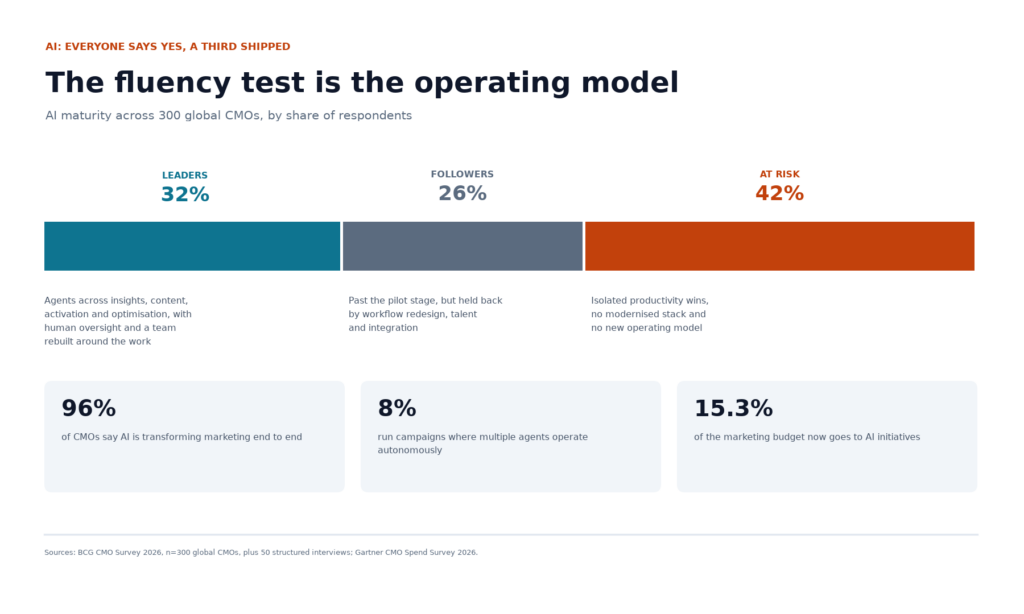
BCG’s 2026 survey of 300 CMOs worldwide, plus 50 structured interviews, found that 96% say AI is transforming marketing end to end. Then the number falls off a cliff. Only 8% run campaigns in which multiple AI agents operate autonomously. Thirty-two percent qualify as leaders — agents embedded across insights, content, activation, and optimization, with humans supervising. Twenty-six percent are scaling pilots. Forty-two percent sit in BCG’s at-risk group: isolated productivity wins, no modernized stack, no redesigned operating model.
About 80% say they are making significant investments in AI upskilling. That is the tell. If your team needs a training program to use the tools you bought, you did not orchestrate anything. You subscribed.
The tell is who owns the budget line
Ask a candidate who signs the AI invoice. BCG found that roughly half of CMOs say marketing now leads AI investment decisions inside the function, against 14% where the CEO or board leads and 15% where strategy teams do. Contrast that with the enterprise as a whole, where 72% of CEOs describe themselves as the primary decision maker on AI. Marketing is one of the few functions running its own AI agenda. If your candidate’s answer is “our CTO,” the fluency is theoretical.
The stakes are not abstract. Boathouse found that CMOs are held four times more accountable for AI ROI than any other executive, while 46% of CEOs grade their AI capability C or lower and only 6% hand out an A. You are answerable for a return you may not control. That is the definition of a bad seat, unless you were the one who built the thing.
Gartner’s spend data shows where the money went. The 2026 CMO Spend Survey puts marketing budgets at 7.8% of company revenue, essentially flat, with 15.3% of that budget now allocated to AI initiatives. The 2025 edition found budgets stalled at 7.7% with 59% of CMOs saying they lacked the funds to execute their strategy. Flat budgets plus a new line item means something else got cut. Usually the agency roster, the headcount, or the brand budget.
Test Three: Will You Hold the Brand When the Quarter Screams?
This is the test that separates a competent operator from a hireable leader, and it is the one candidates most often fail.
The 60:40 argument, and the budget truth nobody wants
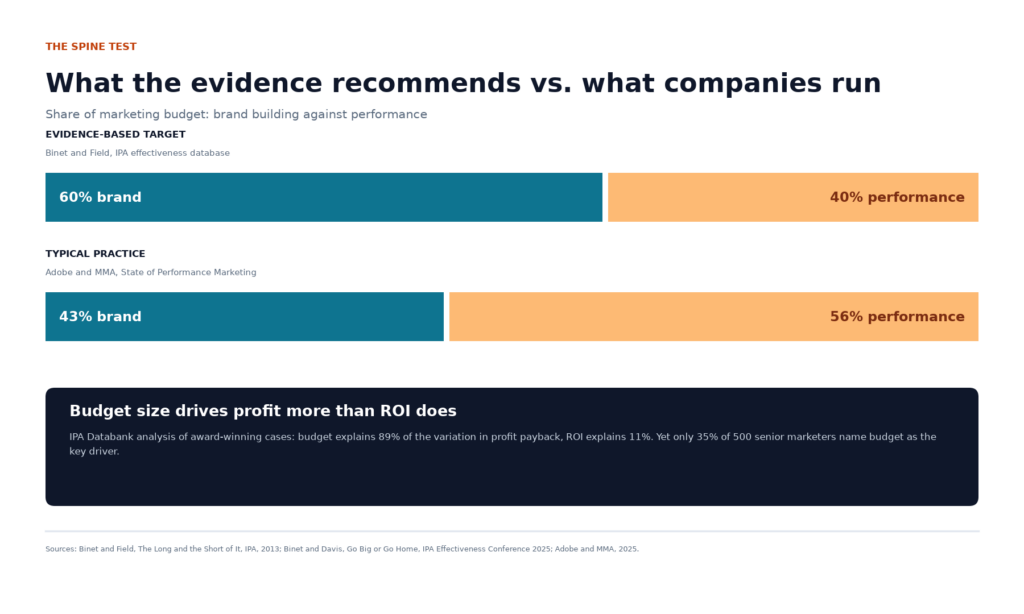
Les Binet and Peter Field’s IPA work established the rough split: about 60% of budget to long-term brand building, 40% to short-term activation. It is a heuristic, not a law, and the authors have always said so. What has held up is the direction.
Then Binet and Will Davis went back to the IPA Databank in 2025 with a sharper question. What actually explains the variation in profit payback across award-winning cases? ROI explained 11%. Budget explained 89%. Budget is roughly eight times the driver of effectiveness that ROI is. Note the caveat: this is a sample of IPA Effectiveness Award winners, so it describes what separates good campaigns from great ones, not what works for an indifferent one.
And what do marketers believe? In a survey of 500 senior marketing decision-makers commissioned by Medialab, 65% named ROI as the most important contributor to effectiveness. Only 35% named budget. The industry is optimizing the variable that matters least, then wondering why profit is not moving. Media ROI rose 4% after the pandemic while net profit generated fell 11%.
The enemy is the review cycle, not the intent
If so many people know the mix is wrong, why does it stay wrong? Adobe and the MMA surveyed 389 senior marketers worldwide and found that 57% of budget now goes to performance marketing, and 80% say they want to rebalance. They are not confused. They are trapped.
Look at how they are evaluated. Thirty-two percent face budget or performance reviews weekly or monthly, and 4% are assessed in real time. You cannot demonstrate the return on brand building inside a four-week window. So the rational move is to fund the thing that shows a number by Friday, which starves the thing that compounds, which makes next year’s number harder, which increases the pressure to fund the short term. Binet calls this the death spiral, and it is a loop rather than a mistake.
Which is why this is a hiring criterion and not a training topic. The board is not screening for someone who understands the 60:40 argument. It is screening for someone willing to defend it in a room where the quarter is written on the wall.
The Gap Between Alignment and Delivery
Here is the twist that should make every sitting CMO uneasy.
By Boathouse’s 2026 measure, the CEO–CMO relationship has never looked better. Seventy-nine percent of CMOs show strong commitment to the CEO and board, the highest in five years. Seventy-one percent are seen as putting company interests ahead of their own function. CEO confidence in their CMO’s P&L understanding is at 72%, up from 61%.
And yet. Only 15% of CMOs earn an A grade, down from 24% a year earlier, while 32% are rated C or lower. Overall CEO confidence in the role has fallen to 43%. Fifty-seven percent still describe the CMO as an execution leader rather than a strategic advisor. Most strikingly, the share of CEOs who see marketing as a cost centre rose from 35% to 60% in a single year, while the profit-centre view fell from 65% to 40%.
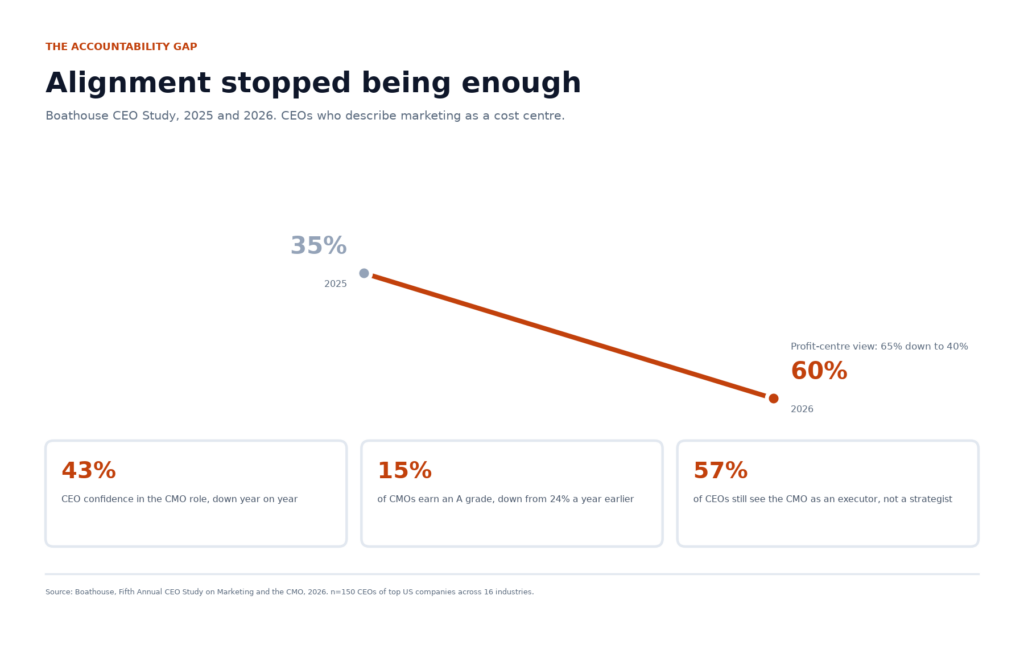
Trust went up. Regard for the function went down. Those two facts can coexist because trust is about the person and regard is about the output. CEOs like their CMOs more than ever and believe marketing delivers less than ever. That is a difficult place to negotiate a budget from.
The explanation Boathouse offers is the one I find most persuasive: expectations moved faster than capability. Marketing is asked to be a growth engine while still being managed as an execution function. Accountability is broad; control is not. Their own data supports it — strategic use of AI inside marketing fell from 63% to 36% in one year, as usage shifted toward analytics, customer experience, and content production. The function got busier doing the work it already did.
What This Means If You Are the Candidate
Stop building a portfolio and start building three files.
File one: the number you moved
Not the campaign. The number. What was the business situation when you arrived, what was the constraint, what did you change, what moved, and what did it cost. Russell Reynolds’ read of the market is blunt about this: candidates who lead with campaigns sound small; candidates who lead with the business problem sound like leaders.
Be ready to say where the attribution is weak. Interviewers who know the measurement literature will respect it, and the ones who do not will learn something worth learning.
File two: the system you shipped
Not the tools you evaluated. What did you automate, what did you deliberately leave with humans, how did the team structure change, and where did the model produce something off-brand — and what catches it now. BCG’s leaders, the 32%, redesigned workflows and restructured teams around business objectives rather than channels. That is a describable act. “We are exploring use cases” is not.
File three: the brand you protected
This is the rarest file and the most valuable. When did you argue against the quarter and win? What did you refuse to do? A candidate who can describe a specific moment of institutional pushback, with the commercial reasoning attached, is answering the third test before it is asked.
And answer the question behind the question. When a CEO asks whether you are a brand marketer or a demand marketer, the useful reply is not a lecture on full-funnel integration. It is a read of their actual constraint, followed by how you would sequence against it.
What This Means If You Are the Board
Screen for proof and spine, not polish
The interview should test whether a candidate can defend a number under pressure, whether they can describe an operating model rather than a tool list, and whether they have held a long-term position against a short-term incentive. Charm is not a criterion. Neither is a sizzle reel.
One diagnostic worth borrowing: ask who owns the AI budget in their current role. If the honest answer is the CTO, you are hiring someone who will be held four times more accountable for a return they do not control, and Boathouse’s grading data suggests how that ends.
Fund what you screen for
This is the part most boards skip, and it is why the cycle persists. If you hire for brand spine and then set a monthly review cadence, you have hired a contradiction. The IPA evidence is unambiguous that budget and time horizon drive outcomes more than efficiency does. A board that wants the 89% cannot keep managing the 11%.
McKinsey’s 2025 analysis of Fortune 500 executive teams points at the structural version of the fix: companies with a single customer- or growth-oriented role on the executive committee grow up to 2.3 times faster than those that split the responsibility across several roles. Pulling the CMO back to the centre only works if the mandate, the decision rights, and the measurement arrive with the title.
Deloitte’s research on CMO–CFO collaboration makes the same point at the level of the individual relationship. In its 2021 study, the highest-growth companies reported C-suite agreement on marketing metrics at 79%, against 55% at lower-growth companies. Alignment on the scorecard is not a soft skill. It shows up in the revenue line.
Where This Argument Is Weak
Three honest caveats, because the numbers above are strong enough to deserve them.
First, tenure data invites a narrative fallacy. A short average can mean failure, promotion, or a role redesigned mid-flight, and the aggregate cannot tell them apart. Spencer Stuart’s framing — that exits are mostly advancement — is persuasive but not conclusive, because the sample is large listed US companies and says little about mid-market hiring. The Findem data widens coverage but measures time served rather than completed tenures, which biases it in the opposite direction.
Second, the AI-maturity figures are self-reported. A CMO who says they have deployed agents has every incentive to mean “we ran a pilot.” BCG’s categories are more honest than most because they are built on operational implementation rather than stated ambition, but they are still survey data, and 300 CMOs is a small window on a large population.
Third, and most importantly, the 60:40 split is a heuristic derived from award-winning case studies. Ehrenberg-Bass researchers have correctly noted that award entries are not a representative sample of advertising, and the eightfold finding inherits that limitation. The direction is robust. The precise ratio is not scripture. Use it to argue about balance, not to win a decimal point.
The Short Version
The CMO is not being hired for taste anymore. The hire is being made against three tests — a P&L you can defend, a system you actually shipped, and a brand you were willing to protect — and it is being made on a shorter clock than at any point in the last fifteen years.
The uncomfortable symmetry is this: the boards that screen for those three things and then refuse to fund them are recreating the exact problem they are trying to hire their way out of. Marketing leadership got redefined. Whether the seat gets the mandate to match is a separate decision, and it is not the CMO’s to make alone.